

CIS Subcontractor Returns Explained for UK Contractors

A sole-trader electrician sends a main contractor an invoice for £1,200. The bank payment that arrives is £1,080, and the remittance advice shows a CIS deduction. Nothing appears to be wrong with the invoice, but £120 has been withheld, leaving the subcontractor unsure whether the contractor made an error or whether HMRC has taken the money directly.
This is a common first reaction to CIS. The deduction isn't an extra fee and it isn't lost income. It's an advance payment towards the subcontractor's Income Tax and National Insurance, recorded through the contractor's monthly reporting. To understand what happened, you need to connect four pieces: the CIS300 return, the monthly deadline, the deduction statement, and the way the deduction is later dealt with through Self Assessment.
A Subcontractor's First Encounter with CIS Deductions
The electrician in this example is registered and verified under the Construction Industry Scheme. The contractor therefore applies the standard 20% deduction to the amount subject to CIS. On £1,200, that produces a £240 deduction, which would leave £960 before considering whether any part of the invoice is outside the CIS calculation.
If the actual payment is £1,080, the figures may indicate that only £600 was treated as subject to CIS, with the remaining £600 paid without deduction. That could happen where the invoice contains qualifying materials or other amounts that aren't included in the CIS deduction calculation. The important point is that the bank receipt alone doesn't explain the result. The payment and deduction statement should show the gross amount, the deduction and the net payment.
Practical rule: Never try to reconstruct a CIS deduction from the bank receipt alone. Match the receipt to the invoice and the contractor's deduction statement.
The contractor, not the subcontractor, submits the monthly CIS300 return to HMRC. It records the subcontractor's details, the payment and the deduction rate used. HMRC guidance says contractors must report every subcontractor payment made in the relevant tax month, including payments made gross, with the standard deduction or with the higher deduction. HMRC's monthly CIS return guidance explains the contractor's filing responsibility and how the deductions operate.
For the subcontractor, the return is still highly relevant. A late, incomplete or inaccurate return can make the deduction difficult to trace later, especially when the subcontractor is preparing a Self Assessment return or checking whether the amount withheld matches the bookkeeping records.
The four questions to keep in view are simple:
- What was reported? The CIS300 return is the contractor's monthly report to HMRC.
- When was it due? The return must reach HMRC by the required deadline.
- What proves the deduction? The payment and deduction statement should show the calculation.
- Where does the money go? The deduction is treated as an advance payment towards the subcontractor's tax and National Insurance.
Once those links are clear, a CIS deduction stops looking like an unexplained reduction in an invoice and becomes part of a traceable monthly process.
What the CIS Monthly Return Actually Is
The Construction Industry Scheme is a tax deduction and reporting system for construction payments. In plain English, the contractor checks the subcontractor's status, applies the appropriate deduction rate and reports the payment to HMRC. The subcontractor receives the balance and later uses the deduction information when reconciling their tax position.
The monthly form is known as the CIS300 return. It lists the subcontractors paid during the tax month, the relevant payment amounts and the deductions made. A contractor must include all relevant subcontractor payments in the period, rather than reporting only payments where tax was deducted.
The tax month is not a calendar month
A CIS tax month runs from the 6th of one month to the 5th of the next. That means a payment made after the 5th belongs to the next CIS reporting period, even if the contractor's bookkeeping software is organised around calendar months.
The contractor must also verify subcontractors before paying them and report the deduction rate used. HMRC's CIS reform guidance describes the reporting cycle and the requirement to include payment and deduction information on the monthly return. The HMRC CISR65020 manual provides the underlying rules.
CIS deduction rates at a glance
The three rates are 20% for a registered subcontractor, 30% for an unregistered or unverified subcontractor, and 0% for a subcontractor with gross payment status. The following illustration applies each rate to the full £1,000 amount for comparison. In practice, the contractor must first identify which parts of an invoice are subject to CIS.
| Deduction Rate | Who It Applies To | Deducted on £1,000 | Net Paid to Subcontractor |
|---|---|---|---|
| 20% | Registered and verified subcontractor | £200 | £800 |
| 30% | Unregistered or unverified subcontractor | £300 | £700 |
| 0% | Subcontractor with gross payment status | £0 | £1,000 |
These figures illustrate the rate mechanics, not a complete invoice calculation. If an invoice includes amounts that aren't subject to CIS, the deduction may be calculated on a lower base.
The contractor owns the filing duty, but both parties need the data to agree. A subcontractor should recognise the rate, gross amount, deduction and net figure on the statement because those details become the reference point for bookkeeping and Self Assessment.
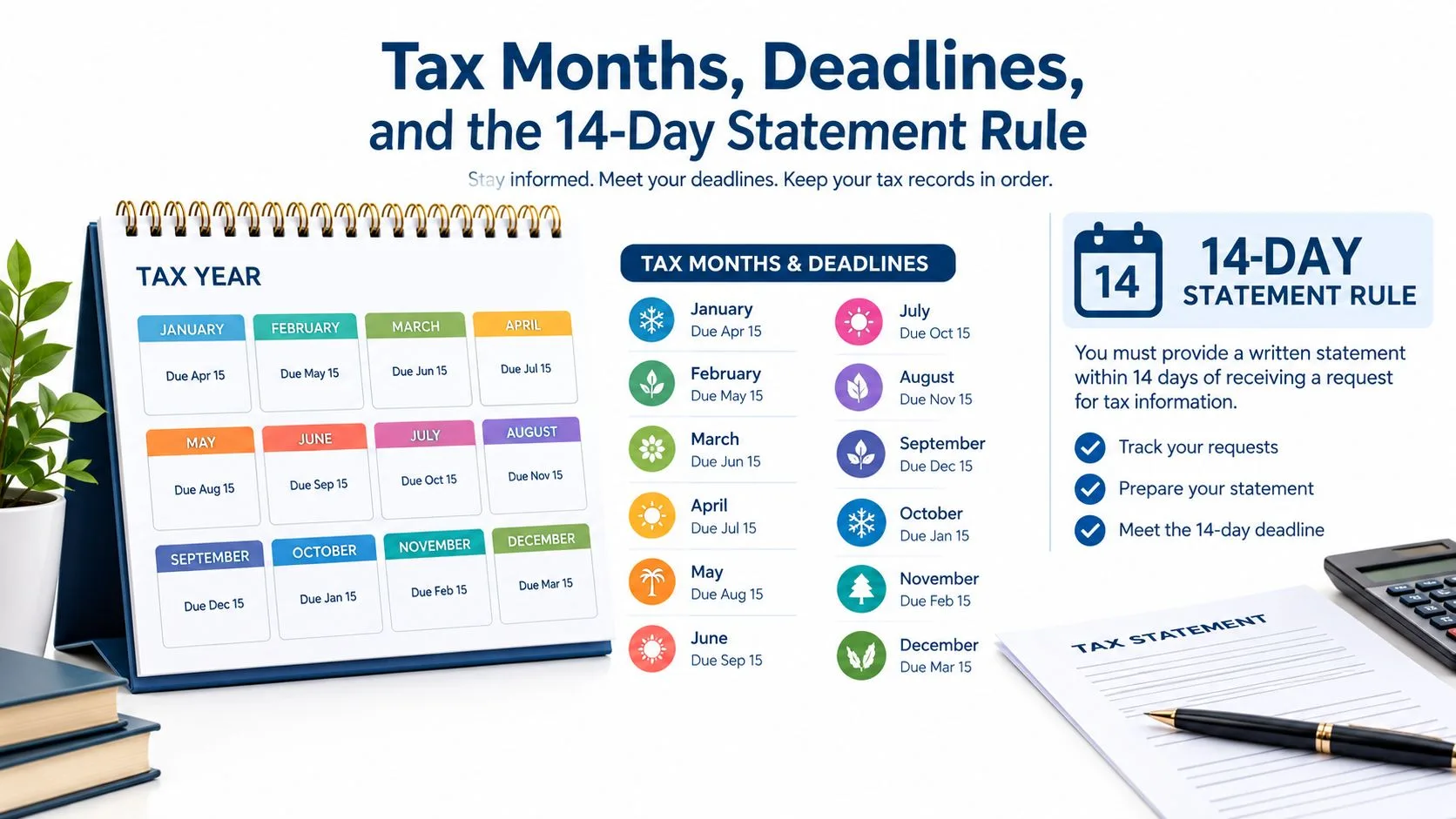
Tax Months, Deadlines, and the 14-Day Statement Rule
A contractor pays a subcontractor on 5 June. That payment belongs to the tax month from 6 May to 5 June, even if the invoice was raised earlier or the money reaches the bank later. The contractor reports it on the CIS300 return for that tax month.
The deadline sequence is:
- 6 May to 5 June: record payments made during the CIS tax month.
- By 19 June: submit the CIS300 return to HMRC.
- Within 14 days of 5 June: issue the payment and deduction statement to the subcontractor.
The CIS monthly return deadline controls the reporting date, while the 14-day rule controls when the subcontractor should receive evidence of the deduction. Keeping those dates together helps contractors and subcontractors connect the return, bank payment and bookkeeping records.
Why the statement matters
The payment and deduction statement is the subcontractor's receipt for CIS tax withheld. It should identify the contractor, the relevant tax month, the gross payment, the deduction rate, the deduction amount and the net payment.
For example, if the statement shows a gross payment of £1,000, a 20% deduction of £200 and a net payment of £800, the bank receipt should normally support the £800 figure. If it does not, keep the original records, ask the contractor to explain the difference and request a corrected statement where necessary. Do not alter the bookkeeping entry just to force a match.
These documents make CIS subcontractor returns easier to reconcile with later Self Assessment records, because they show how much tax has already been deducted from payments.
A contractor with an active CIS scheme must also submit a nil return for a tax month with no subcontractor payments, unless HMRC has accepted an appropriate period of inactivity. No payment still requires a filing decision.
A connected monthly routine
During the tax month, record each relevant payment and retain its invoice. At month-end, check that no payment has been missed. Before submission, confirm the deduction rate and figures. After filing, send or obtain the statement and compare its gross, deduction and net amounts with the accounts and bank records.
This sequence gives both parties an audit trail from payment to return and, later, to tax reconciliation.
How a CIS300 Return Is Built and Signed
Suppose a contractor pays a subcontractor against a £4,800 invoice. The contractor has verified the subcontractor and the payment is subject to the standard 20% rate. For a simple illustration where the full amount is subject to CIS, the return line would show a gross payment of £4,800, a deduction of £960 and a net payment of £3,840.
A CIS300 entry will be tied to the correct subcontractor record. The contractor needs to identify the subcontractor accurately, use the relevant Unique Taxpayer Reference, report the gross payment and select the verified deduction position. The figures on this line then need to agree with the payment and deduction statement issued to the subcontractor.
What happens before submission
HMRC's CIS process can pre-populate information about subcontractors already verified. The contractor must still check the entries, add new subcontractors where needed, enter the payment and deduction figures and complete the declarations. Pre-population reduces rekeying, but it doesn't remove the contractor's responsibility to check the return.
The contractor signs and submits the return. If an accountant or other agent submits it on the contractor's behalf, the contractor still needs to authorise the arrangement and provide accurate records. The subcontractor doesn't file the CIS300 for the contractor, although they should review their own evidence carefully.
A pre-populated return is a starting point, not an approval that every figure is correct.
For the subcontractor, a statement connected to the £4,800 example should make the calculation visible:
- Gross payment: £4,800
- CIS rate: 20%
- CIS deduction: £960
- Net payment: £3,840
That example assumes the whole invoice is subject to CIS. If the invoice includes qualifying amounts outside the deduction calculation, the gross amount on the statement may not equal the amount on which the percentage was applied.
The CIS monthly return example can help contractors compare their internal records with the structure of a submitted return.
A subcontractor should expect their own statement to contain enough information to answer four questions: which contractor paid them, which period the payment belongs to, what amount was treated as subject to CIS and how much was withheld. Those are the fields to check before filing records away.
Late Filing Penalties and the Real Cost of a Missed Month
A late CIS return creates a problem for the contractor first, but it can also make the subcontractor's records harder to reconcile. HMRC states that a contractor may receive a penalty when the signed CIS300 return doesn't reach it by the 19th of the month. The penalties at six and twelve months late can be £300 or 5% of the CIS deductions on the return, whichever is higher. HMRC's CIS penalty guidance sets out that rule.
The cash impact depends on the return. A return with substantial deductions can produce a percentage-based penalty that is higher than the fixed amount. A nil return has no deductions to which the percentage can apply, but missing it still creates a late-filing exposure under the fixed penalty regime.

Why nil months deserve attention
A quiet month can be more dangerous than a busy one because nobody has an invoice prompting them to act. If the contractor has an active CIS scheme and makes no subcontractor payments, the contractor must submit a nil return or notify HMRC of an expected period with no payments. Leaving the month blank isn't a reliable compliance strategy.
The subcontractor may not know that the contractor missed the return. They may only discover the gap when checking their CIS record or preparing Self Assessment. That is why subcontractors should maintain their own monthly log rather than assuming the contractor's filing will always be complete.
Separate the two tax problems
The contractor's late CIS300 penalty is different from the subcontractor's own Self Assessment position. A subcontractor shouldn't treat a contractor's filing failure as permission to omit a genuine CIS deduction from their records. Instead, retain invoices, bank receipts and correspondence, then ask the contractor to correct or confirm the missing information.
A missed month can therefore cost more than a fine. It can delay the evidence needed to reconcile deductions, create uncertainty over the amount withheld and force the contractor to spend time rebuilding records. A recurring calendar reminder, an assigned owner and a monthly reconciliation are practical controls that work for both busy and inactive periods.
Matching CIS Returns to Payroll, VAT, and Self Assessment
A subcontractor receives £3,840 in the bank after raising an invoice for £4,800. The deduction statement shows £960 withheld under CIS. Those figures are three parts of one transaction, like pieces of the same receipt: the bookkeeping should connect the £4,800 gross income, the £960 CIS deduction and the £3,840 cash receipt.
The £960 isn't VAT, and it does not reduce the value of the work performed. It represents tax and National Insurance paid in advance on the subcontractor's behalf. Keep CIS deductions separate from VAT records, even when one invoice includes both VAT information and CIS information.
One payment, several records
| Tax Area | Treatment for Subcontractor | Treatment for Contractor |
|---|---|---|
| CIS | Record the gross payment and deduction shown on the statement | Verify the subcontractor, calculate the deduction and report the payment |
| Bank account | Match the net receipt to the statement | Match the payment made to the subcontractor's records |
| VAT | Account for VAT under the applicable VAT treatment, separately from CIS | Record the purchase and VAT treatment separately from CIS deductions |
| Payroll and employment records | Keep self-employed CIS income distinct from employee payroll records | Record the worker's status and payment route consistently |
| Self Assessment and other tax records | Use the CIS deduction as an advance payment when reconciling the tax position | Keep CIS records aligned with bookkeeping and other statutory records |
The CIS deduction calculator provides a useful sense check. It does not replace the contractor's verification record or the formal deduction statement.
The year-end matching exercise
CIS subcontractor returns should be reconciled month by month, then checked again at year end. Compare:
- The gross CIS income recorded in the bookkeeping.
- The net payments received in the bank.
- The CIS deductions shown on contractor statements.
Using the example above, £3,840 in the bank plus the £960 deduction equals £4,800 gross income. If the year-end totals do not follow that pattern, identify the specific month, invoice or statement causing the difference instead of forcing an unexplained year-end adjustment. Invoice items treated outside CIS may affect the comparison.
A limited company subcontractor also needs consistent records across CIS, payroll and corporation tax. Keep deduction statements, payroll records, VAT reports and company accounts together so the same deduction is not claimed twice or left out.
For a sole trader, deduction statements support the Self Assessment reconciliation. The deduction is an advance payment, not the final tax calculation. Match it to the income and tax position reported for the year, as explained in HMRC guidance on paying tax and claiming back CIS deductions.
Common CIS Return Problems and How Subcontractors Fix Them
Many CIS problems begin with a reasonable assumption: if the contractor paid the money, the records must already be correct. That assumption fails when a contractor files late, forgets a statement or uses the wrong subcontractor record. The subcontractor needs an independent trail.
The contractor filed late
If a month is missing from the subcontractor's online record, first compare the month with the invoices and bank receipts. Then ask the contractor whether the CIS300 return was submitted and request the payment and deduction statement. Keep the request in writing so there's a clear record of what was missing and when it was requested.
If the contractor can't resolve the gap, contact HMRC for guidance and provide the information you do have. Don't invent a deduction figure just because the bank payment appears lower than the invoice.
The statement is missing or doesn't match
A lost statement is recoverable. Ask the contractor to reissue it and compare the replacement with the invoice, remittance advice and bank receipt. Where the statement shows a different gross amount or deduction from your records, ask the contractor to explain which invoice lines were included.
A running spreadsheet can make this straightforward. Useful columns include:
- Tax month: the period ending on the relevant 5th.
- Contractor: the business that made the payment.
- Invoice reference: the document supporting the income.
- Gross amount: the payment reported before the deduction.
- CIS rate and deduction: the rate used and amount withheld.
- Net receipt: the amount appearing in the bank.
- Statement status: received, requested or disputed.
There was no payment
Being on site doesn't necessarily mean a CIS payment occurred in that tax month. The contractor's nil-return obligation concerns payments, so a subcontractor shouldn't assume that work performed automatically creates a return entry. Ask the contractor to confirm the position and keep the confirmation with the monthly records.

The business structure changed
A person may operate as a sole trader for one engagement and through a limited company for another. Those are separate records and may require separate verification details. Don't assume that a deduction made against one structure can be transferred to the other.
An apparently inflated deduction rate can also arise when the contractor couldn't verify the subcontractor's details. Ask the contractor which record was verified, check the Unique Taxpayer Reference used and request correction if the wrong entity or rate was applied. Keep the supporting correspondence until the Self Assessment or company reconciliation is complete.
A Practical Monthly CIS Checklist and Reconciliation FAQs
A monthly routine prevents most CIS issues because it gives each document a place and each discrepancy an owner. Use the following sequence even when payments are irregular.
- Review the month ending on the 5th: list every CIS payment made or received in the period.
- Check the contractor's record: confirm the gross amount, deduction rate and deduction figure.
- Chase the statement: request any payment and deduction statement not received within the required period.
- Match the bank: reconcile the net receipt to the statement, not just to the invoice.
- Record nil activity: if no subcontractor payment was made, confirm that the contractor has filed a nil return or notified HMRC appropriately.
- Update the bookkeeping: keep CIS, VAT, payroll and Self Assessment records connected but separately identifiable.
Monthly control: If the invoice, statement and bank receipt don't agree, stop the reconciliation at that month and resolve the difference before carrying the total into year-end figures.
How do I claim back an over-deduction?
Keep the contractor's statement, invoice, bank receipt and correspondence showing the error. Ask the contractor to check the CIS300 entry and correct the deduction where appropriate. If the deduction remains part of the evidence available for the year, include the correct CIS figure in the relevant tax reconciliation rather than treating the over-deduction as an ordinary business expense.
What if a contractor refuses to send a statement?
Make a clear written request identifying the tax month, invoice and payment. If the contractor still doesn't respond, retain alternative evidence and contact HMRC for guidance. A missing statement doesn't justify guessing, and the contractor's failure to provide one should be documented.
Do nil months still need filing?
Yes, where the contractor has an active CIS scheme and no subcontractor payments were made, the contractor must file a nil return unless HMRC has accepted an appropriate inactivity notification. A subcontractor should ask the contractor to confirm the position when work is intermittent.
How do CIS deductions enter Self Assessment?
CIS deductions are advance payments towards the subcontractor's Income Tax and National Insurance. Match the total statements to the bookkeeping and bank records, then use the verified deduction information when completing Self Assessment. The deduction shouldn't be counted as income, VAT or an expense.
CIS subcontractor returns are easiest to manage when every month leaves a complete trail. If your invoices, deduction statements or bank receipts don't reconcile, contact Stewart Accounting Services once, as one available option, for support with subcontractor verification, monthly record reconciliation and CIS300 submission through its accounting services.
If you're a UK contractor or subcontractor with missing statements, irregular CIS payments or figures that don't reconcile, gather your invoices, bank records and available deduction statements now. Then speak with a qualified accountant before the next monthly deadline so the records can be corrected while the transactions are still easy to trace.
Recent Posts
07 Nov, 2026