

Making a company dormant is the official process for pressing pause on your UK business without shutting it down for good. It means you’ll stop all significant trading and then formally notify both HMRC and Companies House. This drastically reduces your filing obligations and puts your Corporation Tax on hold.
What It Really Means to Make a Company Dormant
Deciding to make your company dormant isn’t throwing in the towel. Far from it. Think of it as a strategic move—a way to put your business into hibernation, giving you breathing room while keeping the legal structure perfectly intact. It's still your company, just resting.
This is a really practical option in a few common situations. Maybe you've got a fantastic business idea and want to lock down the company name before you're ready to go all-in. Or perhaps you're a contractor who's decided to take on a permanent role for a couple of years but want to keep your limited company ready for when you return to freelancing. It’s also a smart move if you're restructuring or simply taking a well-deserved extended break.
The Definition of Dormancy
So, what does 'dormant' actually mean in the eyes of the law? A company is officially dormant when it has stopped all trading and has no other income coming in, such as from investments.
The only money that can go through its bank account is for a very short, specific list of things, like paying the annual Companies House confirmation statement fee. If you pay a supplier invoice or even receive a penny of bank interest, you've just woken the company up and it's no longer dormant.
In short, HMRC considers a company dormant when it has zero trading activity or other income. This can apply to a brand-new company that hasn't started trading yet or an established one taking a strategic pause. The big win here is that dormant companies get to file super-simple accounts and don't have to pay any Corporation Tax. As long as you keep up with the minimal annual filings, a company can stay dormant indefinitely. For a deeper dive, the dormant company rules from Quality Company Formations are a great resource.
Key Takeaway: Making a company dormant protects your company name and legal status on the official register, but without the administrative headache of running an active business. It offers a flexibility that completely dissolving the company just can't match.
Dormant vs Dissolved: A Critical Distinction
It’s incredibly important not to mix up making a company dormant with dissolving it. They are two completely different paths with very different outcomes.
Dissolving a company, often called 'striking it off', is the final chapter. It’s a permanent end. The company legally ceases to exist, and any assets left in it typically become the property of the Crown (Bona Vacantia). There's no coming back from it.
A dormant company, on the other hand, is still a living legal entity. It stays on the Companies House register, your company name is protected from being used by anyone else, and you can fire it back up again relatively easily whenever you're ready.
Understanding this difference is fundamental. Choosing the right one depends entirely on what you see for your business's future.
Here’s a simple table to break down the key differences between putting a company to sleep and closing it for good.
Dormant vs Dissolved Key Differences
| Aspect | Dormant Company | Dissolved Company |
|---|---|---|
| Legal Status | Still exists as a legal entity on the register. | Ceases to exist legally; removed from the register. |
| Company Name | The name is protected and cannot be used by others. | The name becomes available for others to register. |
| Reactivation | Can be easily reactivated to start trading again. | Cannot be reactivated. A new company must be formed. |
| Assets & Bank Account | Can hold assets and a bank account (though transactions are restricted). | All assets and bank accounts must be dealt with before dissolution. |
| Filing Duties | Minimal annual filings required (confirmation statement, dormant accounts). | No further filings required once the process is complete. |
| Best For | Temporary breaks, securing a name, or pausing before launch. | Permanent closure when the company is no longer needed. |
As you can see, dormancy offers a lifeline—a way to keep your options open. Dissolution is a final decision, closing the door on that particular business entity forever.
Letting HMRC Know You’ve Gone Dormant
Once you've decided to put your company on hold, your first call should be to HM Revenue & Customs (HMRC). Getting this right isn't just a formality; it's the critical step that stops automated tax demands and penalties from piling up on your doormat. A quick, clear communication now can save you a world of headaches later on.
You need to be proactive here. A common mistake is thinking that because you’ve told Companies House you're dormant, HMRC will automatically know. They won't. They are entirely separate entities, and you have to inform the tax authority directly that your company won't be generating any taxable profit.
This applies whether you're pausing a business that's been trading for years or you've set up a company that never got off the ground. The goal is the same: to tell HMRC they shouldn't expect a Corporation Tax return from you.
Getting in Touch with the Corporation Tax Office
The main department you need to deal with is the one for Corporation Tax. You can reach them by phone or by post. When you do, be direct and state clearly that your company is dormant and, crucially, the specific date this took effect.
To make the process smooth, have this information handy:
- Your full Company Name and Registration Number (CRN)
- Your company’s 10-digit Unique Taxpayer Reference (UTR)
- The exact date your company became dormant
Once HMRC has processed your request, they'll update their records. This is what stops them from issuing a ‘notice to deliver a Company Tax Return’ every year. From that point on, you won't need to file a tax return unless they specifically ask for one, which is highly unlikely for a company that’s truly dormant.
Expert Tip: Don't just file dormant accounts with Companies House and call it a day. I’ve seen countless business owners get caught out by this, receiving automated penalty notices for a tax return they had no idea was due. Always contact HMRC directly to confirm your status.
Tying Up Other Tax Loose Ends
Sorting out Corporation Tax is a great start, but it's often not the only piece of the puzzle. If your company was active, you were probably registered for other tax schemes like PAYE or VAT. You have to deal with each of these separately.
HMRC doesn’t automatically pause these schemes when you go dormant for Corporation Tax. Forgetting this is probably one of the most common and expensive mistakes people make.
Closing Your PAYE Scheme
If you had anyone on the payroll—even just yourself as a director—you must formally close your PAYE scheme. You can't just stop submitting reports. You need to tell HMRC you no longer have employees and won't be making any more payments. This is usually done after sending your final payroll report for the tax year.
If you don't, HMRC’s systems will keep expecting your regular PAYE filings, and the penalty notices for non-submission will start rolling in. The easiest way to do this is online via your Government Gateway account.
De-registering for VAT
It's a similar story for VAT. If your company is VAT-registered, you are legally required to de-register within 30 days of ceasing to trade.
This involves submitting a final VAT return where you may need to account for tax on any assets you’re keeping, like stock or equipment. If you skip this, you’re still on the hook for submitting quarterly VAT returns (even nil ones), and again, penalties for failing to file will follow. Keeping track of tax obligations is vital; you can learn more about key dates, including when a limited company tax return is due, to stay fully compliant.
By methodically working through Corporation Tax, PAYE, and VAT, you can ensure a clean and stress-free transition to dormancy.
Meeting Your Companies House Filing Duties
Just because your company is taking a break doesn't mean its legal duties are. Even in a deep sleep, your company has responsibilities to Companies House that you can't ignore. Forgetting about these is one of the fastest ways to get hit with automatic, and quite hefty, penalties.
The good news is that keeping on top of a dormant company's filings is pretty straightforward once you know the annual routine. While you've massively cut down your admin workload, you still have a couple of key documents to file each year. Think of it as a quick annual check-in to prove the company still exists and isn't trading, keeping its spot on the official register secure.
The All-Important Confirmation Statement
First on your list is the confirmation statement (often referred to by its old form number, CS01). This isn't about your finances; it's simply a snapshot of your company's core details at a specific moment in time. The whole point is to confirm that the information Companies House holds for you is still accurate.
You’re basically verifying details like:
- The company's registered office address.
- Who the directors are and their personal details.
- Where you keep your statutory records.
- Information on shareholders and any People with Significant Control (PSCs).
You have to file a confirmation statement at least once every 12 months. Missing the deadline can lead to fines, and if you ignore it for long enough, Companies House could start proceedings to strike the company off the register. The easiest and cheapest way to do it is online – it only costs £13.
Filing Your Dormant Company Accounts
Your second critical task is filing dormant company accounts. Since your company hasn't been trading, you don't need to get bogged down with a full profit and loss statement or a complicated balance sheet. Instead, you just submit a super-simplified version that confirms no 'significant accounting transactions' have taken place.
So, what counts as a 'significant accounting transaction'? Essentially, it’s any money going in or out of the company. The only exceptions allowed are:
- The initial payment for shares when the company was first set up.
- Fees paid to Companies House (like the confirmation statement fee).
- Any penalties you might have had to pay for filing previous accounts late.
If you receive any other income—even a few quid of bank interest—or pay a supplier, the company instantly wakes up from a legal perspective. It's so important to avoid this to keep that dormant status.
A Real-World Example: I once had a client who kept their business bank account open. Over the year, the bank paid a tiny £1.42 in interest. That single transaction meant their company was no longer legally dormant. They had to go through the hassle and expense of preparing and filing full, active accounts, all for less than the price of a cup of coffee.
Deadlines and How to File
Your dormant accounts are due 9 months after your company's financial year-end. If it’s a brand-new company, the first set of accounts are due 21 months from the date it was incorporated. Stick these dates in your calendar with reminders!
By far the easiest way to file is through the Companies House online service. The process is stripped right back for dormant companies and often takes just a few minutes. You’re simply asked to confirm the company has been non-trading and that the balance sheet is all zeros. For a more detailed look at the general filing process, our guide on how to submit company accounts is a great place to start.
The Cost of Getting It Wrong
Companies House is incredibly strict with filing deadlines, and the penalties for being late are issued automatically. You won't get a polite nudge—just a penalty notice landing on your doormat.
The fines for late limited company accounts kick in at £150 if you’re up to one month late. If you’re late two years running, that fine doubles.
Here’s a quick breakdown of how the penalties stack up for a private limited company:
| Lateness | Penalty |
|---|---|
| Up to 1 month | £150 |
| 1 to 3 months | £375 |
| 3 to 6 months | £750 |
| Over 6 months | £1,500 |
As you can see, a simple slip-up can quickly become a very expensive mistake. The key is to be organised. Your annual routine should be simple: check your details, file the confirmation statement, and submit your dormant accounts. On time, every time.
A Director's Ongoing Responsibilities
Making your company dormant dials down the day-to-day admin, but it doesn't switch off your legal duties as a director. That’s a common and potentially expensive mistake to make. Even when the business is inactive, you’re still very much in the driving seat, and failing to keep up with your responsibilities can lead to some serious headaches.
Think of it like this: the engine is off, but you're still the one legally responsible for the car. You have to make sure it’s compliant, even while it's parked. This means staying on top of filings, keeping records in order, and making sure all the company’s details are up-to-date.
Maintaining Statutory Records
Even a company that isn't trading has to maintain its official statutory records. These are the company's core legal documents, required under the Companies Act 2006, that detail its ownership and structure.
There are two key registers you absolutely must keep current:
- The Register of Members: This is simply a list of the company’s shareholders, detailing their names, addresses, and how many shares they own.
- The PSC Register: This identifies the ‘People with Significant Control’ in your company. If anything changes that affects who has control—like a major shareholder selling their stake—it must be recorded here immediately.
These registers must be available for inspection at your company's registered office. Not keeping them is an offence, and you, as a director, could face a fine.
Even while dormant, directors have a duty to oversee these records. For those who might re-activate the company later, understanding the basics of bookkeeping and financial record-keeping is still incredibly useful.
A Director's Duty: Your legal obligations don't just disappear. Dormancy pauses trading, not your statutory responsibilities. You remain personally on the hook for ensuring filings are on time and records are accurate.
Managing Your Registered Office
Every UK company, active or not, needs an official registered office address. This address is on the public record and is where all formal letters from Companies House and HMRC will land. It's absolutely vital that you have a system in place to receive and act on this post.
You can use your home address, of course, but many directors opt for a professional registered office service to maintain their privacy. Whichever path you take, make sure mail is checked regularly. "I didn't see the letter" won't wash with the authorities and could lead to penalties or even the company being forcibly struck off.
This graphic outlines the simple, recurring annual tasks needed to keep your dormant company compliant.
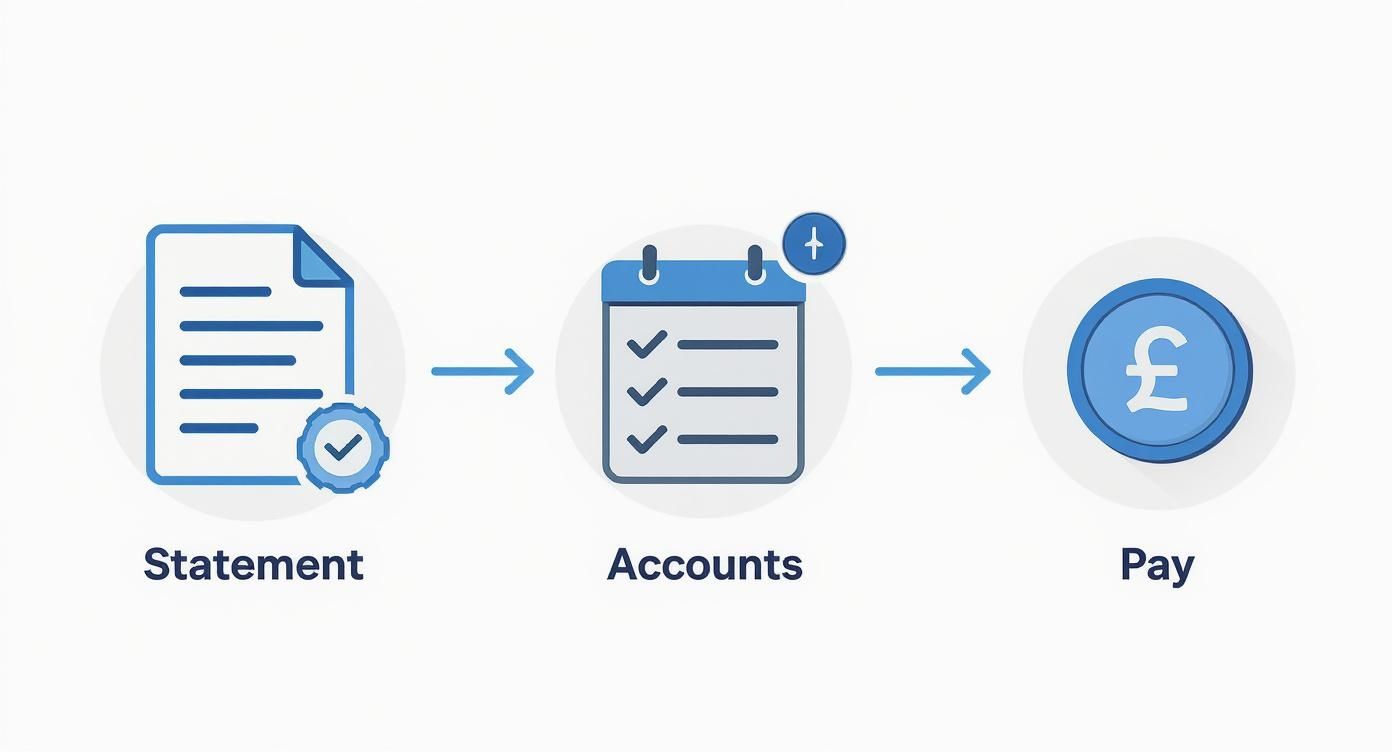
From the confirmation statement to the dormant accounts and the filing fee, these are the essential annual jobs that remain firmly on your to-do list.
Director Liability and Why It Matters
At the end of the day, the buck stops with the directors. It's your personal responsibility to file the confirmation statement and dormant accounts on time, every time. While late filing penalties are issued to the company, persistent failures can lead to Companies House taking action against the directors personally.
This could mean prosecution or even being disqualified from acting as a director for a number of years. The message is simple: making a company dormant changes your duties from operational to purely administrative, but it certainly doesn't erase them. Staying organised and remembering those key dates is non-negotiable.
Waking Up or Winding Down Your Company
Think of dormancy as a strategic pause. It’s a crossroads where you’ll eventually need to decide on one of two paths: either you restart the business engine, or you close the company down for good. Knowing how to navigate each option correctly is key to a smooth, compliant transition, whichever way you go.
The path you take really just depends on your future plans. If the market has picked up or you’ve got a fresh wave of inspiration, reactivating is the logical next step. On the other hand, if the dormant period has simply confirmed the business has run its course, a formal closure is the final, definitive action.
Reactivating Your Dormant Company
Waking up your company is surprisingly straightforward. The moment your business carries out what’s called a ‘significant accounting transaction’—like buying stock, sending an invoice, or even earning bank interest—it's legally considered active again.
You don't need to fill out a special form to "reactivate" with Companies House, but you absolutely must get in touch with HMRC straight away.
Your main job is to tell HMRC you've started trading again. You have to re-register for Corporation Tax within three months of becoming active. If you miss this, you could face penalties, as HMRC won't know you now have tax to pay.
Once you’ve done that, they'll send you a ‘notice to deliver a Company Tax Return,’ and all your regular filing duties will kick back in.
Key Takeaway: Your first set of full, active accounts will be due nine months after your company's accounting reference date. Make sure you're ready for this deadline from the moment you start trading again so it doesn't catch you by surprise.
Winding Down The Business Permanently
If you've decided the business just doesn't have a future, the most common way to close a dormant company with no debts is to have it "struck off" the official register. This process is called dissolution, and it formally and permanently closes the company.
To get started, you'll need to complete and send Form DS01 to Companies House. But hold on—you can only apply for a strike-off if the company meets certain conditions. For instance, in the last three months, it must not have:
- Traded or done any business.
- Changed its name.
- Engaged in any activities except those needed to close down.
Before you send the form, you also have a legal duty to inform any interested parties within seven days. This means sending a copy of the application to all directors, shareholders, employees, and any creditors. It's a crucial step to make sure everyone is aware of what's happening. If you want to dig into this further, our guide on how to voluntarily close a limited company covers it all in detail.
Choosing Your Next Move Wisely
Deciding whether to reactivate or dissolve is a major business decision. For many directors, dormancy is a smart alternative to insolvency, allowing them to pause trading during a rough patch. Given the financial pressures on UK companies, it can be a very sensible move. Recent UK government data showed the company insolvency rate in England and Wales was 53.0 per 10,000 companies, which really highlights the tough economic climate. You can discover more insights about these insolvency statistics on The Gazette.
Ultimately, keeping a company dormant gives you the breathing room to make a clear-headed decision. Whether you're ready to reignite your business ambitions or you're giving it a respectful final chapter, following the correct procedures with HMRC and Companies House is non-negotiable. It keeps you compliant and lets you move forward with confidence, free from any loose ends.
Common Questions About Dormant Companies
Even after you've gone through the steps, a few questions often pop up about making a company dormant. The details really matter here, and getting them right from the start saves a lot of headaches later on. We've pulled together some of the most common queries we hear from business owners to give you clear, straightforward answers.
Think of this as your go-to guide for the finer points. These are the practical, real-world questions that tend to surface once you actually start down this path.
How Long Can a Company Stay Dormant in the UK?
This is probably the first question on everyone's mind. The short answer? There's no legal time limit on how long a UK limited company can stay dormant. You can keep it in this state indefinitely, as long as you keep up with your annual filings.
This flexibility makes it a great strategy for a few different situations. Maybe you want to protect a company name for a future venture that's still a few years off. Or perhaps the company holds an asset, like a trademark, and you have no plans to trade for the foreseeable future.
Your only ongoing responsibility is to remember to file two key documents with Companies House each year:
- The confirmation statement (Form CS01)
- The dormant company accounts
As long as you get these in on time, your company can happily sit dormant for one year, five years, or even longer.
What Is a Significant Accounting Transaction?
The official definition of a dormant company hinges on this phrase, but what does it actually mean in practice? A "significant accounting transaction" is any transaction that needs to be entered into the company's accounting records.
For a dormant company, this umbrella covers pretty much all financial activity. There are only a handful of specific exceptions allowed by Companies House:
- The fee for filing your annual confirmation statement (currently £13 online).
- Any penalties you might unfortunately incur for late filing.
- The very first payment for shares when the company was incorporated.
Anything else—no matter how tiny—will break your company's dormant status. If you receive a payment, pay a supplier, or even just buy a coffee with a company card, your company is immediately considered active again in the eyes of the law.
A Word of Warning: The rules here are incredibly strict. Even a single penny of bank interest is classed as a significant accounting transaction. That alone is enough to require you to file full, active accounts for the year. Keeping a close eye on any remaining company assets is crucial.
Can a Dormant Company Keep a Bank Account?
Technically, yes, a dormant company can have a bank account. But—and it's a big but—it comes with a major risk. The danger is that the account could accidentally generate a transaction and wake the company from its slumber without you even realising.
If the account earns any interest, that's a transaction. If the bank charges a service fee, that's also a transaction. Either one would instantly end your dormant status for that financial year.
If you absolutely must keep the account open, you need to be incredibly careful. The best approach is to find a business account that pays zero interest and has no monthly or annual fees. This massively reduces the risk of an automated transaction tripping you up. For most directors, though, the safest and simplest route is to just close the business bank account once all the final bits are settled.
What Happens If I Miss the Filing Deadline?
Missing a filing deadline with Companies House has automatic and immediate consequences. There's no grace period; the penalty system kicks in the very next day.
The fines for filing dormant accounts late are surprisingly steep and they escalate quickly the longer you leave it.
- Up to 1 month late: £150
- Between 1 and 3 months late: £375
- Over 6 months late: £1,500
What's more, these penalties will double if you file late two years in a row. Companies House takes this very seriously. A consistent failure to file can lead to them taking action to forcibly strike the company off the register, and in the worst-case scenarios, directors can face prosecution for failing to meet their legal duties.
Trying to get your head around the rules for dormant companies can feel a bit much, but you don't have to figure it all out on your own. If you want peace of mind knowing your filings are handled correctly and on time, the team at Stewart Accounting Services can manage the whole process for you. Contact us today for expert support.