

When you're starting a business in the UK, one of the first big questions you'll face is whether to operate as a sole trader or a limited company. The answer really comes down to the classic trade-off between risk and reward.
As a sole trader, you are the business. It's the simplest way to get started, but it also means there's no legal distinction between your personal and business finances. On the other hand, setting up a limited company creates a separate legal entity, which shields your personal assets but comes with a heavier administrative burden.
Choosing Your UK Business Structure
Getting this foundational decision right is critical. It has a direct impact on your personal liability, how much tax you'll end up paying, and the day-to-day paperwork you'll have to keep on top of.
For many freelancers, contractors, and new startups, the sole trader route is the perfect launchpad. It’s straightforward, cheap to set up, and the compliance is minimal. If this sounds like the right fit for you, our guide on how to register as a sole trader walks you through everything you need to know.
But what happens when your business starts to take off? As profits grow, the perks of operating as a limited company often start to look much more appealing, particularly for tax efficiency and presenting a more established image to bigger clients or lenders.
Sole Trader vs Limited Company At a Glance
To give you a clearer picture, let's break down the fundamental differences between the two. This table offers a quick, side-by-side comparison of the key points.
| Feature | Sole Trader | Limited Company |
|---|---|---|
| Legal Liability | Unlimited personal liability. Your personal assets are at risk. | Limited to company assets. Your personal finances are protected. |
| Tax Structure | You pay Income Tax and Class 2/4 National Insurance on profits. | The company pays Corporation Tax; you pay tax on salary (PAYE) and dividends. |
| Public Perception | Seen as a simple, low-cost setup for smaller operations. | Often perceived as more professional, stable, and credible. |
| Admin Load | Relatively simple: just an annual Self Assessment tax return. | More complex: requires annual accounts and a Confirmation Statement for Companies House. |
| Privacy | High. Your business details are kept private. | Low. Director and company financial details are publicly available on Companies House. |
Think of this table as your starting point. It captures the essence of each structure, but the right choice for you will depend on your specific circumstances.
It’s also worth noting that the landscape is always shifting. For instance, the introduction of Making Tax Digital (MTD) will soon require sole traders earning over £50,000 to submit quarterly updates, starting from April 2026. This change closes the gap on the administrative front, potentially making the limited company structure a more logical step for higher-earning sole traders sooner than they might have planned.
As you weigh these options, it can be helpful to see how professionals in other fields approach similar decisions. For example, guidance on how to start a CPA firm often covers these same foundational business structure choices. In the following sections, we'll dive deeper into each of these points to help you make a truly informed decision for your business.
The Day-to-Day Reality: Key Differences in Practice
Once you're up and running, your choice of business structure really starts to show its colours. It’s not just about the name on your invoices; it dictates how much personal financial risk you’re taking on, how you handle your taxes, the amount of paperwork on your plate, and even how clients see you. Let's break down what these differences actually mean for you and your business.
Legal Liability: Your Personal Safety Net
This is arguably the most crucial difference, and for many, it’s the deciding factor. As a sole trader, the law makes no distinction between you and your business. You are the business.
That means you have unlimited liability. If the business gets into debt and can't pay its bills, your personal assets are fair game. We’re talking about your house, your car, your personal savings – everything could be on the line to cover those business debts. It’s a sobering thought and the biggest risk of operating this way.
A limited company, on the other hand, creates a legal wall between you and the business. It’s a completely separate legal entity. This gives you limited liability, which is a huge comfort. Should the company run into financial trouble, your personal assets are safe. Your risk is typically capped at the value of your shares in the company, protecting your personal life from business downturns.
The Bottom Line: A limited company acts like a financial firewall. It contains any business debts or legal troubles within the company itself, stopping them from spilling over into your personal life. This protection is the number one reason most people choose to incorporate.
Navigating the Tax Maze
The tax systems for each structure are worlds apart. The sole trader route is definitely more straightforward, but a limited company opens up far more opportunities for savvy tax planning as your income grows.
For a sole trader, it all happens through your annual Self Assessment tax return. You’ll be dealing with:
- Income Tax: This is paid on all your business profits, regardless of whether you’ve actually taken the money out for personal use.
- National Insurance Contributions (NICs): You’ll pay both Class 2 and Class 4 NICs on those profits.
A limited company has a few more moving parts when it comes to tax:
- Corporation Tax: First, the company itself pays this tax on its profits.
- PAYE (Pay As You Earn): If you pay yourself a director's salary, it's handled just like any other job. Income Tax and National Insurance are deducted before you get the money.
- Dividend Tax: The real game-changer is taking dividends from the profits left after Corporation Tax. Dividends are taxed at lower rates than salary and, crucially, they don't attract any National Insurance. This is the cornerstone of tax efficiency for company directors.
Paperwork, Privacy, and Perception
Your choice also involves a direct trade-off between keeping things simple and private versus appearing more established and credible.
As a sole trader, you get to keep your affairs almost entirely private. There's very little on the public record. Your main obligation is simply getting that Self Assessment tax return filed with HMRC each year.
A limited company is a different story – it’s built on transparency. You’re required to file annual accounts and a Confirmation Statement with Companies House every year, and anyone can look them up online. This includes details about directors and major shareholders. While that means giving up some privacy, it’s this very transparency that boosts your professional image. Banks, larger corporate clients, and even some suppliers often prefer dealing with limited companies, seeing them as more stable and serious. It’s a classic case of balancing simplicity and privacy against a more formal, credible business stature.
How Your Business Structure Hits Your Wallet
The theory is all well and good, but what really matters is the bottom line: how much money actually lands in your personal bank account at the end of the day. The structure you choose – sole trader or limited company – has a direct and significant impact on your take-home pay.
To cut through the jargon, let’s look at some real-world numbers.
This infographic gives a great at-a-glance summary of the fundamental differences in liability, tax, and the paperwork involved.
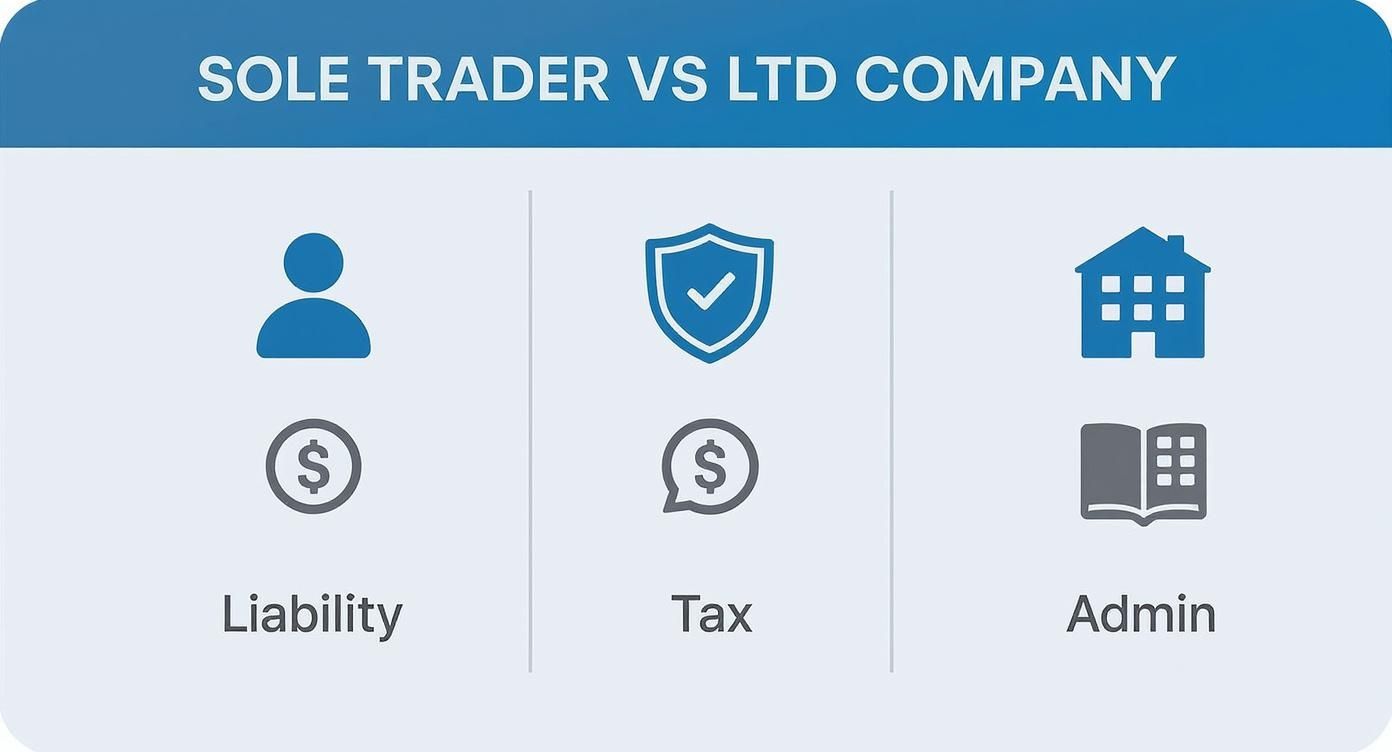
It boils down to a classic trade-off. Being a sole trader is wonderfully simple, but you're personally on the hook for everything. A limited company wraps you in a layer of legal protection, but that comes with more complex tax and admin duties.
Comparing Take-Home Pay at Key Profit Levels
Let's see how this actually plays out with some pounds and pence. We'll compare the final take-home pay for both structures at three common annual profit points. For the limited company director, we're assuming the most common tax-efficient setup: a small salary just below the National Insurance threshold, with the rest of the profits drawn as dividends.
A quick note: these are simplified examples for the 2024/25 tax year. They're for illustration only and don't factor in things like other personal income, student loans, or specific allowances you might have.
Tax Liability Comparison at Different Profit Levels
Here's a breakdown of how your net pay changes as your business grows. This table clearly shows the point at which the limited company structure starts to pull ahead in terms of tax efficiency.
| Annual Profit | Sole Trader Take-Home Pay | Limited Company Director Take-Home Pay |
|---|---|---|
| £30,000 | ~£24,450 | ~£24,350 |
| £60,000 | ~£44,350 | ~£46,000 |
| £100,000 | ~£67,350 | ~£71,900 |
As you can see, the financial benefits of operating as a limited company become much more compelling once your profits start climbing. Let's dig into why.
Scenario 1: £30,000 Annual Profit
As a sole trader, after you've paid Income Tax and National Insurance, you’d be left with around £24,450. Through a limited company, taking a small salary and dividends would leave you with roughly £24,350.
At this level, there's not much in it. In fact, the simplicity and lower accountancy fees of being a sole trader often make it the more sensible choice. The minor tax difference could easily be swallowed up by the extra admin costs.
Scenario 2: £60,000 Annual Profit
Here’s where things start to change. A sole trader would take home approximately £44,350. But as a limited company director, your take-home pay jumps to around £46,000.
This is the point where the tax efficiency of the limited company really kicks in. Because your dividends aren't subject to National Insurance, you start to see a real, tangible financial advantage.
Key Insight: The tipping point where a limited company becomes more tax-efficient usually happens somewhere between £30,000 and £40,000 in profit. Once you cross that threshold, the savings can start to add up quickly.
Scenario 3: £100,000 Annual Profit
Now the difference becomes impossible to ignore. A sole trader on this profit would take home about £67,350. The limited company director, however, keeps significantly more, taking home around £71,900.
When you're dealing with six-figure profits, the financial argument is crystal clear. The limited company structure offers a substantial advantage, putting several thousand pounds extra back in your pocket each year. Getting this mix right is vital, and we explore the strategy in more detail in our guide on salary versus dividends.
These examples show a clear pattern: the more profitable your business becomes, the stronger the case for operating as a limited company. The secret lies in extracting those profits in the most tax-efficient way possible.
When to Operate as a Sole Trader
Kicking things off as a sole trader is the go-to route for most new businesses in the UK, and it’s easy to see why. The biggest draw is sheer simplicity. If you’re just getting started—especially as a freelancer, consultant, or small service provider—it’s the quickest, most straightforward way to get up and running.
There are virtually no setup costs, you don't have to deal with Companies House, and the administrative burden is incredibly light. You and the business are legally one and the same, giving you total control and keeping your finances private. It’s the perfect framework for testing a new business idea without much risk or initial investment.
Is the Sole Trader Route Right for You?
The sole trader structure is a fantastic fit for certain types of businesses and at particular stages of growth. It offers an easy entry point for entrepreneurs who value speed and simplicity over everything else.
You should seriously consider staying a sole trader if your business fits one of these descriptions:
- Low-Risk Ventures: If you’re not taking on big debts to start and the chances of facing major financial losses are slim, the whole 'unlimited liability' issue is much less of a worry.
- Freelancers and Contractors: For professionals selling their personal skills—think writers, designers, or IT contractors—the sole trader model is usually the most practical and cost-effective option.
- Testing the Waters: Got a side hustle or aren't sure if the business will be a long-term success? This structure lets you start trading without the costs and formal commitments that come with setting up a company.
Think of the sole trader setup as your business on easy mode. It’s all about speed, simplicity, and privacy, making it perfect for new, low-risk ventures where you are the business.
Why It's So Popular (and When the Numbers Make Sense)
The numbers really do speak for themselves. The sole trader model has long been the most common business structure in the country, making up a massive chunk of the UK's business population. By the start of 2025, the total number of UK businesses reached 5.7 million, with sole traders driving a huge part of that growth. In fact, their numbers grew by 138,900 between 2024 and 2025 alone—a 5% jump. You can get a better sense of this trend from the data on smeweb.com.
This structure is most effective when your profits are still modest. As we saw in the financial examples, once you get past the £30,000-£40,000 profit mark, the tax advantages of a limited company start to look more appealing. Below that, the simplicity and lower accountancy fees often mean you’ll be better off financially as a sole trader. Just remember the trade-off: this simplicity comes at the price of unlimited personal liability for your business's debts.
Strategic Reasons to Form a Limited Company

While the simplicity of being a sole trader is appealing, setting up a limited company is a deliberate, strategic decision—one that’s geared towards ambition, security, and long-term growth. It’s more than just a bit of legal paperwork; it fundamentally alters how your business is run, how it’s perceived, and critically, how you protect your personal wealth.
The single biggest draw for most people is limited liability. This creates a solid legal wall between your business finances and your personal assets. If the company were to find itself with debts it couldn't pay, that wall means your home, car, and personal savings are kept safe. For any business owner taking on loans, signing commercial leases, or operating in sectors with inherent financial risks, this protection isn't just nice to have—it's essential.
Building Credibility and Trust
Beyond the personal protection, operating as a limited company just looks more professional. It projects an image of stability and permanence that clients and partners take seriously. In fact, many larger corporations and public sector bodies simply have policies against working with unincorporated businesses.
That 'Ltd' after your company name acts as a badge of credibility. It signals to potential clients, suppliers, and investors that you’re a serious, established entity. This often leads to better access to finance, as banks are generally more comfortable lending to a limited company with its formal structure and transparent financial records at Companies House.
A limited company isn't just a business structure; it's a statement of intent. It tells the world you are building something durable, trustworthy, and ready for growth, opening doors that might remain closed to a sole trader.
A Framework for Future Growth
The limited company model is designed for expansion from the ground up. It gives you the ability to issue shares, which is a clean and simple way to bring in new partners, attract investors, or even offer equity to key employees. This kind of flexibility is vital when you're looking to scale your operations or raise funds for a big project.
It also makes long-term planning much more straightforward. Ownership can be transferred cleanly by selling shares, which creates a clear path for succession planning or an eventual exit. You're building a solid foundation for an enterprise that can thrive long after you've stepped back. We delve into these points in more detail in our guide covering the advantages of being a limited company.
This forward-thinking structure is why their numbers keep climbing. Between 2024 and 2025, the number of UK limited companies grew by 40,200, a 2% increase, bringing the total to 2.1 million. You can see the full picture in the latest UK business activity statistics on ons.gov.uk. The trend is clear: as businesses mature, they increasingly opt for the strategic benefits that come with incorporation.
Making the Right Choice for Your Business
Deciding between being a sole trader or setting up a limited company isn't about finding a single 'best' answer. It’s about figuring out which structure fits your business right now, while also thinking about where you want to be in a few years. Let’s pull all the threads together into a clear decision-making framework to help you weigh up the pros and cons for your specific situation.
A good starting point is to ask yourself some honest questions. What are your genuine profit forecasts for the next year or two? And how do you really feel about the idea of unlimited personal liability? Getting clear on these answers will give you a solid foundation for making the right call.
A Practical Checklist to Guide You
Run through these key points to get a better sense of whether the straightforward nature of a sole trader or the protective shell of a limited company is the right fit.
- Risk Tolerance: Does your business deal with big financial risks? Think large loans, pricey equipment, or client contracts with hefty penalty clauses. If the answer is yes, the protection offered by limited liability is a massive plus.
- Growth Ambitions: Do you have plans to look for investment, bring in partners, or maybe sell the business down the line? A limited company structure is designed for this kind of growth, making all those processes much simpler to manage.
- Credibility Needs: Are you hoping to work with large corporate clients or public sector bodies? Many bigger organisations prefer, and sometimes insist, that their suppliers are incorporated. A limited company just looks more professional in their eyes.
- Admin Capacity: Are you ready for the extra paperwork that comes with running a limited company, like filing annual accounts and a confirmation statement? Or does the minimal admin of a sole trader setup sound far more appealing right now?
Switching from a Sole Trader to a Limited Company
Plenty of businesses start out with one person trading as a sole trader and then incorporate later on. It’s a very common and sensible path to take as you grow. The trigger is often hitting a certain profit level – usually around the £30,000-£40,000 mark – where the tax savings of a limited company begin to make the extra admin worthwhile.
Other triggers could be landing a big contract that demands it, or deciding you're ready to seek investment.
The journey from sole trader to a limited company is a natural evolution for a growing business. It marks a shift from prioritising simplicity to prioritising protection, tax efficiency, and long-term strategic growth.
Making the switch involves registering your new company with Companies House, opening a dedicated business bank account, and letting HMRC know you’ve stopped trading as a sole trader. While it's a well-trodden path, getting professional advice is vital to make sure the transition is seamless.
Once your structure is sorted, you can focus on building your business. For instance, implementing a smart marketing strategy for small businesses is crucial for attracting customers and driving growth. Ultimately, whether you're just starting out or ready to scale, the right advice ensures your business is built on the strongest possible foundation.
Got Questions? We've Got Answers
After weighing up the pros and cons of being a sole trader versus a limited company, you’ll probably have a few practical questions buzzing around your head. Let’s tackle some of the most common ones I hear from clients.
At What Point Does a Limited Company Make Sense Financially?
There isn’t one magic number that works for everyone, but my general rule of thumb is to start seriously thinking about it when your profits hit the £30,000 to £40,000 mark. Below this, the simplicity and lower accountancy fees of the sole trader route often mean you’ll take home more money at the end of the day.
Once you’re consistently earning more than this, the tax advantages of a limited company really start to kick in. The classic strategy is to pay yourself a small, efficient salary and take the rest of your income as dividends. This structure can significantly cut down your National Insurance contributions, which is the main reason incorporation becomes the smarter financial move as your profits grow.
Key Takeaway: While every business is different, hitting that £30,000 profit level is your cue to sit down and run the numbers. The potential tax savings often more than cover the extra admin costs.
Can I Be a Sole Trader and a Limited Company Director at the Same Time?
Yes, absolutely. It's completely fine to run a business as a sole trader while also being a director of a limited company, as long as they are for separate business activities. The two aren't mutually exclusive.
For instance, you could be a freelance photographer operating as a sole trader, but also be the director of a limited company that owns a rental property. The key is managing the tax affairs for both correctly. You'd file a Self Assessment tax return covering your sole trader income and any director's dividends, while the company files its own Corporation Tax return.
What Are the Must-Do Tasks for a Limited Company?
Running a limited company definitely comes with more formal responsibilities than being a sole trader. These are non-negotiable legal duties needed to keep your company on the right side of HMRC and Companies House.
Here are the core ongoing jobs:
- Annual Accounts: You have to prepare and file a set of statutory accounts with Companies House every year.
- Company Tax Return: This is the CT600 form, which you send to HMRC annually to declare your company's profit or loss and calculate its Corporation Tax bill.
- Confirmation Statement: Think of this as an annual check-in with Companies House. You’re simply confirming that the details they have on file for your company (directors, registered office, etc.) are all up to date.
- PAYE Filings: If you pay yourself or anyone else a salary, you’ll need to run a PAYE payroll scheme and report everything to HMRC.
Deciding between a sole trader or ltd company is one of the most important decisions you'll make for your business. Here at Stewart Accounting Services, we specialise in guiding business owners to the right choice for their unique situation, making sure your setup is compliant and tax-efficient right from the start. Find out how we can support your business journey.