

What is the Self Assessment process for sole traders in 2026?
Did you know that approximately 60% of the UK’s £46.8 billion tax gap is attributed to small businesses, often due to simple reporting errors? For many business owners in Alloa, Stirling, and Falkirk, the upcoming changes to the tax system feel like a heavy burden. It’s understandable to feel anxious about the 2026 Making Tax Digital (MTD) transition or the fear of a surprise HMRC penalty landing on your doorstep. Managing the self assessment for sole traders process shouldn’t cost you your peace of mind or your evenings and weekends.
We believe your focus should be on your actual work, not wrestling with spreadsheets. Our goal is to lift the weight of compliance from your shoulders, restoring your time and mental well-being. This guide offers a clear, expert breakdown of your tax obligations to help you regain your professional liberty. You’ll get the facts on key deadlines, the new quarterly reporting thresholds, and how to claim every legal expense. By the end of this article, you will have a roadmap to keep your finances on track, save time, and ensure you pay the minimum amount of tax legally required.
Key Takeaways
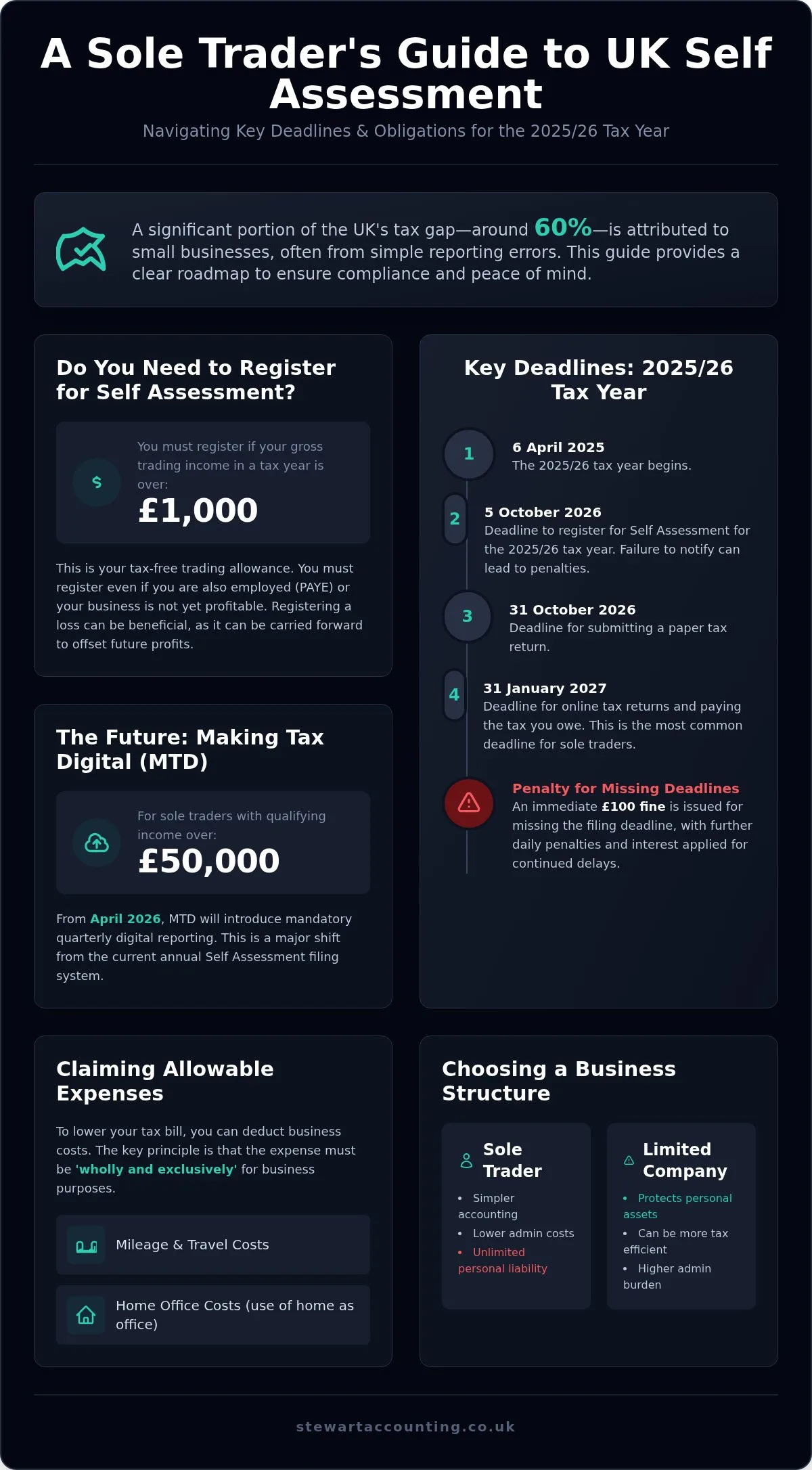
- Identify if you need to register for self assessment for sole traders by checking your gross trading income against the £1,000 tax-free allowance.
- Protect your business from HMRC penalties by meeting the 5th October registration deadline and the 31st January deadline for online filing and payments.
- Lower your tax bill by correctly claiming allowable expenses under the ‘wholly and exclusively’ rule, including mileage and home office costs.
- Prepare for the April 2026 Making Tax Digital transition which introduces quarterly reporting for those with qualifying income over £50,000.
- Restore your time and mental well-being by delegating your tax return to an expert, ensuring you remain compliant while focusing on your actual work.
Who needs to register for Self Assessment as a sole trader?
In the eyes of HMRC, you are a sole trader if you run your own business as an individual and are self-employed. This status means you are the business; there is no legal distinction between your personal assets and your professional ones. Many people in Stirling, Falkirk, and Alloa choose this path because it is the simplest way to start trading. You might be a freelancer, a local tradesperson, or someone running a shop. Whatever your craft, the process of reporting your income to the government involves completing UK tax returns each year to ensure you pay the correct amount of tax and National Insurance.
Registration is mandatory if your gross trading income was more than £1,000 in a tax year. This rule applies even if you are also employed elsewhere and pay tax through PAYE. If you have a side hustle, receive rental income from a property, or earn untaxed income from savings and investments, you must declare these earnings once they exceed the threshold. Managing the self assessment for sole traders process is the first step toward professional liberty, yet it often brings an initial wave of anxiety. Our role is to replace that stress with a clear, structured path to compliance.
Understanding the registration thresholds
For the 2025/26 tax year, you must register for Self Assessment if your gross trading income exceeds the £1,000 trading allowance. You should register even if your business is not yet making a profit. Recording a loss is a strategic move, as these losses can often be carried forward to offset future profits, reducing your tax bills in later years. You must register by 5 October 2026 if you started trading in the 2025/26 tax year. After registering, HMRC will issue your Unique Taxpayer Reference (UTR) number. This ten-digit code is your permanent identifier, and you will need it for every piece of correspondence with the tax office.
Sole traders vs other business structures
Deciding whether to remain a sole trader or transition into limited companies is a common crossroad for growing businesses. Sole traders enjoy lower administrative costs and simpler accounting, but they face unlimited personal liability for business debts. A limited company provides a protective barrier for your personal finances and can offer better tax efficiency as your turnover increases. Your choice of structure also dictates how you contribute to the state. Sole traders pay Class 4 National Insurance based on their profits, while company directors manage their contributions through payroll. If you are moving from a casual side hustle to a full-time venture, delegating the requirement for self assessment for sole traders to a professional ensures you choose the most pragmatic structure for your long-term goals.
What are the key tax dates and deadlines for 2026?
Missing an HMRC deadline is a common source of stress for business owners. To maintain your mental well-being and keep your finances on track, you need to mark several critical dates in your diary. If you are new to business, you must register for Self Assessment by 5 October 2026 for the 2025/26 tax year. Failing to do so can result in “failure to notify” penalties, even if you eventually pay your tax on time. Our goal is to help you avoid these avoidable costs through professional delegation and clear planning.
The most significant date in the calendar is 31 January. For the 2025/26 tax year, your online return must be submitted and any tax owed must be paid by midnight on 31 January 2027. If you still use paper returns, your window is much shorter, closing on 31 October 2026. Missing these dates triggers an immediate £100 fine. If the delay continues beyond three months, HMRC adds daily penalties and interest, which can quickly erode your hard-earned profits and create unnecessary anxiety.
The 2025/26 tax year calendar
The 2025/26 tax year runs from 6 April 2025 to 5 April 2026. While the final deadline feels far away, filing your self assessment for sole traders return in April or May is a pragmatic choice. Filing early doesn’t mean you have to pay early. It simply gives you the exact figure you owe months in advance. This foresight restores your personal liberty by removing the “January panic” and allowing you to budget effectively for the payment due on 31 January 2027.
Managing payments on account
Payments on account are essentially advance payments toward your next tax bill. HMRC requires these if your tax bill is over £1,000, unless you’ve already paid more than 80% of the tax you owe through other means. These payments are due in two equal instalments: one on 31 January and the second on 31 July. For the 2025/26 tax year, your second payment on account is due by 31 July 2026.
If you know your income has dropped, perhaps due to a change in market conditions in Central Scotland, you can apply to reduce these payments. However, doing so without accurate bookkeeping is risky. If you reduce them too much, HMRC will charge interest on the shortfall. Professional delegation of your tax affairs ensures these calculations are precise, saving you from unnecessary interest charges and financial surprises. To ensure your business remains compliant without the stress, you can speak with our team for expert guidance.
Which expenses can sole traders claim to reduce their tax bill?
The golden rule for claiming business costs is that they must be incurred “wholly and exclusively” for the purposes of your trade. This principle is the foundation of a correct self assessment for sole traders filing. If a cost has a dual purpose, such as a mobile phone used for both client calls and personal chats, you can only claim the business proportion of that expense. Identifying these costs accurately is a pragmatic way to lower your tax liability and ensure you only pay what is legally required.
Common office expenses include stationery, postage, and business software subscriptions. You can also claim for professional insurance and the cost of accounting services, provided the work relates to your business tax affairs. Delegating your bookkeeping and tax preparation to an expert isn’t just a way to restore your time; it’s often a tax-deductible investment in your business’s financial health.
Travel is another significant area for potential savings. You have two choices when it comes to vehicle expenses:
- Actual costs: You keep track of all fuel, insurance, and repair bills, then claim a percentage based on your business mileage.
- Simplified mileage: You claim a flat rate of 55p per mile for the first 10,000 business miles in a car or van, and 25p per mile thereafter.
Working from home and simplified expenses
If you run your business from a home office in Central Scotland, you can claim a portion of your utility bills, such as heating, electricity, and council tax. Alternatively, HMRC offers a simplified flat rate based on the hours you work from home each month. You can claim £10 for 25 to 50 hours, £18 for 51 to 100 hours, and £26 for 101 hours or more. Whichever method you choose, you must keep valid receipts and digital records for at least six years to stay compliant with HMRC regulations.
Marketing and business development costs
Investing in your growth is essential, and many of these costs are allowable. You can claim for website hosting, digital advertising, and professional subscriptions to bodies related to your trade. Training courses that help you maintain or update your existing skills are also deductible. Regarding client relations, business entertaining is almost always disallowable for tax purposes, meaning you cannot claim for the cost of taking a client to lunch or providing hospitality.
How will Making Tax Digital (MTD) change Self Assessment in 2026?
The introduction of Making Tax Digital (MTD) represents the most significant change to the UK tax system in decades. From 6 April 2026, the way you manage self assessment for sole traders will shift from a single annual event to a continuous digital process. This initiative aims to reduce reporting errors and close the tax gap by requiring businesses to maintain digital records and provide more frequent updates to HMRC. While this might feel like an added administrative burden, it is designed to give you a more accurate, real-time view of your tax liabilities throughout the year.
Rather than facing one large, unexpected bill in January, you will see your tax position develop as you trade. To remain compliant, you must use online accounting services that are compatible with HMRC’s systems. Moving away from manual entry allows for a smoother transition, restoring your professional liberty by automating the most tedious parts of your bookkeeping. This shift is a pragmatic step toward modernising your business finances and reducing the anxiety associated with the traditional year-end rush.
The April 2026 roadmap
If your qualifying income is over £50,000, you are in the first group affected by the April 2026 rollout. Following this, those earning over £30,000 will join the scheme in April 2027. Under these new rules, you will submit quarterly updates instead of waiting until the end of the tax year. The first update for those in the 2026 bracket will be due by 7 August 2026. Old methods, such as paper ledgers or simple spreadsheets without digital links, will no longer meet the legal requirements. Embracing this change early ensures you aren’t caught in a last-minute scramble as the deadline approaches.
Preparing your business for digital tax
Transitioning to software like Xero is the most effective way to prepare for the 2026 changes. Automated bank feeds mean your transactions flow directly into your accounts, which significantly reduces the risk of manual errors and saves you hours of work each month. For our clients in Alloa and Stirling, we provide the specific training and support needed to make this shift feel effortless. We handle the technical setup and delegation of these tasks so you can focus on your actual work. If you are feeling anxious about these upcoming requirements, you can contact us to discuss your MTD transition and ensure your business is ready for the new era of digital tax.
Why should you consider professional help for your tax return?
Managing the self assessment for sole traders process can feel like a constant weight on your shoulders. While many business owners start by handling their own books, there comes a point where the complexity of HMRC regulations begins to eat into your personal liberty. Delegating your tax affairs to a professional is not just about avoiding numbers; it is about restoring your mental well-being and reclaiming the hours you currently spend on paperwork. By shifting this burden, you ensure that your focus remains on growing your business rather than decoding tax codes.
A significant benefit of professional support is the identification of tax-saving opportunities that generic software often misses. While an automated tool might catch basic expenses, professional sole trader accounting services provide an understanding of specific allowable costs that apply to your trade. We act as a protective barrier between you and HMRC, ensuring every claim is legitimate and every deadline is met. This level of expert oversight provides total peace of mind, knowing that you are paying the minimum legal amount of tax while remaining compliant.
The true cost of doing it yourself
Many sole traders hesitate to hire an accountant because they view it as an extra expense. However, the true cost of doing it yourself is often much higher than the professional fee. Market rates for sole trader tax returns typically range from £150 to £500 or more, depending on the complexity of your income streams. When you calculate the value of the hours you spend wrestling with spreadsheets, plus the risk of a £100 late filing penalty or interest on mistakes, professional delegation often pays for itself. You avoid the high-stress January 31st rush and ensure your finances are handled with precision from the start.
Local expertise in Central Scotland
We pride ourselves on being a solid, reliable partner for small enterprises across the region. With offices in Alloa, Stirling, and Falkirk, we offer a personal service that national software providers simply cannot match. We don’t just file your return; we act as your authorised agent with HMRC, meaning we handle the correspondence and queries on your behalf. This complete transfer of responsibility allows you to breathe easier and focus on your actual work. If you are ready to remove the stress of tax season and ensure your business remains on the right track, Contact Stewart Accounting Services today to discuss how we can support your next filing.
Secure your financial peace of mind for 2026
Navigating the self assessment for sole traders process doesn’t have to be a source of constant anxiety. By understanding your registration requirements, marking key deadlines like 31 January, and preparing for the digital shift in April 2026, you can maintain total control over your business finances. Claiming every legal expense and keeping accurate records ensures you keep your hard-earned profits where they belong. This proactive approach is the best way to avoid HMRC penalties and protect your well-being.
The transition to Making Tax Digital is a significant milestone, but it also offers a pragmatic opportunity to modernise your bookkeeping and gain clearer financial insights. As Chartered Accountants with offices in Alloa, Stirling, and Falkirk, we specialise in the stress-free delegation of all HMRC paperwork. We provide fixed-fee quotes to ensure there are no surprises, allowing you to focus on your actual work while we handle the technical compliance. This complete transfer of responsibility restores your time and mental energy.
Get your tax return sorted by our experts today and reclaim the professional liberty you deserve. We are here to support your success and keep your business on the right track every step of the way.
Frequently Asked Questions
Is there a difference between a tax return and Self Assessment?
Self Assessment is the system HMRC uses to collect Income Tax, while the tax return is the actual document you submit to report your earnings. Completing a self assessment for sole traders involves using the online SA100 form to declare all taxable income. While the terms are often used interchangeably, understanding the distinction helps when navigating HMRC guidance. The system relies on you to calculate and report your own tax liability.
Can I file my sole trader tax return myself for free?
Yes, you can file your return for free directly through the HMRC online portal. This method is suitable for those with very simple financial affairs and the time to manage the data entry. However, many find that the time spent wrestling with the software and the anxiety of making an error outweighs the cost of professional support. Delegating the self assessment for sole traders process ensures every figure is accurate and compliant.
What happens if I make a mistake on my Self Assessment?
You can usually amend your return for up to 12 months after the original filing deadline. If you discover an error, it is best to correct it immediately through the HMRC portal to show you are acting in good faith. If HMRC discovers the mistake during an investigation, they may charge penalties based on whether the error was deemed careless or deliberate. Professional oversight significantly reduces this risk.
How much should a sole trader set aside for tax each month?
A pragmatic rule of thumb is to set aside between 20% and 30% of your gross monthly income into a separate savings account. This range typically covers your Income Tax and National Insurance contributions. Setting money aside regularly restores your mental well-being by ensuring you are prepared for the January 31st payment. Our team in Stirling and Falkirk can help you calculate a more precise percentage based on your expected annual profits.
Do I need an accountant to file my tax return as a sole trader?
There is no legal requirement to use an accountant, but many business owners choose to do so to save time and ensure compliance. A chartered accountant identifies allowable expenses you might miss and provides a protective barrier against HMRC queries. This delegation allows you to focus on your core work while knowing your finances are in expert hands. We provide fixed-fee quotes for this service to keep your costs predictable.
What is the penalty for missing the January 31st deadline?
Missing the online filing deadline triggers an immediate £100 fixed penalty from HMRC. This fine applies even if you have no tax to pay or if you have already paid your bill in full. If the return is more than three months late, additional daily penalties of £10 per day apply, up to a maximum of £900. These avoidable costs can quickly erode your business profits and cause unnecessary stress for the business owner.
Can I claim for clothing or laundry as a business expense?
You can only claim for clothing if it is a specific uniform or protective gear required for your work. Everyday business wear, such as a suit or smart dress, is not an allowable expense even if you only wear it for client meetings. If you do wear a uniform or protective clothing, you can also claim the cost of laundering or repairing these items. This follows the strict “wholly and exclusively” rule for business costs.
How do I pay my Self Assessment tax bill to HMRC?
You can pay your bill via the HMRC website using a debit card, corporate credit card, or by setting up a Direct Debit. Most sole traders prefer using a bank transfer or an online payment through their banking app. To ensure the payment is credited to the correct account, you must always include your ten-digit Unique Taxpayer Reference (UTR) followed by the letter ‘K’ as the payment reference for the transaction.
Recent Posts
06 Oct, 2026
04 Oct, 2026