

value added tax Best Practices and Expert Advice

TL;DR: Value added tax is a multi-stage consumption tax collected at every production step, requiring mandatory registration once rolling 12-month turnover exceeds official limits.
- Standard rates apply to most goods unless items qualify for reduced or zero rates or exports.
- Except when customers can reclaim tax, voluntary registration often hurts cash flow for consumer-facing firms.
- Register early if your business structure involves heavy setup costs to reclaim input tax immediately.
- The calculation that shows why tracking rolling turnover prevents penalties is detailed in the article.
Managing value added tax compliance requires tracking your rolling 12-month turnover against official limits to avoid heavy administrative fines. Professional accountancy management across the wider UK market varies annually depending on turnover scale and transaction volume. Your core decisions are when to register, which scheme fits your structure, and how much to budget for ongoing fees. You can request a personalized quote to determine your specific business costs.
The ideal vat setup depends on your current business structure
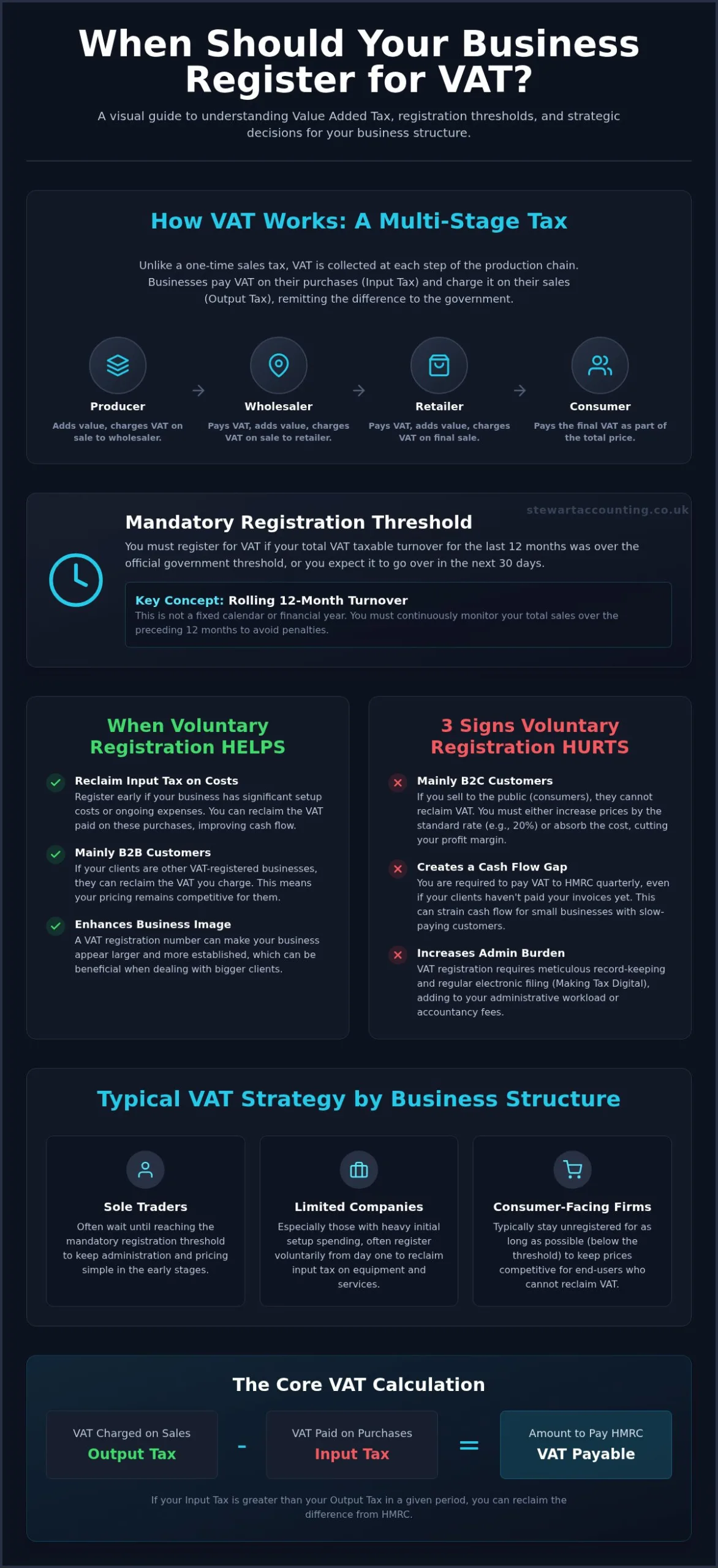
Your business structure dictates how you calculate, collect, and report Value Added Tax to tax authorities. A few patterns show up again and again: sole traders still under the limit often wait until mandatory registration so admin stays light, then pass returns to a specialist as turnover approaches the line; limited companies with heavy setup spend register early so they can reclaim input tax on initial expenses; consumer-facing firms below the threshold stay unregistered to avoid a twenty percent price rise their buyers cannot reclaim. With clients we see that sole traders often delay setup until reaching mandatory registration limits, whereas limited companies often register early to reclaim initial expenses. Choosing the right approach early prevents administrative penalties.
Starting out as a self-employed business owner often brings uncertainty around tax rules and bookkeeping obligations. You can manage these administrative duties by partnering with experts for VAT Returns and Accounting Services Alloa | Value Added Tax. Getting your business structure aligned with the right tax scheme keeps your operations compliant.
A commenter in the theaccountancy.co.uk thread "Accountants for Startups, Affordable support from £23.70 a month":
"As a first-year sole trader, I was a little unsure about the accounting side of things, but James has been incredibly helpful throughout the whole process." (source)
A first-year sole trader unsure about the accounting side (situation) received hands-on help from the adviser (solution), and the tax processes were set up correctly from day one with the stress removed (result). That path matches the affordable monthly support described in the thread title and shows why early guidance matters for newly self-employed owners.
VAT works as a multi-stage tax you offset on purchases and sales
Value-added tax (VAT) applies to goods and services as a consumption levy based on the value added at every step of production or distribution.
Unlike a sales tax collected only at the final point of sale, businesses collect VAT on every transaction throughout production. You offset the VAT you pay on purchases against the tax you charge to customers. Think of it like a relay race where each runner passes along only the extra distance they covered. According to the National Archives Open Government Licence v3.0 (2014), public sector information remains accessible under clear open terms for business compliance.
If you are Looking for top-notch accountants in Alloa, Stirling, working with specialists helps you manage these calculations correctly. Selecting the standard accounting method works best for steady cash flows, while cash-basis accounting suits businesses facing late-paying clients.
3 Signs Voluntary VAT Registration Will Hurt Cash Flow
Voluntary VAT registration drains your cash flow if your main customers cannot reclaim the extra tax you must charge them. Registering early forces you to pay HM Revenue and Customs before clients clear your invoices. This timing gap creates severe financial pressure for small firms.
Dealing primarily with unregistered end-users forces you to either raise your rates by twenty percent right away or swallow the difference. When buyers already find accounting work stressful, unclear rules add more pressure. Expert support removes that burden.
You can learn How to Value and Price Your Goods and Services Right to protect your profit margins. Raising prices without a strategy damages your client relationships. Staying unregistered is the right choice for consumer-facing businesses below the threshold: it keeps your offerings competitive.
Vat registration thresholds determine when your business must register
Mandatory registration applies once your rolling twelve-month turnover crosses the official limit. From practice, I observe that business owners often mistake this calculation for a fixed calendar year. Tracking total sales continuously prevents missing the deadline.
Reaching this limit creates urgent duties, but you do not have to tackle the paperwork alone. Discover About Stewart Accounting, Professional Accountants to get expert guidance before penalties accrue. Handing off these complex figures to a qualified practice restores peace of mind and clears urgent filing headaches.
A commenter in the theaccountancy.co.uk thread "Accountants for Startups, Affordable support from £23.70 a month":
"Kieran McCann provided outstanding support in helping me file my corporation tax return within an extremely tight timeframe." (source)
A filer facing an extremely tight corporation tax deadline received rapid support from Kieran McCann and got the return filed inside that window (result). That sequence turns a compliance bottleneck into a managed process when time is short.
Correct VAT rate classification protects your margins from audit risk
Value added tax applies to most commercial sales of goods and services at distinct rates depending on item classification.
Our experience with client accounts indicates that incorrect product classification results in steep audit penalties for non-compliance. Incorrect tax codes quickly ruin profit margins. Standard rates cover most general business transactions. Reduced rates apply to essential items such as specific foods, medical supplies, or utility services. Zero rates apply to qualifying items such as exports, where no tax gets added, but you still reclaim input tax. Exempt sales carry no tax and prohibit input tax recovery. Choose standard rates for default items, while reserving zero rates strictly for qualifying exports.
| Rate Type | Item Category | Tax Application |
|---|---|---|
| Standard | General commercial goods | Applied at full rate |
| Reduced | Essential goods and energy | Applied at lower rate |
| Zero | Exported goods | Zero percent applied |
4 Steps to Submit Your First Electronic Return On Time
Submitting your digital tax filings correctly requires direct preparation before the final deadline arrives. Setting up digital credentials weeks before your deadline prevents last-minute gateway lockouts. Follow these steps for filing:
- Gather records: Collect all sales invoices and purchase receipts for the specified accounting period.
- Reconcile accounts: Check every transaction figure against your business bank statements to ensure full accuracy.
- Calculate figures: Total your output tax collected and input tax paid to find the final net figure.
- Submit online: Send your completed summary directly through approved software to the tax portal.
Tip: Automate your digital record keeping early using MTD-compliant software so you cut manual calculation errors.
Avoid Missed Filing Deadlines to Prevent Late Penalties
Failing to meet tax deadlines triggers automatic financial penalties and immediate interest charges from tax authorities. Missing your submission window creates stress for your business operations.
When an inherited tax mess leaves you stranded, swift intervention protects your remaining working capital. Relying on an outdated accounting setup often causes unexpected processing delays. As noted in the Afrikaans Wikipedia BTW entry from 2026, value added tax regulations require strict compliance to avoid statutory fines.
Partnering with a dedicated professional keeps records clean and submissions on time. If you face a tight deadline right now, professional help resolves backlogs quickly: reach out before the next penalty window closes.
Budget 1 200 to 90 000 GBP for Ongoing Accountancy Fees
Accountancy fees for value added tax management vary based on your business size and transaction volume.
The overall cost reflects the work involved. Managing basic value added tax filings takes fewer resources than handling complex international trade rules. Match the support level to what your business actually needs so you avoid paying for unused capacity.
Work volume drives costs up or down. A business with thousands of monthly retail receipts requires significantly more attention than a firm issuing three invoices a month.
Smaller sole traders benefit from basic digital compliance support. Larger enterprises with complex cross-border trade require dedicated specialists. Ask for figures built around your transaction volume and scheme choice.
Frequently asked questions
What is a value-added tax?
A value-added tax is a consumption tax charged on the value added at each stage of a supply chain. Business owners collect it on sales and pay it to the tax authorities. Tax rules apply to most commercial activities.
How does VAT differ from sales tax?
Sales tax is collected only at the final point of sale to the end consumer. Value-added tax is collected at every stage of production and distribution. Businesses reclaim the tax they paid on inputs.
What goods and services are VAT charged on?
Value-added tax applies to most goods and services supplied by registered businesses. Certain essential items, financial services, and educational activities receive lower rates or zero ratings. Specific exemptions depend on national legislation.
How much VAT should I charge?
You must charge the specific rate dictated by local government tax regulations for your item category. Rates vary significantly depending on the product type and target market. Tax professionals can calculate your exact duties.
What are the VAT registration thresholds?
You must register for tax purposes once your business turnover exceeds a statutory limit set by tax authorities. These entry levels differ by country and business sector. Check your local regulations to stay compliant.
Value added tax compliance for your business
Managing value added tax requirements in 2026 does not have to drain your time or cause administrative anxiety. The same decisions you met at the start (registration timing, structure fit, and fee budget) stay workable when bookkeeping routines match your goals. Client work shows how tailored bookkeeping keeps growth plans on track. Proper compliance guidance protects your daily operations while you keep focus on business expansion.
Managing filings alone often leads to expensive mistakes. The Stewart Accounting Services advisers tailor bookkeeping routines to your specific commercial goals. Contact the team to streamline your returns and safeguard your business against filing errors.
Recent Posts
22 Oct, 2026