

Management Accounts for Falkirk SMEs: Do You Need Them?

What if your accounts could help you decide what to do next, not just explain what happened last year? If you run a business locally, management accounts for SMEs Falkirk businesses can use turn bookkeeping records into a clearer view of performance, cash flow and profitability.
Year-end accounts serve an essential purpose, but they may not give you timely insight to plan spending, review margins or spot cash flow pressure during the year. Management accounts help fill that gap when they are based on reliable records and focus on the decisions you need to make.
This article explains what management accounts can show, how to judge the level of support that suits your business, and what to prepare before getting started. Stewart Accounting Services is a firm of Chartered Accountants with an office in Falkirk, offering management accounts alongside bookkeeping, cash flow forecasts and business advisory support. The right help can take financial tasks off your hands, giving you more time, more money, more mind.
Key Takeaways
- Management accounts complement year-end accounts by giving you information to support decisions during the year.
- Use income, costs and cash flow information to investigate changes in performance and assess business plans.
- When comparing management accounts support, look for clear explanations and reports that match your priorities.
- Before arranging support, identify the decisions you need to make and gather useful records, such as bookkeeping information or existing forecasts.
- Management accounts can work alongside bookkeeping, cash flow forecasts and business advisory support from a firm with an office in Falkirk.
What do management accounts tell a Falkirk SME that year-end accounts cannot?
Management accounts are internal financial reports that help you assess how your business is performing and make decisions during the year. Unlike annual year-end accounts, they are intended to help you understand current performance and consider what to do next. They complement year-end reporting rather than replace it.
In brief: management accounts turn business records into information you can use to review performance and make decisions between year ends. The detail depends on your business, your records and the questions you need the reports to answer. Management accounting is the use of internal financial information to support planning and decision-making.
For a short introduction, watch this video on management accounts:
A helpful report makes the figures easier to understand, rather than simply giving you more numbers to interpret. Management accounts should draw on accurate records and focus on information that matters to your decisions.
Which figures can help you understand business performance?
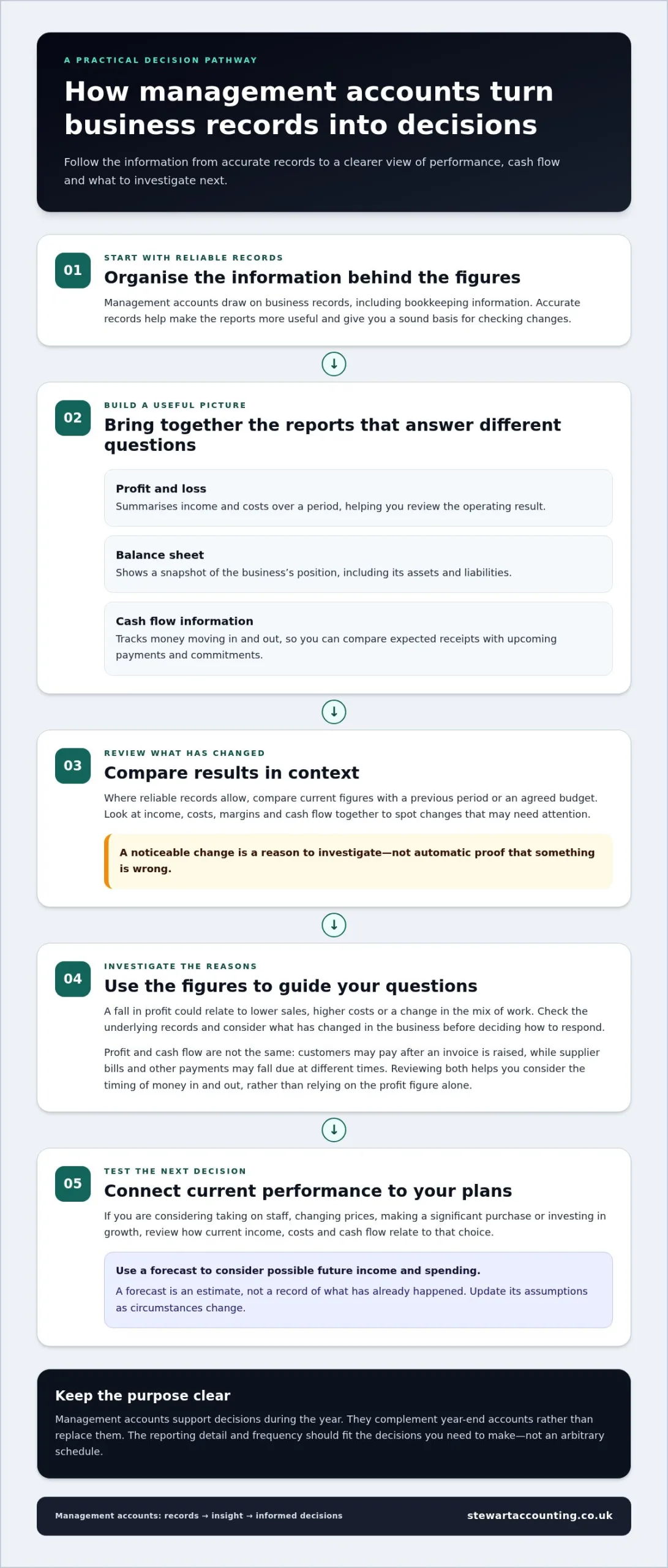
A profit and loss report summarises income and costs over a period. It helps you review the operating result and consider which activities contribute to it. A balance sheet is a snapshot of the business’s position, including its assets and liabilities. Cash flow information tracks money moving in and out, helping you compare expected receipts with upcoming payments and other commitments.
When do management accounts add value between year ends?
They can help you review changing margins, investigate rising costs or assess whether a significant purchase fits your plans. The right reporting frequency depends on the decisions you need to make and the arrangements for your business. The aim is to receive useful information in time to inform a decision, not to produce reports on an arbitrary schedule.
Year-end accounts have a separate reporting purpose. For a clear explanation of that process, read our year-end accounts guide for UK small businesses. Stewart Accounting Services can connect management accounts with bookkeeping and cash flow forecasts, helping you build a clearer view of performance and take financial tasks off your hands.
How can management accounts help you make better SME decisions?
Management accounts are most useful when they help answer a practical question: do your current plans fit what the business is earning and spending? Reviewing income alongside costs can show what contributes to profit and where a change may be worth investigating. A fall in profit, for example, could relate to lower sales, higher costs or a change in the mix of work. The figures point you towards questions, but may not explain the cause on their own.
Timely, accurate financial information helps you make better-informed decisions by showing how your business is performing and where to look more closely. It can give you a firmer basis for choices about staffing, spending, pricing or growth, while leaving room to weigh other business factors. The Chartered Institute of Management Accountants describes management accounting as information that supports planning and decision-making.
What can management accounts reveal about profit and cash flow?
Profit and cash flow answer different questions. Profit summarises income and costs over a period, but it does not necessarily show how much cash is in the bank at that moment. Customers may pay after an invoice is raised, while supplier bills and other payments may fall due at different times. Reviewing cash flow alongside profit helps you plan around these timings instead of relying on the profit figure alone.
Where reliable records allow, compare current figures with a previous period or an agreed budget. A noticeable change in income or costs is a reason to investigate, not automatic proof that something is wrong. Check the underlying records and consider what has changed in the business before deciding how to respond.
How can reports support planning and business growth?
Use actual results to test the assumptions behind your plans. If you are considering taking on staff, changing prices or investing in growth, review how current income, costs and cash flow relate to that decision. A forecast helps you consider possible future income and spending, but it is an estimate, not a record of what has already happened. Update the assumptions as circumstances change.
For forward planning, Stewart Accounting Services can connect management accounts with cash flow forecasts and business planning support. To discuss what information could help with a decision in your business, find out about management accounts for SMEs Falkirk businesses can use.
How should you compare management accounts support for a Falkirk SME?
Start with the decisions you want the figures to support. Are you trying to understand which parts of the business are profitable, keep a closer eye on costs or plan a change? That gives you a practical basis for deciding what information would help, rather than choosing a report simply because it looks detailed.
Look for management accounts support that makes the figures understandable and relevant to your priorities. Consider whether explanations are in plain English, whether you have room to raise questions and whether the reports focus on information you can act on. The approach should fit your business, not leave you unsure what to do with accounting terminology.
Do you need management accounts, bookkeeping, or both?
Bookkeeping keeps financial records organised. Management accounts use that information to help you interpret performance and consider decisions. The services have different purposes but work together: if records are incomplete or inaccurate, reports based on them may be less useful. Stewart Accounting Services provides bookkeeping alongside management accounts, helping you address both the records and the insight you need.
Year-end accounts have a separate reporting role. They do not replace internal management information, and management accounts do not replace year-end accounts. When discussing support, explain which tasks you currently manage and where you need help, so the relationship between record-keeping, reporting and year-end work is clear.
What makes financial reporting useful rather than just detailed?
A useful report helps you answer a business question. Clarify who will use it and what decisions they need to make. For example, if you are reviewing spending, clear information about costs may be most useful. If you are planning a change, you may need figures that help you assess its likely effect on the business. Relevant measures and plain-English explanations are often more helpful than extra detail without context.
Also consider how you will access and discuss the information. Cloud accounting platforms can make financial records easier to view digitally, while clear communication helps turn figures into understanding. Stewart Accounting Services offers Xero training and support to help businesses use the platform.
Before agreeing the format of management accounts, describe the questions you want the reporting to help answer. That conversation can shape support around your priorities and make it easier to use the information with confidence.
What should you prepare before arranging management accounts support?
You do not need perfect records or a complete list of reports to get started. A clear business question is a useful first step. Then gather the information you already have, note any gaps and discuss an approach suited to your business.
Try this simple sequence:
- Define the decision. Identify what you need to understand or plan.
- Gather available information. This might include bookkeeping records, business bank information or an existing cash flow forecast.
- Note any gaps. Flag records that are missing or difficult to interpret.
- Set priorities for support. Discuss a practical approach based on your business and the information available.
Which business questions should you bring to an initial discussion?
Choose the priorities that matter most right now. You might want a clearer view of cash flow, understand what is affecting profitability, review costs or consider a planned investment. Think about who will use the information, too. You may need it to guide your decisions or explain plans to other people involved in the business. You do not need to request every possible report. A few clear questions help keep the discussion focused.
What records can help start the conversation?
If available, recent bookkeeping information, relevant business bank details and existing forecasts can help explain your current position and plans. The information needed depends on your business and circumstances, so treat these as examples rather than a fixed checklist. Stewart Accounting Services can discuss what would be useful and how management accounts might fit with other accounting support, including year-end accounts support.
If your records are incomplete, be open about what is missing. That gives you a practical starting point for discussing what can be prepared from the information available and whether your record-keeping needs attention first. You can also read more about what to expect from a chartered accountant in Scotland as you consider professional support.
To discuss the questions you want your financial information to answer, read more about management accounts support.
Where can Falkirk SMEs get management accounts support?
Stewart Accounting Services is a firm of Chartered Accountants with an office in Falkirk, supporting SMEs with management accounts and related accounting and business services. Useful management accounts reflect what you need to understand, the information available and your business priorities.
Management accounts can sit alongside bookkeeping, cash flow forecasts and business advisory support. Bookkeeping helps maintain financial records, while management accounts help you make sense of the figures. A cash flow forecast helps you consider expected money coming in and going out. Business advisory support connects financial information with the decisions you are weighing up. The right combination depends on your circumstances, rather than a fixed package or reporting schedule.
How can local accounting support take financial tasks off your hands?
Working with an accountant on related financial tasks can reduce the bookkeeping and reporting you need to manage yourself, while giving you support to interpret the information. A clear working relationship also helps you understand where to turn with questions about the figures or your next steps. The aim is practical support, not another layer of work.
Stewart Accounting Services has offices in Falkirk, Alloa and Stirling, providing a regional option for local SMEs. With appropriate financial tasks taken off your hands, you can focus more on running your business and working towards more time, more money, more mind.
What is a sensible next step for your business?
Before discussing support, note what reporting you have now and what you want to improve. You might want clearer insight into costs, a better view of cash flow or useful information to support a planned business decision. You do not need every answer or perfect records. Sharing your current position and priorities gives the discussion a practical starting point.
An initial discussion is an opportunity to explain how your business works, what information you already have and where you need more clarity. Stewart Accounting Services can discuss management accounts and related support in light of your needs and available information, recognising that each SME has different priorities.
For more detail on management accounts support for your Falkirk business, visit Stewart Accounting Services.
Make your next business decision with greater clarity
Management accounts are most useful when they turn accurate records into information you can act on. They complement year-end accounts by helping you review performance between year ends, consider cash flow and explore questions about costs, profitability or future plans. The right support should focus on your priorities and explain the figures in a way that makes sense to you.
Before arranging support, note the decisions you want to make and gather the financial information you already have. You do not need every answer in advance. A conversation can help you identify a practical starting point and the support that may suit your business.
Stewart Accounting Services is a firm of Chartered Accountants with an office in Falkirk. Its stated credentials include CPA and ICB, and it provides a free Employment and Health & Safety Support Service Helpline. With suitable financial tasks taken off your hands, you can focus on running your business and working towards more time, more money, more mind.
Ready to discuss management accounts for SMEs Falkirk businesses can use to support informed decisions? Contact Stewart Accounting Services to discuss management accounts for your Falkirk SME.
Frequently Asked Questions
What are management accounts for an SME?
Management accounts are internal financial reports that help you review how your business is performing and make informed decisions. They use financial records to show areas such as income, costs, profit and cash flow. The most useful information depends on what you need to understand. For example, you might review spending, compare performance with a previous period or support a business plan.
Are management accounts the same as year-end accounts?
No. Management accounts help you monitor performance and make decisions during the year. Year-end accounts provide an annual record for reporting purposes and, for companies, form part of their statutory reporting obligations. They serve different purposes, so one does not replace the other. Management information helps you track performance between year ends, while year-end accounts provide the formal annual picture.
How often should an SME prepare management accounts?
There is no single reporting frequency that suits every SME. It depends on your business, the decisions you need to make and the arrangements for preparing the information. You may want reports often enough to monitor a changing position, while a more stable business may have different needs. Agree an approach that is practical and useful for the decisions you need to make.
What should management accounts include?
The content should reflect your business priorities and the quality of your records, rather than follow a fixed list for every company. Reports might include profit and loss information, a balance sheet or cash flow information. Together, these can help you review income and costs, understand assets and liabilities, and consider money moving in and out. Ask for clear explanations of the figures that matter to your decisions.
Are management accounts worth it for a small business?
They can be valuable if you need clearer information to guide decisions between year ends. For example, reviewing income, costs and cash flow may help you investigate a change in performance or assess a planned expense. Their value depends on reliable underlying records and using the information to inform real decisions. If reports would add detail without helping you act, discuss a simpler approach that fits your priorities.
Can a Falkirk accountant prepare management accounts for my SME?
Yes. Stewart Accounting Services is a firm of Chartered Accountants with an office in Falkirk and offers management accounts to SMEs. The reporting approach should suit your business and the information available. Stewart Accounting Services can also discuss how management accounts work alongside bookkeeping, cash flow forecasts and business advisory support.
Do I need bookkeeping before getting management accounts?
You need financial records that provide a sound basis for useful management accounts, but your bookkeeping does not have to be perfect before you start a discussion. Bookkeeping keeps business transactions organised; management accounts use financial information to help you understand performance. If records are incomplete or unclear, explain this when discussing support. Stewart Accounting Services can review what information is available and whether bookkeeping support would help prepare for useful reporting.
Recent Posts
30 Sep, 2026