

Management Accounts Definition: A Guide for UK SMEs 2026
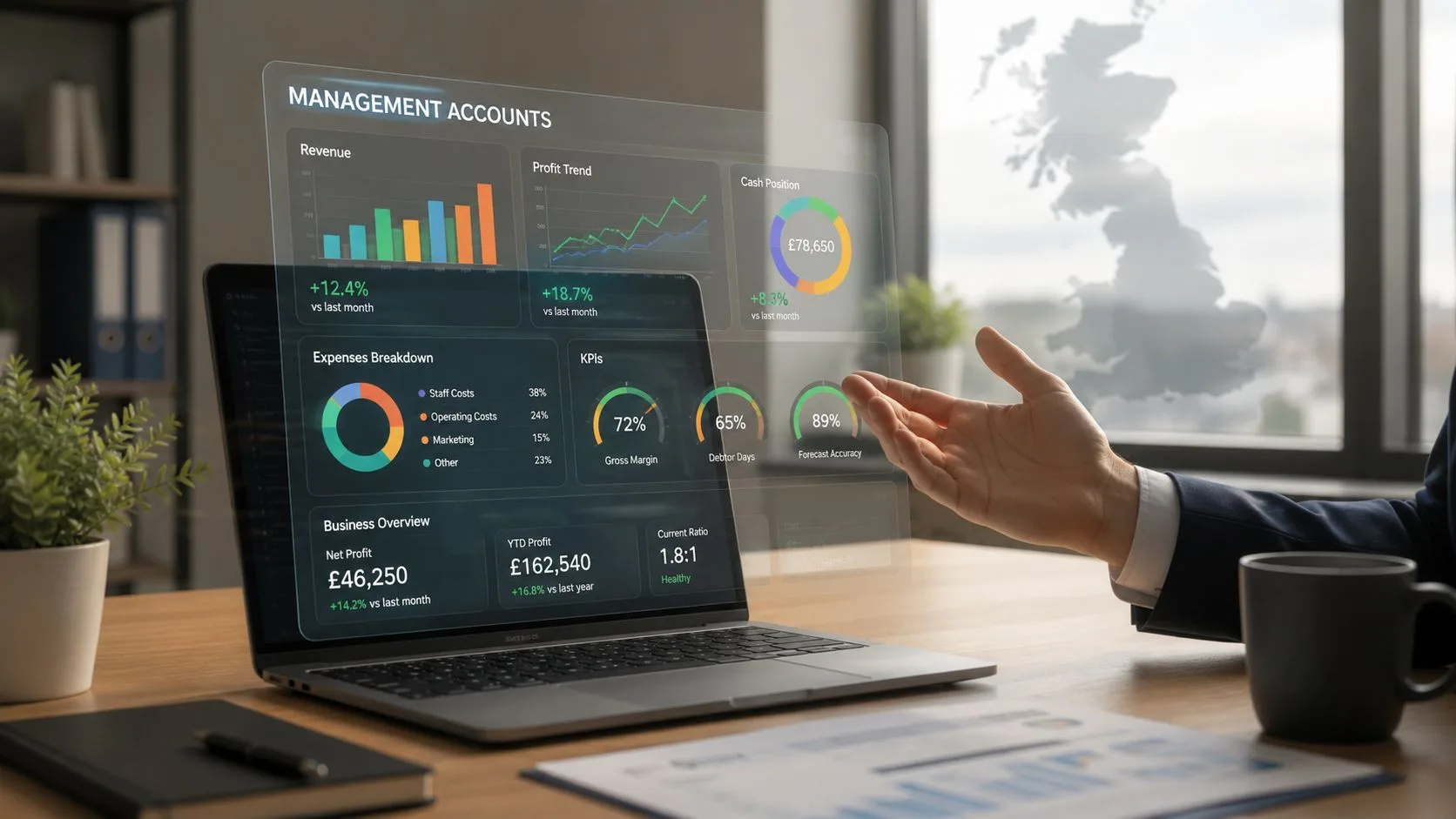
Management accounts are internal financial reports created regularly, usually monthly or quarterly, to help business owners make informed, real-time decisions. They're not a legal requirement in the UK, but they give you a much more useful view of the business than waiting for year-end accounts.
If you're running a growing SME, you've probably had this moment. Your year-end accounts arrive, they're accurate, and they tell you what happened. The problem is that what happened was months ago. They don't tell you whether margins slipped last month, whether cash is tightening now, or whether a hiring decision still makes sense this quarter.
That's where the management accounts definition becomes practical, not academic. Think of statutory accounts as the rear-view mirror. Useful, necessary, and legally important. Management accounts are the dashboard. They help you steer.
What Are Management Accounts Exactly
A simple management accounts definition is this: they are internal reports prepared for the owner or leadership team to monitor business performance and support decisions. Unlike year-end accounts, they're built for running the business, not just reporting on it after the fact.
For most SMEs, a management accounts pack brings together the numbers you need to answer questions such as:
- Are we making money this month?
- Is cash keeping pace with sales?
- Which costs are drifting off budget?
- Are the key parts of the business performing as expected?
The format is flexible. That matters more than many owners realise. Management accounts aren't governed in the same way as statutory accounts, so the business can decide what goes in them, how detailed they are, and how often they're produced. That flexibility is one reason they're so valuable for owner-managed companies.
Why owners search for this in the first place
Those looking up the management accounts definition aren't after a textbook answer. They're trying to solve a frustration.
You might be profitable on paper but constantly short of cash. You might feel turnover is growing but can't see whether gross profit is keeping up. Or you might have reports from software already, but they don't help you decide what to do next.
A proper management accounts pack turns raw bookkeeping into something decision-ready. If you want a broader explanation of how internal reporting works in practice, this guide on what management reporting means for SMEs is a useful companion.
Management accounts matter because business decisions can't wait until the year is over.
What they are not
They are not just a printout from Xero or another system. They are not a compliance exercise. And they are not useful merely because they contain numbers.
Useful management accounts explain performance. They show movement, context, and exceptions. They help you spot what needs attention before it becomes a bigger problem.
Beyond the Definition A Look at Purpose and Cadence
The purpose of management accounts is simple. They help you run the business while the business is moving.

If you're driving to a new destination, you don't stare only in the rear-view mirror. You look at speed, fuel, warning lights, and directions. A business works the same way. Historical accounts show where you've been. Management accounts help you judge what's happening now and whether you need to adjust.
Who they are for
These reports are for internal use. Typically that means:
- Owners and directors who need to make commercial decisions
- Managers responsible for budgets or team performance
- Advisers helping interpret trends and risks
That internal focus changes how the reports should be built. They should answer operational questions, not just accounting ones.
How often they should be produced
Cadence matters because slow reporting weakens decision-making.
UK guidance discussed by Price & Accountants notes that management accounts are commonly produced monthly or quarterly, and cites a government good practice guide stating they should be available within 15 working days or less of month-end for effective budget control and reliable forecasting. You can read that context in their article on management accounts for UK SMEs.
For a growing SME, monthly is usually the sweet spot. It's frequent enough to catch issues early, but not so constant that reporting becomes noise.
What good cadence makes possible
Regular reporting helps you:
- Spot problems sooner before a margin issue or cost increase becomes embedded
- Compare actuals to plan instead of relying on instinct
- Hold managers accountable with the same numbers each period
- Track progress properly when you track the right KPIs for growth
Practical rule: If your reports arrive so late that the month feels old, they're already losing value.
A quarterly pack can still help, especially for simpler businesses. But the more moving parts you have, the more often you need the dashboard in front of you.
Management Accounts vs Statutory Accounts
Many owners mix these up because both involve financial statements. They aren't the same tool.
Statutory accounts exist because the law requires them for limited companies. Management accounts exist because running a business well requires current information. One is a formal filing obligation. The other is an internal control system.
Management Accounts vs. Statutory Accounts at a Glance
| Feature | Management Accounts | Statutory Accounts |
|---|---|---|
| Legal requirement | Not a legal requirement in the UK | Must be filed for limited companies |
| Main audience | Owners, directors, managers | Companies House, HMRC, external stakeholders |
| Frequency | Usually produced during the year as needed by the business | Prepared annually |
| Content | Tailored internal reports, often including KPIs and budget comparisons | Formal year-end financial statements |
| Purpose | Support decisions, monitor performance, manage risk | Meet legal and tax reporting obligations |
The practical difference
Statutory accounts are standardised. They look backwards. They summarise a completed financial period and support compliance.
Management accounts are flexible. You decide the level of detail. You decide which departments, product lines, properties, contracts, or cost centres need visibility. You can include commentary, budget variances, and operational measures that matter to your business.
That's why the management accounts definition has to include purpose, not just format. If a report doesn't help you decide whether to recruit, spend, pause, price differently, or chase cash faster, it isn't doing the job.
Why both matter
This isn't an either-or choice.
- Statutory accounts keep the business compliant.
- Management accounts keep the business informed.
One common mistake is assuming that because year-end accounts are accurate, they are enough. They aren't. They may be completely correct and still be too late to help with current decisions.
Another mistake is treating management accounts as informal and therefore optional in practice. Legally optional, yes. Operationally, that's a different question. For a business trying to grow without losing control, they become part of the discipline of management.
Core Components and Essential KPIs to Track
A useful management accounts pack doesn't need to be bloated. It needs to be readable and relevant.
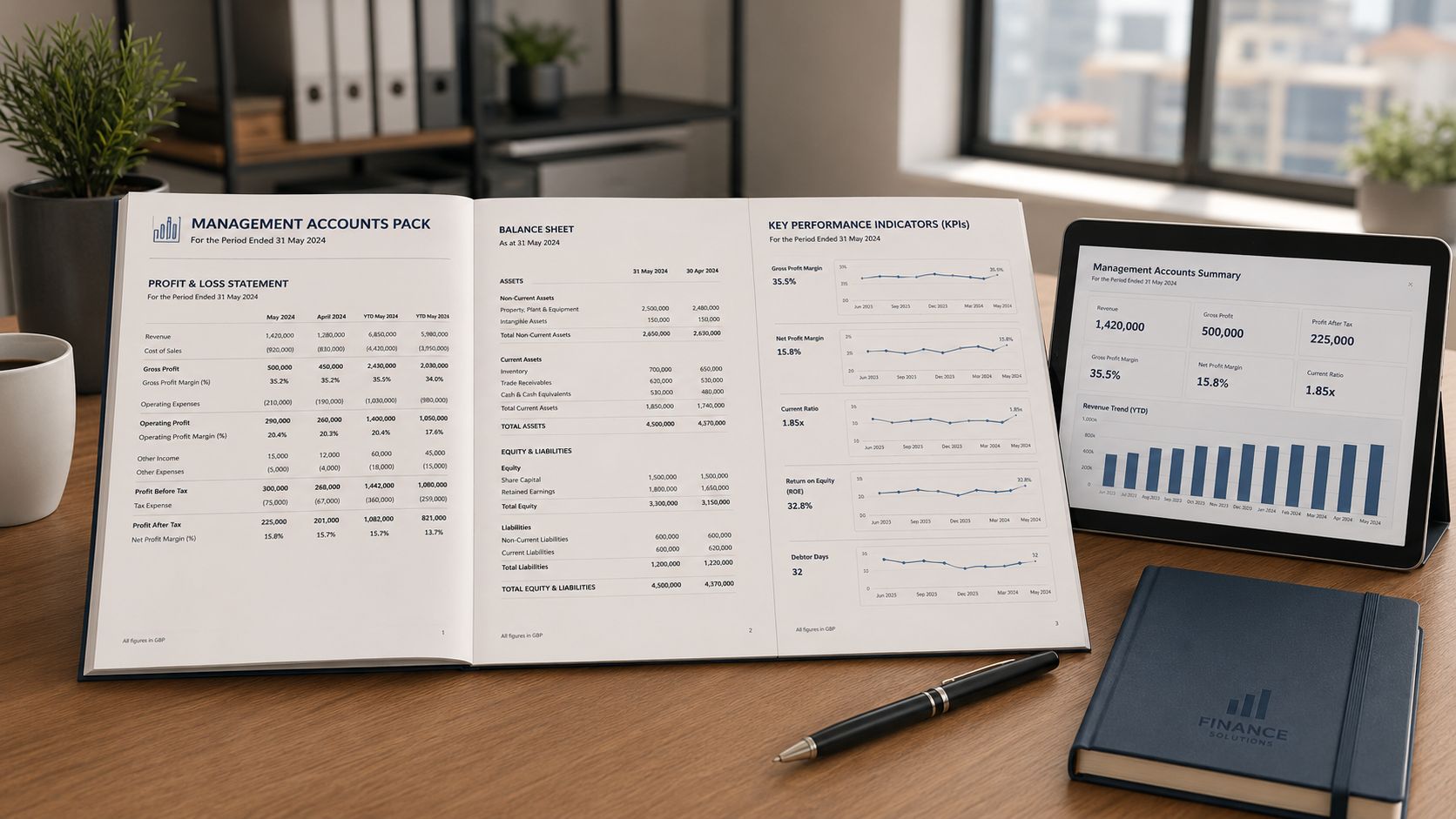
At the core, most packs include three financial reports. Then they add KPIs and commentary that explain what the numbers mean.
The three reports most owners need
Profit and Loss
Your Profit and Loss account shows income, direct costs, overheads, and profit over a period.
This answers questions like:
- Are sales rising or falling?
- Is gross profit holding up?
- Have overheads increased faster than expected?
A P&L is often the first page owners look at. That's sensible, but it's not enough on its own.
Balance Sheet
The Balance Sheet is a snapshot of what the business owns, what it owes, and what remains.
This often reveals issues the P&L hides. A profitable business can still have weak working capital, overdue debtors, or growing liabilities. Owners who ignore the balance sheet sometimes get an unpleasant surprise when cash gets tight.
Cash Flow view
A cash flow report helps you understand where cash is coming from and where it's going.
That matters because profit and cash are not the same thing. You can win work, invoice clients, and still struggle if payments are slow or costs hit before receipts arrive.
What makes the pack actionable
Bracey's explains that actionable management accounts should include budget comparisons and KPIs, and that they are retrospective, analysing monthly or quarterly performance, while forecasts are prospective, predicting future revenue and costs. Their explanation of what makes management accounts actionable is particularly useful on this point.
That distinction clears up a very common confusion. Management accounts tell you what happened. Forecasts use that information, plus assumptions, to model what may happen next.
Historical reporting helps you see the road you've travelled. Forecasting helps you judge the bend ahead.
KPIs that usually matter to a growing SME
Good KPIs depend on the business model, but common examples include:
- Gross profit margin to see whether pricing and direct costs still work
- Debtor days to show how quickly customers pay
- Cash balance trend to monitor resilience
- Revenue by service line or customer type to expose concentration or opportunity
- Customer acquisition cost if you're investing in growth
- Customer lifetime value if repeat revenue is a major driver
The key is not to cram in every metric the software can produce. Choose the few that directly influence decisions. This guide to four critically important KPIs for SMEs is a helpful starting point if you're unsure where to focus.
Variance analysis is where insight begins
Variance analysis means comparing actual performance against budget, forecast, or a prior period and asking why the gap exists.
For example:
- Sales are on target, but gross profit is down. Are supplier costs up, or are discounts creeping in?
- Payroll rose. Was that planned recruitment, overtime, or poor rota control?
- Cash dipped despite good sales. Are invoices being paid later?
That's where management accounts become a management tool rather than a reporting ritual.
A short explainer can help if you want to see this in a more visual format:
The True Benefits and Why Most Reports Fail
When management accounts work, owners usually feel three things.
First, they gain time because decisions are quicker and less reactive. Second, they often make better commercial choices because the numbers show where the business is earning, leaking, or stalling. Third, they get a clearer mind because uncertainty reduces when the picture is current.
That's the upside. The harder truth is that many report packs never deliver it.
Why reports become useless
A4G LLP puts the core problem plainly. Management accounts “will only be as accurate as the data entered into them.” Their article on why management accounts become ineffective is worth reading because it gets to the core issue quickly.
If bookkeeping is late, miscategorised, incomplete, or unreconciled, the reports won't guide anything well. They may look polished. They may arrive on schedule. They may still be wrong in the ways that matter.
The data integrity gap in growing businesses
At this stage, many SMEs get caught out.
At an earlier stage, owners can often spot errors by instinct because they're close to every transaction. As the business grows, that becomes harder. Work is delegated. Bookkeeping is outsourced or split across staff. More systems are involved. More invoices, suppliers, payroll movements, and cost centres flow through the ledger.
Then the reports start to drift away from reality.
Typical warning signs include:
- Sales look healthy but cash feels strained
- Margins vary but nobody can explain why
- Balance sheet figures are ignored because trust is low
- Owners rely on bank balance alone instead of the report pack
If you don't trust the inputs, you won't trust the outputs. And if you don't trust the outputs, the reports stop influencing decisions.
For owners trying to scale, that's dangerous. Better reporting isn't just about seeing more numbers. It's about seeing numbers you can act on with confidence.
If you want a useful primer on the mindset behind understanding real-time reporting, it helps frame why timeliness and quality have to work together. There's also a practical discussion of management accounts benefits for SMEs if you want to connect the reporting process to day-to-day business decisions.
Get Actionable Insights with Stewart Accounting
The way to make management accounts useful is straightforward, even if it takes discipline.
Start with clean bookkeeping. Keep records current. Reconcile key balances. Decide which KPIs drive decisions. Then build a monthly reporting pack around those needs, not around whatever default report the software offers.
What a practical setup looks like
A sensible process usually includes:
- Cloud bookkeeping kept current using tools such as Xero and connected apps
- A consistent monthly close so the same checks happen each period
- Customized reporting packs built around the owner's priorities
- Review commentary that explains exceptions, not just totals
- A separate forecast model for forward planning
That combination addresses the biggest weakness in many SMEs. It closes the gap between data entry and decision-making.
One option for implementation
For businesses that want outside support, Stewart Accounting Services offers management accounts as part of a broader cloud accounting setup, using Xero and compatible apps to turn bookkeeping data into regular internal reports. The main value in that kind of arrangement is practical: better data discipline, reporting built around the business, and fewer decisions made from incomplete information.
The important point isn't the provider. It's the method. Good management accounts come from a repeatable system, not a once-a-quarter rush to print reports.
Your Management Accounts Questions Answered
Can I create management accounts myself using Xero or similar software
Yes, you can. Software can produce the raw reports quickly. The challenge is accuracy, structure, and interpretation. If the bookkeeping isn't clean, the outputs won't be reliable. And if nobody adds commentary, variance analysis, or KPI context, you'll still be left doing the hard thinking alone.
How much does it cost to outsource management accounts
It depends on the complexity of the business, the quality of the existing bookkeeping, and the level of analysis you need. A simple service business needs a different pack from a company with stock, projects, payroll complexity, or multiple income streams. The core question is whether better reporting helps you avoid poor decisions and act sooner.
How quickly can we get started
That depends on how organised the current records are. If bookkeeping is current and systems are already cloud-based, setup is faster. If records need tidying first, that usually comes before meaningful reporting. In practice, the quickest route is to agree the reporting format, fix the ledger foundations, and then start producing the same pack on a regular monthly cycle.
If your year-end accounts tell you where the business has been, management accounts help you decide where it goes next. That's the operative management accounts definition in practice. Not just reports, but a working dashboard for better decisions.