

How Does VAT for Small Business in the UK Work in 2026?

What if reaching the £90,000 turnover mark felt like a celebrated milestone instead of a looming administrative headache? For many entrepreneurs, the reality of managing VAT for small business UK involves a constant background noise of anxiety over HMRC penalties and the complexity of quarterly returns. You want to focus on growth, yet it’s easy to feel stuck worrying if you’ve applied the correct 20% standard rate or if a 5% reduced rate applies to your newest service.
It’s understandable to feel that the weight of tax compliance is pulling you away from your core goals. This guide provides a clear, expert breakdown of registration rules, current 2026 rates, and digital compliance to help you navigate these waters with confidence. We’ll explain the £90,000 threshold and help you identify which VAT scheme will best protect your cash flow. Our goal is to show you how professional delegation can liberate your time, finances, and mental well-being, ensuring your business continues to thrive without the stress of complex tax calculations.
Key Takeaways
- Understand the £90,000 registration threshold and why the rolling 12-month rule is more critical than your financial year-end.
- Learn how to manage VAT for small business UK through Making Tax Digital (MTD) using compatible software to avoid HMRC penalties.
- Differentiate between standard, reduced, and zero rates to ensure your invoicing and VAT reclaims are consistently accurate.
- Evaluate which VAT accounting scheme is best suited to support your cash flow while reducing your overall administrative burden.
- Discover how transferring the responsibility of VAT returns to a specialist can protect your mental well-being and free up your time.
What is VAT and Why Does it Matter for Your Business?
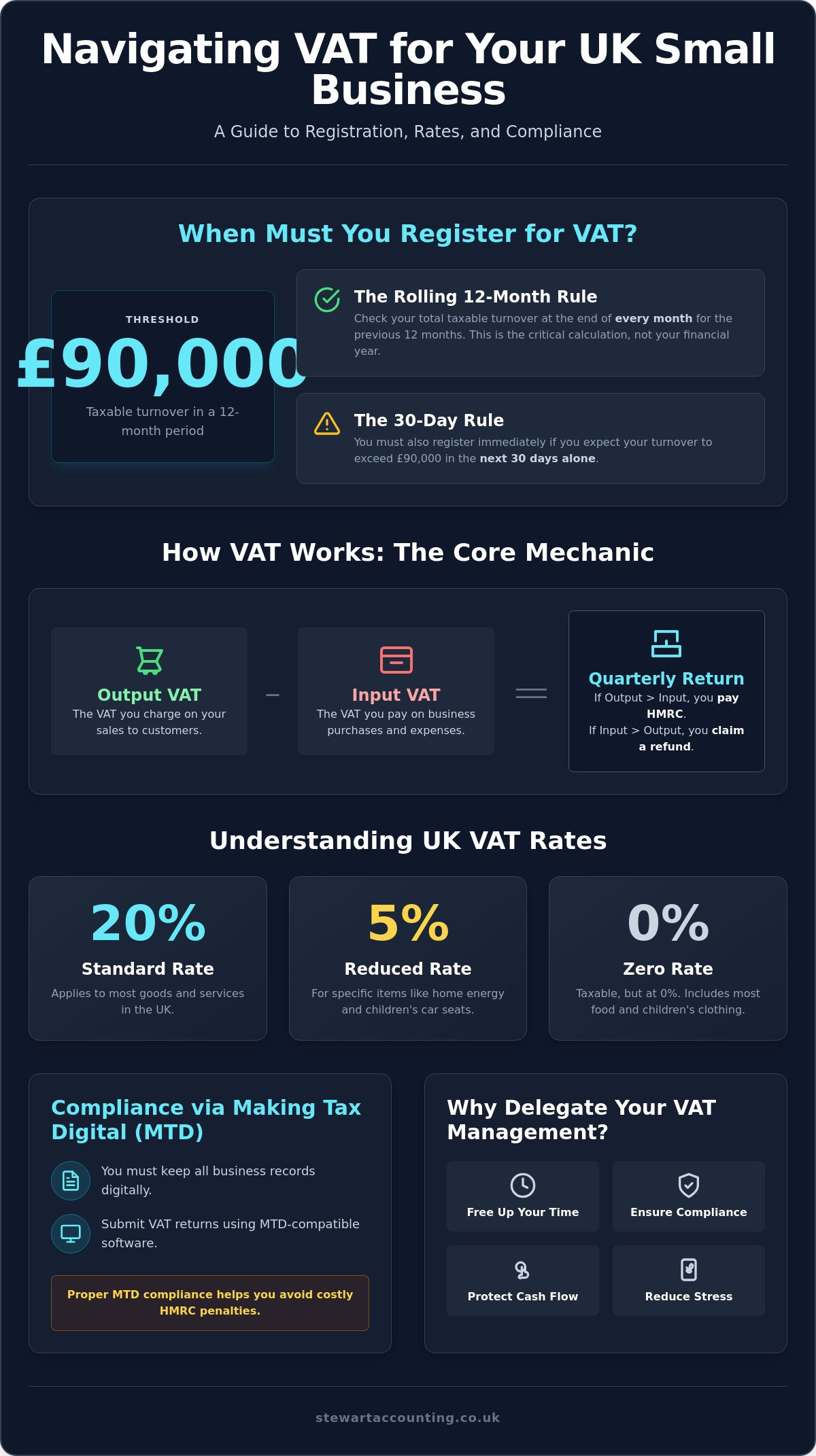
VAT, or Value Added Tax, is a consumption tax charged on most goods and services in the UK. When you register your company, you effectively become an unpaid tax collector for HMRC. You add this tax, usually at the standard 20% rate, to your invoices and then pass it on to the government. A deeper look at the history of Value-added tax in the United Kingdom shows it has evolved into a cornerstone of the national tax system. For most growing entrepreneurs, it’s a mandatory part of scaling.
It’s vital to distinguish between your total profit and your “taxable turnover.” Your turnover is the total value of everything you sell that isn’t exempt from VAT. You might have a high turnover but low profit, yet HMRC only looks at the turnover figure when deciding if you must register. Managing VAT for small business UK requires a clear eye on these gross sales figures to avoid missing legal deadlines and incurring unnecessary penalties.
To better understand this concept, watch this helpful video:
While VAT is often seen as a burden, it’s technically designed to be “neutral” for your business. You charge it to customers, but you also get to claim back the VAT you pay to your own suppliers. The only person who truly “pays” the tax is the final consumer who cannot reclaim it. By delegating these complex calculations to a specialist, you remove the administrative burden from your daily routine and restore your professional liberty.
The Mechanics of Input and Output Tax
There are two main components to your quarterly return. Output VAT is the tax you’ve charged on your sales. Input VAT is the tax you’ve paid on business-related purchases, such as stock, equipment, or utility bills. Every three months, you calculate the difference. If your output tax is higher than your input tax, you pay the difference to HMRC. If you’ve paid more out than you’ve collected, you can usually claim a refund.
How VAT Affects Your Business Cash Flow
Understanding the nuances of VAT for small business UK isn’t just about compliance; it’s about protecting your cash flow. One of the biggest traps for new owners is the “VAT windfall” effect. Because you collect tax throughout the quarter, your bank balance looks healthier than it actually is. It’s easy to accidentally spend that money on stock or wages, only to face a stressful scramble when the HMRC bill arrives.
Maintaining professional bookkeeping services is the most effective way to manage this risk. By tracking your liabilities in real-time, you always know exactly how much of your bank balance belongs to you and how much is reserved for the taxman. This clarity provides a sense of relief and allows for much smoother financial planning, protecting your time, finances, and mental well-being.
When Do You Need to Register for VAT?
Deciding when to register for VAT often feels like a high-stakes guessing game. For 2026, the mandatory threshold for VAT registration stays at £90,000. It’s not a simple calculation based on your financial year, though. HMRC uses a “rolling 12-month” rule. This means at the end of every month, you must check your total taxable turnover for the previous 12 months. If that figure crosses £90,000, you have 30 days to notify HMRC.
There is another trigger to watch for. If you realize that your turnover will exceed £90,000 in the next 30 days alone, you must register immediately. Missing these windows can lead to backdated tax bills and penalties that eat into your hard-earned profits. It’s a heavy administrative burden to track this manually while trying to run a business. For a full look at the requirements, the official government guidance on VAT registration provides the underlying legal framework. Managing VAT for small business UK becomes much simpler when you delegate the monitoring to a professional partner.
The Mandatory Registration Threshold Explained
The £90,000 threshold for 2026 is the highest in the OECD, giving micro-businesses plenty of room to grow before tax duties kick in. Monitoring this monthly is non-negotiable. Whether you manage limited companies or operate as a sole trader, the threshold applies to your total taxable sales. If you’re approaching this limit, getting a professional assessment can help you plan for the transition without the usual stress.
Should You Register Voluntarily?
Many owners choose to register before they’re legally required to. This is often a smart move if you’ve invested heavily in start-up costs or expensive equipment. By registering early, you can reclaim the VAT paid on those purchases, putting cash back into your bank account. Key benefits include:
- Input Tax Reclaims: You can recover the VAT paid on business purchases, which improves your cash flow.
- Brand Reputation: Registration can make your firm look larger and more established to B2B clients.
- Early Compliance: You avoid the last-minute scramble and potential penalties of mandatory registration.
Understanding VAT Rates and Special Accounting Schemes
Applying the correct tax rate is a fundamental part of managing VAT for small business UK. Most goods and services fall under the standard 20% rate, but many owners find themselves confused by the alternatives. For instance, a reduced rate of 5% applies to domestic fuel and children’s car seats. In 2026, it’s also vital to track temporary changes. Between June 25 and September 1, 2026, a specific 5% rate applies to certain children’s meals and admission to family attractions, theatres, and cinemas. Missing these windows can lead to overpaying tax or facing corrections from HMRC.
You also need to understand the difference between zero-rated and exempt items. While both result in 0% tax for the customer, they affect your business differently. Zero-rated sales, such as most food and children’s clothing, still count toward your £90,000 registration threshold. More importantly, you can still reclaim the VAT you’ve paid on costs related to these sales. Exempt sales, like certain insurance or health services, don’t count toward your threshold and don’t allow you to reclaim any related input tax. This distinction is a common source of anxiety, but getting it right ensures your returns are both legal and optimized.
Standard, Reduced, and Zero-Rated Goods
Correctly displaying these rates on your invoices is non-negotiable. If you sell products across different categories, your invoices must clearly show the VAT rate for each line item. Many entrepreneurs struggle with “mixed” supplies, where a single price covers items with different rates. This is where professional VAT return services become invaluable. We ensure every penny is accounted for correctly, removing the administrative burden from your shoulders and providing the mental peace you need to focus on growth.
Flat Rate and Cash Accounting Schemes
Choosing the right accounting scheme can significantly improve your cash flow. The Flat Rate Scheme allows you to pay a fixed percentage of your gross turnover to HMRC. While you can’t usually reclaim VAT on purchases, the reduced paperwork saves hours of time. This is often a great fit for businesses with very low expenses.
Alternatively, the Cash Accounting Scheme is a lifeline for firms that suffer from late-paying clients. Under this scheme, you only pay VAT to HMRC when your customer has actually paid you. It prevents the stress of paying tax on money you haven’t received yet. If your turnover is under £1.35 million, this scheme is likely available to you. We help you analyze these options to find the most pragmatic solution for your specific needs, focusing on resource optimization and stress reduction.
Staying Compliant with Making Tax Digital (MTD)
How do you stay on the right side of HMRC while the rules keep shifting? Making Tax Digital (MTD) is no longer a future goal; it’s the current standard for everyone managing VAT for small business UK. If you’re registered, you must keep your records digitally and use software that communicates directly with HMRC. This shift has rendered manual spreadsheets and paper ledgers obsolete for compliance purposes. It’s not just about VAT, either. The landscape is changing with HMRC MTD income tax changes in 2026, which will require similar digital reporting for self-employed individuals with a gross income over £50,000.
Digital Record Keeping Requirements
HMRC defines a digital record as a digital copy of your business transactions, but the “digital link” rule is where many owners get tripped up. You can’t simply copy and paste data from one file to another; the transfer between your bookkeeping records and the HMRC portal must be automated. Our online accounting services simplify this by using tools like Xero to capture data from receipts and bank feeds automatically. This creates a seamless audit trail, reducing the complexities of VAT for small business UK while protecting you from human error.
Filing Your Quarterly VAT Returns
Filing your return involves submitting a standard 9-box summary that details your sales, purchases, and the total tax due. The deadline is strict: you have one month and seven days after the end of your quarterly period to file and pay. Submission day doesn’t have to be a source of panic if you follow a structured approach:
- Sync your bank feeds: Ensure all transactions are pulled into your software daily.
- Review categorisations: Check that your expenses are assigned the correct VAT rate.
- Reconcile accounts: Match every bank transaction to a corresponding invoice or receipt.
- Verify the 9-box summary: Perform a final check for any obvious anomalies or missing data.
- Direct submission: Use your software’s API to send the data straight to HMRC in seconds.
Transitioning from manual habits to a fully digital system is a pragmatic step toward resource optimization. By delegating the setup and management of these digital accounts to a specialist, you ensure total compliance without the mental drain of learning complex software. If you’re worried about meeting the upcoming 2026 deadlines, contact us today for a digital readiness review. We help you bridge the gap between old bookkeeping habits and modern requirements, effectively restoring your professional liberty.
How Stewart Accounting Services Simplifies Your VAT Obligations
Managing VAT for small business UK shouldn’t be a source of constant dread. While previous sections have outlined the technical thresholds and digital requirements for 2026, the real secret to successful tax management is delegation. We physically remove the administrative weight from your shoulders, allowing you to focus on what you do best. Stewart Accounting Services builds our approach around a core promise: the liberation of your time, your finances, and your mental well-being. This “Thematic Triad” ensures that tax compliance becomes a silent, efficient background process rather than a quarterly crisis.
Whether you are operating as sole traders or managing a group of limited companies, our Chartered Accountants provide the high-level expertise you need. We don’t just file forms; we act as a dependable partner for small and medium-sized enterprises across Central Scotland. Having local experts at Stewart Accounting Services in Stirling, Alloa, or Falkirk means you have accessible, community-based support whenever you need a pragmatic solution to a real-world business challenge.
Expert VAT Support in Central Scotland
Our team provides personalised advice that accounts for your specific industry and regional context. We handle all direct correspondence with HMRC on your behalf, so you never have to worry about interpreting complex letters or missing a deadline. This total delegation includes ensuring your VAT data flows smoothly into your year end accounts. By aligning these processes, we optimize your resources and reduce the overall complexity of your financial life.
Integrating VAT with Your Bookkeeping
A seamless digital link is the only way to stay compliant with MTD rules in 2026. Stewart Accounting Services specialises in setting up modern tools that automate the collection of data, ensuring your records are always accurate and up to date. If you’re new to digital tools, we offer Xero training and support to help you understand your numbers without the stress of managing the software yourself. This practical approach ensures that your VAT for small business UK obligations are met with smoothness and ease.
You deserve to run your business with a sense of relief, knowing that your tax obligations are managed professionally. Don’t let the fear of HMRC penalties or administrative burdens hold you back from achieving your long-term objectives. Contact us today for a free VAT consultation and take the first step toward reclaiming your professional liberty.
Secure Your Business Growth with Expert VAT Management
Navigating VAT doesn’t have to be a solo struggle that keeps you awake at night. We’ve explored how the £90,000 threshold operates on a rolling basis and why digital compliance is now the non-negotiable standard for everyone managing VAT for small business UK. Choosing the right accounting scheme is a pragmatic step that protects your cash flow and reduces administrative friction. Getting these foundations right today ensures you’re prepared for the continued rollout of HMRC’s digital initiatives.
As Chartered Accountants with offices in Alloa, Stirling, and Falkirk, we provide the reassuring, local expertise you need to stay ahead of complex requirements. We specialise in Making Tax Digital (MTD) compliance, ensuring your transition to digital record-keeping is smooth and error-free. Let us handle your VAT returns so you can focus on growing your business. By delegating these complex tasks to a trusted partner, you reclaim your time, your finances, and your mental well-being. Your business is ready for the next level; let’s ensure your tax strategy is too.
Frequently Asked Questions
What is the current VAT threshold for UK small businesses in 2026?
The current VAT registration threshold for 2026 is £90,000. This limit applies to your taxable turnover over any rolling 12-month period, which means you must monitor your sales every month rather than waiting for your year-end. If your turnover drops, the threshold for deregistration is currently £88,000.
Can I reclaim VAT on items bought before I registered?
You can usually reclaim VAT on business-related goods and services purchased before your registration date. HMRC generally allows you to claim back tax for goods bought up to four years ago, provided you still have them in the business, and services purchased within the last six months. It’s vital to keep every receipt and invoice to support these historical claims.
What happens if I accidentally go over the VAT threshold?
You must notify HMRC within 30 days of the end of the month in which you crossed the £90,000 limit. If you miss this window, you may be liable for a late registration penalty and will have to pay the VAT due on all sales made since the date you should have been registered. This can be a significant financial hit, so monthly monitoring is essential for your mental peace.
Is it better to be on the Flat Rate Scheme or the Standard Scheme?
The best choice depends entirely on your business structure and your typical volume of expenses. The Flat Rate Scheme simplifies VAT for small business UK by letting you pay a fixed percentage of your turnover, which reduces your daily administrative burden. However, the Standard Scheme is often more pragmatic if you have high VAT-inclusive costs that you want to reclaim in full.
How do I pay my VAT bill to HMRC?
You must pay your VAT bill electronically using HMRC’s online portal or through your MTD-compatible accounting software. Most business owners prefer to set up a Direct Debit, which ensures payments are collected automatically and on time. This approach prevents late payment interest and helps you maintain a smooth, predictable cash flow.
Do I need to register for VAT if I only sell to customers outside the UK?
Yes, you may still need to register if your total sales of “taxable” supplies exceed £90,000, even if those sales are zero-rated for export. While you won’t charge VAT to your overseas customers, these transactions still count toward your mandatory registration limit. We help you navigate these international rules to ensure you stay compliant without unnecessary stress.
What are the penalties for filing a late VAT return?
HMRC uses a points-based system for late submissions and financial penalties for late payments. Every late return earns you a penalty point, and reaching a specific threshold triggers an immediate £200 fine. Interest is also charged daily on any unpaid tax, which can quickly become a heavy burden on your company’s finances.
Can an accountant file my VAT returns for me?
A Chartered Accountant can take full responsibility for your VAT filings, effectively removing the burden from your shoulders. Our team in Alloa, Stirling, and Falkirk manages the entire process for you, ensuring your VAT for small business UK obligations are handled with total professional accuracy. This delegation allows you to reclaim your time and focus on your long-term business objectives.
Recent Posts
21 Aug, 2026
21 Aug, 2026
20 Aug, 2026