

Year End Accounts: A Simple Guide for UK Small Businesses

For many small business owners, the phrase “year end accounts” can trigger a wave of stress and confusion. It often brings to mind piles of paperwork, confusing jargon, and the looming fear of deadlines and penalties. But it doesn’t have to be that way. Understanding your year end accounts is crucial for legal compliance and is also one of the most powerful tools you have for tracking the health and success of your business. This simple guide will walk you through exactly what they are, why they matter, and how you can prepare them without the headache.
What Are Year End Accounts? (And Why They’re More Than Just Paperwork)
In simple terms, your year end accounts are your business’s annual financial report card. They provide a comprehensive summary of your company’s financial activity over its financial year. For all limited companies in the UK, preparing and filing these accounts is a legal requirement. While sole traders have different reporting obligations through their Self Assessment tax return, limited companies must file formal accounts with both Companies House and HMRC.
But thinking of them as just a compliance task is a missed opportunity. Beyond keeping you on the right side of the law, well-prepared accounts are essential for:
- Securing funding: Banks and investors will always ask to see your accounts before lending you money or investing in your business.
- Tracking performance: They show you exactly where your money is coming from and where it’s going, helping you identify what’s working and what isn’t.
- Planning for growth: By understanding your financial position, you can make smarter, data-driven decisions for the future.
Key Components of Year End Accounts, Explained Simply
While the full document can seem intimidating, it’s made up of a few key parts, each telling a different part of your financial story:
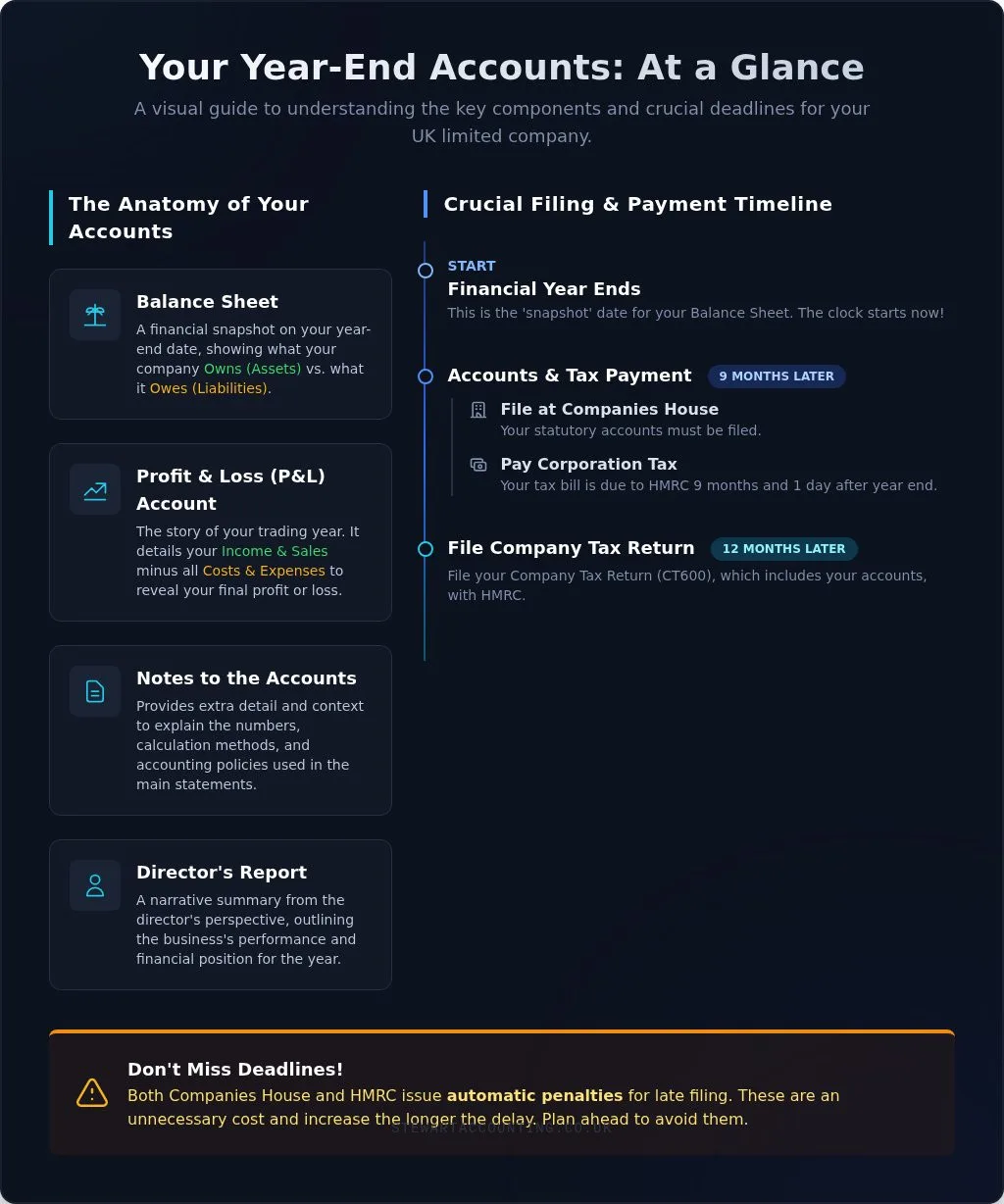
- The Balance Sheet: This is a snapshot of your business’s financial health on the last day of your financial year. It lists everything your company owns (assets) and everything it owes (liabilities).
- The Profit and Loss (P&L) Account: This tells the story of your trading over the year. It shows your company’s sales and income, deducts all your running costs and expenses, and reveals the profit or loss you made.
- Notes to the Accounts: These provide extra detail and context to the numbers in the main statements. For example, they might break down how you’ve calculated certain figures or explain your accounting policies.
- The Director’s Report: This is a summary of the year from the director’s perspective, often required for companies that aren’t ‘micro-entities’. It provides a narrative overview of the business’s performance and position.
The Year End Accounts Process: From Shoebox to Submission
The golden rule for a smooth year end is this: good bookkeeping makes everything easier. If you’ve kept your financial records organised throughout the year, the process of preparing your accounts becomes far more straightforward. The general process involves gathering all your financial records-bank statements, sales invoices, purchase receipts, and payroll data-and using them to compile the financial statements listed above.
Crucial Deadlines You Absolutely Cannot Miss
Forgetting a deadline can lead to automatic penalties, so it’s vital to have these dates in your calendar:
- Filing with Companies House: Your statutory accounts must be filed with Companies House 9 months after your company’s financial year ends.
- Filing with HMRC: Your Company Tax Return (which includes your accounts) is due 12 months after your accounting period. However, the deadline to pay your Corporation Tax bill is usually earlier-typically 9 months and one day after your year end.
- What happens if you file late? Both Companies House and HMRC issue automatic penalties for late filing, which increase the longer the delay. It’s an unnecessary cost that can be easily avoided with proper planning.
Do You Qualify for Simpler Accounts? (Micro-entity & Small Company Rules)
The good news for many small businesses is that you may not need to file a full, complex set of accounts. UK regulations allow smaller companies to submit simpler, or ‘abridged’, accounts. You may qualify as a ‘micro-entity’ or ‘small company’ if you meet at least two of the following criteria: a certain turnover, balance sheet total, or number of employees. Filing simpler accounts can save you a significant amount of time and administrative effort while ensuring you remain fully compliant.
DIY vs. Hiring a Chartered Accountant: Making the Right Choice
It is possible to prepare and file your own year end accounts, especially if your business is very small and has straightforward transactions. However, it’s important to weigh the pros and cons. The main risk of the DIY approach is making a mistake, which could lead to penalties from HMRC or an inaccurate view of your business’s performance. You could also miss out on valuable tax-saving opportunities that a professional would spot.
The value of a qualified accountant goes far beyond just filling in forms. They provide expert advice, ensure accuracy, and take the stress and time burden off your shoulders. If you find the process overwhelming, are growing your business, or simply want to ensure you’re as tax-efficient as possible, it’s time to call an expert.
How Stewart Accounting Services Takes the Stress Out of Year End
We believe your time is better spent running and growing your business, not worrying about complex accounting rules. Our team of Chartered Accountants is here to give you complete peace of mind.
- We ensure your accounts are prepared accurately and filed on time, every single time, so you never have to worry about a deadline again.
- Our experts review your finances to identify every opportunity to make your business more tax-efficient, saving you money.
- Most importantly, we give you back your time and peace of mind, allowing you to focus on what you do best. Ready for a stress-free year end? Talk to our team today.
Frequently Asked Questions
What is the difference between a financial year and a tax year?
A company’s financial year is the 12-month period it reports on, which can start in any month. The UK tax year for individuals runs from 6th April to 5th April, but the Corporation Tax year for companies runs from 1st April to 31st March.
How much does it cost to get an accountant to do my year end accounts?
The cost varies depending on the size and complexity of your business and the quality of your bookkeeping records. At Stewart Accounting Services, we offer fixed-fee packages so you always know the cost upfront. Contact us for a tailored quote.
Can I change my company’s financial year end?
Yes, you can change your company’s Accounting Reference Date (ARD), but there are specific rules about how and when you can do this. It’s best to speak to an accountant to ensure it’s done correctly.
What records do I need to keep for my year end accounts?
You must keep detailed records of all your business’s sales, purchases, expenses, and assets. This includes invoices, receipts, bank statements, and payroll information. By law, these records must be kept for at least 6 years.
Do I need an audit for my small company accounts?
Most small companies are exempt from needing a full statutory audit. You generally only need an audit if your company exceeds certain size thresholds for turnover, assets, and employees.
Preparing year end accounts is a vital part of running a limited company, but it shouldn’t be a source of anxiety. By understanding the basics and getting the right support, you can turn a legal obligation into a valuable business tool. If you’re ready to take the burden of compliance off your shoulders and gain clarity on your finances, we’re here to help. Let us handle your year end accounts for complete peace of mind. Get in touch for a free chat.
Recent Posts
09 Oct, 2026
09 Oct, 2026
08 Oct, 2026
07 Oct, 2026