

VAT Return Preparation: A Practical Guide for UK SMEs
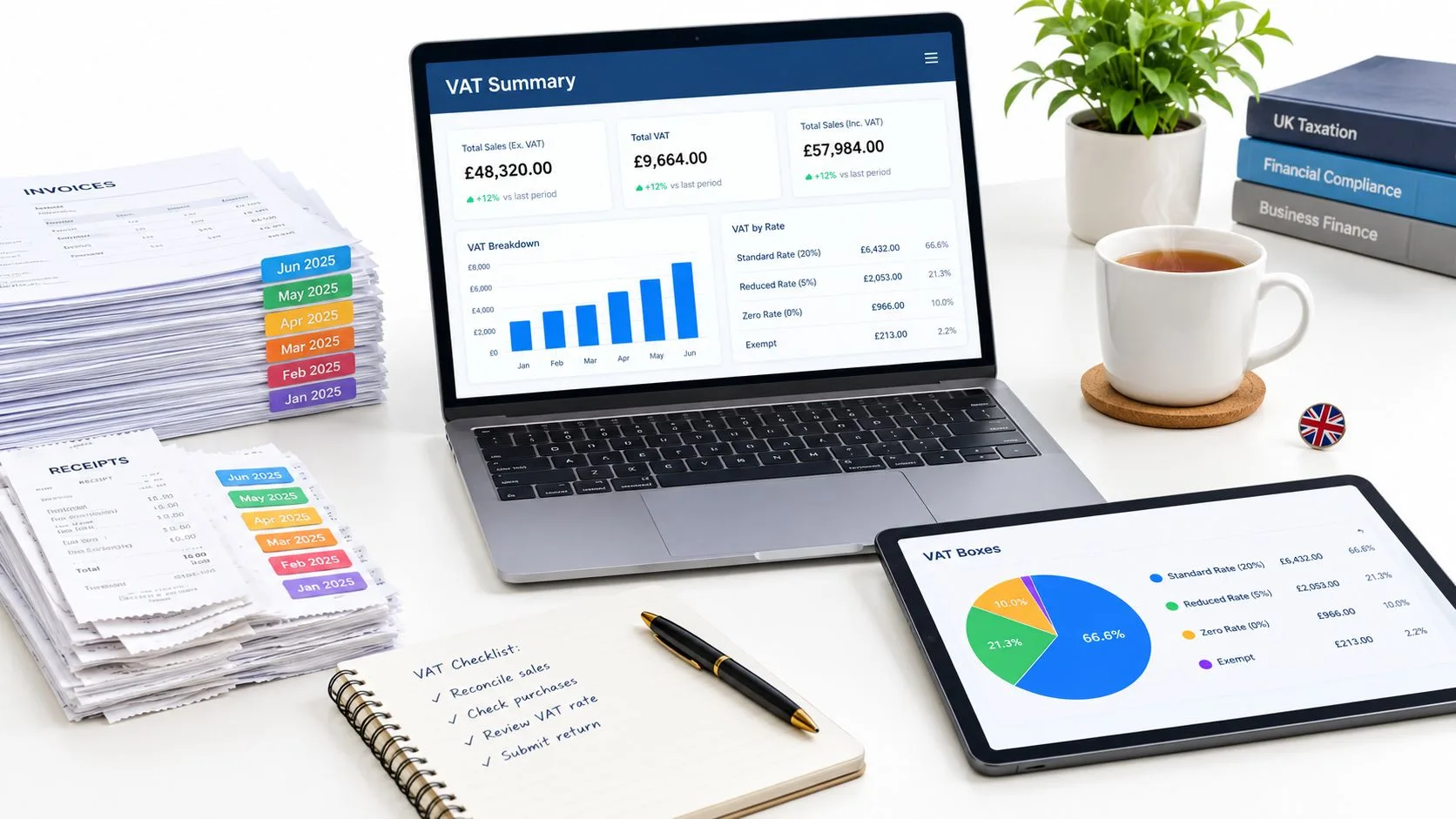
Two days before the VAT deadline, a small consultancy owner opens a spreadsheet they haven't touched since the last quarter. Receipts sit in a drawer, several supplier invoices are missing, the bank account hasn't been reconciled, and nobody can explain why the draft VAT figure is higher than expected. The return may still be filed, but the business owner is relying on guesswork rather than evidence.
That's the wrong way to approach VAT return preparation. A VAT return is the final output of a bookkeeping process that should run throughout the year. Treat it as a monthly operating discipline, and the quarterly submission becomes a review and approval exercise instead of a financial emergency.
The timing matters. Since 1 April 2024, a UK business must register for VAT when taxable turnover exceeds £90,000 in a rolling 12-month period, or when it expects to exceed that level in the next 30 days. HMRC also requires registration within 30 days of the end of the month in which the threshold is breached, so growing businesses can't afford to let records fall behind. HMRC's VAT registration guidance sets out the thresholds and registration deadlines.
Why VAT Return Preparation Is a Monthly Habit, Not a Quarterly Chore
A quarterly deadline can make three months of bookkeeping look like one task. It is not. The return depends on hundreds of decisions about sales, purchases, VAT codes, imports, expenses, credit notes and payments.
Run those checks monthly and the quarter becomes a review and approval exercise. Missing invoices are easier to find while transactions remain fresh, and unusual VAT movements can be investigated before they become a filing-day problem.
Practical rule: If you cannot explain this month's VAT movement, you are not ready to approve the quarter.
The three monthly controls that matter
Start with bank-feed reconciliation. Match each payment and receipt to the relevant invoice, bill or expense record. Put unmatched items on a review list, assign an owner and record the next action. An accounting-system balance that agrees with the bank does not prove the VAT records are right, but a discrepancy is an immediate warning.
Then categorise transactions according to their VAT treatment. Separate standard-rated, zero-rated, exempt and outside-the-scope items instead of applying a general expense code for convenience. Flag reverse-charge and import transactions for review. Software can automate recurring entries, but it cannot reliably determine the treatment of an unusual transaction without accurate configuration and informed review.
Finally, review aged debtors and creditors. Disputed, cancelled or doubtful customer invoices may need attention. Old supplier balances often expose missing bills, duplicated entries or unposted credit notes. This review also gives you a monthly explanation for movements that would otherwise surface only during quarter-end preparation.
Build the routine into the calendar
Assign responsibility for the monthly close, even when an accountant performs a later review. Set a fixed date, lock the bookkeeping period after approval and retain a concise evidence file with reconciliations, adjustments and unresolved questions. That discipline gives the quarter a clear audit trail rather than a rushed collection of corrections.
Use a clear guide to VAT payment dates to align the monthly close with the filing and payment timetable. The deadline should drive the routine, not initiate it.
Making Tax Digital supports this operating model. HMRC reported that, by 9 March 2020, more than 1.4 million businesses had joined the new VAT service and more than 4 million VAT returns had been submitted successfully using MTD-compatible software. HMRC's evaluation of the VAT service records the role of software-based filing in routine VAT compliance.
Choose software with the next obligation in mind. Some sole traders and landlords will need to use Making Tax Digital for Income Tax from 6 April 2026, so a VAT-registered business should confirm that its system supports both requirements. HMRC's software guidance for Making Tax Digital for Income Tax makes software selection part of compliance planning, not an afterthought.
Records and Reconciliations You Need Before You Start
Don't open the VAT return screen first. An accountant starts with the underlying records, because the return only reflects the quality of the bookkeeping behind it.
Begin with the sales ledger. Check every VAT invoice issued during the period, including zero-rated and exempt supplies. Flag reverse-charge sales, credit notes and CIS-related entries separately so they don't disappear inside a generic sales code. Confirm that the sales ledger agrees with the invoicing system and that cancelled invoices haven't been included.
Then examine purchases. Separate goods from services and identify domestic purchases, EU transactions, non-EU acquisitions and imports. Import VAT paid at the border, including entries dealt with through postponed VAT accounting, needs supporting customs evidence and the correct treatment in the accounting system.
Reconcile the VAT control accounts
Tie the VAT control accounts to the trial balance before drafting the return. For output VAT, add the VAT charged on valid taxable sales, remove credit-note adjustments, and investigate any manual journals. For input VAT, agree the claimed amount to supported purchase invoices and remove private, blocked or incorrectly coded expenditure.
A simple example makes the principle clear. Suppose the sales ledger shows output VAT of £12,000 after credit notes, while the VAT control account shows £12,450. Don't submit the higher figure because it “looks safer”. Find the £450 difference. It might be a duplicated invoice, a manual journal or a transaction coded into the wrong period.
Apply the same discipline to input VAT. If supported purchase records show £7,800 but the control account reports £8,100, investigate the £300 variance before claiming it. The reconciliation matters more than the software's draft total.
Box 6, which reports total sales excluding VAT, provides an important reasonableness check and feeds calculations such as partial exemption and flat-rate reviews. It should agree to the relevant sales records, with adjustments documented rather than hidden in a journal.
Keep working papers that another person can follow
Retain an aged debtor list, purchase day book, sales ledger, bank reconciliation and a digital-link evidence file. The file should show how source records moved into the VAT return and identify any adjustment made outside the normal transaction flow.
| VAT Box | What it reports | Source record | Reconciliation step |
|---|---|---|---|
| Box 1 | VAT due on sales and other outputs | Sales ledger and output VAT control account | Agree VAT charged, credit notes and reverse-charge adjustments |
| Box 4 | VAT reclaimed on purchases and other inputs | Purchase ledger and input VAT control account | Match claims to valid records and remove blocked or unsupported amounts |
| Box 5 | Net VAT to pay or reclaim | Boxes 1 and 4 | Recalculate the difference and compare it with the ledger balance |
| Box 6 | Total value of sales and other outputs, excluding VAT | Sales ledger and trial balance | Tie taxable, zero-rated, exempt and relevant outside-scope sales to the accounts |
| Box 7 | Total value of purchases and other inputs, excluding VAT | Purchase ledger and trial balance | Agree domestic purchases, imports and adjustments to source records |
A daily or regular bank reconciliation process for small businesses keeps these working papers much easier to produce. Reconciliation is not a separate bookkeeping luxury. It is the control that makes the VAT return defensible.
Choosing the Right VAT Accounting Scheme for Your Business
The right scheme depends on your customers, margins, input VAT and cash collection pattern. Don't choose a scheme because its name sounds simpler.
Standard accounting is the default for businesses that need to recover meaningful input VAT or deal with varied transactions. You account for VAT based on invoices and recover eligible input VAT according to the normal rules. It creates more coding and reconciliation work, but it gives the clearest picture when the business has substantial purchases, imports, stock or mixed supplies.
Flat Rate can suit a low-overhead service business with limited VATable costs. You charge VAT to customers but pay HMRC using the scheme's sector percentage, while input VAT recovery is restricted. It isn't automatically cheaper, and a business should model its actual numbers before joining. Leaving the scheme also carries a 12-month restriction before rejoining, so switching casually is poor planning.
Cash Accounting aligns VAT payments with money received and VAT recovery with money paid. That can help a cash-strapped B2B trader with slow-paying customers, but it changes the timing of both output and input VAT and requires careful control of unpaid invoices. It also affects how bad debts are handled, so don't adopt it without checking the consequences for your customer base. Businesses generally need to treat entry and exit as a deliberate decision, not a monthly experiment.
Annual Accounting reduces the frequency of formal returns but doesn't remove the need for accurate monthly records. It only works when cash flow is stable and the business can budget for payments without relying on each quarter's exact VAT result.
The Margin Scheme is a specialist option for eligible second-hand goods and similar transactions. It calculates VAT on the margin rather than the full selling price, so it should be considered only where the goods and records meet the relevant conditions.
| Scheme | Eligibility | Cash-flow impact | Best for |
|---|---|---|---|
| Standard | Businesses using normal VAT accounting | VAT timing follows invoices and eligible purchase claims | Businesses with significant input VAT, stock or varied transactions |
| Flat Rate | Businesses meeting the scheme conditions and sector rules | Can simplify payments, but input VAT recovery is limited | Low-overhead service businesses |
| Cash Accounting | Businesses meeting the scheme conditions | Delays output VAT until customer payment is received | Traders with slow-paying customers and tight cash flow |
| Annual Accounting | Businesses meeting the scheme conditions and able to budget | Smooths payments but reduces short-term visibility of the final position | Stable businesses with predictable cash flow |
| Margin Scheme | Eligible dealers in qualifying goods | VAT applies to the margin rather than the full selling price | Second-hand goods businesses with suitable records |
If taxable turnover has fallen below the registration threshold, voluntary registration needs a commercial reason. Keep it when customers expect VAT invoices or the input VAT recovery is valuable. Otherwise, deregistration can simplify the books, but review stock, assets and final-return consequences first.
Preparing and Submitting Returns Under Making Tax Digital
A VAT return should be the output of a controlled monthly close, not a rushed quarterly exercise. Under Making Tax Digital, a VAT-registered business must keep digital records and submit through MTD-compatible software. Figures must pass through a digital link from the underlying records into the return, rather than being typed into HMRC's form by hand.
Choose software with both obligations in mind. Your bookkeeping system should handle bank feeds, invoices, bills, VAT codes, adjustments and the submission connection. If your business will fall within MTD for Income Tax from 6 April 2026, confirm that the same system has a credible route for that requirement. Software that solves VAT today but forces a second system tomorrow creates duplicate work and more opportunities for errors.

A practical Xero workflow
In Xero or similar software, finish the bookkeeping before opening the VAT dashboard. Reconcile bank feeds, post missing sales and purchase invoices, review VAT codes, and clear suspense or uncategorised transactions.
Use this sequence:
- Close the period: Lock the bookkeeping date after completing the review.
- Review the VAT dashboard: Check the tax basis, period dates and unusual movements.
- Draft the return: Compare every box with the reconciled ledger and prior working papers.
- Investigate exceptions: Examine imports, reverse charges, partial exemption adjustments and credit notes.
- Submit through the HMRC connection: Approve the return only after a second-person review where the business has enough complexity to justify it.
- Save evidence: Retain the submission confirmation, draft review and adjustment notes.
The rules for Making Tax Digital for VAT are easier to apply when the process forms part of the monthly close, with clear ownership and a documented review.
Check the digital link
A digital link may use an API connection between systems, an import from a compatible file, a CSV transfer or bridging software. The test is whether figures move electronically and whether you can demonstrate their route from source records to submitted return.
- Source records: Identify the ledger, invoices, bank feeds and import evidence supporting each box.
- Transfer method: Record whether the data moved through an API, export, CSV or bridging file.
- Adjustments: Document permitted calculations and show how they changed the totals.
- Software status: Confirm that the filing tool supports MTD for VAT and assess its planned support for MTD for Income Tax.
- Evidence file: Keep the draft return, reconciliation and submission confirmation together.
Manual workarounds increase compliance and accuracy risk. They also make a future system change harder because the business cannot show how the figures were assembled. Build the digital trail into the monthly routine, then the quarterly submission becomes a controlled approval rather than a reconstruction exercise.
Common VAT Return Errors and How to Prevent Them
A VAT return can look tidy while containing a material error. One duplicated purchase, a private expense, a missed import or an unreconciled adjustment is enough to distort the figures. These failures usually reflect a broken monthly process, not a lack of awareness that VAT exists.
A deadline reminder will not correct weak records. Assign a control to each recurring error and complete it before the return reaches approval.
Match each error to a control
Wrong box mapping usually comes from an incorrect VAT code or an unreviewed manual journal. Review unusual sales, imports, reverse charges and credit notes at transaction level. Then reconcile every affected box to the ledger.
VAT-inclusive and VAT-exclusive figures become confused when staff move between invoices, spreadsheets and accounting software. State the basis used on every working paper. Before entering any total, confirm whether it includes VAT.
Private expenditure and unsupported input VAT belong outside the claim unless the business purpose and evidence are clear. Require the invoice or receipt, record why the cost is business-related and challenge any claim that fails the evidence test.
Flat Rate and Cash Accounting errors arise when a scheme is treated as a shortcut rather than a set of operating rules. Use a scheme-specific checklist and verify that transaction timing and VAT recovery follow the scheme selected.
Late filing often signals incomplete records or unresolved queries. Automated VAT reporting commentary links late and incorrect returns with manual re-keying, failed reconciliations, missing invoices and box-level mistakes. The discussion of automated VAT reporting supports a practical conclusion: reduce manual handling, but keep a human review of the final figures.
| Common Error | Root Cause | Preventive Control |
|---|---|---|
| Incorrect box mapping | Wrong VAT code or unexplained journal | Review unusual transactions and reconcile each affected box |
| Duplicate invoice | Manual entry alongside an imported transaction | Check invoice sequences and assign clear ownership of data entry |
| Missed import VAT | Customs records not connected to bookkeeping | Reconcile import documentation to the purchase ledger |
| Private expense claimed | No review of expense purpose | Require evidence and remove private items before filing |
| Wrong scheme treatment | Scheme selected without an operating checklist | Document scheme rules and review timing and recovery treatment |
| Late submission | Monthly bookkeeping left incomplete | Set a fixed close date and escalation process before filing |
Threshold monitoring needs its own monthly check. The VAT registration threshold is £90,000, and the deregistration threshold is £88,000, according to HMRC registration guidance. Compare taxable turnover with the relevant threshold throughout the year. Do not wait for year-end accounts to reveal that registration should have been considered.
International activity adds registration and documentation risk. If your business is expanding across borders, review common EU Inc registration mistakes and check that overseas transactions are coded consistently in the UK bookkeeping system. A monthly exception report should flag missing customs records, unfamiliar VAT treatments and transactions awaiting clarification before they reach the return.
When to Outsource VAT Return Preparation to an Accountant
Filing yourself is sensible when the business has straightforward books, a limited number of transactions and an owner who completes the monthly reconciliation. It stops being sensible when the owner spends each quarter arguing with spreadsheets, postponing customer work and trying to remember why a transaction was coded a certain way.
Outsource when the business has multiple sales channels, partial exemption, imports, reverse charges, international services or a growing payroll. Those features don't automatically require an accountant, but they do require stronger review controls than a simple one-bank-account consultancy usually needs.
The economic case is time and risk
The cost of professional support isn't just the fee. Compare it with the owner's recovered time, the cost of delayed decisions, the risk of an incorrect claim and the disruption caused by a late submission. A qualified reviewer can also identify recurring bookkeeping weaknesses, rather than correcting the same error every quarter.
A fixed-fee monthly package should be specific. Ask whether it includes bookkeeping review, VAT coding checks, return preparation, MTD submission, reconciliations, adjustment queries and a named contact. “VAT filing” alone may mean little more than pressing submit on figures you prepared yourself.
The right question isn't “Can I file this return?” It's “Can I produce reliable records every month without pulling myself away from the business?”
Stewart Accounting Services is one option for UK SMEs that want support with bookkeeping review, VAT return preparation and MTD-ready records. Its wider accounting service also covers bookkeeping, payroll, CIS, tax returns and business reporting, so the owner can assess whether a broader outsourced workflow makes more sense than buying isolated filing help.
For businesses with overseas suppliers, customers or expanding operations, guidance on domestic and international tax compliance provides useful context for the wider responsibilities that can sit alongside a UK VAT return.

Don't outsource because VAT sounds frightening. Outsource because the business has reached the point where reliable monthly controls are worth more than the owner's spare time.
Your Monthly VAT Preparation Checklist and Common Questions
Use this checklist at month-end, not the day before the return is due.
- Reconcile bank feeds: Clear matched, unmatched and duplicated transactions.
- Close sales and purchases: Confirm that invoices, bills, credit notes and expenses are posted to the correct period.
- Review VAT codes: Check standard-rated, zero-rated, exempt, outside-scope, reverse-charge and import entries.
- Post import VAT: Match customs and postponed VAT accounting records to the ledger.
- Check scheme adjustments: Review partial exemption, Flat Rate or Cash Accounting treatment where relevant.
- Confirm the digital link: Ensure source records connect electronically to the return and retain the evidence.
- Draft the return: Prepare the draft at month-end instead of storing unfinished bookkeeping until quarter-end.
- Run a sense check: Compare Box 1 with recent periods and investigate a movement you can't explain.
Questions owners ask
How quickly can I correct a VAT error?
Don't wait for the next deadline if the error is material or affects several periods. Preserve the original records, identify the cause, and ask your accountant or HMRC what correction route applies. The correct treatment depends on the nature and size of the error.
What triggers a default or late-filing consequence?
Missing the filing deadline, submitting incomplete information or failing to resolve a return that has been rejected can create compliance problems. A nil return still needs to be submitted when the VAT registration remains active. “Nothing happened” isn't a reason to skip the filing.
Can I reclaim input VAT without a VAT invoice?
Usually, you need adequate evidence that supports the claim. A bank transaction alone doesn't prove the supplier charged recoverable VAT or that the cost qualifies. Put unsupported items into a review queue rather than claiming them automatically.
What about a late customer invoice?
Post it according to the correct tax point and period, then document why it was included or excluded. Don't use the payment date as a substitute for understanding the transaction's VAT treatment.
How do bad debts affect VAT?
Review unpaid and irrecoverable customer debts under the rules that apply to your accounting scheme. Keep the invoice, collection history and adjustment evidence together, and get advice before changing a previous return.
International supplier checks should be part of the evidence process. For example, teams dealing with Greek suppliers can validate Greek VAT numbers before relying on the VAT treatment in their records.
VAT return preparation works when the business repeats the same controls every month. Reconcile the records, challenge unusual treatments, confirm the digital link and submit only after the figures can be explained.
If your VAT records currently depend on last-minute spreadsheets or incomplete reconciliations, contact Stewart Accounting Services to discuss a monthly bookkeeping and VAT return process. Ask for a review of your current software, VAT scheme, digital links and MTD for Income Tax readiness so your next return is prepared from organised records rather than reconstructed under pressure.
Recent Posts
09 Oct, 2026
09 Oct, 2026
08 Oct, 2026
07 Oct, 2026