

Terms of Business Explained for UK Accounting Clients

You've agreed to prepare a client's year-end accounts, only to discover that they also expect VAT advice, unlimited HMRC queries and a cash-flow meeting to be included. When the first additional invoice arrives, both sides feel disappointed. The client believes the work was implied, while the accountant believes the original scope was clear.
That situation is rarely caused by bad intentions. It usually comes from an incomplete conversation at the start of the relationship. Terms of business provide the shared rulebook. They set out what the accountant will do, what the client must provide, how fees are calculated, when payment is due and what happens if circumstances change.
This guide is for limited companies, sole traders, partnerships and landlords working with Stewart Accounting Services. It will help you read terms with confidence, identify points worth questioning and understand what acceptance means in practice. If you're also reviewing broader questions about choosing professional support, this guide on essential questions to ask an accountant for a small business can help you prepare.
The aim isn't to turn you into a solicitor. It's to help you see an accounting agreement as a practical management tool, much like using cloud software or working with specialist resources for accountants. Clear terms give you a better basis for planning, budgeting and making decisions before work begins.
Introduction to Terms of Business for Accounting Clients
A small company owner may assume that “annual accounts” includes every question connected with the business's finances. The accountant may mean the preparation and submission of statutory accounts and the company tax return, based on records supplied by an agreed date. Both descriptions sound reasonable until an urgent VAT query, payroll correction or HMRC letter appears.
Terms of business prevent that gap from becoming a dispute. They translate a general service promise into practical instructions. A good document answers questions such as:
- What's included: For example, bookkeeping, payroll, VAT returns, self-assessment or year-end accounts.
- What isn't included: Such as specialist tax planning, financial advice or work caused by incomplete records.
- Who acts: The firm, the client, directors, trustees, landlords or other authorised people.
- How payment works: The fee basis, invoice timing, payment method and treatment of overdue balances.
- What happens next: The process for queries, complaints, amendments, termination and handover.
This matters across different client types. A sole trader may need clarity about self-assessment records and allowable expenses. A landlord may need to understand which property information must be supplied. A limited company director may need to distinguish routine accounts work from advisory support. A partnership may need agreement about who can instruct the accountant and approve submissions.
Terms shouldn't be treated as a document to sign quickly and forget. Read them as you would read the instructions for a financial system that you're about to rely on. If a phrase feels broad, ask what it means in your situation. If a fee is described as “additional work”, ask which events could trigger it.
The rest of this guide builds that understanding gradually. You'll first see what terms of business are, then why they matter, how the main clauses work and how to move from receiving a document to accepting it with a clear record.
What Terms of Business Mean in an Accounting Relationship
Think of an accounting relationship as a journey. The proposal is the route suggested by the accountant. The engagement letter records the particular trip you've agreed to take. The terms of business are the operating manual, explaining how the relationship works when the journey includes routine work, delays, extra requests or a change in direction.
A proposal normally focuses on the commercial offer. It may summarise services and fees in a concise format. An engagement letter usually connects that offer to your circumstances, identifying the client, the agreed assignments and any specific arrangements. Terms of business provide the wider framework, including payment, responsibilities, confidentiality, complaints, liability, termination and applicable law.

The UK Small Business Commissioner describes a business contract as a clear agreement between two or more businesses. Its guidance recommends that even a basic contract identifies who is involved, what is being supplied, how much is being supplied, how long the arrangement lasts and how it ends. Those points map closely to the questions an accounting client should ask before work starts. You can also browse Professional Insurance Advisors terms to see how another professional services business presents contractual conditions.
Accounting firms use standard terms because many services repeat from one period to the next. Bookkeeping, payroll, VAT preparation and self-assessment each involve recurring tasks, deadlines and information supplied by the client. A standard framework helps the firm work consistently, while the engagement details adapt the framework to the particular client.
How the documents fit together
A useful way to separate the documents is:
- Proposal: The commercial summary, often including the services discussed and the proposed fee.
- Engagement letter: The client-specific appointment, including the assignments the accountant has accepted.
- Terms of business: The general rules governing the relationship, such as payment, responsibility, confidentiality and ending the appointment.
- Schedules or addenda: Additional detail for services such as payroll, VAT, CIS or cloud bookkeeping.
The documents should work together rather than contradict one another. If the proposal says monthly bookkeeping is included but the terms describe it as an optional service, ask which document controls the agreement.
The legal framework matters, but the practical objective is simple. Written terms make the service promise specific enough for both sides to understand their obligations. They're not designed to replace a conversation. They make that conversation easier to record and apply.
Why Clear Terms Matter Legally Commercially and Practically
Clear terms protect three connected parts of an accounting relationship. Legally, they define the agreed service and help manage risk. Commercially, they create a basis for predictable billing and scope control. Practically, they tell people what to do, when to do it and who owns each deadline.
The legal benefit isn't that a long document automatically makes every clause valid. A term still needs to be clear and suitable for the relationship. The UK government's guidance for customer contracts says consumer-facing terms should be fair and transparent, and shouldn't create a significant imbalance or hidden detriment. It also stresses drawing unusual or significant terms, price inclusions and cancellation rights to the customer's attention in a durable format, such as email, through its guidance on writing a fair contract for customers.
For business clients, written terms also help establish the boundaries of professional responsibility. They can explain whether the accountant relies on information supplied by the client, whether advice must be separately requested and how liability is treated. They can identify the relevant jurisdiction and explain how complaints should be raised before a disagreement escalates.

The commercial case
An accounting practice needs a reliable way to price recurring work and charge fairly for work outside the agreed assignment. A client needs to know whether the monthly fee covers routine processing, corrections, meetings, software support or advisory time. If the document explains the fee basis, both sides can make informed choices before extra work is undertaken.
Payment wording also supports cash-flow discipline. It should state when invoices are issued, how clients pay, what happens if an invoice is disputed and whether work can be paused when payment remains outstanding. That isn't aggressive. It gives both parties a process to follow instead of leaving a sensitive issue to informal messages.
A practical control: Terms of business are part of the operating system for your finance function, not paperwork kept in a drawer.
The practical difference
Good terms reduce avoidable questions. A client can see whether they must approve a VAT return, upload payroll changes by a particular point or notify the firm about a new director. The accountant can see whether a request falls within the appointment or needs a separate quote.
UK government research on unfair contract terms found that only two in five businesses reviewed their contract in the previous year, meaning 60% had not reviewed their contracts in the previous 12 months at the time of the study. The finding is reported in the UK government research on businesses' understanding of unfair terms. Regular review matters because services, software, people and trading arrangements change. An old document may no longer describe the relationship you're operating.
Essential Clauses Every Accounting Terms Document Should Include
The best terms of business are specific without becoming unreadable. They answer ordinary business questions in language that a director, sole trader or landlord can apply. If you want additional context, this overview of small business contract provisions offers another perspective on how provisions support commercial relationships.
Parties and scope
The document should identify the legal client and the accounting firm. For a company, that may include the company name and registration details. It should then describe the services precisely, such as preparation of year-end accounts, corporation tax work, bookkeeping, payroll, VAT returns, CIS or self-assessment.
Avoid descriptions such as “all accounting matters”. They sound helpful but create uncertainty. A clear scope states the work covered, the information required and any services that need a separate instruction.
Fees and payment
A fee clause should explain whether charges are fixed, recurring, hourly, based on complexity or subject to review. It should also cover VAT where applicable, billing dates, payment methods and the treatment of additional work.
Clients should look for the trigger that creates an extra charge. It might be a late records submission, an urgent deadline, a historic correction or a request outside the engagement. The wording should allow you to understand the likely consequence before authorising the work.
Responsibilities
Accounting work depends on information. The client normally needs to provide complete records, answer questions, approve returns and tell the firm about relevant changes. The firm's responsibilities may include preparing agreed submissions, communicating requests and explaining information it reasonably needs.
The clause should not imply that the accountant assumes responsibility for every business decision. It should distinguish preparing information from making management decisions, and compliance work from specialist advice.
Liability and limitations
A limitation clause explains how responsibility is allocated if something goes wrong. It may address reliance on client information, third-party software, missed instructions and the financial limit of liability, subject to applicable law.
Read this section carefully. A fair limitation should be understandable and shouldn't try to remove responsibility in circumstances where the law won't permit it. Ask for clarification if the wording seems wider than the service itself.
Confidentiality and data protection
Accounting firms handle financial and personal information. Terms should explain confidentiality, permitted disclosures, data processing responsibilities, security expectations and the use of subcontractors or software providers where relevant.
The wording should be practical. It may explain how documents are exchanged, who can authorise access and what happens when the relationship ends. Clients should know whether their information will be stored in a portal, accounting platform or other system.
Complaints and disputes
A complaints clause should give you a clear route for raising concerns. It may identify a contact, explain escalation and state how the firm will respond.
This process is valuable even when the relationship is healthy. A written route encourages early resolution and prevents a minor service issue becoming a formal dispute.
Termination and governing law
Termination wording should explain how either party can end the appointment, the notice required, immediate termination events and what happens to outstanding fees and client records.
The document should also identify the governing law and jurisdiction. UK businesses commonly use terms to establish which legal system applies, but the wording should match the parties and the service arrangement.
Clause comparison
| Clause | Purpose | What to Check |
|---|---|---|
| Parties and scope | Identifies the appointment and agreed work | Are the legal client and services accurate? |
| Fees and payment | Establishes billing and payment expectations | Can you identify fixed fees and extra-work triggers? |
| Responsibilities | Allocates information and approval duties | Who supplies records and approves submissions? |
| Liability | Explains how risk is managed | Are limits clear and connected to the service? |
| Confidentiality and data protection | Protects information and explains handling | How are records stored, shared and deleted? |
| Complaints | Provides an early resolution route | Is the contact and escalation process clear? |
| Termination | Explains how the relationship ends | What notice, handover and payment rules apply? |
| Governing law | Establishes the legal framework | Is the stated jurisdiction appropriate? |
Practical Examples and Sample Wording for SMEs
A vague clause can look harmless until a deadline arrives. The difference between weak and strong wording is usually not legal complexity. It's whether the reader can identify the task, the boundary and the next action.
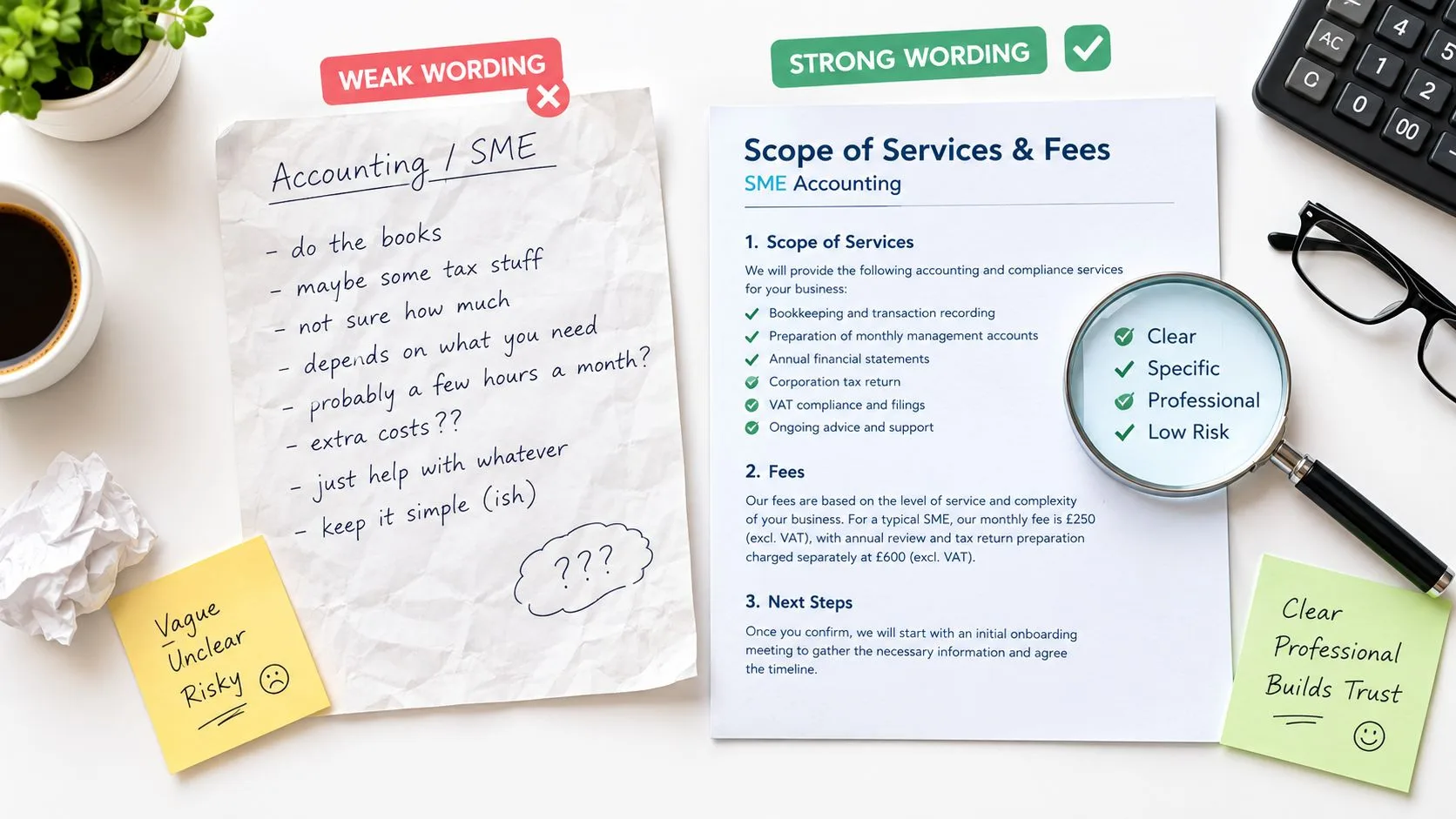
Scope for year-end accounts
Weak wording
We'll prepare your annual accounts and deal with your tax affairs.
This leaves several questions unanswered. Does “tax affairs” include corporation tax, VAT, director self-assessment, HMRC correspondence or tax planning?
Stronger wording
We'll prepare the company's annual accounts and corporation tax return using the accounting records and information you provide. VAT returns, payroll, personal tax returns, tax planning and responses to HMRC enquiries aren't included unless listed in the engagement schedule or separately agreed.
The stronger version doesn't promise less. It makes the appointment usable.
Fees for bookkeeping and Xero
Weak wording
Bookkeeping is charged monthly. Extra work may be charged.
A client can't tell what “bookkeeping” covers or when “extra work” begins.
Stronger wording
The monthly bookkeeping service covers processing the records made available through the agreed Xero access and reconciling the accounts using information supplied by you. Work involving historic corrections, missing records, new reporting requirements or urgent requests outside the agreed service will be discussed with you before it proceeds and may be charged separately.
This gives the client a chance to approve a cost before the work is done.
Responsibilities for payroll and CIS
Weak wording
You must provide payroll information on time.
Stronger wording
You'll provide approved hours, pay changes, starters, leavers and absence information through the agreed channel before each payroll processing date. We'll process the payroll based on the information received and provide the agreed reports. We can't accept responsibility for errors caused by late, incomplete or inaccurate instructions.
The wording connects the client's action to the firm's ability to deliver.
VAT returns
A VAT engagement should make the approval process visible. For example:
We'll prepare the VAT return from the records and VAT information supplied by you. You'll review and approve the return before submission, and you'll tell us promptly about unusual transactions, changes to VAT registration or correspondence from HMRC.
That clause doesn't transfer every VAT decision to the accountant. It creates a shared process.
How the wording adapts
A limited company may need director approval, Companies House filing work and corporation tax responsibilities. A sole trader's terms may focus on self-assessment, business records and personal tax information. A landlord's terms may need property income, finance costs, ownership changes and records for each property.
The wording should reflect those differences rather than forcing every client into an identical service description. Standard terms create consistency, while the engagement schedule creates relevance.
How Stewart Accounting Services Presents and Agrees Terms
Terms work best when acceptance is treated as a short workflow, not a signature hunt. The firm should provide the document before substantive work begins, alongside the proposal or engagement information, so the client has time to read the commercial and operational rules.

A durable format matters. An email attachment or client portal record gives both sides something they can retain and revisit. The message accompanying the document should draw attention to practical points, including the service scope, fee basis, client deadlines and termination arrangements, rather than assuming the client will find every important detail unaided.
A low-stress acceptance workflow
- Receive the documents: Check that the proposal, engagement letter, terms and any service schedule are all present.
- Read the scope first: Confirm that the described work matches what you discussed, including VAT, payroll, CIS, bookkeeping, accounts and tax returns.
- Check the money: Identify the fee basis, invoice timing, payment method and circumstances that may create additional charges.
- Confirm responsibilities: Note which records you must provide, who approves submissions and how urgent queries are handled.
- Ask questions in writing: If a phrase is unclear, send a focused question and keep the response with the agreement.
- Agree amendments formally: Don't rely on a verbal promise that a clause “won't apply”. Ask for the engagement document or schedule to be updated.
- Record acceptance: Complete the stated acceptance method and retain the final version, including any agreed changes.
Before signing, use this checklist:
- Scope: Are included and excluded services clear?
- Fees: Do you understand routine and additional charges?
- Information: Do you know what records and approvals are required?
- Data: Is the handling of financial and personal information explained?
- Deadlines: Is responsibility for client and HMRC-related actions clear?
- Termination: Do you understand notice, outstanding fees and handover?
- Complaints: Do you know who to contact if something goes wrong?
If you're changing firms, the same discipline helps. Review the current agreement for notice periods, fee calculations and outstanding charges, then follow a documented handover process such as the one described in how to switch accountants smoothly.
Final Checklist and Next Steps With Your Accountant
Terms of business are easier to understand when you stop viewing them as fine print. They're a mutual protection document and a practical operating manual for the work you're paying for.
Before accepting any agreement, confirm:
- The appointment: The correct legal parties are named.
- The service: Accounts, tax, VAT, payroll, CIS, bookkeeping or self-assessment work is described accurately.
- The boundaries: Exclusions and additional-work triggers are visible.
- The payment: Fees, billing dates and payment arrangements make sense.
- The responsibilities: You know what information and approvals you must provide.
- The risk: Liability, confidentiality and data handling are understandable.
- The exit: Notice, handover, records and outstanding invoices are explained.
- The questions: Anything uncertain has been answered or amended in writing.
A clear agreement gives you more than legal protection. It gives you more time, because fewer tasks fall into an unclear middle ground. It gives you more control over money, because the fee basis and scope are visible. It gives you a clearer mind, because you know who is responsible for the next action.
If you're moving between firms, professional clearance may also form part of the transition. Understanding what a professional clearance letter is for accountants can help you prepare the information needed for an orderly change.
Speak with Stewart Accounting Services about your terms of business and accounting requirements across Alloa, Stirling, Falkirk and remotely throughout the UK. Bring your current agreement, list the services you need and ask for the scope, fees, responsibilities and exit arrangements to be explained in plain English before you proceed.
Recent Posts
06 Oct, 2026
04 Oct, 2026
1 comment