

Need Tax Advice for Consultants in Bonnybridge?

What if the tax decisions causing you uncertainty depend less on your consultancy work and more on how you trade? If you’re unsure which tax responsibilities apply, what records to keep or when a filing is due, you’re not alone. The right tax advice for consultants in Bonnybridge starts with understanding your business structure, income and circumstances, rather than applying a one-size-fits-all approach.
Whether you work as a sole trader or through a limited company, getting clear on your tax responsibilities can help you plan ahead and avoid last-minute admin. This article explains the main tax considerations for consultants, how bookkeeping and year-end accounts support organised finances, and how tax planning and Self Assessment support can help.
Stewart Accounting Services is a firm of Chartered Accountants with offices in Alloa, Stirling and Falkirk, supporting clients remotely across the UK. Practical accounting support can take tax tasks off your hands, giving you more time, more money, more mind.
Key Takeaways
- Consultancy income, business costs and the way you trade all shape the tax questions you may need to address.
- Compare how you operate as a sole trader, contractor or limited company director to identify the records and accounting support that fit your situation.
- Tax planning, Self Assessment, bookkeeping, VAT returns and year-end accounts can each support different consultancy needs.
- Prepare for an accounting conversation by outlining your work, organising income and expense information, and noting your questions and priorities.
- Stewart Accounting Services supports consultants in Bonnybridge from its Central Scotland offices and remotely across the UK.
What tax advice do consultants in Bonnybridge need?
Consultancy income can arrive at different times, business costs vary, and the way you trade affects how you organise your finances. To work out which tax questions need attention first, start with how your consultancy operates and earns income. Tax advice for consultants in Bonnybridge should then focus on practical steps that fit your circumstances, rather than assumptions based on your job title.
Consultant tax advice can cover your business finances, tax responsibilities, records and relevant planning. It can help you understand what information to keep, which accounting tasks need attention and what to consider as your consultancy changes. For a general overview of an adviser’s role, see Role of a Tax Adviser.
To hear another perspective on tax advice for consultants, watch this short video:
Tailored tax advice helps you understand your options and make informed decisions based on your consultancy, without promising a particular tax saving. It can also bring clarity to routine questions, such as how to keep business activity separate in your records and when a change in your work might mean your accounting arrangements need a review.
Which consultant circumstances can change the advice you need?
A sole trader, a contractor and a limited company director aren’t automatically in the same position. “Contractor” describes a type of work arrangement, while sole trader and limited company describe ways of operating. Your clients, income patterns and business costs can all affect which records and questions deserve attention. Stewart Accounting Services supports contractors with accounting tailored to their circumstances.
For example, regular work for a small group of clients may raise different record-keeping questions from projects with changing clients and uneven payment dates. Advice should reflect the full picture, so review your own circumstances rather than assuming your work arrangement leads to a particular tax outcome.
Can you get accounting support while based in Bonnybridge?
Yes. You can discuss accounting support for your consultancy without needing to be based in a particular town or visit an office. Stewart Accounting Services can help you talk through your trading arrangements and identify which records or tax questions need attention. This gives you a practical way to focus the discussion on your work and circumstances.
Once you understand how you work and earn, you can prioritise the records, responsibilities and planning that matter to your consultancy. That’s a practical starting point for more time, more money, more mind.
How do your business structure and consultancy work affect tax advice?
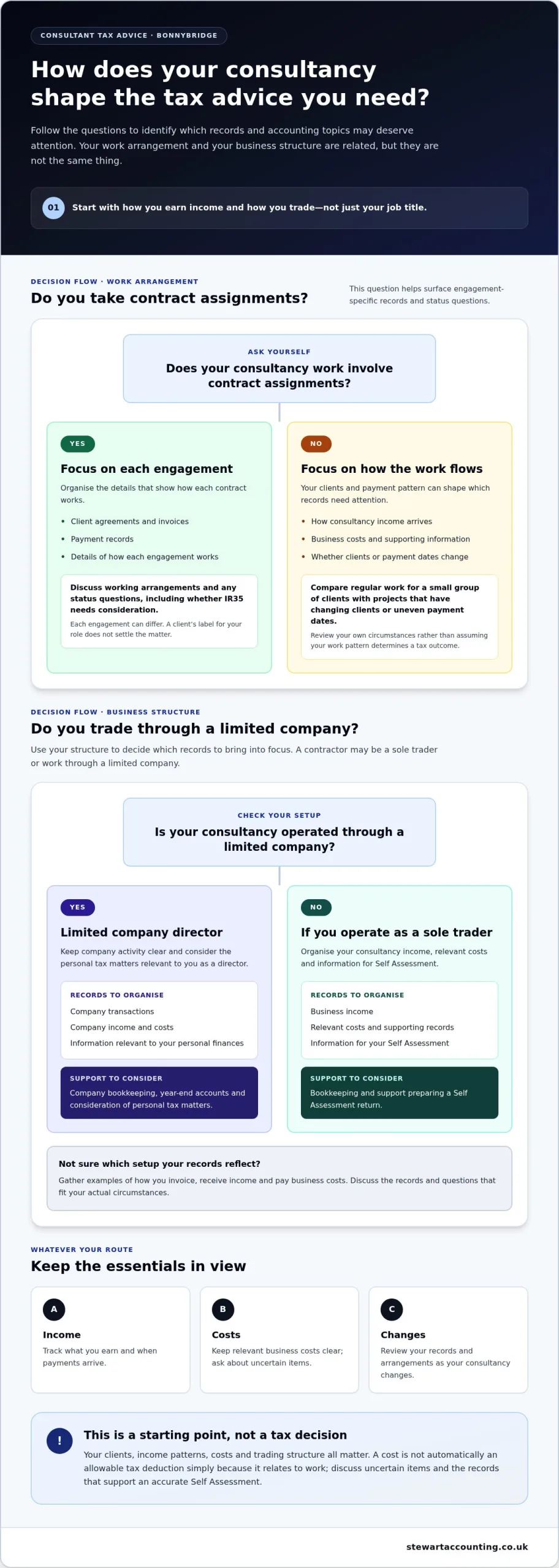
Your trading structure helps determine which records and accounting questions deserve attention. A consultant working independently, taking contract assignments or running a limited company may have different processes to manage. Useful tax advice for consultants in Bonnybridge should reflect both how you operate and how your consultancy earns income, rather than relying on assumptions based on your job title.
Use this comparison as a starting point, not as a tax decision in itself. A contractor may be a sole trader or work through a limited company, so “contractor” describes the work arrangement rather than a separate business structure.
| How you work | Records to organise | Support to consider |
|---|---|---|
| Sole trader consultant | Business income, relevant costs and information for your Self Assessment | Bookkeeping and support preparing a Self Assessment return |
| Contractor | Client agreements, invoices, payment records and details of how each engagement works | Review of your working arrangements, records and any status questions |
| Limited company director | Company transactions, income and costs, plus information relevant to your personal finances | Company bookkeeping, year-end accounts and consideration of personal tax matters |
The table describes topics to discuss, not a conclusion about your tax position. For contractors, the terms of an engagement and the practical working arrangement can raise questions about employment status, including whether IR35 needs consideration. Each engagement can differ, so a status question merits individual review. Don’t assume that a client’s label for your role settles the matter.
What should a sole trader consultant discuss with an accountant?
Start with how you track consultancy income and business costs, and whether your records show a clear picture of activity across the year. Your circumstances determine which expenses and tax questions need review. A cost isn’t automatically an allowable tax deduction just because it relates to work. Discuss uncertain items and how your records can support an accurate Self Assessment. Self Assessment tax return support can help make the process more organised.
What changes when you consult through a limited company?
A limited company brings company records and year-end accounts into the picture, alongside personal tax considerations for you as a director. Keep company transactions clearly recorded and separate from personal spending. If you take money from the company, record the transaction clearly so it can be considered in the right context. Limited company accounting support can help you maintain that separation and prepare accounts from orderly records.
If you’re unsure which arrangement your records reflect, gather examples of how you invoice, receive income and pay business costs. Discussing these with an accountant can help identify the questions to address and the type of support that fits, so you can put financial admin in order and focus on your consultancy.
Which accounting and tax support fits your consultancy?
The right support depends on what needs attention and how much routine administration you want help managing. You might need a focused conversation about a tax decision, regular help keeping records up to date, or support preparing accounts and submissions. You don’t necessarily need every service. Start by identifying where you’re uncertain, which tasks take the most time and how your consultancy’s workload is changing.
For wider context on professional support, a guide to working with a chartered accountant in Scotland can help you understand the role. For your business, Stewart Accounting Services can match relevant accounting support to your circumstances and records.
- Tax planning: Discuss decisions that may affect your business finances, based on your structure and situation.
- Self Assessment: Get help preparing your personal tax return where this applies to you.
- Bookkeeping: Keep income and business costs organised as work and transactions happen.
- VAT returns: Get support with VAT records and returns where relevant to your consultancy.
- Year-end accounts: Prepare accounts for a limited company using organised company records.
One-off guidance can help you address a particular question or review a decision. Recurring support can help keep records and submissions moving as part of your regular business routine. If your work is steady and your records are straightforward, you may need a different level of support from a consultant with changing projects, varied costs or more involved company finances.
When can bookkeeping and tax return support help?
Orderly records make it easier to review income, costs and the information needed for tax tasks. If invoices and expenses are scattered across different places, regular bookkeeping can bring them together in a clearer process. Delegating some of that work can reduce the time you spend on administration and leave you better placed to discuss questions with your accountant. Stewart Accounting Services provides bookkeeping tailored to business needs.
Bookkeeping and tax return support can work together, but they do different jobs. Bookkeeping keeps business records organised; tax return preparation uses relevant information to complete a return. Neither removes the need to review your individual circumstances, but reliable records can make that review more straightforward.
When might VAT or year-end accounts support be relevant?
VAT questions depend on your circumstances and the rules that apply at the time. Your activity, clients and business arrangements may all be relevant, so don’t rely on a general assumption about whether VAT support is needed. A tailored discussion can help identify the right records and questions.
Year-end accounts are a separate area of support for limited companies. They use company financial information to prepare accounts for the relevant year and are not the same as a personal tax return. If you’re unsure where to begin, discuss your consultancy accounting needs and identify the support that fits your workload.
How can you prepare for a useful tax advice conversation?
A little preparation can help make tax advice for consultants in Bonnybridge more focused and practical. You don’t need to have every record perfectly arranged before asking for guidance. Aim to explain how you work, show what information you have and identify the decisions or admin causing uncertainty.
Use this simple sequence to get ready:
- Outline your work. Describe the services you provide, the kinds of clients you work with and how your engagements are arranged.
- Gather available records. Bring together income and business expense information, bookkeeping records and relevant previous tax information.
- List your questions. Note what you want to understand, from record-keeping to filing responsibilities or a change in your work.
- Agree priorities. Before finishing the discussion, clarify what needs attention first, who will handle each next step and when you’ll review progress.
Share your business structure and how you keep records today, even if your process is informal. For example, explain whether you update records as you go or catch up after a project ends. Organised records make tax discussions clearer, helping you and your accountant focus on useful decisions rather than searching for basic information.
What information should you organise before seeking advice?
Gather what’s readily available, such as summaries of consultancy income, business expenses, bookkeeping information and previous tax details. Note any recent changes in your trading arrangements, client engagements or business structure. This is a helpful starting point, not an exhaustive or legally prescribed checklist. If some information is missing or unclear, make a note of that too so you have a specific point to discuss.
Group information in a way that makes sense to you, whether by project, client or time period. If a payment or cost is difficult to identify, flag it rather than guessing. The aim is to explain what happened in your business, not to present a flawless set of records before asking for advice.
Which questions can help focus the discussion?
Write down questions that connect directly to your concerns. You might ask which tax planning points are relevant to your circumstances, what filing responsibilities to plan for, or how to keep business records more consistently. If you’re unsure about contractor status or whether your current business structure still suits your work, explain what has changed and ask what information would help assess it.
Before the conversation ends, agree the practical next steps. Clarify which information you’ll provide, which tasks will be handled as part of any accounting support, and what you’ll need to keep doing yourself. That shared understanding can reduce uncertainty without assuming a particular tax result.
Preparing these details can help you use the discussion well and decide where support would be most useful. If you’re ready to talk through your consultancy’s tax questions, contact Stewart Accounting Services. A clear plan for records and responsibilities can take more admin off your hands and help you work towards more time, more money, more mind.
How can Stewart Accounting Services support consultants in Bonnybridge?
Good accounting support should fit the way you work, whether you need help with a particular tax question or want ongoing assistance with financial tasks that take you away from client work. Stewart Accounting Services can tailor support around your consultancy, its business structure and the records you keep. This gives you a clearer route from tax questions to practical action.
The firm supports consultants with tax planning and accounting tasks that help keep business finances in order. Depending on your circumstances, support can include:
- Tax planning to discuss decisions in the context of your consultancy and business structure.
- Tax return support to help prepare your relevant return.
- Bookkeeping to organise income and business costs and keep records up to date.
- VAT returns where VAT support is relevant to your situation.
- Year-end accounts for limited companies, prepared using the company’s financial records.
You don’t have to take on every part of the process yourself. Depending on the support agreed, you can delegate routine record-keeping or tax and accounts tasks, while keeping a clear understanding of the information you need to provide and the decisions that need your input. The aim is to reduce administrative pressure and make it easier to focus on your consultancy, not to promise a particular tax result.
What can you delegate to a chartered accountancy firm?
You might hand over regular bookkeeping if keeping records current is taking time away from projects. You may want support preparing a tax return, completing VAT returns where relevant, or organising records for year-end accounts. Stewart Accounting Services can tailor accounting support to your needs and take these tasks off your hands where appropriate. The goal is more time, more money, more mind.
Clear, reliable records are useful across these tasks. If you operate through a limited company, year-end accounts preparation supports the company’s year-end reporting and is distinct from your personal tax return. The right mix of help depends on your structure, current workload and how you prefer to manage records.
What is the next step for a consultant in Bonnybridge?
Start by sharing how you trade, the kinds of consultancy work you undertake and the questions on your mind. You can also explain which tasks you want help with, such as tax planning, bookkeeping, tax returns or accounts. This helps Stewart Accounting Services understand your priorities and shape the discussion around support that suits your circumstances.
A conversation can help clarify your priorities and agree practical next steps. There’s no need to have every answer ready. Talk to Stewart Accounting Services about your tax needs and discuss how to manage your consultancy finances with greater confidence.
Give your consultancy a clearer path forward
Your accounting needs may shift as your client work, income patterns or business arrangements change. Set aside time to review what’s working, where record-keeping feels difficult and which decisions you’d like to approach with more clarity. A focused conversation can help turn those concerns into practical next steps, without assuming the same approach will suit every consultant.
If you’re looking for tax advice for consultants in Bonnybridge, Stewart Accounting Services can discuss your circumstances and help you consider support that fits your priorities. Explain what you do, how you trade and which financial tasks are taking up too much of your attention. From there, you can explore a sensible way to manage them with greater confidence.
Start a conversation about your consultancy’s accounting needs and take the next step at a pace that works for you. Clear guidance can make the decisions ahead feel more manageable.
Frequently Asked Questions
Can I use an accountant remotely if I live in Bonnybridge?
Yes. Stewart Accounting Services supports clients remotely, so living in Bonnybridge doesn’t prevent you from discussing your consultancy finances with the firm. Remote support can be practical if you work across different client sites or prefer to manage admin around your projects. Explain your current questions and working arrangements, then discuss the accounting support that fits your circumstances.
Do consultants need to register for VAT?
It depends on your taxable turnover and circumstances. As of October 2026, the UK VAT registration threshold is £90,000 of taxable turnover in a rolling 12-month period. Turnover is not the same as profit, so keep track of your sales across the relevant period. If your turnover is approaching the threshold, review your position against current HMRC guidance and get advice on your next steps.
Can a consultant claim tax deductions for business expenses?
You may be able to claim a tax deduction for qualifying business expenses, but a cost isn’t automatically claimable simply because you paid it while working. For example, a cost with both personal and business use may need closer consideration. Keep a clear record of what you spent and why it relates to your consultancy. An accountant can help review specific costs in light of your circumstances.
Should I operate as a sole trader or through a limited company?
There isn’t one structure that suits every consultant. Consider how you work with clients, how you expect the business to develop and how much administration you’re prepared to manage. A limited company involves company records and accounts as well as your personal tax considerations. A sole trader arrangement has a different record-keeping and reporting context. Discuss your plans and circumstances before deciding or changing structure.
Does IR35 apply to every consultant?
No. IR35 doesn’t automatically apply to every consultant. The question may arise when you provide services through an intermediary, such as a personal service company, and the engagement’s working arrangements need to be considered. Different client engagements can have different terms and day-to-day practices, so don’t assume one assessment covers every contract. If you’re unsure, gather your engagement details and discuss the status question with an accountant.
Can an accountant help me plan for tax throughout the year?
Yes. Tax planning can be discussed throughout the year, rather than only when a return is due. Reviewing your records and expected income regularly can help you identify questions early, consider upcoming business decisions and keep tax tasks in view. For instance, you could raise a change in client work or costs as it happens. Planning supports informed decisions, but it can’t guarantee a particular tax outcome.
Recent Posts
08 Oct, 2026
07 Oct, 2026
06 Oct, 2026