

Need Tax Advice for Joiners in Alloa? Here’s What to Know
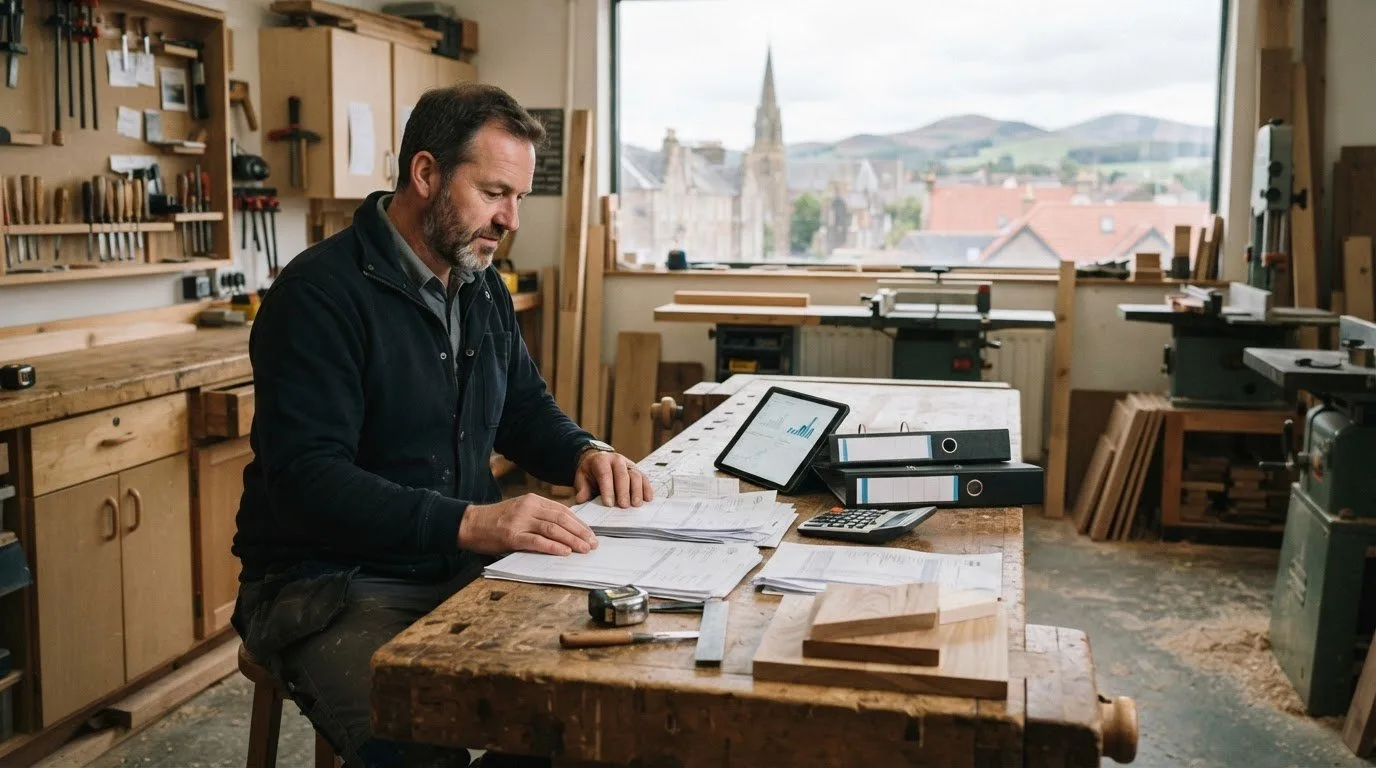
If you’re looking for tax advice for joiners Alloa, start with how your business actually works. Your business structure, the way you’re paid and the jobs you take on all affect which tax and record-keeping questions are relevant. Keeping invoices, receipts and costs in order can feel like another job in itself, especially when you’re balancing paperwork with work on site.
This guide covers practical topics to discuss, including business expenses, possible Construction Industry Scheme (CIS) deductions, VAT and filing responsibilities. It also explains which records to organise and how bookkeeping and tax-return support can make recurring admin easier to manage. Stewart Accounting Services supports trades businesses from its Alloa office, with meetings available in person or remotely. A free initial consultation gives you a chance to talk through your circumstances. Fees are agreed in advance, and the firm never undertakes work without agreeing the fee in advance. The aim is to take the paperwork off your hands and help you make more time, more money, more mind.
Key Takeaways
- Your business structure and working arrangements shape the tax questions to discuss, whether you’re a sole trader, in a partnership, running a limited company or working as a contractor.
- Tax advice for joiners Alloa can help you focus on the records and responsibilities relevant to your joinery business, rather than treating every setup the same.
- Match support to your admin needs by considering tax returns, bookkeeping, VAT support, payroll and year-end accounts.
- Prepare for a useful accounting conversation by gathering invoices, receipts, bank records, customer payment details and relevant business documents in a clear order.
- Stewart Accounting Services supports construction and trades businesses from its Alloa office, with tailored accounting support to help take recurring admin off your hands.
Why Joiners in Alloa May Need Tailored Tax Advice
A joinery job doesn’t end when the tools are packed away. You may be balancing customer work with estimates, material purchases, invoices, payment follow-ups and tax administration across several projects. Keeping each item in order takes extra effort when workloads shift, a customer pays in stages or you move from one site to another.
The right tax questions depend on how your business is set up, where its income comes from and how you work. A sole trader taking subcontracting jobs, for example, may have different matters to discuss from a limited company working directly for homeowners. Tax advice for joiners Alloa should start with your circumstances, not assumptions that every trade business works the same way.
What makes a joinery business’s finances different?
Project-based work can mean deposits arrive before a job begins, staged payments come in as work progresses, and materials are bought at different points. You might also pay for tools or use subcontractors on particular jobs. These are useful details to record and discuss, not automatic rules about how a payment or cost is treated for tax.
When invoices, receipts and customer payment details are incomplete or hard to match, it can be difficult to see what has been received and what the business has spent. A consistent bookkeeping process helps connect transactions to jobs and keeps records ready for review. Stewart Accounting Services provides bookkeeping tailored to businesses, helping make recurring record-keeping easier to manage.
Before making decisions, note how you’re paid, the types of work you take on and whether you operate alone, with a partner or through a company. A UK tax return requirements overview can provide general background, but advice about what applies to you depends on your own position and current HMRC guidance.
Why local knowledge matters for joiners around Alloa
Working in Alloa or elsewhere in Clackmannanshire doesn’t mean different tax rules apply because of your town. Local support can still make it easier to explain the realities of your work and keep communication straightforward. Stewart Accounting Services has an Alloa office, with additional offices in Stirling and Falkirk, and supports clients remotely across the UK.
Good advice helps you keep accurate records and make informed choices. It cannot guarantee a particular tax outcome or a specific reduction in your bill. A Chartered Accountant can help you understand which questions fit your business structure and working arrangements, and where your records may need attention. With the right support, you can spend less time untangling paperwork and gain a clearer view of income and costs, with more time, more money, more mind.
Which Tax Questions Should Joiners Discuss With an Accountant?
Tax advice looks at your business records, tax responsibilities and financial decisions in light of your circumstances. For a joiner, useful questions might include how income is reported, whether VAT applies to particular work, or how to record payments when working as a subcontractor. The answers depend on the details of your business, so general examples shouldn’t be treated as a personal tax decision.
Give your accountant a clear picture of how you trade: who your customers are, how you agree and receive payment, whether you work with subcontractors and how your business is structured. This helps turn tax advice for joiners Alloa into practical guidance you can use, rather than a generic checklist.
How business structure can affect a joiner’s tax advice
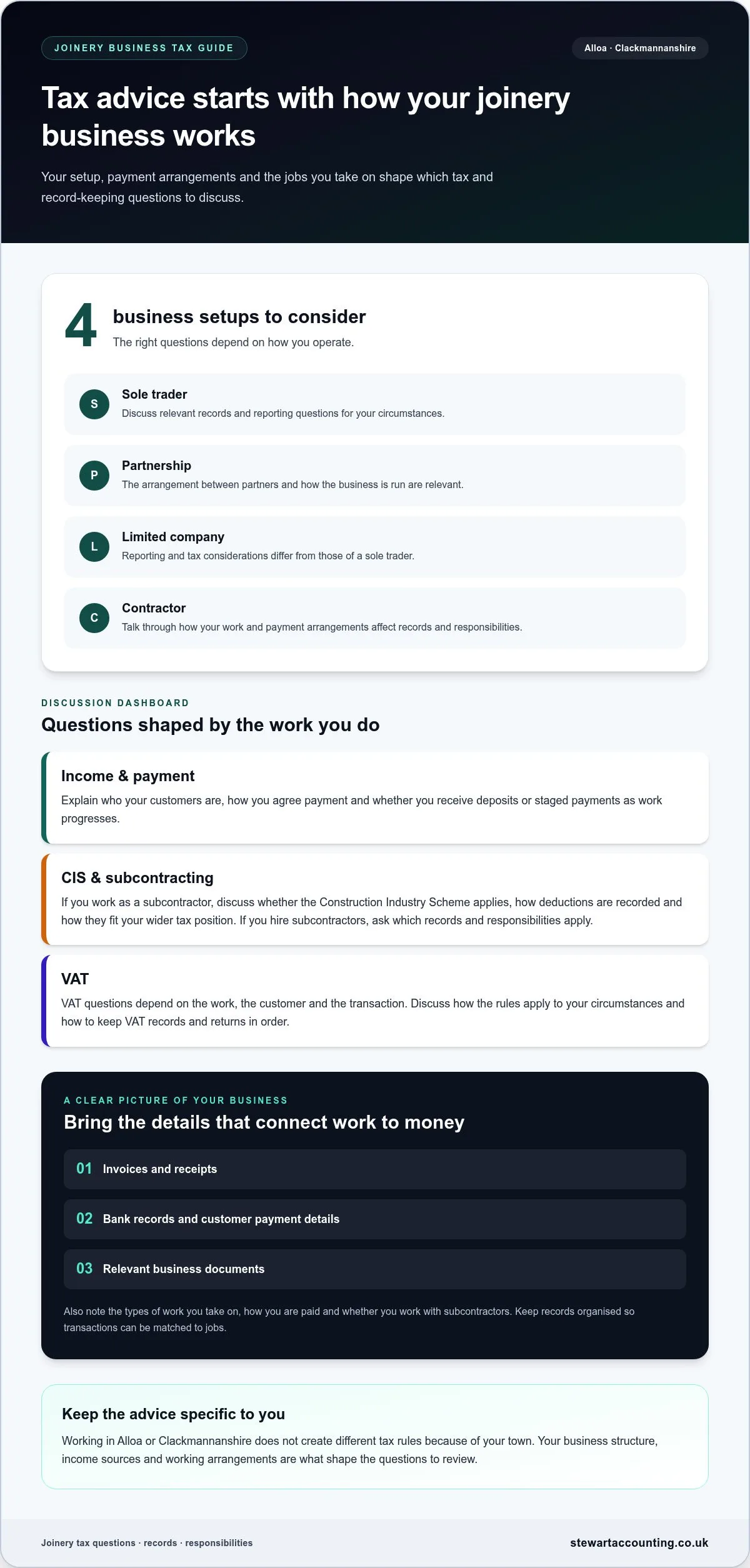
A sole trader and a limited company have different reporting and tax considerations. In a partnership, the arrangement between partners and how the business is run are relevant to the advice. Contractors may also need to discuss how their work and payment arrangements affect their records and tax responsibilities. No structure is right for every joiner, so weigh the practical and tax considerations against your own plans with an accountant.
If you’re a sole trader, accounting support can help you understand which records and reporting questions to raise. If you’re considering a change in structure, discuss how the options fit your circumstances before deciding.
When CIS, VAT, or subcontracting questions need attention
Your role on a job and the contracts involved can affect which tax rules need checking. If you work as a subcontractor, discuss whether the Construction Industry Scheme (CIS) applies to your work, how any deductions are recorded and how they fit into your wider tax position. If you hire subcontractors, ask what records and responsibilities apply to your business. Don’t assume the same treatment applies to every project.
VAT questions also depend on the work, the customer and the transaction. For background on the UK system, read HMRC’s guide to how VAT works. An accountant can help you consider how the rules apply to your circumstances and how to keep VAT records and returns in order. Stewart Accounting Services provides VAT return services for businesses that need support with this recurring task.
You don’t need to arrive with every answer. Make a note of the questions causing uncertainty, such as which business records to keep, how to treat a payment or what applies to a subcontracting arrangement. Stewart Accounting Services offers a free initial consultation in person or remotely. Fees are agreed in advance, and the firm never undertakes work without agreeing the fee in advance. You can discuss your joinery business and its tax questions with the team and get clearer on the next steps.
How to Choose Tax Support That Fits Your Joinery Business
A small joinery business can still have a sizeable admin burden, but that doesn’t mean you need every accounting service. Start with the task that takes up the most time or causes the most uncertainty. Then consider whether help with that task alone or regular support would suit you better. Good tax advice for joiners Alloa should fit your workload and business structure, not add unnecessary complexity.
Use this guide to compare common types of support and where they may help:
Tax returns: Support to prepare and submit the relevant return using your business information. This can suit you if filing is the main pressure point.
Bookkeeping: Help organising income and costs throughout the year, so records don’t build up until filing time.
VAT support: Help with VAT records and returns if VAT responsibilities apply to your business.
Payroll: Support with payroll administration if you employ staff and need help managing pay records.
Year-end accounts: Preparation of accounts at the end of your accounting period, with the work shaped around your business setup.
One-off filing help focuses on a particular return or year-end task. Ongoing bookkeeping support deals with records as work progresses. The first may address an immediate deadline or backlog. The second can help you keep a clearer view of jobs, payments and costs throughout the year. They can also work alongside each other, depending on what you need.
Match accounting support to your business structure and workload
A sole trader may need help with personal tax reporting and keeping business records separate and organised. A partnership may have shared records and partner-specific considerations. A limited company has its own accounts and reporting needs. Your structure, the work you take on and the state of your records all affect where support is most useful. Start by identifying whether filing or recurring bookkeeping is the biggest strain.
If personal tax filing is your immediate concern, Stewart Accounting Services can help with Self Assessment tax returns. If your records are hard to keep up with between jobs, regular bookkeeping may be a better starting point to discuss.
Understand fees and the first conversation
Stewart Accounting Services agrees fixed fees in advance, and never undertakes work without agreeing the fee in advance. You can start with a free initial consultation, either in person or remotely. Use the conversation to outline the kind of joinery work you do, how your business is structured, what records you currently keep and which tasks are causing concern.
That gives you a practical basis for discussing the support that fits, rather than choosing services by guesswork. To talk through your circumstances, arrange a conversation with Stewart Accounting Services and work out a manageable next step.
What Records Should Joiners Organise Before Getting Tax Advice?
You don’t need to turn your paperwork into a finished set of accounts before speaking to an accountant. A clear, practical collection of records is enough to give the conversation a useful starting point. For tax advice for joiners Alloa, focus on showing how work comes in, what you’ve been paid and which business spending you need to discuss.
Try this preparation sequence:
- Gather sales invoices and estimates. Include invoices issued to customers and details that help identify the job or agreed work.
- Collect payment information. Bring bank records and notes showing customer payments, including deposits, staged payments and any amounts still outstanding.
- Bring receipts and purchase records. Group records for materials, tools and vehicle-related spending. Keep the supporting details together so each transaction is easier to identify.
- Set aside subcontractor documents. Include invoices, payment information and any paperwork relating to subcontracted work.
- Add relevant business documents. Include details that help explain your business setup or working arrangements, such as partnership or company information where relevant.
This is a starting point, not a full year-end accounts checklist. Keep business transactions distinct from personal spending where practical, and label records by date, customer, project or transaction type. If you can’t identify a payment or aren’t sure how to describe a cost, mark it for discussion rather than guessing its tax treatment.
Bring a clear picture of work, income, and costs
Sorting records by customer or job can help show how an invoice relates to a payment and which purchases were connected with the work. Materials, tools, vehicle costs and subcontractor payments are useful topics to flag. You don’t have to decide in advance how each item should be treated. A short note beside an unclear transaction can help your accountant understand what happened and advise on the next step.
Make bookkeeping easier to maintain
Organised bookkeeping can help you see income and costs more clearly as work progresses, rather than trying to piece them together later. Stewart Accounting Services provides bookkeeping and online accounting support, including Xero implementation, training and support. Xero can provide real-time financial data and automated bank feeds, helping you keep track of transactions as they are recorded. The right approach can be tailored to your records and the way you run your joinery business.
With bookkeeping services, recurring records can be organised as part of a regular process. If you already use Xero, training and support can help you work with the system more confidently. Bring your documents as they are and explain what you find difficult to keep up with. You can talk with Stewart Accounting Services about organising your bookkeeping and decide what support would make the workload easier to manage.
How Stewart Accounting Services Supports Joiners in Alloa
Joinery businesses don’t all need the same kind of accounting help. You might want support with a Self Assessment tax return or need a steadier way to keep records up to date between jobs. Stewart Accounting Services works with construction and trades businesses, including sole traders, partnerships, limited companies and contractors. Its Chartered Accountants can tailor support to your business structure, working arrangements and priorities.
Support can include tax returns, bookkeeping, VAT returns and year-end accounts. Bookkeeping can help organise business transactions as they arise, while year-end accounts bring financial information together for the close of your accounting period. VAT return support can help you manage the records and reporting relevant to your VAT position. The right combination depends on what you need help with. Advice can help you understand your responsibilities and make informed decisions, but it can’t guarantee a particular tax result.
For tax advice for joiners Alloa, the benefit is having a conversation grounded in how trade businesses work. Explain how you operate and where administration is taking up too much of your time, then discuss support that fits. The aim is to take recurring tasks off your hands and help you focus on the work ahead.
What to expect when you start a conversation
Bring a clear outline of your business structure, the type of joinery work you do, how you’re paid and your main accounting concerns. You can also describe what records you keep and which tasks feel hardest to manage. You don’t need to have every document perfectly organised before you talk.
The initial consultation is free and can take place in person or remotely, including by email or Skype. Stewart Accounting Services agrees fixed fees in advance and never undertakes work without agreeing the fee in advance. That gives you a clear understanding of the proposed cost before deciding how to proceed.
Take the next step with local tax support
You can meet in person at Stewart Accounting Services’ Alloa, Stirling or Falkirk offices, or choose remote support. The Alloa office offers a local point of contact, while remote options make it possible to speak with the team from elsewhere in the UK. Client calls, emails and queries are responded to promptly, so you can raise questions and get a reply as you work through your accounting needs.
With tailored bookkeeping, tax-return and accounts support, recurring administration can become easier to manage and take up less of your working day. That means more time to focus on your jobs, a clearer view of your finances and less worry about paperwork: more time, more money, more mind.
Arrange a free initial consultation to talk through your joinery business and the support that could make its accounting easier to handle.
Make Space for the Work Ahead
The next step doesn’t have to be a major overhaul. Choose one practical priority, such as getting your paperwork up to date, understanding a tax question or making bookkeeping easier to maintain. A clear starting point can help you take control of the admin without losing sight of the work that keeps your joinery business moving.
With tax advice for joiners Alloa, the aim is to make decisions with a clearer understanding of your own circumstances. You can discuss what’s working, what’s causing uncertainty and where support could take recurring tasks off your hands. That can create more room for customer work and help bring more time, more money, more mind to running your business.
Take the first step at a pace that feels right for you. Talk through the next step for your joinery business and move forward with greater confidence.
Frequently Asked Questions
Can a joiner in Alloa get a free initial consultation with an accountant?
Yes. Stewart Accounting Services offers a free initial consultation, either in person or remotely, including by email or Skype. You can explain how your joinery business operates and raise questions about records, payments or tax returns. Meetings are available at the Alloa, Stirling and Falkirk offices, as well as remotely. It’s a chance to talk through your circumstances and understand what support may suit you. Fees are agreed in advance, and the firm never undertakes work without agreeing the fee in advance.
Is tax advice useful if I am a self-employed joiner?
Yes. Tax advice for joiners Alloa can help you understand which business records and tax-return responsibilities apply to your situation. For instance, a sole trader with several customers may want a clear way to track income and prepare information for a Self Assessment return. Stewart Accounting Services supports sole traders with accounting and tax returns. The guidance you need depends on your circumstances, so a general example shouldn’t replace advice based on your own position.
Can an accountant help me change accountants without disrupting my joinery business?
An accountant can discuss your current arrangement, the records you have and the timing you’re considering before a handover. Raise practical concerns such as an upcoming filing task or how your bookkeeping is currently organised. This helps you understand what needs attention, but it doesn’t guarantee a disruption-free transfer. Stewart Accounting Services responds promptly to client communications, so you can clarify questions as you consider the change. Fees are agreed in advance, and the firm never undertakes work without agreeing the fee in advance.
Can Stewart Accounting Services help if I already use Xero?
Yes. Stewart Accounting Services supports businesses already using cloud accounting and provides Xero implementation, training and support. Getting help doesn’t mean you have to change software. During the free initial consultation, describe how you currently use Xero, what your bookkeeping routine looks like and where you’d like more guidance. That discussion can help identify whether you need support with your existing setup, training or another part of your accounting.
Can joiners claim tools, materials, or vehicle costs against tax?
Possibly, but a cost isn’t automatically eligible for tax relief just because it relates to joinery work. Its treatment can depend on what was bought, how it was used, the records available and current tax rules. Keep invoices and receipts, and make a note of any business and personal use where relevant. A Chartered Accountant can review the details with you and explain how they may apply to your circumstances.
Does a joiner need to register for VAT?
Not necessarily. Whether VAT registration is required depends on current rules and your business circumstances, so don’t assume it applies simply because you work in joinery. Check current HMRC guidance for the rules relevant to your position, and discuss any uncertainty with an accountant. Stewart Accounting Services provides VAT-return support to help you manage related records and submissions if VAT applies to your business.
Should a joiner operate as a sole trader, partnership, or limited company?
There isn’t one structure that suits every joiner. The choice depends on your circumstances, responsibilities and plans for the business, including whether you expect to work alone or with others. Consider the practical effect of each option as well as its accounting and tax implications before deciding. Stewart Accounting Services can discuss business-structure advice during an initial consultation, helping you consider the questions relevant to your situation.
Recent Posts
17 Oct, 2026
17 Oct, 2026
16 Oct, 2026