

Payroll for Contractors: A Practical UK Compliance Guide

You've just agreed a day rate with your first contractor. The invoice lands, your bookkeeper asks whether tax should come off before payment, and the contractor says everyone else pays them gross. That short conversation is where most payroll problems start. The rate is only half the agreement. You also need to know who's the employer for tax, who reports to HMRC, and who carries the risk if the status call is wrong.
What Payroll for Contractors Actually Means in the UK
Paying a contractor isn't one process. In practice, UK businesses use three routes, and each route puts payroll for contractors in different hands. You can contract with the worker's own limited company, engage them through an umbrella company, or put them on your payroll directly. The commercial label on the contract matters less than the tax treatment that follows.
PAYE has required employers and pension providers to deduct Income Tax and National Insurance contributions before paying wages or pensions since it was introduced in 1944, as set out in ONS guidance on earnings and employment from PAYE Real Time Information. That history matters because PAYE isn't an optional admin layer. If someone is an employee or a deemed employee for tax, tax and National Insurance are withheld through payroll rather than left entirely to self-assessment.

The Three Routes in Plain Terms
- Limited company: You pay the company gross against its invoice, subject to IR35 and any sector rules. The company runs its own director payroll and handles its own tax reporting. Your job is getting the engagement and status evidence right at the start.
- Umbrella company: The umbrella usually employs the worker, pays wages and deducts tax and National Insurance through PAYE. You or the agency pay an assignment rate to the umbrella, not wages direct to the worker.
- Client payroll: You act as employer for payroll. You calculate deductions, issue payslips, submit RTI and pay HMRC. Control is highest, and so is the admin.
A person can work on a contract basis commercially while still being processed through PAYE for tax. That's the point first-time engagers miss. A genuine sole trader sits outside this, invoicing you and handling their own tax reporting, and PAYE data doesn't include self-employment. Similar classification discipline applies in other sectors, which is why a driver classification and recordkeeping guide from Peak Transport is useful background on keeping worker status and records consistent.
Practical rule: Decide the payroll route before the first shift, not when the first invoice arrives. Retro-fitting status to a payment you've already made is where corrections get expensive.
If you can't say, in one sentence, which of the three boxes an engagement sits in, don't pay yet. Confirm the contracting party, check who'll operate PAYE, and file that decision with the contract. Every later step, from RTI to pensions, flows from that single answer.
Running the Monthly PAYE and RTI Cycle
Once a contractor is on payroll, you're committed to a rhythm that repeats every pay period without exception. Real Time Information, or RTI, means HMRC and the ONS receive payroll information each time you pay staff, covering the entire population of PAYE employments rather than a sample. There's no year-end tidy-up that fixes a sloppy month. Late or wrong submissions are visible at once.
FPS and EPS Do Different Jobs
The Full Payment Submission (FPS) is the routine filing. You send it on or before payday, reporting who was paid, gross pay, Income Tax and National Insurance for that run. If wages change, the FPS changes. It is the record HMRC uses to build the worker's tax position.
The Employer Payment Summary (EPS) is the exception filing. You send one only when something needs reporting outside the FPS, such as no one being paid in a period, recoverable statutory amounts, or CIS deductions suffered by a limited company. Sending an EPS every month out of habit creates noise. Not sending one when it's needed creates a mismatch between what HMRC expects and what you pay.
A clean monthly workflow looks like this in practice:
- Confirm hours and rate: Agree timesheets or outputs before you touch payroll software, whether that's Xero Payroll, BrightPay or Sage.
- Process and review: Check tax code, National Insurance category, pension status and any deductions against last month. Investigate movements you can't explain.
- Issue payslips and post journals: Gross pay, employer costs and deductions should land in your accounts in the same period as the work.
- Submit the FPS: File on or before payday and keep the submission receipt with the payroll report.
- Pay HMRC and reconcile: Compare the FPS, any EPS, your payroll liability account and the bank payment before you close the month.
Deadlines You Can't Drift Past
Contractors generally pay PAYE tax, National Insurance and CIS deductions to HMRC by the 22nd of the following month when paying electronically, or the 19th when paying by post, as confirmed in HMRC guidance on paying tax and claiming back CIS deductions. Treat the electronic date as your working deadline and set the bank payment up when you approve payroll, not three weeks later. Cashflow surprises usually come from forgetting employer National Insurance sits on top of the worker's gross pay.
If you're setting up the submission process for the first time, work through guidance on how to submit payroll to HMRC before your first live run and test your Government Gateway credentials early. Locked accounts on payday are a common, avoidable embarrassment.
Watch the supply chain too. Government material states new PAYE rules for labour supply chains involving umbrella companies are due from 6 April 2026, potentially shifting responsibility for accounting for PAYE from the umbrella to the agency or end client. If you use umbrellas, ask now who'll be accountable under the new rules. Don't wait for the first payroll under them to find out.
Comparing PAYE, Umbrella and Limited Company Setups
Headline take-home pay is a poor way to choose an engagement model. You need four columns in front of you: what the contractor keeps, what the engagement costs you in total, who does the admin, and who carries the tax risk if the status decision is challenged. Run every new engagement through those columns and the right route usually becomes obvious.
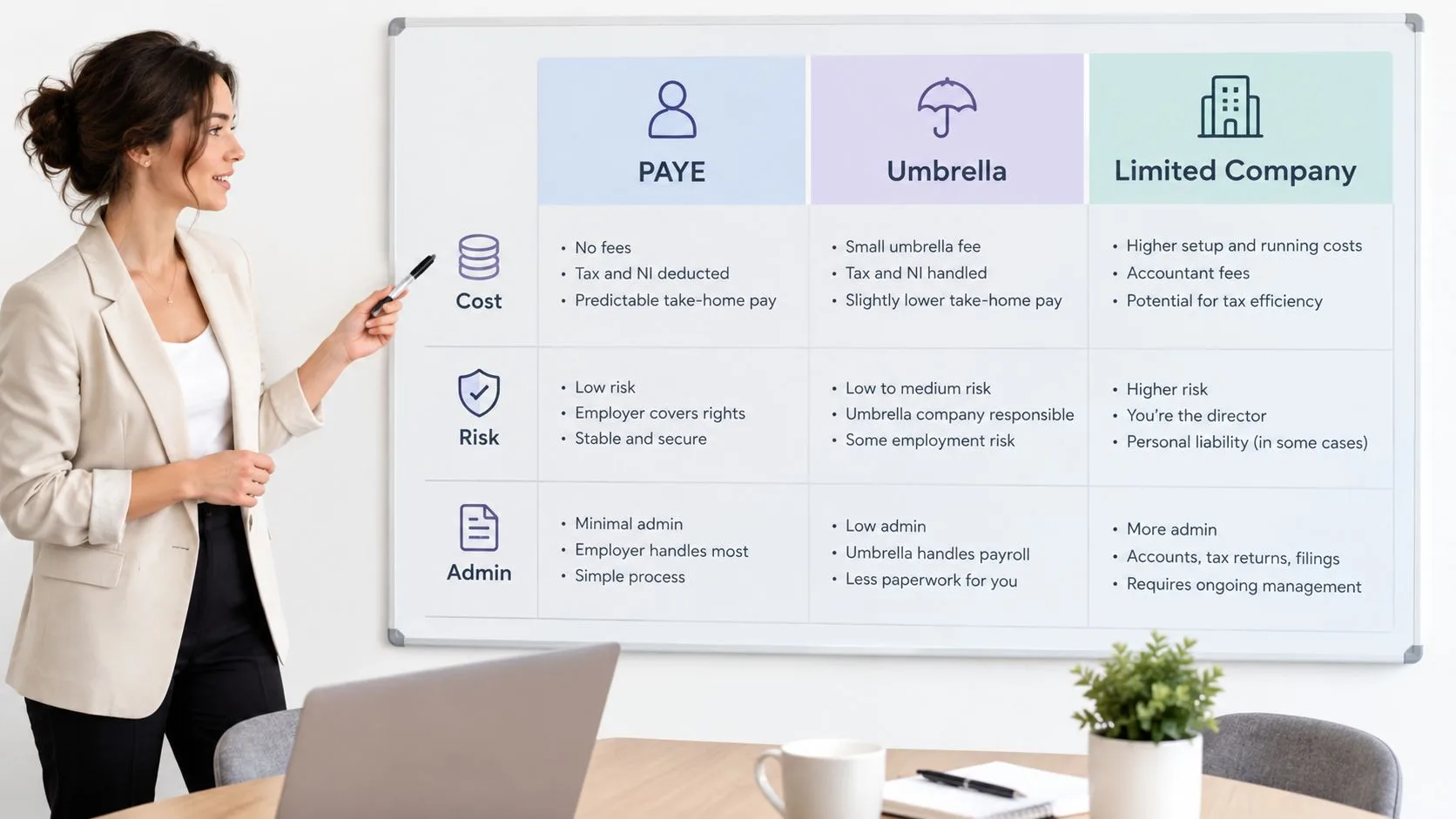
| Factor | PAYE on client payroll | Umbrella company | Contractor's limited company |
|---|---|---|---|
| Take-home pay | Tax and NICs deducted at source, predictable each payday | Similar deductions, but assignment rate must also cover umbrella margin and employer costs | Paid gross to the company where rules allow, tax settled through company and personal reporting |
| Total cost to engager | Gross pay plus employer NICs, pension and payroll admin | Single assignment rate, simpler budgeting but less transparent | Invoice value only, unless IR35 makes you or another party the fee payer |
| Admin burden | Highest for you, RTI, pensions, payslips, starters and leavers | Lowest day to day, but you must still check payslips and deductions | Low for you, high for the contractor's company |
| Tax status risk | Low on status, since you already operate PAYE | Shared in practice, poor umbrellas create worker and tax exposure | Highest if the engagement is really employment in all but name |
The figures inside IR35 surprise people. HMRC's off-payroll rules are designed to produce broadly employee-like Income Tax and National Insurance outcomes, as explained in HMRC guidance on understanding off-payroll working and IR35. So a compliant umbrella and direct PAYE often land closer than sales pitches suggest. The differences sit in employer costs, fees, holiday pay treatment and who does the work.
An umbrella usually employs the worker and provides employment rights such as a contract, payslip, minimum wage and, where eligible, automatic pension enrolment, but the government is moving to regulate umbrella companies under the Employment Rights Bill, as set out in government responsibilities for employment businesses working with umbrella companies. That tells you due diligence isn't optional. Get the key information document, reconcile the assignment rate to gross pay on the first payslip, and confirm the PAYE employer by name.
Relabelling employment as self-employment isn't a saving. It's an unpriced liability that surfaces when HMRC asks for the working practices, not the contract template.
Be candid about avoidance risk. The government has cited an estimated £500 million lost to disguised-remuneration tax-avoidance schemes in 2022-23, much of it facilitated by umbrella companies. Any arrangement promising markedly higher take-home pay for the same work deserves hard questions. Our detailed breakdown of contractor umbrella or limited company choices works through the commercial trade-offs if you're weighing a specific engagement.
Running CIS Payroll for Construction Subcontractors
Construction has its own tax regime sitting beside payroll, and mixing the two up causes real damage. The scale is hard to overstate. ONS reported 364,514 VAT- and PAYE-registered construction firms in Great Britain in the third quarter of 2023 and approximately 1.4 million construction-related employees in 2023 excluding self-employed workers, in ONS construction statistics for 2023. Employee payroll, subcontractor payments and CIS deductions are separate reporting categories. File them as if they're interchangeable and your records won't reconcile.
The Five-Step Monthly CIS Process
- Collect details first: Get the subcontractor's legal name, Unique Taxpayer Reference (UTR) and trading details before work starts, not on payment day.
- Verify before payment: Verify the subcontractor with HMRC and record the result. The verification drives the deduction rate, so keep the evidence.
- Build the taxable base: Start with the invoice, then exclude VAT, directly purchased materials, plant hire, consumable stores and qualifying manufacturing or prefabrication costs.
- Apply the confirmed rate: Deduct at the rate HMRC's verification gives you. Don't use last month's rate from memory.
- Issue the statement: Give a payment-and-deduction statement within 14 days after the end of the tax month, following HMRC guidance on getting paid as a CIS subcontractor.
The rates are fixed reference points. A registered subcontractor suffers 20%, an unregistered or unverifiable subcontractor suffers 30%, and gross-payment status means 0%. So on a purely illustrative £1,000 of labour after allowable exclusions, a registered subcontractor has £200 deducted and receives £800 before any other adjustments. That deduction is an advance payment toward the subcontractor's own tax and National Insurance, not an extra cost to you.
Where CIS Usually Breaks
Incorrect UTR or legal-name data is the most common failure I see, and it pushes people onto the 30% rate unnecessarily. Unsupported materials deductions come second. If a subcontractor claims a large materials element, get the invoices. Treating VAT as deduction-taxable comes third, and it inflates both the deduction and your return.
Reconcile every verification result, invoice exclusion, deduction and statement to the monthly CIS return before you submit it. Then pay the deductions across by the usual 19th or 22nd deadline depending on payment method. For the registration and filing groundwork, check the CIS requirements for contractors and subcontractors before taking on your first subcontractor.
Limited companies suffering CIS deductions need their own discipline. Submit the FPS as normal, use an EPS to report CIS deductions year to date, offset the credit against the PAYE liability and keep contractor statements for every amount claimed, with form CIS132 available as a supporting control. Model the 20% deduction as withheld working capital in your forecast. Treat 30% as an exception to fix at once.
IR35 Status and Who Becomes the Fee Payer
IR35 decides who in the contractual chain must operate PAYE on a contractor's fee. Get it wrong and the tax, National Insurance, interest and argument all land on someone who didn't budget for them. The rules turn on the nature of the engagement. Would this person be your employee if you engaged them directly, ignoring the company in the middle?
Where the off-payroll rules apply, the end client generally determines status and issues a status determination statement with reasons. The fee payer, the party paying the contractor's company, then accounts for PAYE on the fee. Those two roles are often different businesses, which is why chains involving agencies need the determination passed down in writing. A verbal assurance that an engagement is outside IR35 won't help anyone later.

Outside IR35, the picture flips. The contractor's limited company invoices gross, decides its own salary and dividend mix, and settles its own tax. Inside IR35, the same day rate is first reduced by employer costs where they sit in the chain, then taxed much like wages. The contractor's net drops even though the client's headline rate hasn't moved. That's why rate negotiations should happen after the determination, not before it.
This isn't a niche question. IPSE reported that 58% of contractors were paid gross through their own limited company in its 2025 survey, while 28% operated through an umbrella company. A large minority therefore face payroll deductions on engagements they may have priced as gross income. If you're the client, expect pushback on rate when a determination changes the contractor's net position, and plan for it in project budgets.
Inside IR35 doesn't automatically mean umbrella is the only answer. Direct PAYE with the client or agency can be cleaner where the engagement is long, the chain is short, or pension and holiday treatment matter to the worker. The right comparison covers employer National Insurance, pension, holiday pay, insurance, admin and cashflow timing for the whole assignment.
Status first, route second: A well-reasoned determination you can evidence beats a cheaper structure you can't defend.
Keep contracts aligned with working practices. Substitution clauses nobody would honour, or control that looks exactly like line management, undermine the paperwork fast. Review the determination when the role changes, not just at renewal.
NICs, Pension Auto-Enrolment and Payslip Essentials
Three recurring tasks catch first-time payroll admins out even after the engagement model is settled. None is difficult alone. Together, on a tight payday, they're where errors creep in.
National Insurance contributions come in two parts on payroll. Employee NICs are deducted from the worker's pay above the relevant thresholds. Employer NICs are an additional cost to whoever employs the worker, and they must be priced into the assignment rate or project budget. The National Insurance category letter drives the calculation, so check it at starter stage and whenever circumstances change. Where a contractor has another job, each payroll generally calculates on the pay it processes, which can produce results the worker doesn't expect. Explain that before the first payslip, not after a complaint.
Auto-Enrolment Doesn't Pause for Contractors
Once a worker is on PAYE, pension duties follow the employer. You assess the workforce each pay period based on age and earnings, enrol eligible workers into a qualifying scheme, pay employer contributions, and issue the required communications. Providers such as NEST, Smart Pension and The People's Pension handle the mechanics, but the legal duty stays with the employer.
Umbrella arrangements deserve extra checks here. Workers should confirm pension treatment on every payslip, including whether enrolment has been postponed, which scheme holds the money, and whether contributions match the pay period. Missing pension lines are easier to fix in month one than at assignment end.
Reading a Payslip Properly
- Gross pay: Agree it back to hours, day rate or assignment rate workings.
- Tax code and Income Tax: An emergency or outdated code explains most first-month surprises.
- Employee NICs: Check the category letter sits behind the figure.
- Pension contributions: Both employee and employer amounts should be visible where enrolment applies.
- Net pay: Reconcile to the bank payment. Any difference needs a named deduction.
If a deduction appears that you can't trace to tax, NICs, pension or an agreed item, challenge it in writing. Unlawful or unexplained deductions are a worker-relations problem and, for engagers, an early warning about the payroll provider in the chain.
A Monthly Contractor Payroll Checklist
Run the same sequence every month and payroll for contractors becomes routine rather than reactive. The order matters as much as the tasks.
- Status and setup: Confirm IR35 position, contracting party and payroll route for any new starter. File the determination and contract together.
- Verify before you pay: Collect starter details for PAYE workers, and legal name plus UTR for CIS subcontractors. Verify subcontractors with HMRC before payment.
- Process the run: Agree hours and rates, calculate pay and CIS taxable bases, and review variances against last month.
- Issue documents: Send payslips on payday, and CIS payment-and-deduction statements within 14 days of the tax-month end.
- File on time: Submit the FPS on or before payday, an EPS only where needed, and the monthly CIS return where you engage subcontractors.
- Pay and reconcile: Pay HMRC by the 19th or 22nd as applicable, submit pension contributions, and reconcile payroll, bank and HMRC account before closing the month.
Bring in outside help once the mix gets complicated. A handful of contractors across PAYE and CIS, an umbrella chain you don't control, or your first inside-IR35 determination are all sensible triggers. As one option, Stewart Accounting Services runs PAYE and National Insurance administration, RTI submissions, payslips and starter and leaver processing for contractor clients. A bureau or accountant should give you back the checking time, not remove your oversight.
The real prize isn't a clean filing record, welcome as that is. It's predictable cashflow. Payroll mistakes show up first as a worker chasing missing money or a bank balance short of the HMRC payment. The checklist above stops both.
If you're engaging your first contractor, or untangling a mix of PAYE, umbrella and CIS payments that no longer reconciles, talk to Stewart Accounting Services before the next pay run. Bring your contracts, a recent payslip or CIS statement and your current payroll reports, and we'll map each engagement to the right route, fix the monthly cycle, and set deadlines you can keep.
Recent Posts
17 Oct, 2026
17 Oct, 2026
16 Oct, 2026