

Ways to build financial peace of mind as a business owner

A profitable business can still leave you unsure what you can safely spend. Knowing how to get financial peace of mind as a business owner starts with clear cash-flow information, realistic goals and reliable accounting routines, not guesswork.
It’s sensible to wonder whether you need a financial adviser. For day-to-day confidence, practical steps such as tracking income and costs and using a rolling 13-week cash flow forecast can help you spot pressure ahead. Longer-term wealth decisions may call for tailored financial advice, particularly when you’re planning for personal savings, investments or a future business sale.
Build steadier financial habits by planning cash flow, setting short- and long-term goals, balancing reinvestment with personal wealth planning, and maintaining sound accounting processes. Together, these steps give you a clearer view of your finances and help you make decisions with more confidence, more time, more money and less stress.
Key Takeaways
- Use a rolling cash-flow forecast to see potential shortfalls early and plan around changing income and costs.
- Set short- and long-term financial goals so business decisions support the future you want.
- Balance reinvestment in your business with steps to build personal wealth beyond it.
- Keep business finances organised with consistent records, timely invoicing and accounting processes that support tax reporting.
- Consider financial planning when you need to connect your business finances with personal savings, investment or future plans.
1. Considering cash flow and first-year finances
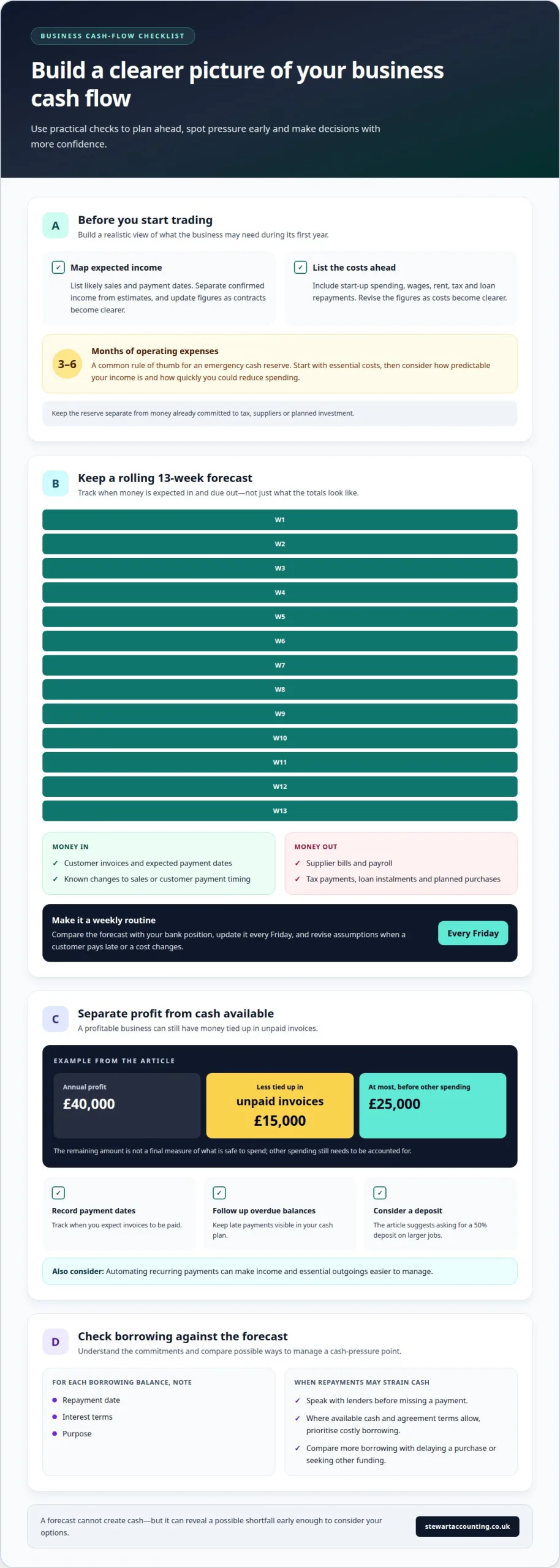
Before investing in a new business, test whether expected income can cover costs through its first year. List likely sales and payment dates, along with start-up spending, wages, rent, tax and loan repayments. Separate confirmed income from estimates, then update the figures as contracts and costs become clearer. For financial peace of mind as a business owner, start with a realistic view of the funding you will need before trading.
How much should a small business keep in an emergency cash reserve? A common rule of thumb is three to six months of operating expenses. Work out essential costs first, then build a reserve that reflects how predictable your income is and how quickly you could reduce spending. Keep it separate from money already committed to tax, suppliers or planned investment.
A rolling 13-week cash flow forecast helps you see when money is expected in and due out. List invoices, supplier bills, payroll, tax payments and loan instalments by expected date, then compare the forecast with your bank position. Update it every Friday and revise assumptions when a customer pays late or a cost changes. A forecast does not create cash, but it can show a shortfall early enough to consider action.
Profit and cash flow are different. A business might report £40,000 annual profit while £15,000 remains tied up in unpaid invoices, leaving at most £25,000 for the year before accounting for other spending. Record expected payment dates, follow up overdue balances, and consider asking for a 50% deposit on larger jobs. Automating recurring payments can also make income and essential outgoings easier to manage.
How can a UK business owner manage debt and reduce borrowing costs? List each borrowing balance, repayment date, interest terms and purpose. Use your cash-flow forecast to identify repayments that could strain the business, and speak with lenders before missing a payment. Where available cash and agreement terms allow, prioritise costly borrowing. Compare taking on more borrowing with delaying a purchase or seeking other funding.
Tax and exit plans also affect the cash you can retain. HM Revenue & Customs states that Business Asset Disposal Relief’s rate rose to 14% from 6 April 2025, then to 18% from 6 April 2026. HM Revenue & Customs states that the UK Business Asset Disposal Relief lifetime limit is £1 million. HM Revenue & Customs sets UK dividend tax rates at 10.75% at the basic rate and 35.75% at the higher rate, after a £500 dividend allowance. From 6 April 2027, most unused pension funds and death benefits are due to be included in a UK estate for inheritance tax, according to HM Revenue & Customs. Understanding these figures is part of how to get financial peace of mind as a business owner, especially when planning withdrawals and future funding.
2. Setting short- and long-term financial goals
Start financial planning by deciding what your business income needs to support. Separate business goals from personal priorities, such as a steadier income, future savings or a planned exit. Write each goal plainly, then identify the decision or action that would move it forward. A clear purpose helps you judge whether a new commitment supports your plans or distracts from them.
Short-term goals should guide decisions you can act on soon. You might aim to make your drawings more predictable, rely less on borrowing or fund equipment that supports trading. For each goal, note the reason, the information you need and when to review it. Before investing in equipment, for example, compare its expected contribution to sales with its purchase and running costs.
Long-term goals call for a wider view. Consider whether you want to grow, continue running or eventually sell the business, and how each path could affect your personal finances. If you are planning a sale, consider timing, ownership and what income might replace business earnings. If you want the business to continue, sustainable growth and succession planning may matter more.
Financial independence means planning for personal needs without relying entirely on the business’s value or future profits. List the resources you expect to draw on, such as savings, investments and pension provision, alongside the lifestyle you want to support. This helps you see how personal wealth-building fits alongside business reinvestment, rather than treating every spare pound as business capital.
Your goals should reflect what wealth means to you. You might want to support family, contribute to your community or leave a particular legacy. Sharing these priorities with a financial adviser can help shape advice around your circumstances and time horizon. An accountant can help connect business decisions with personal financial planning, bringing both sides of your plan into view.
Before committing to a scheme, consider how it fits your goal. Pension planning, for example, should take account of when you may need access to funds. An investment plan should reflect the money’s purpose and your ability to accept losses. A financial adviser can explain the trade-offs and how different choices affect your wider plans. A worthwhile goal is not just ambitious, but workable as your circumstances change.
Review your goals when the business reaches a major decision point, such as taking on a new partner, changing direction or preparing for a sale. Update the plan when your personal needs or trading prospects shift. If you want help turning priorities into a practical plan, discuss your financial goals.
3. Building and reviewing a cashflow plan
Start with a 12-month record of expected income and expenditure. Divide it into months, then list sales receipts, supplier payments, payroll, rent, tax and planned purchases. Use invoice terms and known payment dates rather than assuming every client pays immediately. This calendar shows when cash may be tight, even if the business expects to make a profit across the year.
You can use the business-finance Rule of Thirds as a planning guide. Allocate one third of funds to current projects and upcoming client commitments, such as materials, labour and stock. This helps reserve money for work already promised rather than spending it all on new opportunities. Update your forecast if a project’s costs or timing change.
Set aside another third for essential business expenses, including rent, rates, insurance and equipment maintenance. Listing each cost separately makes it easier to see which payments are fixed and which may change. If a supplier changes a payment date, update that item in your plan. This keeps your forecast tied to actual commitments, not just the original budget.
The final third covers a consistent owner’s salary, reserves and business reinvestment. Treat these as separate uses, even when they come from the same available funds. Planning an equipment purchase, for example, should not obscure whether the business can also support your income and retain money for future needs. The Rule of Thirds is a framework, not a substitute for your own cost profile.
Personal planning matters when business income varies. Base savings, investment and spending decisions on income that may rise or fall, rather than assuming each month will be the same. A director can consider how business withdrawals fit household commitments, while a sole trader may need to plan around changing takings. Include pensions and personal savings in the wider picture, not just business spending.
Review your plan against actual receipts and payments when circumstances change. A delayed client payment, a new contract or an unexpected repair can shift the forecast. Record what changed, revise expected dates and compare the new position with upcoming commitments. This helps you distinguish a temporary timing gap from a longer-term mismatch between income and costs.
Use your forecast to test decisions before committing. If a planned hire, purchase or expansion adds costs before bringing in income, show both sides in the relevant periods. If the figures suggest pressure, consider changing the timing, scope or funding approach. A clear plan also helps you discuss priorities with a financial adviser and link day-to-day choices to longer-term goals.
4. Diversifying wealth while reinvesting in a business
Your business may be your largest asset, but relying on it alone concentrates your personal wealth in one place. Set a personal budget that separates household needs, savings and investments from business spending. Then decide how much available money can support growth without putting every personal goal behind the company. This balance helps you pursue business opportunities while building financial resources beyond the business.
To protect your personal finances if the business fails, build personal savings outside the company and avoid relying on business assets as your only safety net. Review borrowing arrangements and any personal commitments connected with business funding so you understand your exposure before taking on more debt. Business failure can still affect your finances, but separating money and diversifying assets reduces reliance on a single source.
Before investing, assess your capacity for risk as well as your willingness to accept it. Risk capacity is how much loss your finances could withstand without disrupting essential plans. Consider income stability, debts, family commitments and the time available to recover. Investment values and income can fall, and you may get back less than you invested.
Reinvestment should have a clear purpose. Compare the expected benefit of new equipment or an additional employee with the cost and the time needed to support the investment. Keep personal savings and longer-term goals in view when setting the business budget. If one project would use most available funds, consider whether staging the spending would better protect the company’s cash position.
Some business owners explore buying business premises through a self-invested personal pension (SIPP) or a small self-administered scheme (SSAS). These pension arrangements involve specific rules and investment decisions. Assess how property ownership fits your retirement plans and business needs, and consider the structure, risks and effect on your wider wealth with an adviser before proceeding.
Review the balance of business and personal assets when circumstances change, such as taking on a major contract, hiring an employee or planning a sale. A wealth manager can help structure assets around living expenses and longer-term financial freedom. Diversification does not mean withdrawing every available pound. It means deciding deliberately what to reinvest, what to preserve and how to build wealth beyond the trading business.
5. Setting up accounting and finance processes
Build a routine for recording each business transaction while the details are fresh. Record sales, supplier bills, expenses, payroll and tax-related payments in consistent categories. Keep invoices and receipts with their matching entries so you can trace what each figure represents. Clear records make it easier to prepare accounts and use reliable figures in your financial plan.
How should business owners separate personal and business finances? Use a dedicated business bank account for business income and costs, then record personal drawings as transfers rather than business expenses. Limited companies in the UK must have a business bank account. Keeping transactions separate makes the business’s financial position clearer and reduces confusion when preparing accounts.
Choose accounting tools that suit the way you work. Cloud accounting software can organise transactions, invoices and expenses, while bookkeeping services can help keep records accurate and up to date. Management accounts can turn recorded figures into useful summaries of income, costs and changes in cash position. An adviser can help you decide which information supports your decisions.
What accounting tools and services help UK small businesses monitor finances? Use bookkeeping records and accounting software to track transactions, then review management accounts to understand performance. A cash-flow forecast adds a forward view, while an adviser can help interpret the figures and connect them to business decisions.
Set a regular schedule for reviewing records. Match bank transactions to invoices and receipts, identify overdue customer payments, and check that supplier bills are recorded. Keep a separate note of upcoming tax and other planned payments. These checks can reveal missing entries before they affect reports or decisions.
Invoice promptly after completing work rather than letting finished jobs sit unbilled. Record the invoice date, due date and payment status, then follow up according to your agreed terms. For sole traders, setting aside part of each payment can help prepare for personal tax. The right amount depends on the business’s circumstances and tax position.
HM Revenue & Customs states that Making Tax Digital for Income Tax applies to UK sole traders and landlords with qualifying income over £50,000. Digital records and regular bookkeeping make it easier to organise the figures needed for reporting. Build the record-keeping process into your normal work, rather than leaving every receipt and transaction until year end.
If your records are behind or reports are hard to interpret, get support with your accounting processes. An adviser can help you establish a practical routine, understand the information it produces and connect that information with your financial plan.
Stewart Accounting Services: Financial Planning
Stewart Accounting Services offers Financial Planning to help connect business finances with personal goals. This can be useful when organising future savings, assessing your financial position or planning for a change in your business. Bookkeeping Services and Year End Accounts Preparation can support a clearer view of your finances, while Self Assessment Tax Returns help with personal tax reporting.
With the right support to take it off your hands, you can focus on decisions that matter to your business and your future. For support that fits your circumstances, contact Stewart Accounting Services.
Make your next financial decision with confidence
A practical way to find financial peace of mind as a business owner is to make your next financial decision clearer. Choose an upcoming decision, such as changing how the business grows or planning for your future, and identify what you need to understand before acting. A focused conversation can turn broad concerns into priorities you can work through.
You do not need every future detail settled before taking a useful next step. Bring the questions affecting your decisions and consider how your business plans relate to your personal goals. Stewart Accounting Services can discuss financial planning and help you consider a path suited to your circumstances.
Taking time to talk through your priorities can make the next decision feel more manageable. For a supportive conversation about your financial plans, contact Stewart Accounting Services. A clear next step can give you more time, more money, more mind.
Frequently Asked Questions
Do small business owners need a financial adviser?
Not every small business owner needs ongoing financial advice, but tailored guidance can help with decisions that affect personal and business finances. Consider speaking to an adviser if you are weighing a business sale, planning retirement or deciding how to invest personal wealth. An accountant can explain how business figures relate to your plans, while a financial adviser can address wider financial choices. The right support depends on the decisions you need to make.
How can tax planning support your business and personal goals?
Tax planning can help you consider how business decisions affect the money available for personal priorities. Before changing how you take income or making a major investment, for example, review the likely effect on business funds and personal plans. Organised records give you a clearer basis for these conversations. An accountant or tax adviser can help you understand relevant tax considerations and factor them into decisions about growth, savings or a future sale.
How to be consistent when earnings aren’t?
Set a personal spending plan around income you can rely on, rather than treating a strong trading period as the new normal. Decide how much income supports essential household costs, for example, and avoid committing every extra payment to regular spending. In stronger periods, keep some funds available for quieter months. Review your personal budget when contracts, workload or household needs change so you can adapt without rushed decisions.
What does financial peace of mind mean for a UK business owner?
Financial peace of mind means understanding your position well enough to make decisions without guesswork. You can explain what your business can afford, how a choice may affect personal priorities and what information you still need. It does not mean every month will be predictable. It means having clear records, a considered plan and a way to respond when circumstances change, so financial questions feel manageable rather than constantly unresolved.
How can UK business owners create a reliable cash-flow forecast?
Start with expected customer receipts and scheduled payments, using invoice terms, supplier agreements and known commitments as evidence. Mark uncertain amounts clearly and record the assumptions behind them, such as a project starting later than planned. Compare actual transactions with the forecast and adjust when dates or costs change. Adding a cautious scenario, such as a delayed client payment, can show how a change might affect planned spending.