

How to Justify Accounting Fees to a Business Partner

The lowest accounting fee isn’t always the best value. To explain how to justify accounting fees to a business partner, connect the cost to the work included, the quality and timing of financial information, and the time your team can spend on running the business instead.
It’s reasonable to want a clear explanation of a recurring accounting cost. A useful discussion goes beyond the invoice: it sets out what work is done, what falls outside the agreed scope, and how external support compares with the skills and capacity you have in-house.
This article explains how to assess accounting support in practical terms, explain the fees clearly and compare services on a like-for-like basis. You’ll also learn to consider less visible benefits, such as fewer bookkeeping tasks for your team and more time for business decisions. The aim is a fair conversation that helps both partners understand what the fee covers and whether it supports more time, more money and more peace of mind.
Key Takeaways
- Assess accounting support through the quality and timing of reports, complete records, resolved queries and better-informed decisions.
- Explain a fixed monthly fee by linking it to the agreed work, regular outputs and the support your business receives.
- Compare outsourcing with internal capacity by weighing staff time, skills, supervision and the work that still needs to be done in-house.
- Set out what the service covers, who is responsible and which tasks need separate scope before agreeing to the fee.
- Use consistent criteria to compare the fee with time saved and practical value, rather than looking at the price alone.
How can a small business measure the value of accounting services?
Assess accounting support by its contribution to financial control, reliable reporting and business decisions. Business-related accounting fees may be treated as business expenses in the UK. Consider personal tax work separately, because its treatment depends on its purpose and the business structure.
Fees Compared with Value and Time Savings
To compare accounting fees with practical benefits, weigh the agreed work against the time it frees and the decisions it supports. A fee can strengthen financial control, not merely produce paperwork. For example, compare the effort of preparing monthly figures in-house with the value of having reports ready for cashflow decisions. Note whether reports arrive when needed, queries are answered and the information helps partners act sooner.
Financial Reporting and Significant Judgements
Financial reports give partners a structured view of income, costs, assets and amounts owed. Review them alongside the underlying records, rather than judging value by the documents alone. A useful reporting process explains unusual movements, flags missing information and makes significant accounting judgements understandable.
If a transaction could affect reported profit for the period, for example, ask how it was recorded and why. The explanation helps partners understand the figures and decide whether they need more information. Track when reports arrive, whether records are complete and how long queries remain unresolved. These measures show whether the support provides information your business can use.
Partnership Bookkeeping and Financial Records
Partnership bookkeeping records business transactions and helps partners understand how money moves through the firm. UK partnerships must keep full and accurate financial records for at least five years after the submission deadline of 31 January. This makes an orderly record useful beyond routine reporting: partners can trace figures back to supporting documents when reviewing accounts.
Partnership accounts should also show how profits and losses are allocated between partners. Record that allocation in partnership documentation, such as a profit-sharing agreement. This connects bookkeeping to the financial statements and helps partners see how reported results relate to their agreed shares. Partnership accounting support can help keep these records and reporting processes organised.
How Fees Vary by Business Structure, Turnover and Transaction Volume
Accounting fees depend on business structure, agreed work and transaction volumes. A partnership may need records and statements that support profit allocation, while other structures have different reporting requirements. More transactions can mean more records to process and review. Compare the actual workload and deliverables, not turnover alone.
Agreeing a Fair Share of Fees
Partners should agree in advance how to share accounting costs, based on the work those services support. A clear approach can prevent disagreements when invoices arrive. Partners might allocate shared costs according to their partnership agreement, or choose another method that reflects who benefits from specific work. Record the decision and review it if responsibilities, transaction volumes or the scope of the accounting work change.
Explaining fixed monthly accounting fees to partners
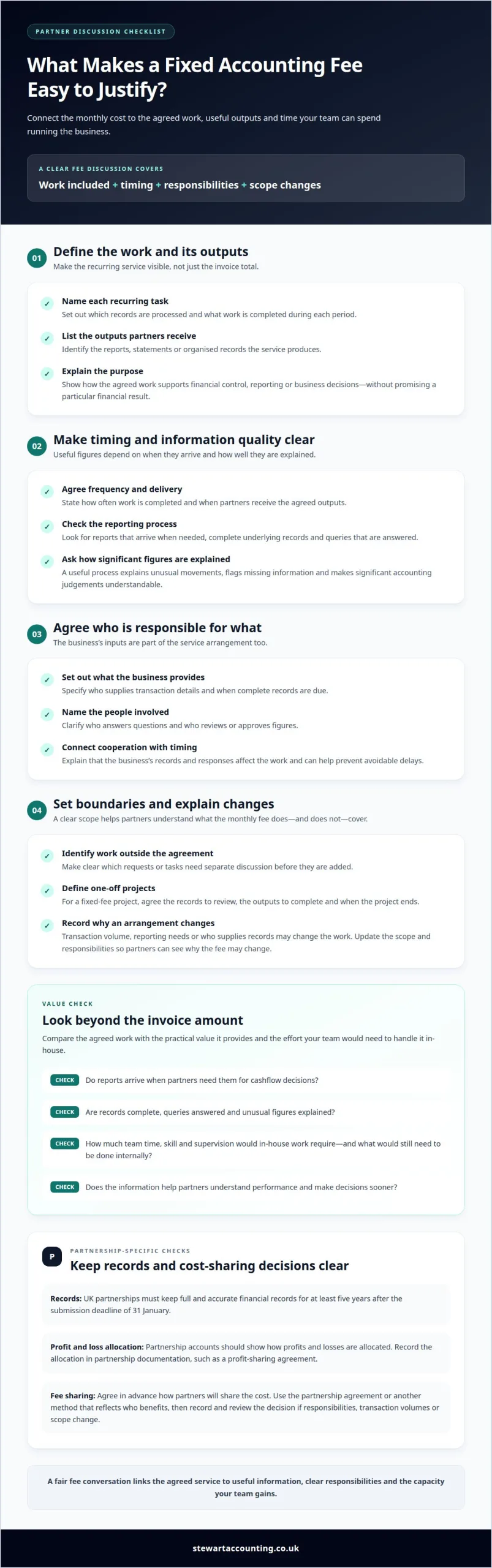
A fixed monthly accounting fee gives partners a predictable cost for an agreed set of services. Explain it by linking the fee to the tasks, frequency, responsibilities and limits in the agreement. It is easier to assess a monthly payment when everyone understands what happens during each period and what would count as extra work.
Explain the fee in practical terms rather than presenting it as an unexplained figure. Set out which records are processed, which reports are prepared and how queries are handled. Then explain what the business needs to provide, such as complete transaction records by an agreed date. This shows partners how their cooperation affects the work and helps prevent avoidable delays.
- Work included: Name each recurring task and the reporting or records it produces.
- Timing: State how often work is completed and when partners receive the agreed outputs.
- Responsibilities: Clarify who supplies transaction details, answers questions and approves figures.
- Changes: Explain how a change in workload or scope could lead to a revised agreement.
For a one-off project, agree a fixed fee for a defined scope. Specify the records to be reviewed, the statements or other outputs to be completed, and when the project ends. If new transactions or requests fall outside that scope, discuss them separately before expanding the work. This keeps the project and its fee clear to every partner.
A value-based fixed fee connects the cost to the agreed service and its purpose, rather than simply to hours worked. This can make sense when partners value timely figures for cashflow planning or a clearer view of performance. Explain the intended benefit without promising a particular financial result. Partners should also understand what remains their responsibility and what the agreed support handles.
Partners can review the arrangement when the business changes. A rise in transaction volume, a new reporting need or a change in who supplies records may affect the work. Record the revised scope and responsibilities so everyone understands why the monthly fee may change. If you’re weighing up a suitable arrangement, discuss your accounting requirements with a professional.
For project work, agree a fixed fee for a defined scope. An accountant’s estimate of delivery costs and a client’s perception of value may differ significantly.
Comparing outsourced accounting fees with internal costs and capacity
Compare outsourced accounting with the full cost and capacity involved in doing the same work in-house. Include staff time, software, supervision and the effect on other business tasks. Partners can then discuss the options using the same assumptions.
To explain an accountant’s fee, set out the agreed work alongside the internal resources it would replace or support. Consider bookkeeping, reconciliations, reporting, queries and review. Compare the time required, the skills available and the impact on daily operations. A fee is easier to assess when partners can see which tasks it covers and where the business retains responsibility.
Build a like-for-like comparison using practical categories:
- Staff capacity: Estimate the time employees spend collecting records, entering transactions, correcting errors and preparing figures.
- Oversight: Include the time a manager or partner spends reviewing work and resolving questions.
- Tools and processes: Account for the software and routines needed to keep information organised.
- Business impact: Consider what staff could complete instead, such as serving customers or supporting sales.
- External scope: Match the accountant’s agreed tasks and outputs against the internal list.
For example, a partner might handle bookkeeping between customer work and supplier payments. The cost is not just the time spent: interruptions can also delay other decisions. Compare this with outsourcing recurring processing while keeping approvals and business decisions in-house. Base the comparison on actual responsibilities, not an assumed hourly saving.
Capacity matters as much as cost. A small team may not have time to review every transaction promptly, even if someone can enter it. Outsourcing can free staff to focus on higher-priority work, while an in-house system may suit a business with trained employees and available capacity. Discuss which tasks need detailed business knowledge and which follow a repeatable process.
Choosing a lower fee without comparing the scope can leave important tasks uncovered. Managing accounts without professional support can also mean errors go unnoticed, records remain incomplete or unusual transactions receive little scrutiny. Clear responsibilities, consistent review and timely answers help reduce these risks, whether the work is in-house or outsourced.
Finally, consider how the business uses its resources. External support may preserve staff capacity for core operations, while hiring internally can build knowledge within the business. Compare both options over the same period and against the same workload. This clarifies the trade-offs: cost, expertise, continuity and time for work that helps the business progress.
Defining service scope, deliverables and exclusions
You can negotiate accounting fees by narrowing the agreed scope, improving the records you provide or adjusting reporting frequency. Keep the work needed for accurate records and required returns in scope. Remove duplication, not essential tasks.
A clear agreement helps partners understand what the fee covers, what remains their responsibility and which requests fall outside the scope.
Service Scope and Deliverables
The scope defines the agreed work; deliverables are the records, reports or statements it produces. This distinction matters because a monthly fee may cover recurring processing without including every accounting task. Set out who supplies transaction information, who reviews it, when outputs arrive and how questions are handled. For example, specify whether the agreed service includes bookkeeping, financial statements or regular management reporting.
Separate recurring bookkeeping from work that needs its own scope, such as VAT or Corporation Tax support, year-end accounts, internal audit or CFO advice. Accounting software can automate data capture and routine processing, but it may not review or interpret unusual transactions. Agree who handles exceptions before they arise. In a UK partnership, the nominated partner is responsible for completing the partnership tax return.
Exclusions and Fee Negotiation
Exclusions identify work outside the agreed service and explain how extra requests are handled. They matter because partners can otherwise expect different outputs from the same fee. A proposal should make deliverables, frequency, responsible parties, exclusions, reporting and issue escalation easy to compare. For example, a package might include four face-to-face meetings each year, while additional meetings require separate agreement.
To reduce fees without weakening compliance, improve the quality of the records you provide, remove duplicated tasks or adjust optional reporting. Keep core records, review and required tax work intact. A staged process can also help: partners organise routine documents while an accountant handles the agreed review and reporting. Discuss any change in scope before work begins, then record the revised responsibilities and outputs.
Compare proposals using the same practical criteria, not just the headline fee. If one includes year-end accounts and another covers bookkeeping alone, they are not equivalent. Record the differences and identify any separately scoped work that could add to the cost. For example, clarify whether VAT support is included and how often management reports are prepared.
Agree how changes will be managed. More transactions, incomplete records or unusual activity may affect the work required. The accountant should explain the impact and get approval before expanding the scope. This gives partners a clear basis for discussing any fee adjustment and keeps responsibilities and reporting transparent.
How can I compare an accountant’s fees with the value and time savings they provide?
Compare the agreed fee with the work delivered, time freed and decisions supported. Use the same period and tasks for each option, then discuss the differences with your business partner. This keeps the conversation focused on practical value, not simply on which figure is lower.
Start by listing the work currently handled by you or your team. Include collecting invoices, recording transactions, correcting entries, preparing reports and answering routine finance questions. For each task, note who does it and what other work gets delayed. For example, sorting purchase records may take a manager away from supplier planning or customer work.
Then map each task to the accountant’s agreed outputs. Check whether the service covers the work your business needs, and identify responsibilities that remain in-house. A useful comparison includes:
- Time: Which recurring tasks could move off your team’s workload?
- Quality: What review or interpretation supports the figures?
- Timing: When will reports or answers be available for decisions?
- Capacity: What work could staff complete with the time released?
- Scope: Which requests are separate from the agreed service?
Next, connect the outputs to business decisions. A cashflow report, for example, can help partners see expected receipts and upcoming payments before committing to spending. Management information can also help explain why costs changed between periods. These benefits matter most when partners know which decisions rely on the information and who will act on it.
Keep your assumptions consistent. If an in-house comparison counts staff time, include checking entries and resolving problems, not just data entry. If an outsourced service excludes a task, add it to the in-house workload. Do not treat every hour freed as a direct financial saving; consider whether the extra capacity supports valuable work.
Review the comparison when transaction patterns, staffing or reporting needs change. A business with seasonal activity may need different support during busy periods than during quieter ones. Record the changes and discuss whether the existing scope still fits. This helps partners judge value against current needs rather than an outdated workload estimate.
For a clearer discussion, prepare a short comparison showing tasks, outputs, responsibilities, timing and the practical benefit of each. Discuss your accounting needs and how suitable support could fit your business.
Stewart Accounting Services
Stewart Accounting Services can help you match accounting support to your business needs and identify the time it could free up. If partners are unsure what a fee covers, start by agreeing clear responsibilities and outputs.
Depending on your needs, support can include bookkeeping, payroll, Self Assessment Tax Returns and Year End Accounts Preparation. Understanding how these tasks fit together can help you discuss accounting costs with your business partner and decide which responsibilities to delegate. Stewart Accounting Services can take it off your hands, giving you more time, more money, more mind to focus on running the business.
If you’d like to discuss your accounting needs, contact Stewart Accounting Services.
Make your next fee discussion constructive
A useful conversation with your business partner can turn an uncomfortable discussion about expenses into a shared decision about the support your business needs. To explain how to justify accounting fees to a business partner, focus on how the agreed work fits your priorities and which responsibilities you want to keep in-house. Then decide together what information will help you review the arrangement as the business changes.
Stewart Accounting Services provides Bookkeeping Services, Year End Accounts Preparation and Self Assessment Tax Returns to meet practical accounting needs. With a clear understanding of your requirements, you can discuss which work would free up your time and reduce administration while keeping business priorities in view.
Take the next step at a pace that feels right for you. Start a conversation about your accounting needs, and move towards more time, more money, more mind.
Frequently Asked Questions
How do you justify the cost of an accounting service?
Explain how the work supports the business, not just what appears on the invoice. To discuss how to justify accounting fees to a business partner, connect the service to a specific need, such as preparing reliable figures for a funding decision or keeping records organised during a busy period. Distinguish time freed from less tangible benefits, such as clearer information and fewer interruptions to daily work.
What should you ask when discussing accounting fees?
Ask what the fee covers, what information the accountant needs from you and how business changes could affect the arrangement. You might also ask who handles follow-up questions, what happens if records arrive late and how additional requests are approved. These questions help partners understand the working relationship, not just the amount due, and clarify responsibilities before they agree.
Which indicators can demonstrate value over time?
Track reporting timeliness, record completeness, outstanding queries and the time your team spends on finance administration. Add a measure linked to a decision, such as whether management information helped you spot rising supplier costs or plan a purchase. Review the same indicators regularly and note changes in workload or business activity. This creates a useful record of how the support performs as your needs evolve.
What services are included in accounting fees for a UK business?
Accounting fees do not all cover the same services. An arrangement might include bookkeeping, payroll, VAT returns, tax returns, year-end accounts or management information, depending on the agreed scope. A business needing payroll support, for example, should not assume bookkeeping or year-end accounts are included too. List each task in the service description so partners can see what is covered.
What should a UK accounting engagement letter say about fees and additional charges?
An engagement letter should describe the agreed work, fee basis, payment arrangements and how extra work is identified and approved. It should also explain what information you must provide, who your main contact is and how either side can request a change. Stewart Accounting Services agrees fees in advance and never undertakes work without agreeing the fee in advance. No extra charges are applied without prior agreement. Written terms give partners a shared reference if their needs change.
Recent Posts
16 Nov, 2026