

CIS Level 1 Explained for UK Contractors

If you've deducted tax correctly under CIS, does that prove your subcontractor is self-employed? No. That's the gap contractors can miss when searching for “CIS Level 1”: the phrase isn't an official HMRC category, and getting the deduction right doesn't settle the worker's employment status.
For a construction business, the practical task is to make several decisions in the right order. Identify the arrangement, establish the correct payment treatment, check the invoice evidence and keep a record that explains what you did.
Which CIS Level 1 Your Search Means
CIS Level 1 isn't an official category within the UK Construction Industry Scheme. Searches for the phrase usually concern either construction tax deductions or an unrelated cybersecurity standard. They share an abbreviation, not a set of rules.
Two meanings of CIS Level 1
| Meaning | What it covers | Who it affects | Where the rules come from |
|---|---|---|---|
| Construction Industry Scheme (UK tax) | Deductions from payments to subcontractors for construction work | Contractors, subcontractors and construction businesses | HMRC guidance on GOV.UK |
| CIS Benchmark Level 1 (Center for Internet Security) | Baseline security settings for systems and cloud accounts | IT and cloud administrators | Published CIS Benchmarks |
In construction, CIS means the system under which contractors deduct money from qualifying subcontractor payments and pass it to HMRC. It's a tax collection arrangement, not a qualification, trade accreditation or grade of subcontractor.
In cybersecurity, CIS Benchmark Level 1 means baseline security configuration recommendations published by the Center for Internet Security. An IT administrator working on AWS, Azure or Linux security needs the relevant CIS Benchmark, not construction tax guidance.
The similar search terms can lead to very different documents.

The construction contractor's starting point
If your business pays subcontractors for construction work in the UK, check whether you have CIS obligations before making payment. Don't assume that receiving an invoice, using a limited company or describing someone as a subcontractor answers that question.
Start by identifying who provides the work, what work they perform and how the engagement operates. Then establish their payment status and the amount of the invoice that falls within the deduction calculation.
Keep the terminology precise: use registered subcontractor, unregistered subcontractor or gross payment status holder in your records, rather than CIS Level 1.
Those descriptions tell your bookkeeper something useful. An informal level label doesn't identify the deduction treatment or explain why you selected it.
Deduction Rates Contractors Must Apply
CIS deduction rates on a £10,000 labour payment
The following illustration applies the registered and unregistered rates in HMRC's subcontractor guidance to a £10,000 qualifying payment after allowable materials have been excluded, with the gross-payment row showing the no-deduction alternative.
| Subcontractor status | Deduction rate | Net received | Amount deducted |
|---|---|---|---|
| Registered, without gross payment status | 20% | £8,000 | £2,000 |
| Unregistered or unverifiable | 30% | £7,000 | £3,000 |
| Gross payment status holder | 0% | £10,000 | £0 |
These are payment treatments, not different final tax rates for the subcontractor. The contractor withholds the relevant amount and passes it to HMRC on the subcontractor's behalf.
Registration therefore affects immediate cash flow. It doesn't, by itself, establish how much tax the subcontractor ultimately owes.
Calculate the deduction base before the deduction
Don't take the headline percentage and apply it automatically to the invoice total. Establish the qualifying amount first, including the appropriate exclusion for the direct cost of materials.
Ask for an invoice that distinguishes the work from the materials supplied. Where the materials figure isn't clear, request supporting purchase records rather than accepting an unexplained allowance.
For example, a subcontractor might submit a combined invoice describing everything as building services. That description gives your accounts team too little information to assess the materials exclusion confidently.
A better record identifies the labour, describes the materials and connects their cost to supporting evidence. Keep that evidence with the invoice so the calculation can be checked without relying on someone's memory.
Understand what the deduction actually does
CIS deductions are advance payments towards tax and National Insurance liabilities, not an additional tax. The subcontractor must still reconcile those deductions with their eventual liabilities.
A lower deduction can leave more money available to run the business, but it isn't automatically a tax saving. A higher deduction can restrict working capital while the subcontractor waits for their tax position to be reconciled.
For the contractor, the immediate control is straightforward: establish the HMRC payment treatment before releasing money. Don't substitute a subcontractor's preferred rate, an old invoice or a verbal assurance for the relevant verification record.
Also keep payment status separate from engagement status. A deduction calculation only answers how an eligible CIS payment should be processed.
Qualifying for Gross Payment Status
Turnover thresholds for gross payment status
HMRC's gross payment status guidance sets the following turnover thresholds, excluding VAT and materials, and requires applicants to satisfy business, turnover and compliance tests.
| Business type | Turnover threshold | Notes |
|---|---|---|
| Sole trader | £30,000 a year | Own turnover, excluding VAT and materials |
| Partnership | £30,000 per partner, or at least £100,000 for the partnership | Check which threshold applies to the partnership |
| Company | £30,000 per director, or at least £100,000 for the company | Companies controlled by five or fewer people generally need £30,000 per person |
Meeting the turnover requirement alone doesn't secure approval. Gross payment status is a compliance-based payment arrangement, not an automatic reward for reaching a particular business size.
What HMRC tests
The business test concerns whether the business carries out construction work or supplies construction labour in the UK. The applicant must also operate through a bank account.
The turnover test concerns qualifying turnover rather than the total value of every invoice. A materials-heavy business should be particularly careful not to mistake headline sales for the amount relevant to its application.
The compliance test concerns the business's record of meeting its tax and National Insurance obligations. VAT compliance also forms part of that assessment, so a business shouldn't review its CIS position in isolation from its wider tax administration.
Our guide to qualifying for gross payment status provides a focused starting point for reviewing an application.
Gross payment status changes when tax is collected. It doesn't remove the obligation to budget for tax.
Approval needs ongoing attention
HMRC keeps gross payment status under review. A subcontractor that no longer meets the conditions can lose approval, changing the treatment of future contractor payments.
For the subcontractor, that can disrupt a cash-flow forecast built around receiving invoices in full. Keep tax reserves separate from money available for wages, suppliers and other operating costs.
For the contractor, a previous gross payment should never become the sole justification for the next payment. Retain the relevant status evidence, record when it was checked and act on HMRC notifications.
A subcontractor's statement that they've always been paid gross is useful background, but it isn't a payment instruction.
How to Run a Monthly CIS Payment Cycle
A reliable monthly routine connects the subcontractor record, invoice, bank payment, deduction statement and return. If those records sit in separate folders with no common reference, someone will eventually have to reconstruct the calculation.
Use a payment checklist alongside your accounting records.
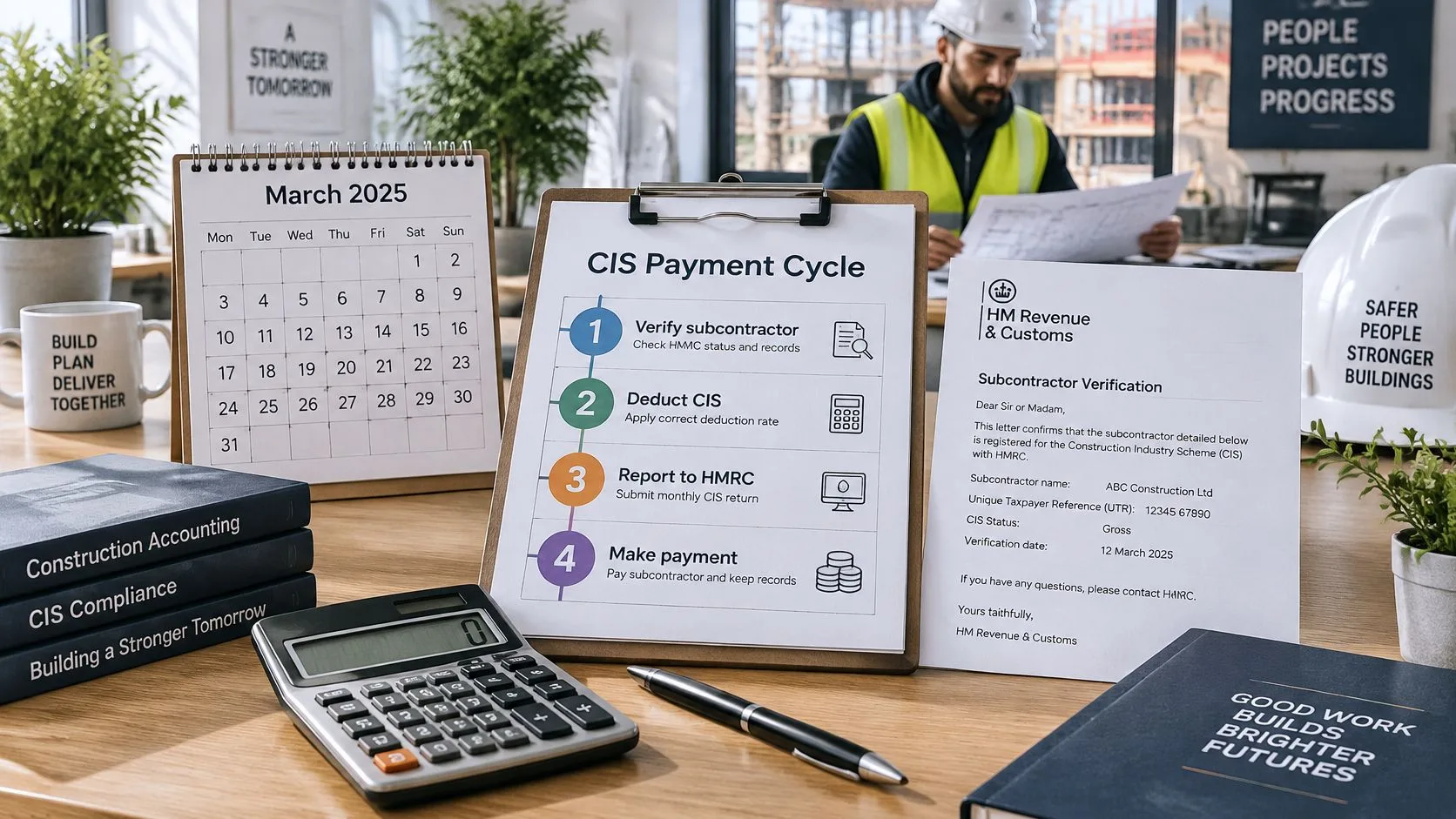
Build the payment record in sequence
Verify the subcontractor before payment. Match the subcontractor's details to the HMRC verification result and retain the reference with their supplier record. The common slip is accepting a UTR as if it confirms the payment treatment.
Separate the invoice components. Identify labour, VAT, directly purchased materials, plant hire and consumables, checking that each exclusion is appropriate and supported. Recording the invoice as a single undifferentiated construction cost makes later checking harder.
Calculate and record the deduction. Apply the verified treatment to the qualifying amount, then show the calculation clearly on the payment record. Check that the bank payment agrees with the amount due after the deduction, rather than entering the deduction afterwards as an unrelated journal.
Issue the payment and deduction statement. HMRC's CIS overview supports issuing the monthly statement within 14 days after the relevant tax month ends, allowing the subcontractor to reconcile their credits. Don't assume the invoice or bank transfer reference replaces that statement.
Prepare the return and HMRC payment separately. Reconcile the return to your payment ledger, then check the applicable submission and payment deadlines in your HMRC account. Treat these as separate tasks, because completing the return doesn't itself transfer the money owed.
Keep the calculation evidence together. File verification records, invoices, materials evidence, and statements so another person can follow the transaction. If materials evidence is inadequate, resolve or document the basis of an appropriate estimate rather than accepting the claimed split without review.
Reconcile before submitting
Use a spreadsheet or your accounting system to connect each invoice reference to its payment date, qualifying amount, deduction and statement. Investigate differences before submission, especially where a supplier has sent a credit note or received a part payment.
Our CIS return guide can help you organise the return-preparation task without confusing it with invoice approval.
For a video-format explanation, use the following resource alongside the written checklist.
The test is whether the records agree: each statement reconciles to the underlying payment calculation, and the return total matches the deductions in your ledger. A completed checklist isn't enough if those amounts differ.
Does CIS Registration Make Someone Self-Employed
CIS concerns how tax is collected on eligible construction payments. Like a tax code on a payslip, it doesn't, on its own, settle the person's employment status.
No, CIS registration doesn't prove self-employment. Government guidance on self-employed contractors makes clear that status depends on the particular engagement, and that tax status and employment-law status need separate consideration.
A UTR, a subcontractor invoice and gross payment approval don't replace that assessment. Nor does a contract heading resolve a mismatch between the written agreement and the way people work.
Keep the engagement evidence alongside the payment paperwork.
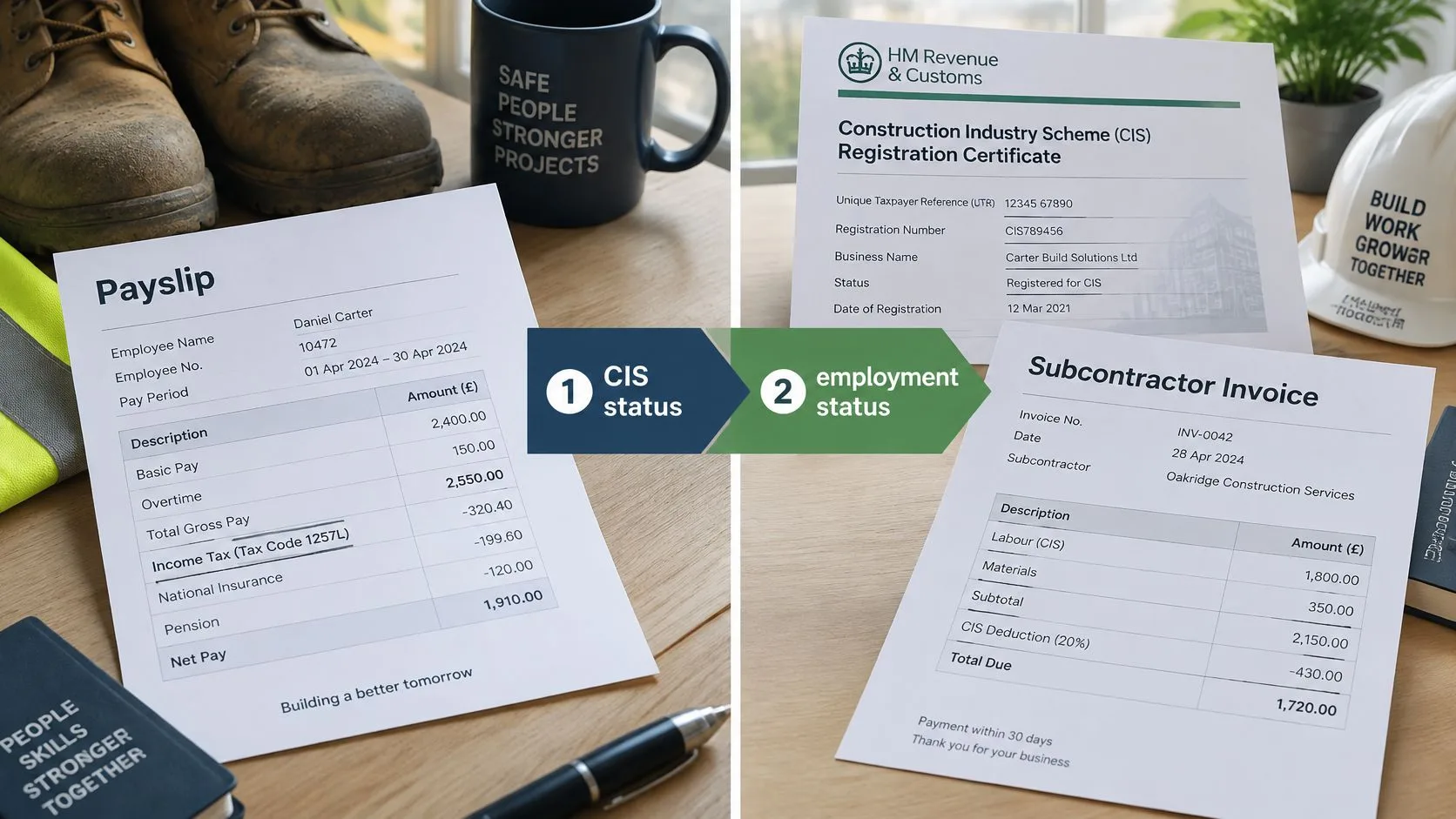
Assess the working arrangement separately
First establish whether the proposed payment belongs within CIS. Then examine the engagement itself, without treating CIS registration as the answer.
- Substitution: Can the individual send a suitable replacement, or must they attend personally?
- Control: Who determines working hours, methods, reporting lines and daily tasks?
- Personal service: Is the agreement effectively for that named person's labour?
- Financial risk: Who pays to correct defective work, and can the subcontractor profit through efficient delivery?
- Mutuality of obligation: What commitments exist to offer and accept work?
- Integration: Does the individual operate as an independent supplier or as part of your internal workforce?
No single question should become a mechanical pass-or-fail shortcut. Document the overall picture and the evidence behind your conclusion.
Look beyond the business presentation
A labour-only subcontractor who works under close daily direction deserves careful review. So does a long-term site worker whose responsibilities and reporting arrangements resemble those of your employees.
A professional website isn't decisive either. Resources such as Operosus's websites built for consultants concern how independent businesses present their services, not the legal status of each engagement.
Worker rights and tax treatment aren't interchangeable. Someone paid through CIS may still have employment-law rights, including holiday pay or protection against unlawful detriment, depending on their status.
For Scottish contractors, keep the tax review distinct from any advice needed about employment rights and their enforcement. Don't assume a satisfactory tax record closes that separate issue.
Ask yourself: would I be comfortable defending this arrangement as self-employment if HMRC asked tomorrow?
How Deductions Change by Engagement Type
The invoice calculation only becomes useful once you've established the correct treatment of the engagement. HMRC's Construction Industry Scheme manual places CIS within construction arrangements involving contractors and subcontractors who aren't employees under PAYE.
The following are hypothetical worked examples, with VAT left out to keep the arithmetic visible. They illustrate the deduction treatments rather than establish whether any particular worker belongs within CIS.
Labour-only work
Say a subcontractor submits an invoice for £9,000, entirely for qualifying labour.
| Illustrative treatment | Calculation | Deduction | Payment received |
|---|---|---|---|
| Registered, without gross payment status | £9,000 × 20% | £1,800 | £7,200 |
| Unverified | £9,000 × 30% | £2,700 | £6,300 |
There's no materials exclusion in this scenario. Don't create an allowance just because the person brings ordinary tools to site.
The accounting record should show the full invoice liability, the amount withheld and the payment made. Recording only the bank payment loses the explanation for the balance.
Labour and materials
Now suppose an invoice totals £12,000, including £4,000 of allowable, evidenced materials. The qualifying labour amount is therefore £8,000.
| Illustrative treatment | Calculation | Deduction | Total payment received |
|---|---|---|---|
| Registered, without gross payment status | £8,000 × 20% | £1,600 | £10,400 |
| Unverified | £8,000 × 30% | £2,400 | £9,600 |
The deduction comes from the labour amount, not the materials reimbursement. Retain the purchase evidence that supports the split, particularly where the invoice description is brief.
Agency-supplied workers
An agency arrangement requires a classification review before you apply invoice arithmetic. Supervision, direction or control can bring agency tax rules into consideration, so the presence of construction work doesn't automatically make CIS the right route.
If a payment falls within CIS, identify its qualifying amount. If PAYE or agency rules apply instead, don't force the payment through CIS merely because the worker is already registered.
Our comparison of contractor umbrella and limited company arrangements provides context for considering different working structures, but the structure's name doesn't replace an engagement-specific assessment.
Classify the arrangement before the first payment. Leaving that decision until year end can require corrections to both payment records and employment tax treatment.
Confirm Your CIS Position Before Your Next Payment
A useful CIS review should end with decisions, not a folder of unanswered questions. Give each unresolved item an owner and decide what must happen before the next payment is approved.
Start with your existing subcontractor population rather than only reviewing new suppliers. Older arrangements can continue unchanged in your accounting system even when the work, supervision or payment status has changed.
Turn your records into an action list
Build a complete subcontractor register. Pull the subcontractors paid during the last tax year from your ledger and bank records, then identify those whose payments rely on gross payment status. Mark any missing verification evidence so your team can distinguish a documented status from an assumption.
Assign review dates and responsibility. Put a named person against each outstanding status check and record when it should be revisited. Keep HMRC correspondence with the supplier record rather than leaving it in an individual's email inbox.
Resolve flagged working arrangements. For engagements with employment-status concerns, decide what needs specialist review before another payment is processed. Don't let a scheduled payment run become the reason nobody addresses the underlying question.
Write down the conclusion. Record the review date, the facts considered, the decision and any changes required. Include who approved the decision and what would trigger another review, such as a change in supervision or responsibilities.
Bring the evidence, not just the question
A productive review starts with the subcontractor list, contracts, recent invoices, verification records and examples of payment statements. For status questions, include a plain description of how the work happens on site.
That description should explain who allocates tasks, whether replacements are accepted and who bears responsibility for correcting work. An adviser can assess the arrangement more effectively when the paperwork and day-to-day practice are both visible.
At Stewart Accounting Services, clients can verify the qualification status of Stewart Accounting Services Limited and Mark Stewart with ICAS. That gives you a direct way to check professional credentials before discussing your business's records.
Arrange an initial consultation with Stewart Accounting Services and bring your current payment records and subcontractor list. Our initial consultation visit is without charge. Use that conversation to identify uncertain payment treatments, missing evidence and engagements that need a separate PAYE or employment-status review before your next payment run.
Recent Posts
16 Nov, 2026