

How to save for unexpected tax bills and manage what you owe

Could income you’ve already received leave you with a tax bill later? If you’re asking, “Can you help me stop worrying about unexpected tax bills?”, the first step is to understand which income may not have had tax taken off it and make a plan before a payment is due.
It’s understandable to feel unsettled when a tax bill arrives unexpectedly. Income from sources such as savings interest, property or self-employment may not be taxed automatically, so keep track of what you receive and set money aside for any tax you may owe.
This article explains how untaxed income can lead to a bill, how to build a tax reserve and what to do if you can’t pay in full. You’ll also learn how to organise your tax affairs, meet deadlines and discuss an instalment arrangement with HMRC if you’re struggling to pay. A clear plan makes the next steps easier to manage.
Key Takeaways
- Income that hasn’t had tax taken off it can lead to a bill later, so keep track of what you receive and plan for the tax due.
- Set aside money as income comes in, and review your reserve when your earnings or circumstances change.
- If you can’t pay a tax bill in full, contact HMRC to discuss whether instalments are an option.
- Pay on time where possible: according to HM Revenue and Customs, a penalty of 5% of the original Income Tax arrears applies when payment is 30 days late.
- Review your income, payslips and tax position before the end of the tax year to spot potential shortfalls sooner.
1. How untaxed income can lead to unexpected bills
A tax bill can arise when income hasn’t been taxed at source or deductions during the year don’t match your final tax position. Bank or building society interest, rental income and self-employment income may all need attention. If PAYE hasn’t covered the tax due, you may need to pay it separately.
HMRC may send two separate simple assessment letters for the 2024/25 tax year when tax is owed on bank or building society interest. A simple assessment is a calculation of tax owed. A simple assessment may be issued when tax is due outside the usual collection methods. Read each letter carefully and compare its figures with your income records.
Different taxes can contribute to an unexpected bill. Income Tax may be due on income that wasn’t taxed automatically; Self Assessment is the process for reporting income and calculating tax owed. A VAT return may show a payment due, while Capital Gains Tax may apply when you dispose of an asset at a gain. The tax depends on the income or transaction.
Keep records that support your figures: payslips, bank interest statements, invoices, business expense receipts, rental statements and records of asset purchases and sales. Retain them for the period that applies to your tax return and circumstances; the relevant period depends on your filing position and income type. Good records make an HMRC calculation easier to review.
Use HMRC’s online tax calculators where they cover your income type, then compare the estimate with your records. A calculator gives an estimate, so include all relevant income and deductions to make the result useful.
For PAYE, compare the tax code on your payslip with the code in your HMRC tax account, then review the tax deducted from each payslip. Check that your bank payment matches your net pay. If the code or deductions seem wrong, contact HMRC to query them.
If an HMRC calculation seems incorrect, gather relevant payslips, statements and receipts, then ask HMRC to explain or correct it. If you receive a penalty you believe is wrong, follow the appeal instructions on the notice and provide your reasons and supporting evidence.
Eligible tax reliefs, allowances and deductions can reduce taxable income or tax due. For example, claiming an allowable business expense as a deduction reduces taxable profit. What applies depends on your circumstances and the expense.
If tax worries are affecting your finances, contact HMRC about your tax account or approach Citizens Advice for support understanding your options. For help preparing a return, Self Assessment Tax Returns can help bring income and relevant records together before submission.
2. Preventing future bills by setting aside tax money
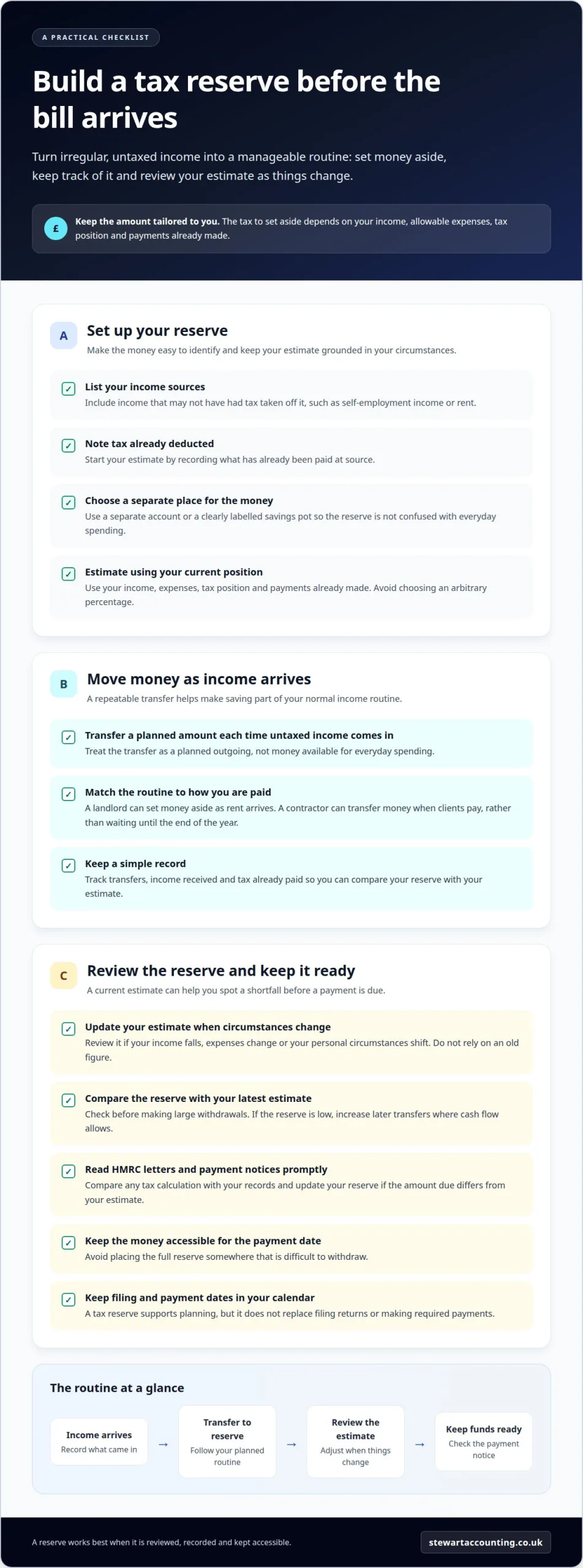
A dedicated tax reserve turns irregular income into a manageable routine. If you receive self-employment income, rent or other untaxed payments, move part of each receipt into a separate savings pot. Treat the transfer as a planned outgoing, not money available for everyday spending.
Start by listing your income sources and any tax already deducted at source. Then estimate the tax due on untaxed income using your current circumstances and the relevant tax rules. Avoid choosing an arbitrary percentage: the amount depends on your income, allowable expenses, tax position and payments already made.
For example, a landlord can transfer part of each rent payment into a reserve as it arrives. A contractor with irregular invoices can transfer money when clients pay, rather than waiting until the end of the year. If income falls or expenses change, update the estimate instead of relying on an old figure.
Make the routine simple enough to follow:
- Use a separate account or clearly labelled savings pot for tax money.
- Transfer a planned amount each time untaxed income arrives.
- Keep a simple record of transfers, income received and tax already paid.
- Review the estimate when your income, expenses or personal circumstances change.
- Compare the reserve with your latest estimate before making large withdrawals.
Regular reviews can reveal a shortfall while there’s still time to adjust future transfers. If the reserve is low, increase later transfers where cash flow allows. If it seems higher than the amount owed, keep it available until your tax position is settled. Don’t assume you’ll get a refund or spend the surplus based only on an early estimate.
HMRC letters can prompt a useful review. Read each tax calculation or payment notice promptly, compare it with your records and update your reserve if the amount due differs from your estimate. Keep enough cash accessible for the payment date, rather than placing the full reserve somewhere difficult to withdraw.
A tax reserve supports planning, but it doesn’t replace filing returns or making required payments. Put relevant tax dates in your calendar and leave time to organise funds before they’re due. Avoiding a last-minute scramble can reduce the risk of missing a payment and facing a penalty.
If your income varies or you’re unsure how much to set aside, a tailored review can help you create a workable routine. Talk with Stewart Accounting Services about making tax planning easier to manage.
3. Settling tax affairs and paying in instalments
If you can’t pay a tax bill in full, act promptly rather than waiting for another letter. HMRC may offer an instalment arrangement if you can’t afford to pay everything at once. Prepare a clear picture of your income, essential costs and existing commitments so that the amount and timing reflect what you can afford.
First, check that the bill matches your tax return and the relevant tax year. Compare HMRC’s calculation with your records, including income, expenses and tax already paid. If you spot an error, ask HMRC to explain or correct the calculation before agreeing to payments. Paying the wrong amount or overlooking an adjustment can make it harder to understand what remains due.
Next, work out a realistic monthly budget. List regular income and essential spending, then identify what’s left for tax payments. Include less frequent costs, such as annual insurance or seasonal business expenses, so the plan remains manageable beyond the first payment. Don’t promise an amount that leaves too little for basic bills.
HMRC checks whether a payment plan is affordable. If you can’t agree on a plan, HMRC will ask you to pay the amount owed in full. Be ready to explain your estimate and how you reached it. Keep copies of correspondence and record the date and amount of each payment.
In England, call HMRC’s Income Tax helpline on 0300 200 3300 about payment difficulties. The helpline is open Monday to Friday from 8am to 8pm, and Saturdays from 8am to 4pm. Have the tax calculation, account details and a budget summary ready, so you can explain the issue clearly.
If you can pay a lump sum, first consider what you can spare without missing essential costs. Citizens Advice recommends speaking to an adviser if more than £5,000 will still be owed after paying a lump sum. A larger upfront payment may reduce the balance, but it shouldn’t leave you unable to meet necessary household or business expenses.
Keep filing any required tax return while arranging payments for an existing bill. A payment plan addresses how you settle an amount owed; it doesn’t replace the return or automatically resolve later tax years. Note each agreed payment date in your calendar and compare the remaining balance with HMRC statements.
If your income changes after you agree to instalments, update your budget and contact HMRC before missing a payment. A new tax calculation, reduced work or an unexpected essential cost can affect affordability. Early communication gives you the clearest opportunity to discuss the situation and keep your tax affairs organised.
4. Filing on time and paying what you can
Filing your return and paying your tax are separate tasks. If the amount due is difficult to pay, don’t let that stop you from dealing with the return. Accurate information gives HMRC a clearer basis for its calculation and helps you understand the balance. Gather income records, allowable expenses and details of payments already made before completing it.
Check the deadline shown on your HMRC notice or tax account, because the date depends on the type of bill. For a UK simple assessment covering the 2024/25 tax year, the stated latest payment date is January 31, 2026. In England, the Income Tax payment deadline discussed by Citizens Advice is 31 January. Use the date that applies to your notice.
Paying late can add costs to Income Tax arrears. According to HM Revenue and Customs, a penalty of 5% of the original Income Tax arrears applies when payment is 30 days late. HM Revenue and Customs also applies further penalties when payment is 6 months late and when it is 12 months late. Late-payment interest applies from the first day payment is overdue.
If you can’t pay the full amount by the deadline, work out what you can afford without missing essential expenses. Check your bank balance, regular income, household bills and upcoming costs, such as a pension payment or essential business expense. Pay what you can, then contact HMRC promptly to discuss the remaining balance and possible instalments.
- Read the tax calculation and confirm the amount and payment date.
- Review essential expenses before deciding what you can pay now.
- Keep a record of each payment and any HMRC correspondence.
- Contact HMRC early if you need to discuss an affordable arrangement.
A partial payment reduces the outstanding balance, but it doesn’t automatically stop interest or penalties. Keep paying what you can manage while resolving the rest with HMRC. If your income changes, update your budget and explain the change when discussing payments.
For example, during a quiet month, a self-employed person can review the cash available after essential costs and pay an affordable amount towards the bill. They should still keep enough for upcoming expenses and tell HMRC if they need a payment arrangement for the remaining balance.
Keep the submitted return, payment confirmation and HMRC letters together. If a calculation seems wrong, raise the issue with HMRC and provide records supporting your figures. A clear paper trail helps you track what’s been paid and what remains outstanding.
5. How can I estimate my UK tax bill before the end of the tax year?
Estimate your tax using income received so far, then add income you expect before the tax year ends. Separate employment pay, self-employment profits, rent, savings interest and other taxable income. Record tax already deducted or paid, because the final amount depends on both income and payments made. A mid-year estimate is a planning tool, not a final tax calculation.
For employment income, use your latest payslip and the pay you expect for the remaining period. Check the tax code and PAYE deductions shown, then compare them with your contractual arrangements. HMRC says checking payslips and contractual arrangements can help workers confirm they’re paying the right Income Tax and National Insurance contributions. A new job or a change in pay can alter your estimate.
If you’re self-employed, total the sales or fees received and expected, then deduct qualifying business expenses. For rental income, record rent received and relevant property costs. Include savings interest and other taxable income too. Don’t count income twice if it appears in multiple records. Link each figure to a statement, payslip or invoice.
The UK personal allowance has been fixed at £12,570 since April 2021 and was scheduled not to increase until the 2028/29 tax year. Your taxable income and applicable tax rates affect the estimate after allowances and deductions. The result also depends on income type and tax already paid. Use HMRC’s tax account and available calculators to compare an estimate with your records.
- Update your income totals as new payslips, invoices or statements arrive.
- Record PAYE deductions and other tax payments separately from income.
- Include eligible expenses and reliefs supported by your records.
- Revisit the calculation when your pay, work or other income changes.
For example, after a pay rise, a worker can update expected annual earnings using their latest payslip and contractual terms. They can then compare projected Income Tax and National Insurance deductions with amounts already withheld. If a landlord’s rent changes or they incur additional costs, those figures should also change the projection. Review the assumptions, not just the final estimate.
Keep the calculation and supporting documents together so you can explain where each figure came from. If HMRC’s calculation differs, compare its income details and deductions with your records. A tax return or payment notice may reveal income missing from your earlier forecast. Revise the estimate when reliable new information arrives, rather than relying on an old snapshot.
If you’d like help reviewing your figures and tax position, get in touch about your tax estimate.
Use your HMRC tax account and available tax calculators to compare your estimate with your income records, deductions and tax payments.
Stewart Accounting Services
Stewart Accounting Services can help you organise your records and tax responsibilities. If changes to your income, bookkeeping or payroll make it harder to estimate what you owe, accurate records can help you understand your position and prepare for tax payments.
Year End Accounts Preparation, Self Assessment Tax Returns, Bookkeeping Services and Payroll Services can support different parts of the process. The right help depends on what you need to manage, from organising business records to preparing a return. Stewart Accounting Services can take routine accounting work off your hands, helping you gain more time, more money, more mind.
If you’d like to discuss your tax concerns, contact Stewart Accounting Services.
Make your next tax decision with confidence
Tax planning works best as an ongoing part of managing your finances, not a task left until a bill arrives. Set a regular time to review your records and update your expected income. If your work, income sources or personal circumstances change, revisit your plans so your tax decisions reflect your current position.
If you want help to stop worrying about unexpected tax bills, Stewart Accounting Services can support you with the accounting work behind clearer decisions. Its Year End Accounts Preparation, Self Assessment Tax Returns and Bookkeeping Services can help keep figures organised and tax reporting on track. The right support can also give you more space to focus on your work and personal priorities.
Contact Stewart Accounting Services to discuss the accounting support that fits your needs. Taking a considered next step can make future tax planning feel more manageable.
Frequently Asked Questions
Is a Surprise Tax Bill Heading Your Way?
Unexpected bills can arise if you receive income without tax being deducted or your circumstances change during the tax year. Rent, savings interest and freelance work are examples to include in your estimate. Look for a gap between total income and tax already paid, and read HMRC calculations promptly. A letter doesn’t automatically mean the calculation is correct, so compare its figures with your records.
How do I avoid unexpected tax bills in future, including self-assessment bills?
Build a routine for recording income and setting money aside whenever untaxed payments arrive. A separate account can keep tax savings apart from spending money. Update your estimate when you take on extra work, receive rent or your expenses change. Regular forecasting can help you stop worrying about unexpected tax bills by showing whether your reserve is keeping pace with your income and likely tax.
What are the UK Self Assessment filing and payment deadlines and late-payment penalties?
Check your HMRC account and tax notices for the filing and payment dates that apply to your return. The deadline can depend on how you’re required to submit it, so don’t assume the payment date is also the filing date. Late Income Tax payments can lead to penalties and interest. If you’re unable to pay, contact HMRC promptly and keep evidence of your return, payments and correspondence.
How does HMRC’s Payments on Account system work, and when are payments due?
Payments on Account are advance payments towards a future Self Assessment bill. HMRC’s calculation determines whether they apply and shows the amounts and due dates in your account or payment notice. Check those dates against your cash-flow plan, since an advance payment may fall due alongside an outstanding balance. If your circumstances change and the estimate no longer reflects your position, review the calculation and follow HMRC’s process.
How can I set aside money regularly for a UK tax bill as a self-employed person or landlord?
Transfer part of each client payment or rent receipt into a separate savings account as soon as it arrives. Regularly review your income, allowable expenses and tax already paid, then adjust the amount you set aside as your estimate changes. Keep the reserve accessible for tax payments and don’t treat it as spare spending money. This approach can make uneven self-employed earnings or rental income easier to manage.
What UK tax reliefs, allowances and deductions could reduce my tax bill?
Eligible tax reliefs, allowances and deductions may reduce your taxable income or tax due. For example, an allowable business expense can reduce taxable profit. What applies depends on your circumstances and the expense.
Recent Posts
16 Nov, 2026
16 Nov, 2026