

Accountant in Alloa: Plain-English Help with Accounts and Tax

What if your accounts helped you make decisions instead of leaving you puzzling over unfamiliar terms? An accountant in Alloa who explains things in plain English can help you understand what your figures show and what needs attention. You don’t need a financial background to follow the essentials.
Accounts and tax can feel complicated, especially when terms such as assets, liabilities, profit and tax deductions appear without explanation. Understanding these terms helps you see how money moves through your business, what you owe and how your results are presented.
This guide explains common accounting terms in everyday language and shows how accounts and tax fit together. You’ll learn what key figures mean, how professional support can clarify the process, and when it may help to have an accountant handle the work. The aim is simple: help you understand your business finances and gain more time, more money and more peace of mind.
Key Takeaways
- Understand how financial terms fit together so you can follow the story behind your business accounts.
- Learn what tax planning and return preparation can cover, and why your circumstances matter when assessing your needs.
- Find practical details about local support in Alloa and what to consider when arranging a conversation.
- Assess an accountant’s explanations, approach and experience against your business structure and tax situation.
- See when support with bookkeeping, payroll, year-end accounts or Self Assessment may help take it off your hands.
Explaining accounts to people without a financial background
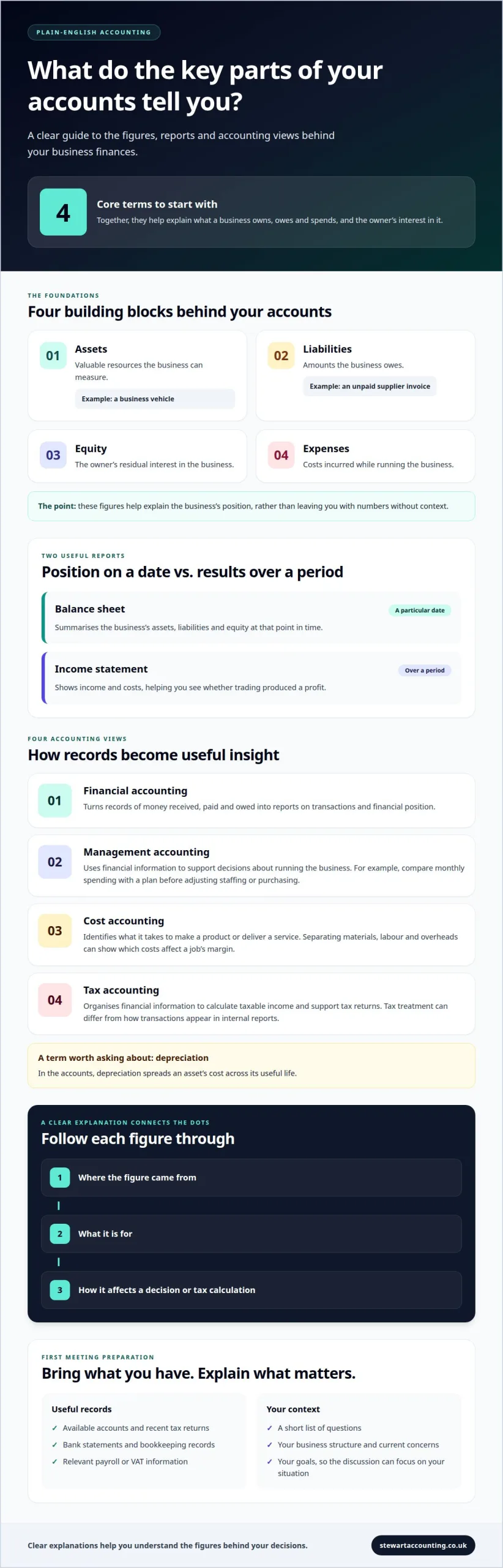
Financial accounts are organised records that show what a business owns, owes, earns and spends. Start with four terms: assets are valuable resources the business can measure; liabilities are amounts it owes; equity is the owner’s residual interest; and expenses are costs incurred while running the business. For example, a business vehicle can be an asset, while an unpaid supplier invoice is a liability. These numbers help explain the position behind a statement, rather than just presenting figures without context.
Financial accounting prepares reports on a business’s transactions and financial position. It turns records of money received, paid and owed into statements that can be reviewed and understood. A balance sheet, for example, summarises assets, liabilities and equity on a particular date. An income statement shows income and costs over a period, helping you see whether trading produced a profit. Record-keeping includes organising transaction evidence and tracking amounts due.
Management accounting uses financial information to help directors make decisions about running the business. A director might compare monthly spending with a plan, then decide whether to adjust staffing or purchasing. Cost accounting identifies what it takes to make a product or deliver a service. Separating materials, labour and overheads, for example, can show which costs affect a job’s margin. These views turn figures into practical choices.
Tax accounting organises financial information to calculate taxable income and support tax returns. It considers how transactions are treated for tax, which can differ from how they appear in internal reports. A clear explanation should connect each figure to its source, purpose and effect on a decision or tax calculation. If depreciation appears, for example, the accountant should explain that it spreads an asset’s cost across its useful life in the accounts.
Financial statements can feel intimidating when the labels are unfamiliar or a poor result seems like a sign of failure. An accountant can explain what changed, such as lower sales or higher costs, and distinguish a cash shortage from an accounting loss. Senior financial guidance can help a business interpret performance and plan decisions. Strategic advice uses the accounts to consider options, risks and priorities, rather than simply reporting past results.
For a first meeting, bring available accounts, recent tax returns, bank statements, bookkeeping records and relevant payroll or VAT information. Prepare a short list of questions and explain your business structure, current concerns and goals, so the discussion focuses on your situation.
To change accountants, agree a handover date and ask your new accountant to coordinate the transfer of relevant records with your current accountant. Review your engagement terms for notice periods or fees, and plan around filing deadlines to reduce the risk of missing information or duplicated work.
Choosing an accountant in Alloa that explains things in plain English means you can ask what each statement shows and how it affects your decisions. Clear explanations help you understand the figures, while Year End Accounts Preparation can bring the reporting work together.
Tax planning and tax return services
Tax planning means reviewing business decisions and records to understand their possible tax effects. It helps you make informed choices before acting, rather than discovering the consequences afterwards. Before buying equipment, for example, an accountant can explain how the purchase affects cashflow, profit and tax records. Not every option suits every business, so the right approach depends on your trading structure and circumstances.
A tax return reports relevant income and financial details to HMRC. Preparing one involves gathering records, checking how income and expenses are treated, and explaining the resulting figures. A sole trader might need business income and expense records, while a landlord may need details of rental income and property costs. Clear explanations show where each figure came from and what action follows.
Bookkeeping is the organised recording of money received and paid by a business. Accurate records support tax calculations and make it easier to trace figures to invoices, receipts or bank transactions. Separating a business purchase from personal spending, for example, helps explain its purpose. Regular bookkeeping also makes year-end preparation more orderly, as missing records can take time to resolve.
Accounting and tax support connects financial records with reporting and tax decisions. It can include reviewing bookkeeping, preparing accounts, explaining figures and identifying questions that need attention. A contractor, for example, may need help understanding how income, operating costs and tax records fit together. The useful outcome is not just a completed statement, but a clear explanation of what it means and what to do next.
VAT services help a business organise VAT records and prepare information for VAT returns. An accountant can explain how sales, purchases and VAT entries appear in the records. A return may need review if an invoice is missing or a transaction has been recorded incorrectly. Clear explanations show how reported figures relate to business activity and any payment due.
In Alloa, local support makes it easier to discuss your business face to face, while remote accounting can suit businesses in different locations. Stewart Accounting Services supports clients across Central Scotland and remotely throughout the UK. An accountant can discuss the information relevant to your circumstances, such as bookkeeping records, previous returns and upcoming business decisions. Remote communication lets businesses elsewhere in the UK share records and questions without relying on local meetings.
Before a discussion, gather the records relevant to your question and identify the decision you need to make. If you are preparing a return, tax return preparation connects those records with the reported figures. For help understanding your tax position and what information to organise, you can talk through your accounting needs.
Alloa office location and contact details
An office location is a local base from which a firm serves clients. Stewart Accounting Services has an office in Alloa, as well as offices in Falkirk and Stirling, and also works remotely with clients. For example, a business owner can discuss records and upcoming decisions face to face or remotely, without treating accounts as a purely online subject.
Contact details are the information used to reach a firm, such as its telephone number or postal address. Before getting in touch, decide whether your main concern is an annual accounts deadline, a tax return or an unclear figure in your records. A focused opening message helps direct the discussion to the right subject.
An annual account is a financial report prepared for a business’s accounting year. Its figures can explain performance and financial position, but are most useful when linked to your decisions. If costs rose during the year, for example, ask which categories changed and how that movement appears in the statements.
An auditor examines financial statements and supporting records. An auditor’s role differs from general accounting support, so explain whether you need help understanding accounts, organising records or preparing reports. A clear description of the task helps distinguish an audit question from a bookkeeping or year-end reporting question.
For a first conversation, prepare a short outline covering your business structure, the accounting issue and the outcome you need. A sole trader asking about annual figures may need a different discussion from a limited company director reviewing business performance. Mention the relevant period and any approaching deadline to help frame the conversation.
If you plan to meet in Alloa, organise the records relevant to your question before you travel. Bring recent accounts, bookkeeping information or correspondence connected with the issue, for example. Keep personal documents separate from business records so the discussion can focus on the right transactions and decisions.
Remote discussions can work well for businesses outside Alloa. A clear email summary followed by a conversation can help explain a particular entry or reporting question. Identify the statement line that concerns you and describe the decision that depends on it. Avoid sending unrelated records, which can make the issue harder to pinpoint.
Before contacting an accountant, write down the questions you want answered. You might ask what a figure means, which records are relevant or how the next reporting step works. If you’re discussing annual accounts, identify the period they cover and any changes in your business, such as a new income stream or major cost.
Good preparation makes a conversation with an accountant in Alloa more useful, whether you meet locally or discuss your accounts remotely. A defined question, relevant examples and organised records give the accountant a clear starting point. You can focus on understanding the figures and making informed decisions, rather than explaining every part of your business at once.
What should an accountant explain when you’re choosing one in Alloa?
Scope of work means the tasks an accountant will handle and those that remain your responsibility. Ask for a plain-English explanation of what happens each month, quarter or year. Clarify whether the work covers bookkeeping, annual accounts, tax returns or selected tasks only. Knowing the boundaries helps prevent gaps, such as assuming someone is recording invoices when you still need to provide them.
An engagement letter is a written agreement describing the work, responsibilities and charges. Ask the accountant to explain each section before you agree. Check what information you need to supply, how questions are handled and whether extra work falls outside the agreed scope. Ask what could trigger additional work, such as incomplete records or a change in business activity.
Fees are the amounts charged for agreed accounting work. Ask how the fee is calculated and what it covers, rather than comparing headline figures alone. For example, one arrangement might include routine bookkeeping, while another covers year-end reporting only. Ask how additional requests are priced and when invoices are issued. A clear explanation lets you judge the likely cost against the work your business actually needs.
Record requirements are the documents and details needed to complete accounting tasks accurately. Ask which records to provide, how often to send them and which format to use. A business with regular customer invoices, for example, may need to provide sales records, purchase evidence and bank information. Agreeing the process early helps reduce missing details and makes it easier to trace reported figures.
Communication arrangements explain how you and the accountant will share information and discuss decisions. Ask who your main contact will be and how unfamiliar terms will be explained. You could bring a question, such as why a cost appears differently in a report. A useful answer connects the entry to its effect instead of simply repeating an accounting label.
Business fit means the accountant understands the records and decisions relevant to your type of organisation. Sole traders, landlords and limited companies have different reporting needs. Explain your structure and ask how the accountant would approach a practical example from your situation. A company director, for instance, may want to understand a change in costs before revising a spending plan.
Professional credentials are qualifications or memberships that indicate relevant training or professional standing. Stewart Accounting Services is a firm of Chartered Accountants and is Xero-accredited. Ask what the credentials of the person responsible for your work mean for the service you need, and how figures are checked and corrections explained. Clear answers about qualifications, review steps and responsibilities help you make an informed choice in Alloa.
Before deciding, summarise the agreed tasks, records, communication and charges in your own words. Ask the accountant to clarify anything that remains unclear. This gives you a practical basis for comparing the proposed service with your priorities, whether you need help with routine records, annual reporting or understanding your financial position.
How can an accountant demonstrate experience with your type of business or tax situation?
Relevant experience means practical knowledge of the records and decisions your business needs. Explain whether you are a sole trader, landlord, contractor or limited company director, then ask how the accountant approaches work for that structure. A landlord’s rental records differ from a contractor’s business income records, for example, so the explanation should relate to your circumstances.
A worked example shows how an accountant would approach a situation similar to yours. Describe a real question, such as organising income from several activities or understanding a change in reported costs. Ask what information is needed, how the figures will be reviewed and how the result will be explained. A clear process is more useful than a general claim of experience.
Professional credentials are qualifications or memberships that indicate training or professional standing. Stewart Accounting Services is a firm of Chartered Accountants and is Xero-accredited. Ask what these credentials mean for your work, who will handle your records and how conclusions will be explained. Credentials are one useful part of the picture, alongside relevant experience and clear communication.
A relevant case example describes a type of past assignment without revealing confidential client information. Ask whether the accountant has worked with a business structure like yours or a tax situation with similar features. A limited company director, for instance, could ask how the accountant explains the relationship between company results and decisions about future spending. The response should clarify the method without disclosing another client’s private details.
Technical explanation means translating accounting or tax terms into language you can use. Test this by asking what a specific figure means, such as a cost shown in your accounts, and how it affects a decision. A helpful response connects the entry to its source and purpose. If the answer relies on unexplained jargon, ask for an example based on your records.
Continuity of support means knowing who manages your work and how questions are handled. Ask whether the same person reviews your records and explains important points, or whether responsibilities are shared. Clarify how an upcoming year-end deadline will be managed and what information the accountant needs from you. This helps you assess whether the working arrangement suits your business routine.
Evidence of fit is a clear connection between your needs and the accountant’s approach. Summarise your business structure, the tax issue and the decision you need to make. Then consider whether the response covers relevant records, explains the process and identifies what the final advice will help you understand. This makes it easier to assess practical value rather than rely on broad claims.
If you want to discuss your business structure or tax situation with an accountant, get in touch to discuss your needs.
Stewart Accounting Services
Stewart Accounting Services helps make sense of business accounts and tax, with explanations connected to your records and decisions. If year-end figures feel unclear, Year-End Accounts support can help you understand what the statements show. Self-Assessment Tax Returns, bookkeeping and payroll support can also help when those tasks are taking time away from running your business.
Bring your questions and explain what you need to understand or take it off your hands. The discussion can focus on the accounting work relevant to your circumstances, helping you work towards more time, more money, more mind.
Contact Stewart Accounting Services to discuss your accounting needs.
Make your next financial decision with clarity
Clear financial advice is most useful when it helps you decide what to do next. If you’re looking for an accountant in Alloa that explains things in plain English, focus your first conversation on a current concern or upcoming decision. A specific starting point can help you understand what information matters and what support would be useful.
Stewart Accounting Services can help with the practical work behind that clarity, including Year End Accounts Preparation, Self Assessment Tax Returns and Bookkeeping Services. You can discuss the accounting support that fits your business and ask for explanations that connect the figures with your day-to-day decisions. The aim is to make financial administration easier to manage, giving you more time, more money, more mind.
Take the next step at your pace. Contact Stewart Accounting Services to discuss what you need help understanding. A clear conversation can be a positive starting point for feeling more confident about your business finances.
Frequently Asked Questions
What accounting and tax services do accountants in Alloa provide?
Accountants in Alloa can support businesses with accounts, tax returns, bookkeeping, payroll and VAT reporting. Stewart Accounting Services provides these services, along with management accounts. A sole trader, for example, may need help preparing a Self-Assessment Tax Return, while a limited company may need year-end accounts and ongoing bookkeeping. The right mix depends on your business structure and which financial tasks you want handled.
Recent Posts
18 Nov, 2026
18 Nov, 2026