

CIS vs PAYE: Which Applies to Your Workers in 2026

The most popular piece of advice on this subject is that CIS is the cheaper way to pay a worker. Register them as a subcontractor, take 20% off the labour, and you've dodged employer's National Insurance, holiday pay, pension contributions and sick pay. It's repeated on forums, in agency emails and in most of the guides that rank for CIS vs PAYE. It's also wrong often enough to put good businesses out of pocket.
Worker status isn't a dropdown you select for tax convenience. It's a legal conclusion drawn from how the engagement runs. HMRC's CIS manual is explicit that a subcontractor's registration or gross-payment status tells you nothing about whether PAYE should apply, because status turns on the facts and terms of the particular engagement.
So treat this as two decisions, in this order. First, who is an employee? Second, how does each group get paid? The 20% and the 30% come a distant third, and they're the easiest part of the whole question.
CIS and PAYE at a Glance
The deduction rate does not decide whether to use CIS or PAYE. The engagement does. CIS covers qualifying construction payments to subcontractors; PAYE is used to pay employees through payroll. Compare the two only after assessing each working arrangement.
| Feature | CIS | PAYE |
|---|---|---|
| Who it applies to | Subcontractors paid by contractors for construction work | Employees and pension recipients on the payroll |
| Who makes the deduction | The contractor, before paying the subcontractor | The employer or pension provider, before paying wages or pensions |
| Deduction rate | 20% for a verified subcontractor, 30% if unregistered or unmatched, or 0% with gross payment status | Income tax and employee National Insurance, calculated using the tax code and earnings |
| What the deduction is | An advance payment against the subcontractor's tax and National Insurance | Income tax and National Insurance withheld from pay |
Under CIS, a verified subcontractor usually has 20% withheld from the qualifying labour element. The rate is 30% if the subcontractor is unregistered or cannot be matched, and 0% if they hold gross payment status.
CIS deductions are payments on account of income tax and National Insurance, not the subcontractor's final tax bill. The subcontractor claims credit for them through the relevant tax process, as explained in HMRC's CIS reform manual.
PAYE deductions are calculated from the employee's earnings and tax code. A construction business can run both schemes at the same time, using PAYE for employees such as an office manager, estimator or apprentice, and CIS for subcontractors who invoice for construction work. Businesses hiring internationally can find compliant global hiring guidance.
Working on a construction site does not, by itself, make someone a CIS subcontractor. The terms and reality of the engagement matter.
Review the people you pay for construction work and classify each engagement as employee, subcontractor or unclear. Resolve the unclear cases before choosing a payment route.
Why CIS Registration Does Not Decide Worker Status
The assumption I hear most often is that a CIS-registered subcontractor must be self-employed, because HMRC registered them. It doesn't follow, and HMRC says so directly. Employment status depends on the facts and terms of the particular engagement, and a subcontractor's CIS registration or gross-payment status is irrelevant to deciding whether PAYE applies (HMRC CIS reform manual on employment status).
The same person can legitimately be paid under CIS on one contract and need PAYE on another when the working relationship changes. A decorator who prices a bathroom refit and sends a mate when he's double-booked is a subcontractor on that job. The same decorator working five days a week in your yard, at your times, using your kit, under your supervisor, is very likely an employee on that engagement.
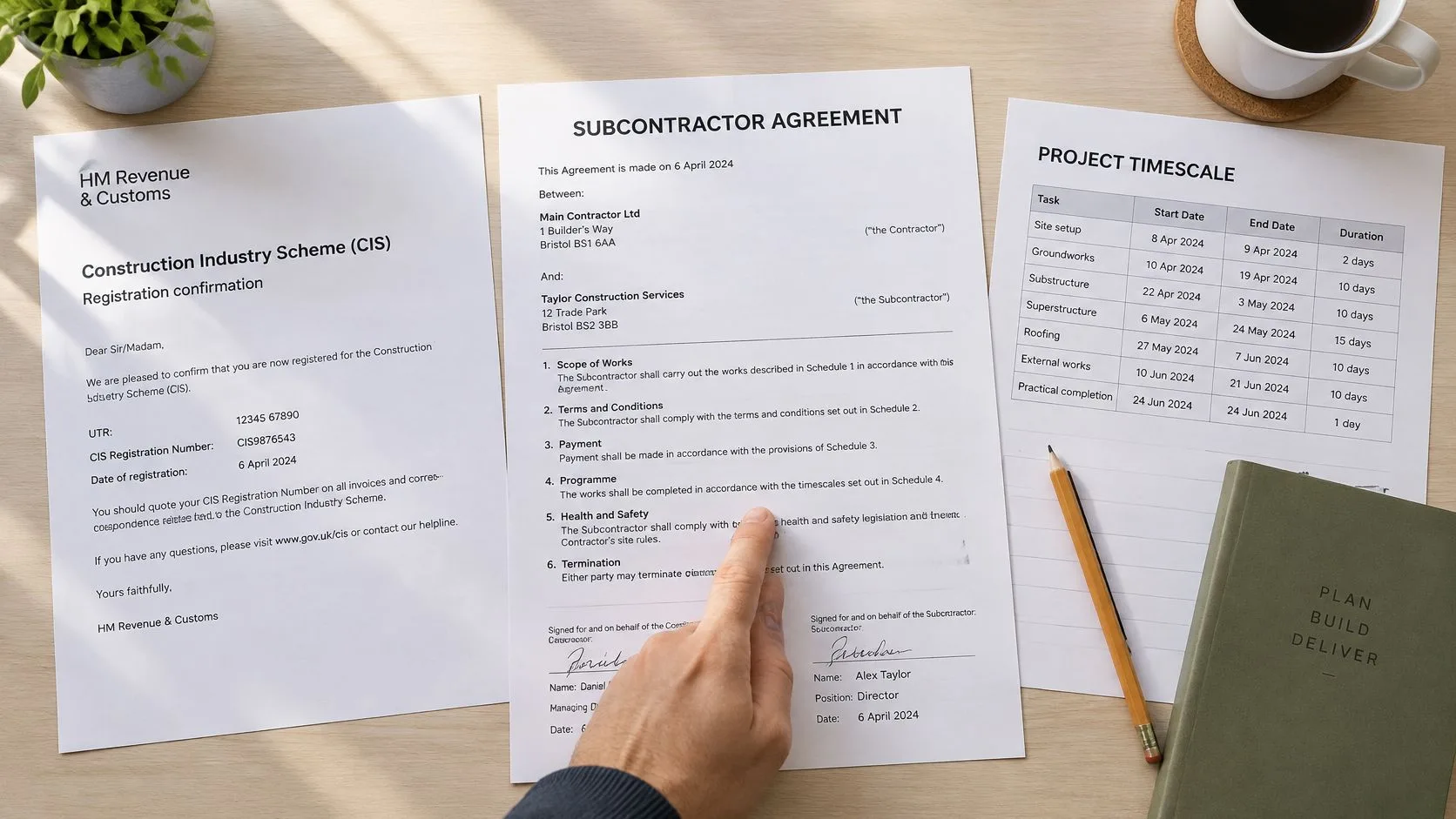
The five tests that decide status
Work through these five for each engagement, not for each worker:
- Control: who decides what gets done, when, where and how. A site foreman directing the day is control. A client pointing at a wall and asking for a price is not.
- Substitution: can the worker send a qualified replacement, at their own cost, without asking permission first? A right that exists on paper and is never used needs explaining.
- Financial risk: who prices the job, who absorbs the loss when it overruns, who returns to fix defects at their own cost.
- Equipment: whose tools, plant and consumables. A labourer using your mixer, your breaker and your fuel is being equipped, not contracting.
- Integration: whether the worker is part of your business, attending your meetings, appearing on your team list, subject to your holiday and discipline rules.
Two contrasting examples show the split. A self-employed electrician quotes for a job, supplies his own test equipment, carries his own insurance and can send a qualified substitute. He's a subcontractor on that engagement and CIS applies. A labourer on fixed hours who takes instructions from the site foreman, uses your plant and can't send anyone else is an employee, whatever his invoice says and whatever his registration shows.
The point most guides skip: moving a worker from PAYE to CIS to cut cost doesn't reduce your risk. It moves the same tax exposure from a known payroll bill to an unknown arrears bill, and HMRC can look back over several years.
That's the contrarian bit, and it's where the money is. If the underlying relationship is employment, CIS withholding doesn't convert it. The deductions you made become an underpayment of PAYE and National Insurance, with penalties and interest layered on top, and HMRC's revised guidance on agencies and off-payroll working has tightened the ground further. The risks of engaging employees as sham contractors are worth reading in full before you restructure a regular crew into subcontractors.
Write the status facts down for every engagement before the first payment: control, substitution, risk, equipment, integration. Review the file whenever the terms change, because the answer changes with them. For firms using labour agencies, personal service companies or mixed teams, that file is what stands between you and an enquiry you can't answer.
How CIS Deductions and Payments Work
Before you pay a subcontractor for the first time, verify them with HMRC. Verification decides which of three outcomes you're in, and it decides it before the invoice arrives rather than after.
CIS deduction rates by subcontractor status
| Subcontractor status | Deduction on labour | What the subcontractor receives |
|---|---|---|
| Verified and registered | 20% | 80% of the qualifying labour payment |
| Not registered or cannot be matched | 30% | 70% of the qualifying labour payment |
| Gross payment status | 0% | 100%, but tax is still due from the subcontractor |
Once you know the status, the arithmetic is simple. What causes the errors is the base you apply it to. The deduction is calculated after excluding VAT, materials you bought in directly, plant hire, fuel used for the job and consumable stores (HMRC on making deductions and paying subcontractors). If the invoice arrives as one lump sum with no split, you'll either over-deduct and irritate a good subcontractor or under-deduct and pick up the difference in an HMRC review.
Separate labour from materials before you calculate
Take a verified subcontractor who invoices £1,000 for labour and £300 for materials they bought directly on your behalf, plus VAT. The deduction applies to the £1,000 labour element only: £200 withheld, £800 paid. The £300 of materials is reimbursed in full and the VAT passes through untouched.
Build that split into your purchase ledger. Every subcontractor invoice gets coded by labour, materials, plant hire and VAT, and anything you can't split gets queried before payment rather than after.
The withheld amount isn't a charge on the subcontractor's income. It's money paid early against their own tax and National Insurance, which they credit on their return. A verified subcontractor banks 80% of the qualifying labour now and settles later. A gross-paid subcontractor banks 100% and still accounts for tax personally, so gross status changes their cash flow, not their duty.
Four controls prevent almost every dispute:
- Verify before the first payment, and re-check if the subcontractor's circumstances change.
- Insist on a split invoice showing labour, materials, plant hire and VAT separately.
- Issue a deduction statement for each subcontractor, showing gross, deductions and net. It's their evidence for the credit they claim.
- Reconcile monthly, matching what you deducted against what you paid over to HMRC.
None of this is complicated, but it has to happen before the money leaves your account. Our guide to CIS deductions explained walks through the calculation sequence if you'd rather check the method against your own invoices.
PAYE Filings and the Deadlines That Follow
The key PAYE risk is not the rate. It is missing a filing or payment deadline because no one owns the payroll calendar.
PAYE and CIS filings and their deadlines
| Obligation | Who files or pays | Due |
|---|---|---|
| Full Payment Submission | Employer | On or before each payday |
| Employer Payment Summary | Employer, where required | By the 19th of the following tax month |
| PAYE liabilities | Employer, paid electronically | Generally by the 22nd |
| CIS monthly return | Contractor, every month | Usually by the 19th of the following tax month |
| Nil CIS return | Contractor with no subcontractors in the period | Monthly from April 2026 |
An employer must send a Full Payment Submission on or before payday. Where an Employer Payment Summary is required, it is due by the 19th of the following tax month. PAYE liabilities are generally due by the 22nd when paid electronically.
PAYE means keeping employee payroll records up to date, calculating tax and National Insurance, and checking pension assessments and benefits in kind. CIS has a different monthly process for contractors. Keep the filing responsibilities clear, and make sure the person handling payroll knows which deadlines apply.
Where small firms slip
A late payroll change can affect more than one submission. Check the Full Payment Submission and, where required, the Employer Payment Summary together. Otherwise, year-end figures may not reconcile and take time to correct.
Quiet periods create another risk. CIS contractors must still file a monthly return, including a nil return when there have been no subcontractor payments.
Assign one person to oversee the payroll and CIS calendar. At Stewart Accounting Services, Arlene is responsible for all payroll, CIS and pension matters. Keeping these responsibilities together helps prevent missed filings and inconsistent records.
Getting worker status wrong has more serious consequences than missing a routine deadline. If someone should be treated as an employee but is paid through CIS, the business may face underpaid PAYE and National Insurance, interest and corrective reporting. Use the payroll submission steps for reporting pay to HMRC to check the filing sequence and keep each submission on schedule.
Cash Flow and Year-End Effects for Limited Companies
The deduction rate is not the main cash-flow risk for a limited company subcontractor. It is the time between CIS money being withheld and HMRC crediting it. Treating a worker as a CIS subcontractor when the engagement belongs on PAYE can create arrears instead of a tax saving.

The two submissions that release the credit
A limited company claiming CIS deductions suffered must submit two Employer Payment Summaries: one reporting no payment for the period, then a final submission reporting the year's CIS deductions. HMRC says that from April 2026, contractors must file monthly even when they have used no subcontractors, either by submitting a nil return or requesting inactivity (HMRC 2026 to 2027 employer further guide). A missed submission can delay the credit, leaving less cash available for operating costs.
Consider £10,000 in verified labour payments. The contractor withholds £2,000, so £8,000 reaches the company's bank account. The withheld amount cannot cover wages, materials or VAT while the company waits for its year-end submissions to be completed and processed.
Gross status and net status hit cash differently
Gross payment status improves cash flow, but the company still has reporting and record-keeping duties. With net status, deductions leave the account before HMRC credits them, tying up cash even when the eventual tax bill is modest.
Protect the cash position with these five controls:
- Keep verification records for each subcontractor, including the check date and result.
- Separate labour from materials so the deduction base is clear.
- Match deduction statements against the invoices paid.
- Forecast corporation tax and PAYE cash needs against expected credits, not gross invoices.
- Calendar monthly returns, including quiet months, so a missed filing does not delay a credit.
These records make year-end a reconciliation exercise. Without them, delayed credits can become a funding problem.
Which Arrangement Fits and What to Confirm Next
There's no single winner in the CIS vs PAYE question, and any adviser who gives you one hasn't looked at your work. The arrangement follows the facts of each engagement, which means the decision gets made per person.
Usual arrangement by working situation
| Working situation | Usual arrangement | Check before the first payment |
|---|---|---|
| Self-employed trade with own tools and several clients | CIS subcontractor, verified | Registration status and gross payment request |
| Worker on fixed hours under a site foreman | PAYE employee | Payroll set up and employer obligations in place |
| Agency-supplied labour | Set by the contract and control facts | Agency status evidence and who makes the deductions |
| Mixed team on one site | Both, decided per worker | Separate records and status file for each person |
| Long contract with a sole trader | Review each engagement | Written status assessment before the first payment |
Self-employed trade with own tools and several clients. CIS, verified, 20% withheld from the labour element. Check registration before the first payment and establish whether they qualify for gross payment status, since that affects their cash flow rather than your obligations.
Worker on fixed hours under a site foreman. PAYE from day one. Payroll set up, employer National Insurance budgeted, pension assessment completed, written contract issued.
Agency-supplied labour. Read the contract, not the invoice. Ask who makes the deductions, get the agency's status evidence in writing and confirm who carries the PAYE liability if the status turns out to be wrong.
The scheme follows the working relationship, not the label on the invoice. When the facts say employment, CIS withholding doesn't change that. It just delays the discovery.
Mixed team on one site. Both schemes, decided per person, with separate records. A site where the groundworks gang is on CIS and the labourers are on PAYE is normal and defensible, provided the file shows the reasoning.
Long contract with a sole trader. Review it at each renewal. A tradesman who starts on a three-week job and ends up full time, on your kit, at your hours, has changed status without anyone deciding to change it.
What to confirm before the next payment run
- Mark every worker you paid for construction work or wages as employee, CIS subcontractor or unclear, using the table above.
- Record the five status facts for each unclear case: control, substitution, financial risk, equipment and integration.
- Check verification and registration for every subcontractor before paying, and keep the result on file.
- Confirm the invoice split between labour, materials, VAT and plant hire before calculating any deduction.
- Put the next three paydays and their CIS and PAYE filing dates in one calendar, so the 19th and the 22nd stop arriving as a surprise.
If the facts stay unclear after that, take the file to a qualified adviser before you make the payment. A wrong call costs far more to unwind in arrears than a review costs up front, and HMRC forms its view on the evidence you can produce, not the contract template you downloaded.
This is routine work here. Stewart Accounting Services runs SME payroll services and CIS support for clients across Central Scotland and the rest of the UK, with Cara handling our unincorporated clients and Arlene covering payroll, CIS and pensions, so the status question and the filing calendar sit with people who see both sides. The initial consultation is free.
Bring three things to that first conversation: your last quarter's subcontractor payments, your current payroll list and any CIS deduction statements you've received. We'll mark each worker as employee, subcontractor or unclear, test the unclear ones against the five status facts, and tell you which filing deadline you're closest to missing. Doing it before the next payment run is cheaper, faster and considerably less stressful than doing it after an HMRC letter lands on the mat.
Recent Posts
18 Nov, 2026
16 Nov, 2026
16 Nov, 2026