

CIS Gross Payment Status: Who Qualifies and How to Apply

CIS gross payment status means your contractor pays the full invoice with 0% deducted for tax, where a registered subcontractor without it loses 20% of each payment and an unregistered one loses 30%. Nothing about your actual tax bill changes. What changes is that the money stays in your account until you settle it yourself through Self Assessment or a Corporation Tax return.
That shift is worth real money, and it comes with a condition most applicants underestimate. Gross status is granted on a look back over your whole tax record and then reviewed again every year, so the businesses that lose it are rarely the ones that missed the turnover figure. They're the ones who filed a VAT return a fortnight late in a quiet month and didn't think it counted.
Treat the status as a punctuality test across every tax account you hold, not a form you fill in once, and the rest of this guide makes sense. Get the records clean first, apply second, and keep the cash flowing.
What Gross Payment Status Changes on Every Invoice
Think of the standard CIS deduction as a prepaid tab. A contractor holds back a slice of every labour payment and sends it to HMRC as an advance against the tax you'll owe, and you settle the difference after the year end. Gross payment status closes that tab. The contractor pays the invoice in full and you settle the lot yourself when your return is filed.
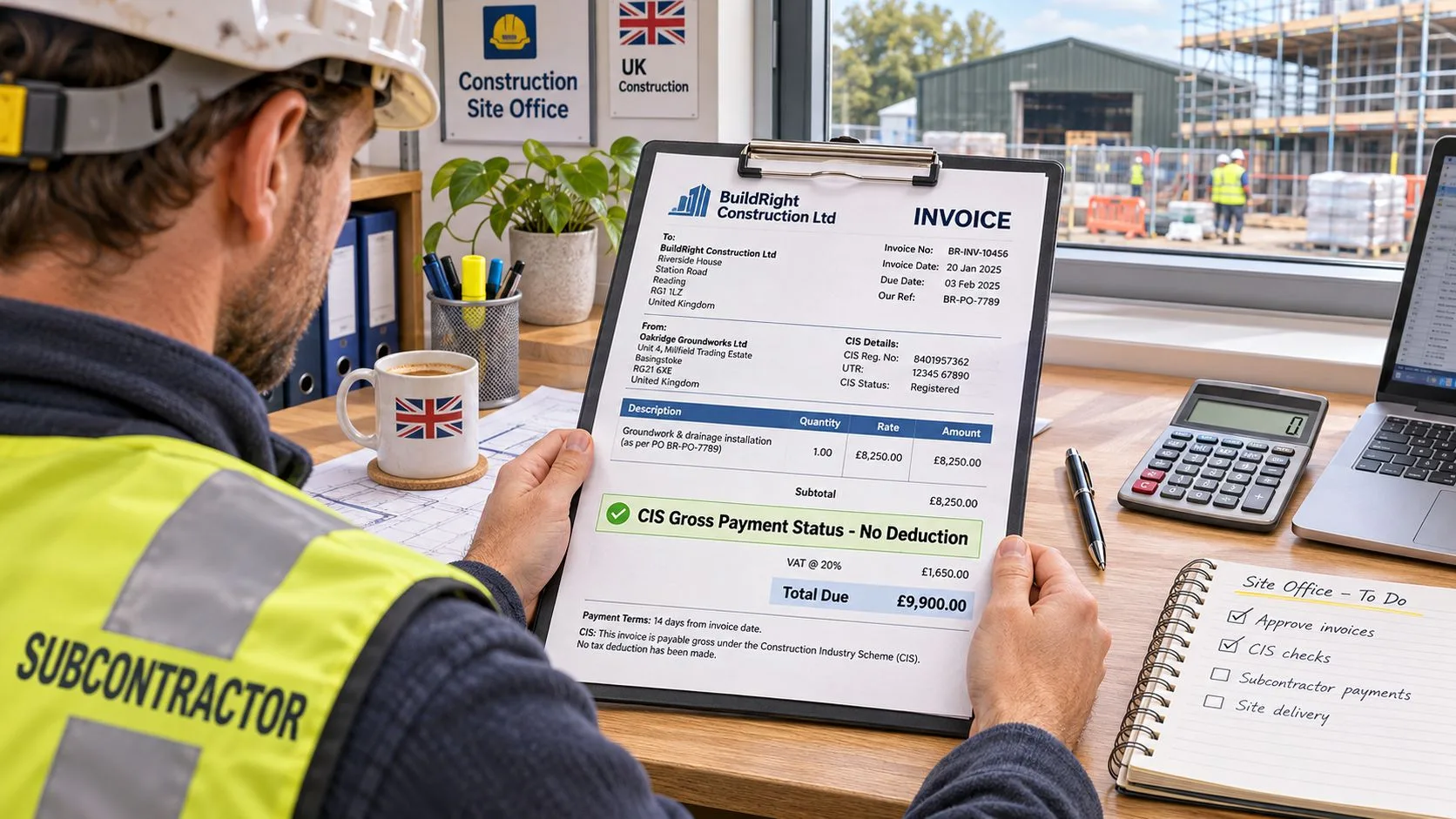
On a £1,000 labour invoice, a subcontractor under deduction sees £800 land while HMRC holds £200. The same invoice paid gross lands at £1,000, with the tax falling due later. GOV.UK's guidance for CIS subcontractors sets out the three treatments: no deduction with gross status, 20% deducted for a registered subcontractor without it, and 30% where the subcontractor hasn't registered at all.
| Status | Deduction from each payment | Who settles the tax and NICs |
|---|---|---|
| Gross payment status | None | You, through your own Self Assessment or Corporation Tax return |
| Registered for CIS, no gross status | 20% advance payment | Deducted by the contractor and offset against your final bill |
| Not registered for CIS | 30% | Deducted by the contractor at the higher rate until you register |
The bill doesn't disappear. Gross status doesn't make the income tax-free. You still report every payment, still pay income tax or corporation tax, and still pay National Insurance, and you now carry the budgeting that a contractor used to do for you. That's the trade: earlier cash in exchange for self-discipline later.
Status doesn't decide employment status. HMRC is explicit that CIS registration or gross status doesn't establish that you're self-employed. The contractor has to assess the relationship for each engagement and operate PAYE where it looks like employment. Win the deduction argument and lose that one, and you've gained nothing.
It can be taken away. HMRC can move a subcontractor from gross payment back to payment under deduction. Where it does, it must generally give 90 days' notice, which is your window to appeal.
The cash-flow point: the deduction doesn't cost you tax, it costs you timing. Gross status hands the timing back to you, and the discipline with it.
Find your row in that table before reading on. If you're in the 20% or 30% line and want to know how the money already held gets reconciled after the year end, our explanation of CIS deductions covers the reclaim.
The Three HMRC Tests
Gross payment status depends on three separate tests. You must pass all three: the business test, the turnover test and the compliance test. Treat them like three locks on the same door. Clearing one does not open it.
The business test checks that you carry out construction work or provide construction labour in the UK, and that the business operates through a bank account. A sole trader who mixes business and personal payments through a personal current account should check that this meets HMRC's requirement.
The turnover test measures net construction turnover for the previous 12 months, excluding VAT and the direct cost of materials. HMRC's gross payment status guidance sets the minimum at £30,000 for a sole trader, £30,000 per partner with at least £100,000 for the partnership overall, or £30,000 per director with at least £100,000 for the company overall. For a company controlled by five or fewer people, the per-person threshold applies to each controlling person.
The compliance test checks whether you have a satisfactory record of paying tax and National Insurance on time. It covers your wider tax record, not just your CIS payments. A late VAT or PAYE payment can put gross status at risk and leave contractors deducting tax from your invoices.
| Business type | Minimum net construction turnover | How the threshold applies |
|---|---|---|
| Sole trader | £30,000 | One individual test |
| Partnership | £30,000 per partner, and at least £100,000 overall | Each partner counts toward the total |
| Company controlled by five or fewer people | £30,000 per director or controlling person, and at least £100,000 overall | Each controlling person counts |
| Any structure, alternative route | £200,000 | Applies regardless of the number of participants |
For a company or partnership, the per-person threshold can raise the target. A four-director company needs £120,000 to meet the multiplied test. HMRC's Construction Industry Scheme Reform manual also describes an alternative route requiring £200,000 of net construction turnover, regardless of the number of participants. A four-director company with £110,000 of net turnover fails the £120,000 multiplied test and the £200,000 alternative, so it needs to reach £120,000 to qualify on the multiplied route. A two-director company with £70,000 fails both routes.
Passing the turnover test alone is not enough. A business can clear the £200,000 threshold and still fail the compliance test because of a late tax or National Insurance payment. Gross status is therefore a punctuality test across your tax accounts, as well as a turnover test.
How to Work Out Your Net Construction Turnover
A sole trader with £48,000 in construction receipts excluding VAT and £15,000 in direct material costs has net construction turnover of £33,000. That is £3,000 above the £30,000 threshold, so accurate records matter.
Start with the receipts and work through the deductions:
- Total your UK construction receipts for the previous 12 months. Use CIS sales reports and invoices to identify the construction work covered by the calculation. Keep the figures consistent with your records.
- Remove VAT from the receipts. For invoices that include VAT at the standard rate, divide the total by 1.2. Including VAT would overstate your turnover.
- Deduct the direct cost of materials used for the work. This can include bricks, timber, cable, tiles and fixings. Plant hire, subcontractor labour, van fuel, tool replacement and accountancy fees are overheads, not direct material costs.
- Compare the result with the threshold for your business structure. Apply the relevant test for a sole trader, partnership or company, including any required multiple for partners or controlling people.
- Check the alternative turnover route too. Calculate both routes before deciding whether your figures meet a threshold.
- Keep the supporting records together. Retain CIS sales reports, invoices, bank statements and receipts for materials so the calculation can be followed.
A narrow margin can disappear if a receipt is missed or a material cost cannot be supported. For the example above, £33,000 clears the threshold by £3,000, but an omitted £4,000 invoice would change the calculation. Reconcile the figures before relying on them.
Separate labour and materials clearly on invoices. If the split is unclear, it becomes harder to show which costs qualify as materials. A cost per square metre for storage is not a substitute for your own invoices and materials records.
Keep your calculation with the evidence behind it. HMRC may check the turnover and material costs after granting gross payment status, so the working should be clear enough to follow later.
How to Apply for Gross Payment Status
Work down this list in one sitting with the records in front of you. The application itself is short; the preparation is what takes the time.
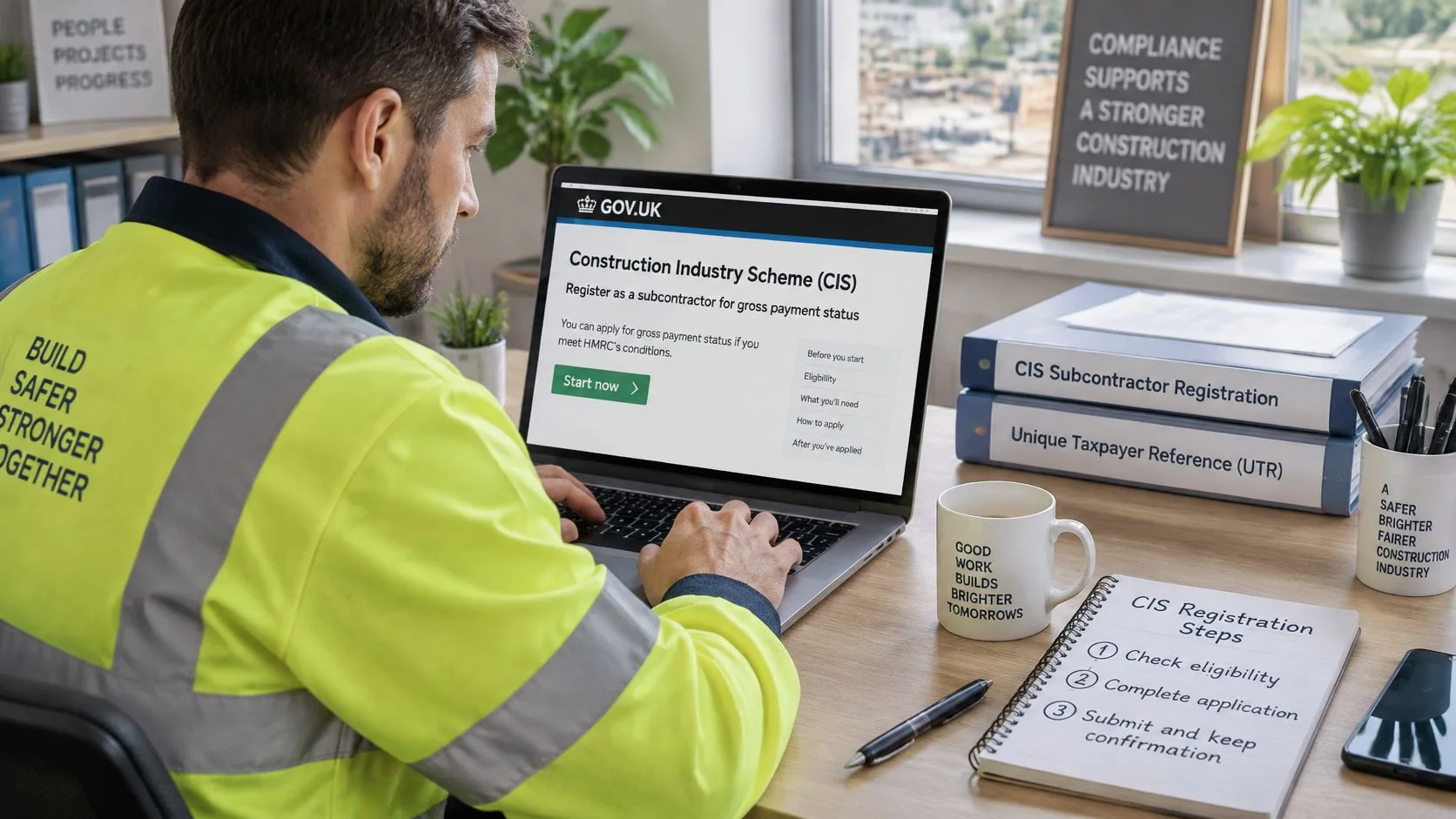
- Confirm you're registered for CIS as a subcontractor. Gross status sits on top of that registration, so it can't be granted to a business HMRC doesn't recognise as a subcontractor. New subcontractors can apply at the same time as registering, and if you haven't registered at all you're currently losing the higher rate.
- Gather your identifiers and figures. Unique Taxpayer Reference, National Insurance number, business bank details, and 12 months of turnover with the direct materials cost separated out. A limited company applies with the company UTR, not the director's personal one. Getting that wrong is the most common administrative delay.
- Check every relevant tax account is current. CIS, PAYE and National Insurance, VAT, Self Assessment and Corporation Tax. Being up to date means filed and paid, with a payment record you can produce. Applying while a late return is still sitting on the system is the single biggest cause of a refusal that could have been avoided.
- Sign in to HMRC online services and start the application in the CIS section, following the current route set out on GOV.UK. Details change, so read the live page rather than an old printout.
- Answer the business, compliance and turnover questions accurately, using the figures from step 2. Don't round up or estimate. Every figure on the form is one HMRC can compare against its own records.
- Submit and record the reference number along with the date. Keep a note of when you expect a decision so a silence doesn't become a lost application.
- Once granted, give your contractor what they need to verify you. Contractors must verify a subcontractor's status before paying, and if they don't make the required checks they can be left liable for deductions that should have been made. Keep the decision letter on file.
Here's a short walkthrough of the CIS basics before you start the form.
A clean outcome looks like this: the decision letter on file, the verification reference noted against each contractor, and payments arriving without deduction from the next invoice. If the application comes back pending or refused after you've paid everything, the answer is almost never in the CIS account alone, and the next section explains where to look.
Keeping Status and Avoiding Failure
One late payment can put gross status at risk even when your CIS returns are in order. HMRC reviews compliance across tax accounts, so VAT, PAYE, National Insurance and Self Assessment can matter alongside CIS.
The compliance checks cover filing and payment obligations across these accounts. HMRC also reviews gross payment status periodically. Since 6 April 2024, it can withdraw status if it has reasonable grounds to suspect fraudulent incorrect returns or information involving VAT, Corporation Tax Self Assessment, Income Tax Self Assessment or PAYE.
A monthly calendar helps keep each account on time:
- CIS monthly return: file it even in months when you paid nobody.
- PAYE and National Insurance: submit the required information on or before payday and pay by the due date.
- VAT return and payment: meet the quarter's deadline and apply the domestic reverse charge correctly to relevant construction sales.
- Payroll records: reconcile them with the RTI submissions.
- Corporation Tax instalments: include them if the company has to pay quarterly.
- Self Assessment: track payment on account dates as well as the balancing payment deadline.
- Payment evidence: save confirmation with the relevant month's records.
A pending application or refusal can stem from a tax account that seems unrelated to CIS. HMRC's checks can include CIS, PAYE and National Insurance, VAT, Self Assessment and Corporation Tax records. A late VAT payment, payroll liability or return may affect the outcome even if your CIS records are up to date.
| Trigger | Threshold | Effect on status |
|---|---|---|
| Unpaid CIS, PAYE or VAT liability | £100 or more, over 14 days late | Can fail the compliance test |
| Late monthly CIS returns | Four or more, each up to 28 days late | Can fail the compliance test |
| Single late return | Any return more than 28 days late | Can fail the compliance test |
| Suspected incorrect returns | Reasonable grounds to suspect, involving VAT, CTSA, ITSA or PAYE | HMRC can withdraw gross status, from 6 April 2024 |
| Turnover shortfall at application | Under £30,000, or the multiplied threshold, over 12 months | Application can be refused |
The thresholds are set out in HMRC's guidance on strengthening the tests for gross payment status. For example, a £100 VAT balance paid 15 days late may be enough to fail the compliance test. Four monthly CIS returns filed up to 28 days late may also be enough.
Punctuality rule: paying a liability eventually is not the same as paying it on time. The permitted lateness is limited.
If you bill £5,000 a month in labour and gross status is withdrawn, a 20% deduction means £1,000 less cash from each payment. That money may already be committed to wages and materials. A late PAYE payment can therefore create a cash-flow gap, even if you settle the bill later.
Use a monthly calendar to track each tax account, and review your CIS tax return obligations as a subcontractor. Before reapplying, check your tax accounts for the previous 12 months, identify late payments and returns, and address any recurring causes. If a deadline looks at risk, contact HMRC before it passes.
Decide Whether Gross Status Suits Your Cash Flow
Gross status isn't automatically the right answer for every subcontractor. It suits you if you can run a monthly compliance calendar without slipping, you hold reserves for the year-end bill, and your turnover records are clean enough to evidence.
It may be safer to stay under deduction, at least for now, if any of these sound familiar:
- Recent late filings, in any tax stream, within the last 12 months.
- Irregular receipts that dip towards the threshold in a slow winter.
- No cash reserve, because the deduction has been doing your saving for you.
- A bookkeeping backlog, where you couldn't produce 12 months of reconciled figures this week if asked.
The reason reserves matter is simple. Gross status changes when tax is collected, it doesn't reduce it. Your reserve has to cover the full Self Assessment or Corporation Tax liability plus the National Insurance on the profit, and it has to be there in January when nothing has been withheld all year.
Run the two outcomes side by side. With gross status, cash arrives in full and you carry the budgeting. Under deduction, the contractor holds back part of each payment, the cash gap is smaller, and it's fixed by someone else's calendar. For a business with steady receipts and a separate tax account, gross status is the better deal. For a business with lumpy income and no discipline yet, it can turn a manageable bill into a January crisis.
Our cash flow forecasting guide for small business shows how to model both positions before you commit. Arlene handles all payroll, CIS and pension matters for our clients, so the day-to-day filing side sits with someone who does it every month.
One action for this week. Open your HMRC business tax account, check your current CIS status, then check every other tax account for outstanding returns or balances. Apply only when each one is up to date and the evidence is filed.
If your records have a few soft spots and you'd rather know before HMRC does, call Stewart Accounting Services on 01259 721156 and we'll review your CIS, VAT, PAYE and Self Assessment history against all three tests. We never start work without agreeing the fee in advance, and clients can verify the qualification status of Stewart Accounting Services Limited and Mark Stewart with ICAS. One conversation now is cheaper than a year back under 20%.
Recent Posts
18 Nov, 2026
18 Nov, 2026