

How to Set Up Accounting for a New Business and Understand the Costs

Do you need an accountant to get a new business’s finances in order? Setting up accounting for a new business means laying the right foundations: registering with HMRC when required, separating business and personal finances, recording income and expenses, and planning cash flow. You do not automatically need an accountant, but the right support can make these responsibilities easier to manage.
It is sensible to weigh the cost against the work you could do yourself. Whether professional support is worthwhile depends on your business structure, record-keeping and tax responsibilities, and confidence managing them. Getting the basics right early gives you a clearer view of what is coming in, what is going out and what you may need to set aside.
This guide covers the practical steps for setting up accounting, from HMRC registration and record-keeping to cash-flow forecasting. It also explains what affects the cost of support, which tasks you might handle in-house and when a professional can ease the workload, helping you gain more time, more money, more mind.
Key Takeaways
- Choose a business structure with its tax, liability and record-keeping responsibilities in mind.
- Match your HMRC registrations and business banking arrangements to how your business operates.
- Use cash-flow forecasts to anticipate income, expenses and periods when money may be tight.
- Keep business transactions separate from personal spending to make records and tax reporting easier to manage.
- Weigh the cost of accounting support against the time, accuracy and practical guidance it can provide.
Do I need an accountant for my start-up business?
A new business does not automatically need an accountant. You can manage bookkeeping yourself, but professional support may help with tax returns, financial records and decisions linked to your business structure. The cost depends on the work involved, including transaction volumes, payroll and reporting needs.
Keep accurate records of all money entering and leaving the business. Sales invoices, expense receipts and bank transactions, for example, help you prepare tax returns and review business performance.
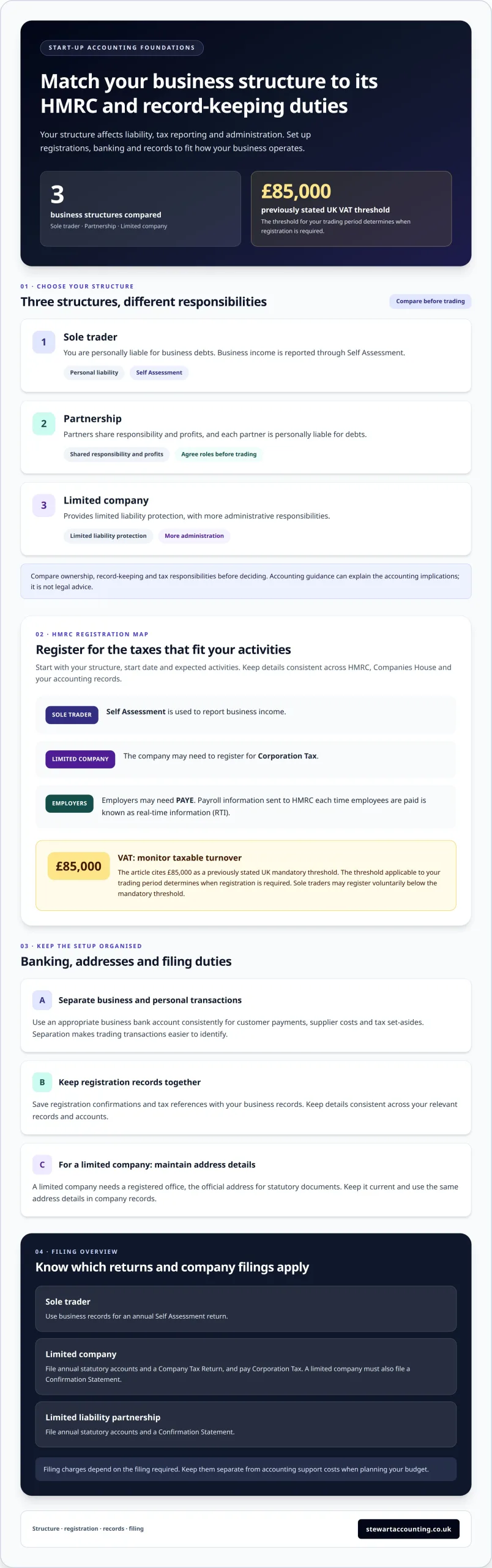
- Choose a structure with its responsibilities in view. A sole trader is personally liable for business debts. A partnership shares responsibility and profits among partners, and each partner is personally liable for debts. A limited company provides limited liability protection but has more administrative responsibilities. Compare how each structure affects ownership, record-keeping and tax before you decide.
- Get advice on the business and accounting implications. An accountant can explain how different structures affect accounts, tax reporting and the records you need to maintain. This is accounting guidance, not legal advice or a substitute for deciding the legal terms of an arrangement. For example, partners should agree how profits and responsibilities are shared before trading.
- Choose bookkeeping support that matches your workload. You can keep routine records yourself, outsource bookkeeping, or combine both approaches. A provider can help organise income and expenses, reconcile transactions and prepare records for accounts and tax returns. Agree which tasks are covered, how often records are updated, and what information you must supply. This makes it easier to avoid gaps between day-to-day bookkeeping and year-end reporting.
- Ask an accountant to assess accounting software against your needs. The right option should support your record-keeping, reporting and tax obligations, rather than add features you will not use. For example, sales invoices, expense tracking and reports can make it easier to see business activity in one place. According to HM Revenue & Customs, UK businesses registered for VAT have to use software that complies with Making Tax Digital.
- Use a payroll provider when staff pay creates extra work. A payroll provider can calculate employee pay and deductions, prepare payslips, and manage PAYE submissions to HMRC. Payroll information submitted each time employees are paid is known as real-time information (RTI). Agree pay dates and provide accurate staff and pay details so each payroll run can be prepared correctly.
For a start-up with few transactions and straightforward records, managing bookkeeping in-house may be practical. If you are unsure about your business structure, software or reporting, professional advice can help you set up accounting for a new business and avoid common errors.
HMRC registration and business bank accounts
Register for the taxes relevant to your structure and activities, and organise your banking and records accordingly. Your filing duties differ depending on whether you are a sole trader or run a limited company.
-
Register with HMRC and Plan Tax
Before registering, identify your business structure, start date and expected activities. Sole traders use Self Assessment to report business income. A limited company may need to register for Corporation Tax, while employers may need PAYE. Consider which records and payments each obligation requires, and keep details consistent across HMRC, Companies House and your accounting records.
-
Check VAT Registration Requirements
Compare your taxable turnover with the applicable VAT registration threshold and consider whether voluntary registration suits your business. A previously stated UK mandatory threshold was £85,000 in annual turnover; sole traders may register voluntarily below the mandatory threshold. The threshold applicable to your trading period determines when registration is required, so build turnover monitoring into your bookkeeping.
- Keep HMRC registration records organised. Save registration confirmations and tax references with your business records. These details help you identify the relevant tax account when arranging returns or payments. An accountant can help organise the information for HMRC registration and explain how tax planning fits your business activities.
- Open the appropriate bank account. A business bank account separates trading receipts and payments from personal spending, making transactions easier to identify. A separate business bank account can help keep trading transactions distinct from personal spending. Match the account name to the business structure, and use it consistently for customer payments, supplier costs and tax set-asides.
- Set up the company address and related records. A limited company needs a registered office, the official address for statutory documents. Keep it current and ensure company records use the same address details. A professional can explain registered-office arrangements and Company Formation, while business-specific permits or registrations depend on the activity being carried out.
- Map returns, filing duties and charges. Sole traders use business records for an annual Self Assessment return. Limited companies and limited liability partnerships file annual statutory accounts; limited companies also submit a Company Tax Return and pay Corporation Tax. Limited companies and limited liability partnerships must file a Confirmation Statement. Filing charges depend on the filing required, so separate them from accounting support costs in your budget.
For help organising registration, tax planning or a registered office, get support with your business setup.
Self-employed UK bookkeeping businesses should register with HMRC unless set up as a limited company. Employers taking on staff may need to register with HMRC for Pay As You Earn (PAYE).
Cash-flow forecasts and profit projections
Build a forecast showing when money is expected to arrive and when bills are due. Compare expected profit with actual results to spot potential pressure before it affects business decisions.
- List expected income and payment dates. Record each planned sale, invoice date and likely payment date. Include regular sales and one-off work separately, so a quieter trading period is visible. If customers pay late, show the delay in the forecast rather than assuming every invoice clears immediately.
- Map costs against the same periods. Include supplier bills, rent, insurance, wages and tax payments in the months they are expected. Separate regular commitments from costs that rise with sales, such as materials for a larger order. This helps you see whether the business can pay its bills even when projected sales look profitable. Update the forecast when a supplier changes terms or a customer moves a payment date.
- Prepare a profit projection as well as a cash forecast. Profit estimates compare expected income with business expenses over a chosen period. Cash flow tracks when money actually enters or leaves your bank account. For example, a sale invoiced today may improve projected profit before the customer pays. Reviewing both figures helps explain why a profitable month can still leave limited cash for upcoming bills.
- Choose the accounting method that fits your structure. Sole traders and partnerships can choose between cash basis and traditional accounting. Cash basis records income and expenses when money is received or paid; traditional accounting records them when earned or incurred. UK limited companies, limited liability partnerships, and partnerships with a corporate partner must use traditional accounting. The method affects how you record transactions and prepare tax returns, so consistency matters.
- Review the forecast and respond to gaps. Compare forecast figures with actual receipts and payments regularly. If an expected customer payment slips, identify which costs can be rescheduled and whether more working capital is needed. Around 20% of new businesses cease trading during their first year, so watching cash flow gives you an early view of pressure, not a guarantee against failure. Keep assumptions clear, such as expected sales volume and payment timing.
Use your forecast to test decisions before committing. If you plan to hire, buy equipment or take on a large contract, include the expected costs and income. Looking ahead helps you assess the effect on cash and profit, while current records show whether your assumptions remain realistic.
Separating business and personal finances
A separate account makes business transactions easier to identify and review. Use the steps below to connect clear records with planning, funding and financial decisions.
- Route business income and spending through a dedicated account. Ask an accountant to help map which receipts and payments belong to the business, then choose a bank account that suits those transactions. For example, pay supplier invoices from the business account and deposit customer receipts there. Keeping personal purchases separate makes it easier to trace business activity and prepare tax returns. It can also help you see how much cash is available for business costs.
- Set a clear process for owner withdrawals. Record money moved from the business to you separately from supplier costs, wages or other expenses. For example, label a transfer as an owner withdrawal rather than recording it as a business purchase. This distinction helps keep income and expenses meaningful in your records. An accountant can help establish consistent categories and explain how to record transactions for your business structure.
- Build your business plan around financial assumptions. Set out what you plan to sell, expected costs and how the business will operate. Then connect those assumptions to projected income, spending and cash needs. A plan can help explain why you need funding and how the funds support a specific activity, such as purchasing stock or covering operating costs. Keep the assumptions visible so you can revise them when actual sales or expenses differ.
- Review funding options against repayment needs. Before taking on finance, match the proposed amount and repayment schedule to expected cash coming into the business. Consider what happens if a customer pays late or sales fall short of the plan. An accountant can help assess the figures and prepare financial information for a funding application. Keep any borrowing and repayments clearly recorded, rather than mixing them with personal transactions.
- Review key reports and control access to records. Review the profit and loss statement, balance sheet and cash flow statement monthly. These reports show different aspects of performance, assets and available cash. Check unusual payments against invoices or receipts, and limit access to banking and bookkeeping records to people who need it. Missing receipts, duplicate payments and unexplained transfers can make errors or suspected fraud harder to identify. Keep supporting documents organised so entries can be traced.
Separate accounts support clearer reporting, but your records still need regular review. Monthly reconciliations help match recorded transactions with bank activity, while accurate categories make business income and costs easier to understand. This routine supports tax returns and helps you make decisions based on figures you can explain.
Accounting service costs and benefits
To decide whether accounting support is worth the expense, compare the service scope with the time and financial responsibilities you currently manage. Assess what you need before requesting a quote.
- List the tasks you want covered. Separate routine bookkeeping from year-end accounts, tax returns, payroll and VAT work. For example, you might keep receipts organised but ask a professional to prepare annual accounts. A quote can then reflect the actual work rather than a broad label such as “accounting”. Set out what you expect the provider to do and what information you will supply.
- Ask what affects the fee. Accounting costs depend on factors such as transaction volume, business structure, payroll, VAT responsibilities and reporting frequency. The price depends on your case and is given after a quote request. A new sole trader with simple records needs a different scope from a limited company with staff and regular reporting.
- Compare like with like. Check whether a proposed service covers transaction entry, reconciliations, year-end preparation, tax submissions or advice. A lower fee may cover fewer tasks, while a broader package may include work you do not need yet. Ask for the included tasks and any separate charges to be set out clearly, so you can compare the same responsibilities.
- Value time and accuracy alongside the fee. Keeping records yourself has a time cost, especially if invoices, receipts and bank transactions need sorting before returns are prepared. Professional support can help organise those records and identify missing information earlier. It does not remove your responsibility to provide accurate details or make business decisions, but it can reduce the bookkeeping and reporting workload you manage directly.
- Match support to your current risks. Consider your tax deadlines, record quality and exposure to errors. For example, if sales and expenses are growing, delayed bookkeeping can make it harder to see what the business owes or can afford. A limited company also has more administrative responsibilities than a sole trader. Choose support that addresses the tasks you find difficult, rather than paying for unused services.
- Review the arrangement as the business changes. New staff, VAT registration or more complex trading can change the accounting workload. Review the agreed scope when those changes arise, and ask how additional work affects the quote. Keeping expectations clear helps you budget for expenses and understand which tasks remain your responsibility.
Stewart Accounting Services
Stewart Accounting Services helps new businesses put practical accounting support in place as they grow. If bookkeeping is taking time away from customers, its Bookkeeping Services can keep transactions organised for reporting and tax returns. Year-End Accounts and Self-Assessment Tax Returns can support your reporting responsibilities.
Consider professional support when you need help keeping records current, preparing accounts or managing recurring payroll. You can choose which responsibilities to delegate and which to retain, so we can take it off your hands and help you gain more time, more money, more mind.
Contact Stewart Accounting Services to discuss accounting support for your new business.
Build your next stage on clear financial foundations
As your business develops, your accounting needs may change. The approach that works at the start may need adjusting as transactions increase, you take on staff or reporting becomes more involved. Treat setting up accounting for a new business as the beginning of an ongoing process, rather than a task to leave until year end.
Stewart Accounting Services can take bookkeeping, Year-End Accounts and Self-Assessment Tax Returns off your hands, giving you practical support with records and reporting responsibilities. You can keep your focus on running the business while we help with these accounting tasks.
Contact Stewart Accounting Services to discuss accounting support for your business. A clear next step can help you move forward with greater confidence and more time for your plans.
Frequently Asked Questions
When should I hire an accountant?
Consider speaking to an accountant before a major decision, such as taking on a business partner, seeking finance or moving from sole trader to limited company. An accountant can explain the accounting implications before you commit. You can also seek support if records are falling behind or a tax deadline feels difficult to manage. Bring recent bank statements, invoices and details of planned changes to make the discussion practical.
How can an accountant help register a new business for tax with HMRC?
An accountant can help gather the information needed for relevant HMRC registrations and explain how to authorise them to act for you. This may include confirming your business structure, trading activity and the taxes relevant to your plans. Stewart Accounting Services offers HMRC Registration and Authorisation. Keep HMRC letters and online account details together so you can respond to queries and track submissions.
Should a UK startup use cash basis or traditional accounting?
Choose an accounting method based on how you want to understand business performance and what your records need to show. If you regularly invoice customers or buy stock on credit, consider whether tracking unpaid amounts would help with decisions. Sole traders and partnerships can choose between accounting methods; companies must use traditional accounting. Keep your approach consistent between tax returns unless you have properly considered a change.
How can an accountant help a small UK business choose accounting software, and what does it cost?
An accountant can help set up the chosen platform, establish transaction categories and show you how to use its reports. Stewart Accounting Services supports systems including Excel, Xero and Sage, with Xero training and support available. Software costs depend on the subscription selected. The firm’s accounting fees are agreed in advance and reflect the work included, so ask for the agreed scope and fee before work begins.
What bookkeeping system can an accountant set up for a new business to record income, expenses and invoices?
An accountant can help establish a consistent workflow for recording transactions, storing receipts and reviewing outstanding invoices. Stewart Accounting Services supports Xero setup and Dext receipt-processing integration, which captures receipt information for bookkeeping. Make clear who records each transaction, where source documents are stored and how errors are corrected. This creates a traceable record when figures need reviewing.