

Companies House Filing Requirements in 2026
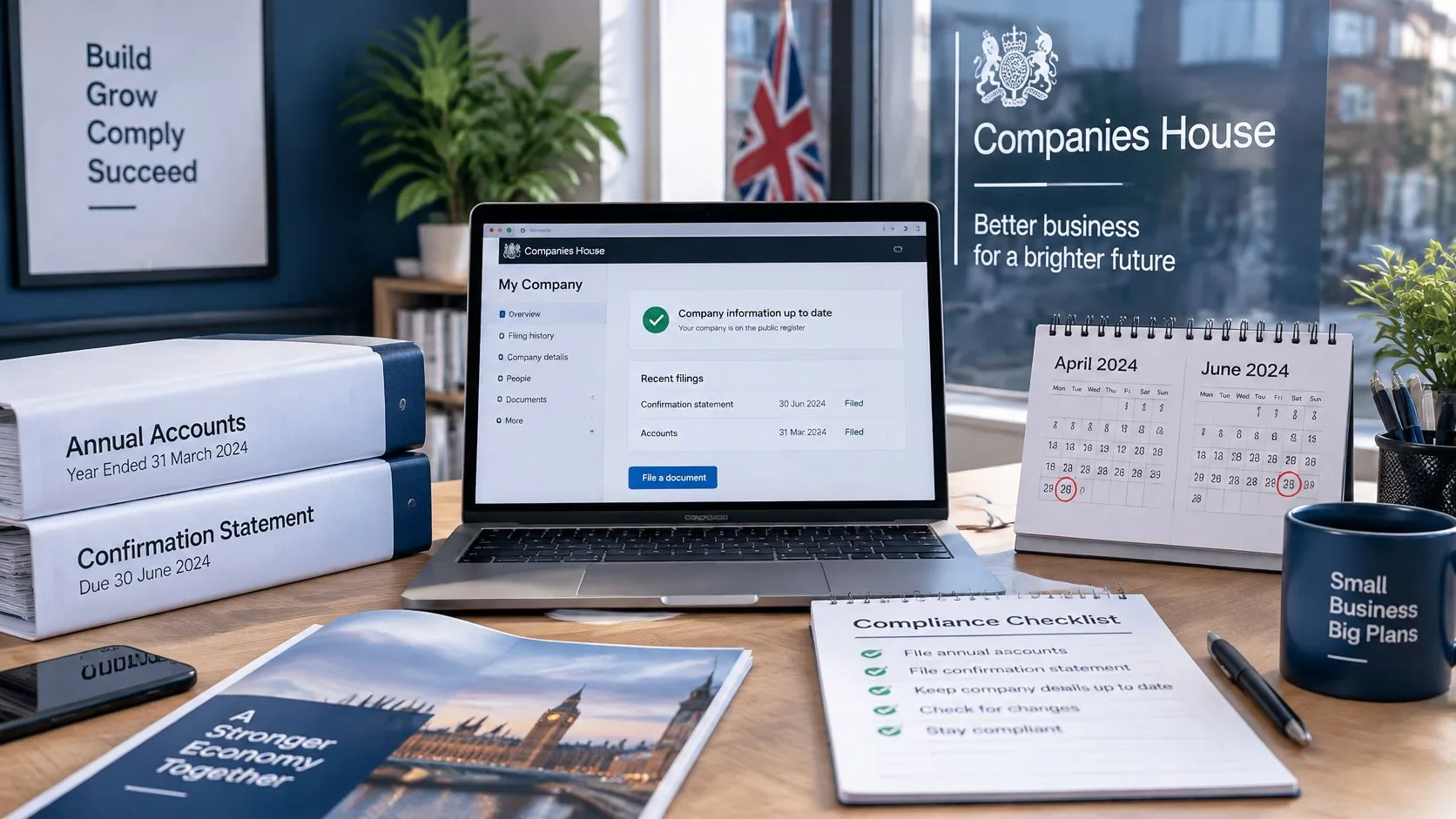
A private limited company must file annual accounts at Companies House within nine months of its accounting reference date and a confirmation statement within 14 days after each 12-month review period, even if nothing has changed. Missing either date isn't a minor admin slip, because one tracks money and the other tracks who controls the company, and both stay live for as long as the company exists.
That's where many directors get caught. They remember the tax return, they pay corporation tax, and they assume Companies House is covered. It isn't. Companies House filing requirements sit alongside HMRC filing, not inside it, and unresolved identity checks or unsuitable software can now block a submission that looks ready on paper.
Companies House Filing Requirements at a Glance
Every private limited company owes Companies House two recurring filings for as long as it exists, including dormant and non-trading companies.
| Filing | Sent to | Usual deadline | Fee |
|---|---|---|---|
| Private company annual accounts | Companies House | 9 months after the accounting reference date | No Companies House filing fee |
| Public company annual accounts | Companies House | 6 months after the accounting reference date | No Companies House filing fee |
| First accounts covering more than 12 months | Companies House | Later of 21 months from incorporation or 3 months after the accounting reference date | No Companies House filing fee |
| Dormant company accounts | Companies House | Same accounts deadline as an active company of that type | No Companies House filing fee |
| Confirmation statement | Companies House | 14 days after each 12-month review period | £50 online or £110 for paper CS01 |
| Company Tax Return | HMRC | 12 months after the end of the accounting period | Separate from Companies House |
Read the Dates off the Register
Use the accounting reference date on the public register, not the year end your bookkeeping software happens to show. If those two dates differ, the register date sets the legal deadline. Put it in your calendar first, then work backwards to bookkeeping close, draft accounts and board approval.
A long first period is the next trap. New directors often assume they get nine months after a first year end that runs beyond twelve months. The rule in the table gives a different answer, and it's the later of the two dates, so you need to calculate both and use the one that falls last.
Keep HMRC on a Separate Line
The Company Tax Return goes to HMRC and usually falls later than the Companies House accounts deadline. Corporation tax is generally payable nine months and one day after the period end, which is close to the private company accounts date but isn't the same obligation. Paying the tax doesn't deliver the accounts, and filing accounts doesn't file the return.
Changes to officers, people with significant control and the registered office don't wait for either annual date. You file those when they happen, using the specific change form. Leaving them for year end leaves the public record wrong in the meantime.
Write this down first: your accounting reference date, your accounts deadline, and your confirmation statement review date. Every other compliance task hangs off those three dates.
The scale of late filing shows why that matters. According to the Companies House Independent Adjudicators' annual report, Companies House issued 317,985 penalties for late filing of accounts in the UK financial year 2024 to 25. That's not a handful of careless firms. It's directors who likely knew filing mattered but didn't anchor it to the correct date.
Before you read any detail, write both Companies House dates down where you'll see them. A deadline in your head isn't a control. A deadline in a calendar, with an approval date in front of it, is.
How Accounts Differ from a Confirmation Statement
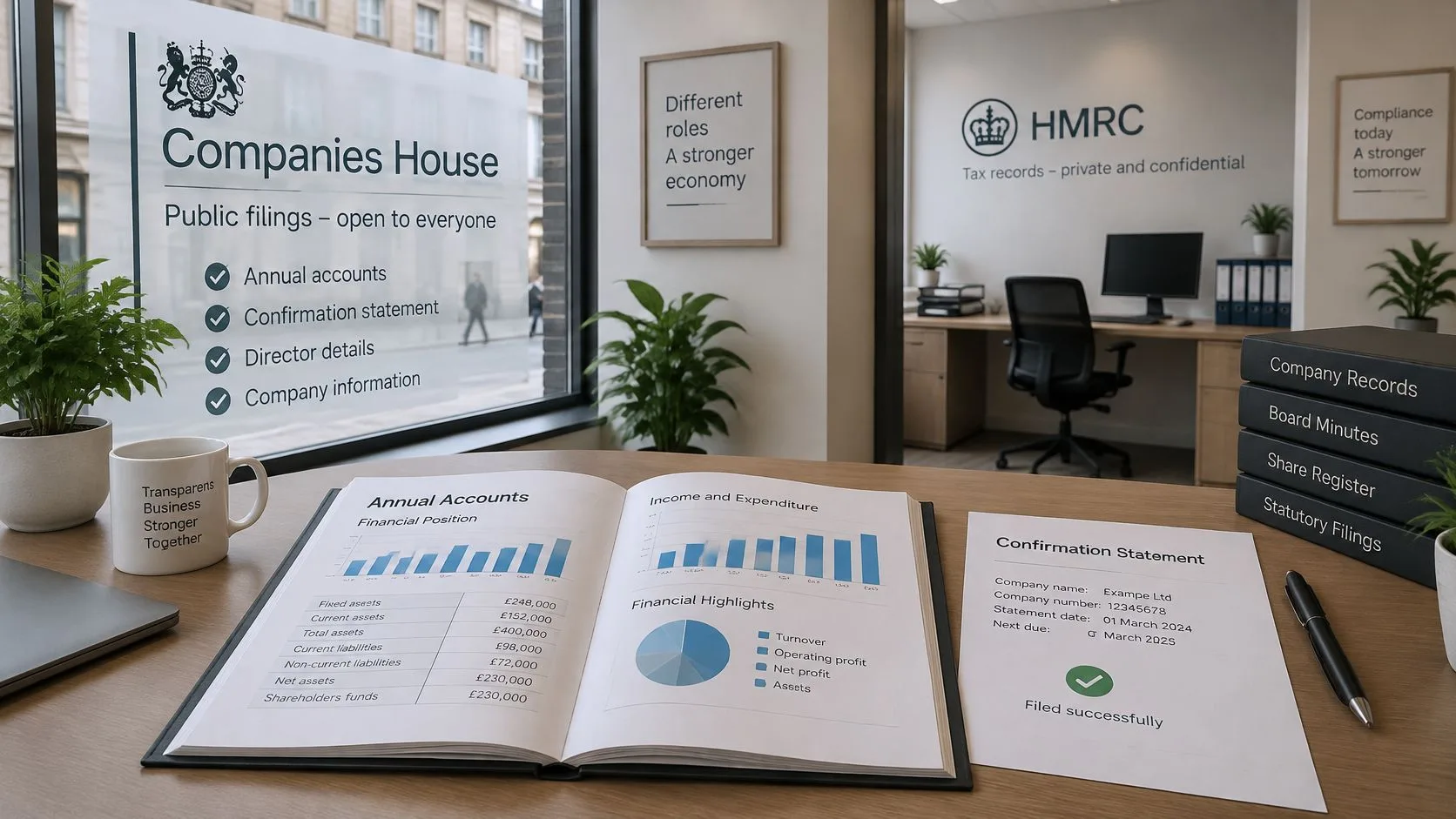
Think of Companies House as the shop window and your accounts as the set of books behind the counter. The window shows who runs the shop, where it's registered and what it says it does. The books show whether the shop made money and what it owns and owes.
What the Accounts Carry
Annual accounts show the financial position. For a typical trading company that means a balance sheet, a profit and loss account and notes, approved by the directors before filing. They're historical financial reporting for a defined period, and the public can inspect what the filing regime requires you to place on record.
What the Statement Carries
A confirmation statement doesn't report profit or tax. Under the GOV.UK guidance on filing your company's confirmation statement, every UK company, including private limited, dormant and non-trading companies, must file at least one confirmation statement during every 12-month review period, and it replaced the annual return in June 2016. It confirms the registered office, directors and secretary, people with significant control, shareholder information, share capital and your Standard Industrial Classification (SIC) code.
That duty continues even where no details have changed. You're not reporting a change. You're confirming the record is accurate. If you want the terminology unpacked further, our guide on what a confirmation statement means at Companies House works through the wording on the form itself.
Sorting records becomes easier once you see the split:
- Accounts pile: sales, costs, assets, liabilities, trial balance and supporting notes.
- Confirmation statement pile: registered office, officers, PSCs, shareholders, share capital and SIC code.
- File now pile: a director appointment, a PSC change or a registered office move that has already happened.
That third pile matters most. Changes to directors, PSCs and the registered office must normally be reported separately rather than left until the statement, and failure to file the statement itself can lead to prosecution and may contribute to strike off. You may file more than one statement in a payment period, but the annual fee is generally collected with the first one, at £50 online compared with £110 for the paper CS01.
For a new company, the first review period runs from incorporation, not from your first accounts date. Add twelve months to the incorporation date, then fourteen days, and diarise that date from day one.
Deadlines Fees and What Late Filing Costs
For a private company with a 31 March accounting reference date, accounts are normally due by 31 December. The deadline is nine months after the year end, and Companies House must receive and accept the filing by that date.
Work the Calculation, Then Check the Documents
The GOV.UK guide to filing your Companies House accounts gives the standard deadline as nine months after the accounting reference date for most private limited companies, and six months for public companies. For first accounts covering more than 12 months, the deadline is the later of 21 months after incorporation or three months after the accounting reference date. Use the registered accounting reference date to calculate the deadline.
A company's first accounts period can be longer than a year, so its first deadline may not follow the pattern of later annual filings. Calculate both parts of the first-accounts rule and use whichever date falls later.
Check that the accounts are complete before filing. They need a balance sheet signed by a director on behalf of the board. Companies outside the micro-entity regime also need a directors' report; profit and loss accounts, strategic reports and auditor's reports depend on the company's regime and circumstances. Keep the approval date and signed copy with the company's records so corrections can be made if a submission is rejected.
The Penalty Ladder
| Company type and delay | Penalty |
|---|---|
| Private company, up to 1 month late | £150 |
| Private company, more than 1 month up to 3 months | £375 |
| Private company, more than 3 months up to 6 months | £750 |
| Private company, more than 6 months | £1,500 |
| Public company, up to 1 month late | £750 |
| Public company, more than 1 month up to 3 months | £1,500 |
| Public company, more than 3 months up to 6 months | £3,000 |
| Public company, more than 6 months | £7,500 |
Companies House applies these penalties when accounts are delivered late. They are separate from any HMRC interest on unpaid Corporation Tax, so paying one does not settle the other. For comparison, late filing guidance for San Diego taxpayers concerns a different tax system; UK Companies House accounts penalties follow the ladder above.
A late confirmation statement does not incur this accounts penalty ladder. It can instead lead to prosecution and contribute to strike-off action.
A rejected filing has not been delivered. Leave time in the schedule to correct and resubmit it. Set a bookkeeping cut-off, then a draft date and a board approval date, all before the filing deadline. If approval and submission fall on the same day, there is no room to fix a problem.
Micro Entity Small and Dormant Filing Examples
A contractor company with a £180,000 turnover, a £40,000 balance sheet and two directors may qualify as a micro-entity. It can file a simpler balance sheet with limited notes, without including the directors' report or profit and loss account in its Companies House filing. The company still prepares accounts, gets them approved and files them by its deadline.
| Regime | Qualify if two tests are met | What can be omitted |
|---|---|---|
| Micro-entity | Turnover not more than £1 million, balance sheet total not more than £500,000, no more than 10 employees | Directors' report and profit and loss account; file a simple balance sheet and limited notes |
| Small company | Turnover not more than £15 million, balance sheet total not more than £7.5 million, no more than 50 employees | Many full disclosures; file reduced small-company accounts |
| Dormant company | No significant accounting transactions in the period | Trading disclosures; file dormant accounts and still file a confirmation statement |
| Full accounts | Fails the small tests, is public, or an audit is required | No micro or small reductions |
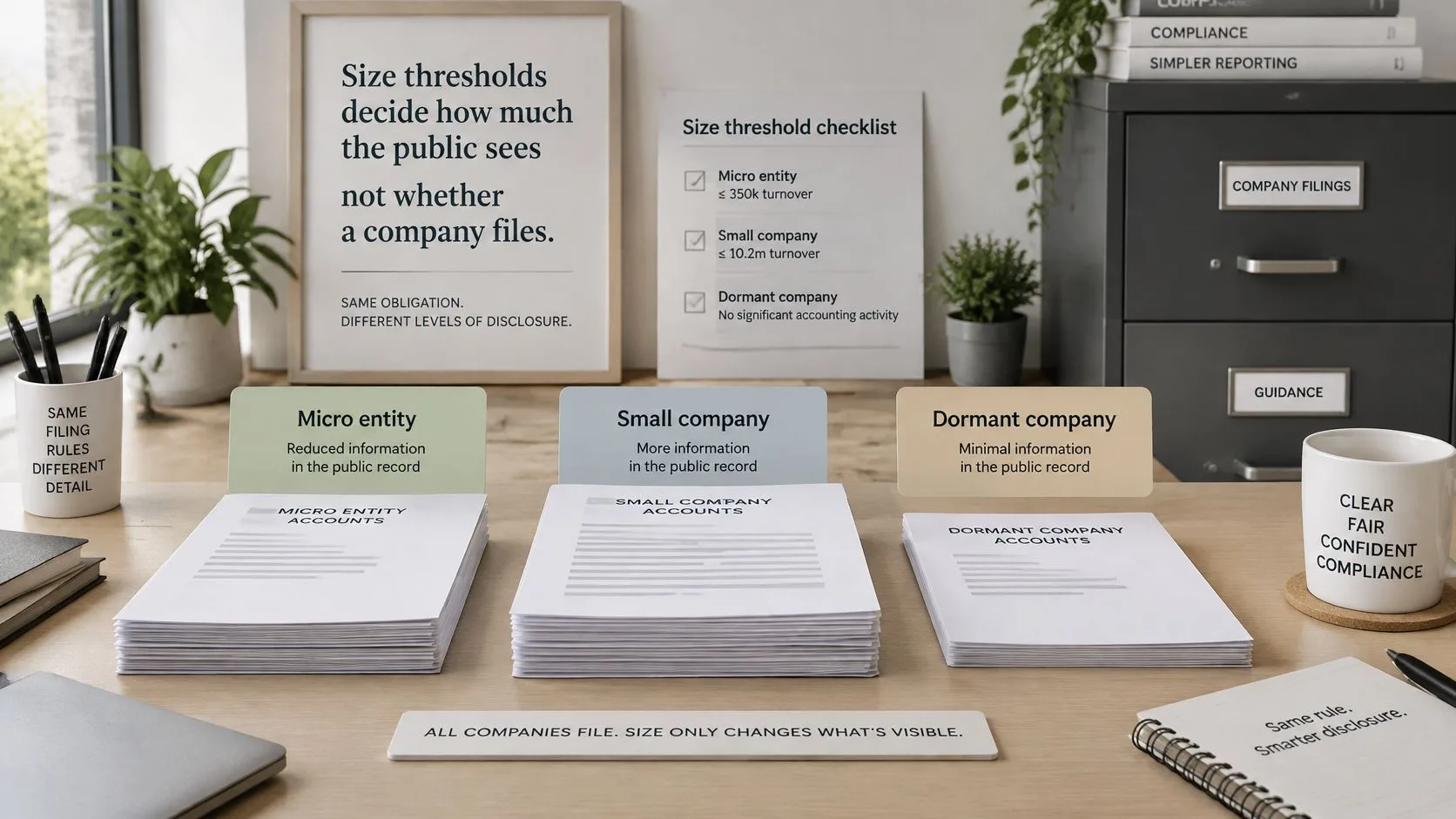
These thresholds apply for periods beginning on or after 6 April 2025, as set out in the GOV.UK guide to filing your Companies House accounts. In general, a company must meet two of the three tests in its row. Compare actual turnover, balance sheet total and average employee numbers with the thresholds; a company's size or trading activity alone does not determine its category.
Two Companies, Two Different Filings
A manufacturer with a £4 million turnover, a £1.2 million balance sheet and 30 employees may qualify as small but not micro. It files reduced small-company accounts, which include more information than the micro-entity accounts in the first example.
Dormancy is a separate test. It depends on whether the company had significant accounting transactions during the period, not on whether it is small or trading very little. A dormant company must still file dormant accounts by its usual deadline and submit a confirmation statement. Dormant status does not remove the company from Companies House filing requirements.
Audit Follows Size, With Exceptions
Small-company size tests can indicate whether an audit exemption is available, but the tests are not the only consideration. Members can demand an audit, and some groups and regulated companies cannot opt out. Check audit exemption separately once you have established the company's size, and record the reason for your conclusion.
Simpler accounts change what a company files, not whether it files. Match the company to the right category, identify which information may be omitted, then prepare and submit the required accounts by the deadline.
Director and PSC Identity Checks Before You File
An otherwise ready Companies House filing can be held up if a director or person with significant control (PSC) has not completed identity verification. Put the check on your filing calendar alongside the accounts deadline, so it is not left until submission day.

Under the GOV.UK guidance on verifying your identity for Companies House, identity verification became a legal requirement from 18 November 2025, with a 12-month transition period. Failure to comply may constitute an offence and can lead to financial penalties or prevent someone from filing or forming a company.
The Check Is Personal
Each director and PSC must verify their own identity. The usual route is GOV.UK One Login, using a passport or driving licence. A Post Office offers a face-to-face option for people who cannot complete the digital route. An accountant or filing agent cannot complete the personal check on someone's behalf.
An agent may prepare and submit a company filing, but the individual still needs to complete their own verification. The guide to verifying your identity for Companies House explains the personal code step.
This short walkthrough shows the verification flow and what to expect.
New directors should plan to verify around their appointment date, rather than waiting until a filing is due. Existing directors and PSCs should check that their personal code is linked where required. Directors based overseas have the same verification duty and may need an alternative document if they do not have UK photo ID.
Details must match. If the name, date of birth or address on the Companies House record differs from the identity document, the code may not link. Correct the personal record before trying again.
Run This Check This Week
- List everyone: check the company's public record for every director and PSC.
- Mark each status: record who is verified, who has a mismatch and who still needs to complete the check.
- Correct errors: fix discrepancies in names, dates of birth or addresses before retrying.
- Clear outstanding checks: allow time to resolve them before the earliest filing deadline.
One unresolved person can hold up a company submission. Add verification status to the filing calendar, alongside the accounts deadline, and check it before preparing a filing.
Software Filing Readiness Through to 2028
Spreadsheets helped many small companies produce year end figures for years. The filing channel is moving away from them, and the records behind the figures need to move too.
The GOV.UK publication on filing your Companies House accounts records that the online service for filing accounts and Company Tax Returns closed on 31 March 2026, with wider accounts filing changes scheduled from 2027 and digital software filing planned for all UK registered companies from April 2028. That means compatible commercial software, cleaner records and a way to reconcile Companies House accounts with the separate HMRC return.
Twelve Months Out
Move sales, purchases, bank and payroll into commercial software and reconcile monthly. Keep the invoices and contracts behind the numbers, organised so you can find them at year end. If expense capture is where your records break down, AurenWell's guide to business expense tracking gives a practical starting point for tightening that habit before it becomes a filing problem.
We work with Xero and other leading cloud accounting software, whether you've used it for years or only recently switched. The aim at this stage is boring and valuable. Clean monthly records that don't need rebuilding in month nine.
Six Months Out
Check that your software, or your accountant's, can produce the tagged accounts file Companies House and HMRC expect. Bookkeeping software that tracks invoices beautifully doesn't automatically produce statutory accounts. Ask the question directly and get a yes or no.
Name the director who'll approve the accounts and confirm that person is verified and available. Our article on profit and loss accounts being filed from April 2028 covers what the wider filing changes mean for what becomes public.
Three Months Out
Agree the trial balance, reconcile the Companies House figures to the HMRC Company Tax Return, and leave time to correct a rejected file. Differences between the two filings should be explained on a schedule, not discovered during submission.
Software readiness test: can your current system produce a tagged statutory accounts file today? If the answer needs a phone call, make that call this month.
Micro, small and dormant companies all need a software route. A dormant company still needs a filer and a verified director, so don't leave it off the migration plan. Work the twelve, six and three month stages in order and the move stays manageable.
Set Your Filing Calendar and Next Step
Build a one page calendar you can copy, pin up and check monthly. It needs dates, people and systems on the same page, because any one of the three can now delay a filing.
Your One Page Calendar
- Accounting reference date: the date on the public register that anchors everything.
- Companies House accounts deadline: nine months later for a private company.
- Confirmation statement date: the review period end plus fourteen days.
- Corporation tax payment date: nine months and one day after the period end.
- HMRC Company Tax Return date: twelve months after the period end.
- Identity verification line: each director and PSC by name, marked linked or outstanding.
- Software line: whether your bookkeeping can produce a software filing before April 2028.
Review that page whenever a director or PSC changes, not just at year end. A new appointment adds a verification task immediately. A registered office move adds a change filing immediately.
If any Companies House date sits inside three months, deal with that filing before improving optional records. Lateness is already running towards you. Optional tidying can wait until the statutory item is delivered and accepted.
We can assist with the preparation of year-end annual accounts, and our company formation services include advising on accounts filing deadlines, preparing and submitting confirmation statements and preparing and submitting Companies House amendment forms, including for contractors trading through limited companies. If you'd rather have those deadlines managed for you, email mark@stewartaccounting.co.uk and we'll take the calendar off your desk.
Start today with two entries and one check. Record both Companies House dates and confirm every director's identity code is linked to the company.
Email mark@stewartaccounting.co.uk today with your accounting reference date and confirmation statement review date, and Stewart Accounting Services will help you build a filing calendar that covers accounts, identity checks and software readiness before your next deadline bites.