

Do I Need to Apply for VAT Registration in Scotland?

Reaching the threshold for VAT registration Scotland isn’t just a tax hurdle; it’s a significant milestone that proves your business is officially scaling. You’ve likely spent late nights worrying about HMRC penalties or feeling overwhelmed by the technical demands of Making Tax Digital. It’s completely normal to feel a sense of dread when faced with the £90,000 turnover limit, especially when you’d rather be focusing on your customers in Stirling, Falkirk, or Alloa.
This guide provides a clear, comprehensive roadmap to understanding the current 2026 VAT requirements and how they impact your specific journey. We promise to clarify exactly when you need to act, how the registration process works, and how you can actually reclaim valuable tax on your initial start-up costs. You don’t have to face the complexities of the tax system alone or risk the stress of a late filing.
We will walk through the essential thresholds, the step-by-step application path, and how delegating these burdens to local specialists can liberate your time and restore your mental well-being. By the end, you’ll see how a professional approach to compliance can protect your finances and let you get back to what you do best.
Key Takeaways
- Learn how to accurately calculate your taxable turnover to determine if you have met the mandatory £90,000 threshold.
- Discover why registering for VAT voluntarily could be a strategic move to reclaim tax on your initial business expenses.
- Get a step-by-step roadmap for VAT registration Scotland that ensures your application is handled correctly the first time.
- Find out how to remove the anxiety of Making Tax Digital (MTD) by utilizing expert software support and training.
- Explore how delegating your compliance burden to local chartered accountants restores your personal and professional liberty.
What is VAT and when is registration mandatory for Scottish businesses?
What exactly is VAT? It’s a consumption tax applied to most goods and services. In the broader context of Value-added tax in the United Kingdom, it’s the government’s way of collecting revenue at each stage of the supply chain. For your business in Stirling or Falkirk, it means you become an unofficial tax collector for HMRC once you hit a certain size. While it’s a sign of business growth, it brings a new layer of compliance that can feel heavy without the right support.
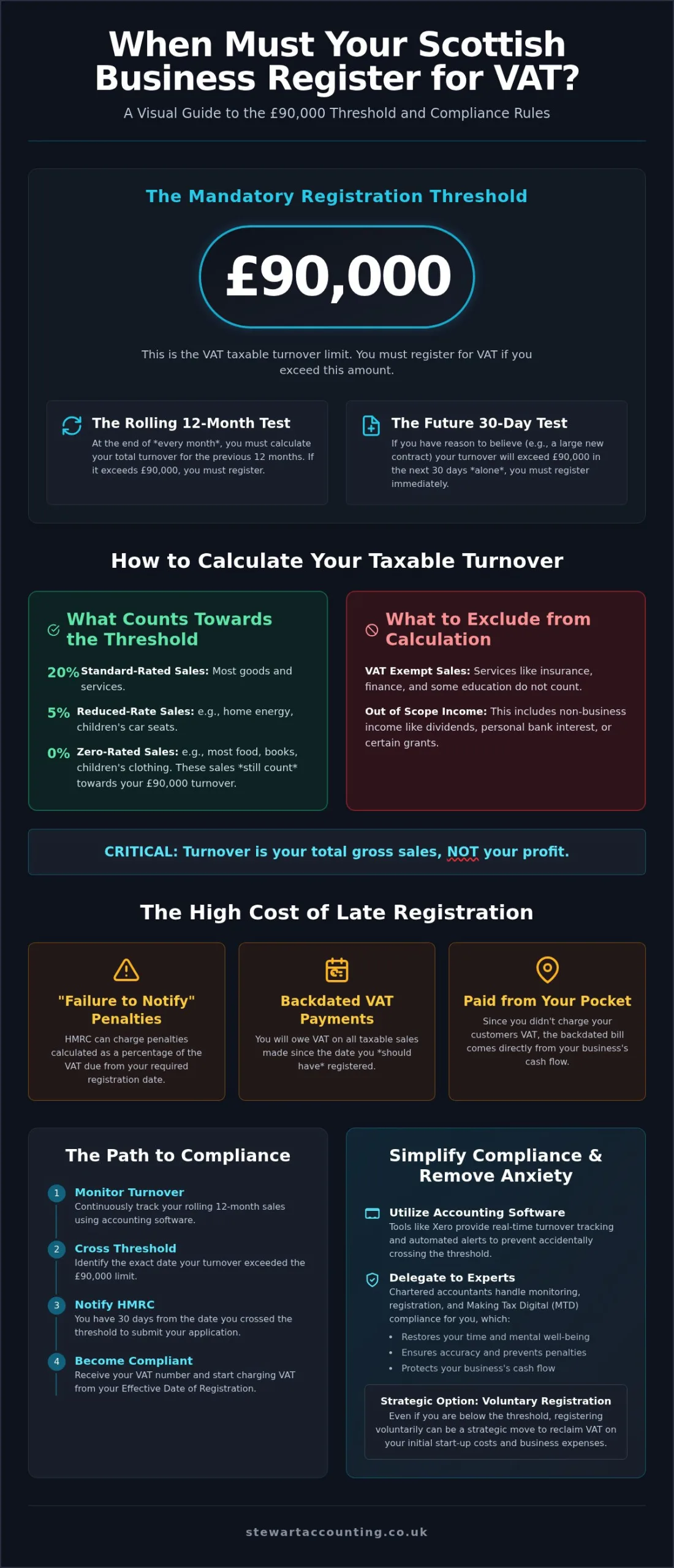
For the 2026 tax year, the mandatory threshold for VAT registration Scotland is £90,000. You must register if your taxable turnover exceeds this amount. However, many business owners get caught out by the timing because they wait for the end of their financial year. HMRC uses a rolling 12-month period instead. Every single month, you must look back at the previous 12 months. If that total hits £90,000, you’ve crossed the line and have 30 days to notify them. It’s a constant cycle of monitoring that we handle for our clients to ensure they stay on the right side of the rules.
There’s also a “future 30-day” rule that causes plenty of anxiety. If you expect your turnover to exceed the threshold in the next 30 days alone, perhaps by winning a major new contract, you must register immediately. Monitoring these two separate tests is vital for staying compliant and avoiding unexpected bills.
VAT taxable turnover explained
Your taxable turnover includes everything you sell that isn’t exempt from VAT. This includes standard rate (20%), reduced rate (5%), and even zero-rated items. A common mistake for sole traders is confusing turnover with profit. HMRC doesn’t care how much you spent on materials or rent; they only look at your total gross sales. If a limited company in Alloa sells £91,000 worth of zero-rated goods, they still must register, even though the tax collected at the point of sale is 0%.
The consequences of late registration
Missing the registration window creates significant financial stress. HMRC can charge “failure to notify” penalties based on a percentage of the VAT due. The real danger is that you’ll owe VAT on all sales made since the date you should have registered. Since you didn’t charge your customers that 20% at the time, the money comes directly out of your own pocket. Our VAT return services include proactive monitoring to prevent these pitfalls. Delegating this task to us removes the burden from your shoulders and protects your cash flow.
How do you calculate your VAT taxable turnover accurately?
Calculating your turnover accurately shouldn’t be a guessing game. It requires a methodical approach to ensure you don’t accidentally miss the mandatory deadline. According to the official UK government guidance, you must include the total value of all goods and services sold that aren’t exempt from VAT. This cumulative total, tracked over a rolling 12-month period, is what ultimately determines your need for VAT registration Scotland. It’s a continuous process of looking back at the last 12 months at the end of every single month, rather than just waiting for your year-end accounts.
Standard-rated, zero-rated, and exempt goods
Distinguishing between these categories is where many business owners feel the most anxiety. Standard-rated goods are the most common, currently taxed at 20%. Zero-rated items include things like most food, books, and children’s clothing. Even though the tax rate is 0%, these sales still count toward your £90,000 limit. Conversely, exempt items like certain financial services or insurance don’t count toward the threshold at all. Income that is “out of scope,” such as dividends, personal bank interest, or non-business grants, is also excluded from your VAT registration Scotland calculations.
Using online accounting to monitor thresholds
Manual spreadsheets often lead to simple errors that result in expensive back-dated tax bills. Utilizing online accounting services like Xero allows you to see your rolling turnover in real-time without the headache of manual data entry. This software can be configured to send automated alerts when you reach 80% or 90% of the threshold, giving you plenty of time to prepare. By integrating professional bookkeeping services, you ensure every transaction is categorized correctly from the start, removing the stress of a last-minute scramble.
Identifying the “effective date of registration” is the final piece of the puzzle. Once you’ve identified that you’ve crossed the threshold, you generally have 30 days to notify HMRC. Your official registration usually begins on the first day of the second month after you surpassed the limit. If your rolling turnover hits £90,500 in March, your effective date would be May 1st. Getting this date wrong can lead to HMRC expecting tax on sales you haven’t even collected yet, which is a burden no small business owner wants to carry. If you’re unsure about your current figures, it’s a good idea to speak with a specialist who can review your accounts for peace of mind.
The benefits and drawbacks of voluntary VAT registration
Choosing to apply for VAT registration Scotland before you hit the £90,000 threshold is a strategic decision that can significantly impact your bottom line. While many see it as an administrative burden, it’s often a sign of a maturing business looking to optimize its finances. One of the most immediate benefits is the ability to reclaim VAT on your business expenses. If you’re a startup in Stirling investing heavily in equipment, software, or stock, you could be leaving thousands of pounds on the table by staying unregistered.
HMRC allows businesses to reclaim VAT on goods purchased up to four years before registration and services up to six months before, provided they were used for business purposes. Understanding these VAT rules for Scottish businesses is essential for maximizing your initial cash flow. Beyond the numbers, having a VAT number enhances your professional image. It signals to larger clients and suppliers that you’re an established, serious entity rather than a small hobbyist.
Strategic advantages for B2B companies
If your primary clients are other VAT-registered businesses, voluntary registration is often a logical choice. Since your customers can reclaim the VAT you charge them, your prices effectively remain the same to them. Meanwhile, you gain the ability to reclaim the VAT on your own overheads, such as office rent, utilities, and professional fees. This shift can lower your overall operating costs and improve your profit margins. It’s a pragmatic way to position yourself as a serious player in the Scottish market while optimizing your resource allocation.
Potential pitfalls for B2C businesses
The situation changes if you’re selling directly to the public in local areas like Alloa or Falkirk. For B2C companies, registration can feel like a “VAT trap.” Since your customers cannot reclaim the tax, you must either increase your prices by 20% or absorb the cost yourself, which eats directly into your profit. This can make you less competitive against smaller, unregistered local rivals. Because every business model is unique, you should consult a chartered accountant in Scotland before making a final decision. We help you weigh the administrative costs against the potential tax savings to ensure the move supports your long-term objectives.
How to register for VAT in Scotland: A step-by-step guide
Applying for VAT registration Scotland doesn’t have to be a source of anxiety. The process begins with gathering your essential business data. You’ll need your Unique Taxpayer Reference (UTR), your business bank account details, and realistic turnover estimates for the next 12 months. While you can create a Government Gateway account and submit the application yourself, many business owners find this step overwhelming. We act as authorized agents for our clients, taking over the entire submission process to ensure every detail is accurate from the start.
Once your application is submitted, HMRC typically issues a VAT registration certificate within 30 days. This document confirms your VAT number and your official effective date of registration. It’s a vital piece of paper that allows you to start charging VAT and, more importantly, reclaiming it on your business purchases. Having an expert handle the submission removes the risk of errors that could lead to delays or unwanted queries from the tax office.
Choosing the right VAT scheme
Selecting the correct accounting scheme is a strategic choice that affects your daily operations and bank balance. The Flat Rate Scheme offers simplicity by allowing you to pay a fixed percentage of your turnover, though it isn’t always the most cost-effective for every industry. Cash Accounting is a popular choice for small Scottish firms because you only pay VAT to HMRC once your customers have actually paid you. This significantly improves your cash flow. Our VAT return services include a full review of your business model to help you select the optimal scheme for your specific needs.
MTD compliance in 2026
As of September 2026, all VAT-registered businesses must comply with Making Tax Digital (MTD) rules. This means you can no longer use the old manual HMRC portal for your filings. You must keep digital records and use MTD-compatible software like Xero to submit your quarterly returns. The transition from registration to digital filing is where many owners feel the most stress. We provide specialized software training and support to ensure you’re confident using these tools. By delegating your digital compliance to us, you protect your mental well-being and stay focused on growth.
If you’re ready to remove the compliance burden from your schedule and ensure your registration is handled professionally, contact Stewart Accounting Services today for expert assistance.
How Stewart Accounting Services simplifies your VAT compliance
Dealing with HMRC shouldn’t keep you awake at night or steal time from your weekend. We specialize in the complete delegation of the VAT registration Scotland process, physically removing the administrative burden from your desk. This means we handle the complex forms, the Government Gateway setup, and the technical communication with the tax office so you don’t have to. Whether you are managing limited companies or operating as sole traders, our approach is designed to eliminate the anxiety that often accompanies tax compliance.
Our work goes beyond simple registration. We integrate strategic tax planning into our service to ensure you reclaim every penny of eligible VAT. Many business owners miss out on significant refunds because they don’t realize they can claim for costs incurred before their registration date. We look back at your initial startup expenses, equipment purchases, and professional fees to maximize your cash flow from day one. This proactive oversight ensures your business isn’t just compliant, but financially optimized.
Local expertise in Alloa, Stirling, and Falkirk
Why settle for a faceless online service when you can work with a dependable regional expert? As Chartered Accountants with offices in Alloa, Stirling, and Falkirk, we are deeply grounded in the Central Scotland business community. This local presence allows us to offer face-to-face consultations and a level of personal support that a government portal or a generic call center simply cannot match. We understand the local economy and the specific needs of small and medium-sized enterprises in our region, providing a trustworthy partnership built on real-world reliability.
Restoring your personal liberty
The “Stewart Promise” is centered on a core mission: the liberation of your time, your finances, and your mental well-being. Delegating your VAT management to us saves you hours of grueling administrative work every month. Instead of wrestling with spreadsheets or worrying about Making Tax Digital deadlines, you can focus on your professional goals or enjoy your personal life. This total transfer of responsibility is a lifestyle improvement that restores your freedom. If you’re ready to experience a stress-free way to handle your taxes, exploring our VAT return services is the first step toward reclaiming your peace of mind.
Take the Next Step for Your Scottish Business
Navigating VAT registration Scotland is a clear sign that your business is thriving. By keeping a close eye on the £90,000 rolling turnover threshold and staying ahead of Making Tax Digital requirements, you protect your cash flow from unnecessary penalties. Whether you need to register immediately or you’re considering a voluntary application to reclaim valuable start-up costs, having an expert partner ensures the process is seamless. Our Chartered Accountants in Alloa, Stirling, and Falkirk have decades of experience supporting Scottish SMEs with reliable, professional advice.
We focus on liberating your time and mental well-being by taking total responsibility for your tax compliance. You don’t have to face HMRC portals or complex digital filing alone. Our specialists handle the technical details so you can focus on leading your company toward its next big milestone. We’re dedicated to helping you achieve professional liberty while ensuring your finances are fully optimized and secure.
Let us handle your VAT registration and returns today. We’re ready to help you move forward with confidence and peace of mind.
Frequently Asked Questions
Do I have to register for VAT if my business is based in Scotland?
Yes, you must register if your business meets the UK-wide criteria. VAT laws apply uniformly across Scotland and the rest of the UK. You must register if your taxable turnover in any rolling 12-month period exceeds £90,000, or if you expect it to cross that mark in the next 30 days. This applies whether you operate from a physical office in Stirling or work remotely from home.
How long does it take to get a VAT number in 2026?
Most businesses receive their VAT registration certificate within 30 days of submitting their application. However, complex cases or those requiring additional checks by HMRC can take longer. While waiting for your number, you should keep a record of all sales and purchases, but you cannot show VAT separately on your invoices until your official number arrives. We help streamline this process to ensure your application is processed efficiently.
Can I reclaim VAT on purchases made before I registered?
Yes, you can often reclaim VAT on goods bought up to four years before registration and services bought up to six months before. The items must still be on hand or used in the business at the time of registration. This is a significant benefit of VAT registration Scotland that can provide an immediate cash flow boost. We carefully review your past records to ensure every eligible penny is reclaimed.
What is the current VAT threshold for small businesses?
The mandatory VAT registration threshold for the 2026 tax year is £90,000. This figure has remained stable since April 2024. You must also be aware of the deregistration threshold, which is currently £88,000. Monitoring your rolling 12-month turnover monthly is the only way to ensure you don’t inadvertently miss the registration window and face penalties. Our team provides the oversight needed to track these limits accurately for you.
What happens if I forget to register for VAT on time?
HMRC can issue “failure to notify” penalties, which are calculated based on the amount of VAT owed and the length of the delay. More importantly, you’ll be liable for the VAT on all sales made since the date you should have registered. Since you likely didn’t charge your customers VAT during that period, this cost must be paid out of your own pocket. This can be a devastating financial blow for any firm.
Do I need an accountant to register for VAT for me?
While you can apply yourself through the Government Gateway, using a professional ensures the application is correct and compliant with current rules. We act as your authorized agent, handling the entire VAT registration Scotland process on your behalf. This delegation removes the administrative burden from your schedule and provides peace of mind that your business is set up correctly from day one, including the selection of the best accounting scheme.
Is the VAT registration process different for limited companies and sole traders?
The core requirements and thresholds are identical, but the information you provide during the application varies. A limited company must provide its company registration number and director details, while a sole trader uses their personal National Insurance number and UTR. Both entities must follow Making Tax Digital rules once registered. We support both business types from our offices in Central Scotland, ensuring the specific nuances of your entity are handled correctly.
Can I cancel my VAT registration if my turnover drops below the threshold?
You can apply for voluntary deregistration if you can prove to HMRC that your taxable turnover in the next 12 months will be less than £88,000. This might happen if you reduce your trading hours or close a specific part of your business. However, you should consider if staying registered voluntarily still provides a benefit, such as the ability to continue reclaiming VAT on your ongoing business overheads and equipment.
Recent Posts
22 Oct, 2026
21 Oct, 2026