

Estate Planning Advice Scotland: The Comprehensive Guide for 2026

Did you know that HMRC collected a record £7.5 billion in Inheritance Tax during the 2023/24 tax year, yet 33% of UK adults over 45 still haven’t secured their legacy? It’s a staggering figure that shows how easily your hard earned wealth can vanish without the right estate planning advice Scotland residents need to navigate our unique legal system. We know you’re likely feeling anxious about the 40% tax rate or confused by how Scottish “Prior Rights” differ from English probate. These worries are completely natural, and the fear of causing family disputes often makes it tempting to simply look the other way.
We’re here to help you take that burden off your hands. This guide provides a clear roadmap to 2026, showing you exactly how to protect your assets and achieve our signature Three Freedoms: more time, more money, and less stress. You’ll discover practical ways to minimise tax leaks to HMRC and ensure your family remains protected. We’ll break down the complexities of Scottish succession law into simple, actionable steps. By the end of this article, you’ll have a methodical plan to keep your wealth where it belongs while gaining the peace of mind you deserve.
Key Takeaways
- Understand why unique Scottish succession laws mean your spouse might not automatically inherit everything and how a valid Will prevents the complications of intestacy.
- Learn how to accurately value your assets and navigate 2026 Inheritance Tax thresholds to minimise your liability and protect your family’s wealth.
- Discover the step-by-step Scottish Confirmation process, from appointing executors to compiling an asset inventory, to take the burden off your loved ones.
- Secure your legacy by seeking professional estate planning advice Scotland to gain the “Three Freedoms” of more time, more money, and significantly less stress.
- Find out how a co-ordinated approach between accounting and estate planning ensures your business interests and personal assets are distributed exactly as you intended.
Understanding Estate Planning in Scotland: Why Scots Law Matters
Estate planning is the strategic management of your assets during your lifetime and the structured distribution of those assets after you pass away. It is not a task reserved for the ultra-wealthy. According to 2023 industry data, 58% of UK adults still do not have a valid Will, which creates significant risks for their families. If you are seeking estate planning advice Scotland provides a unique legal environment that differs substantially from the rules found in England and Wales. Failing to account for these differences can lead to unintended tax burdens and family disputes.
At Stewart Accounting Services, we believe that effective planning is about securing your “Three Freedoms”: more time, more money, and more mind (less stress!). By organising your affairs early, you take the burden off your hands and place it into the care of professionals. This proactive approach ensures your loved ones are protected from the 40% Inheritance Tax rate that applies to estates above the current £325,000 nil-rate band. Our role as Chartered Accountants is to provide the financial framework that supports your legal objectives, ensuring your wealth is transferred as efficiently as possible.
The Difference Between Heritable and Moveable Property
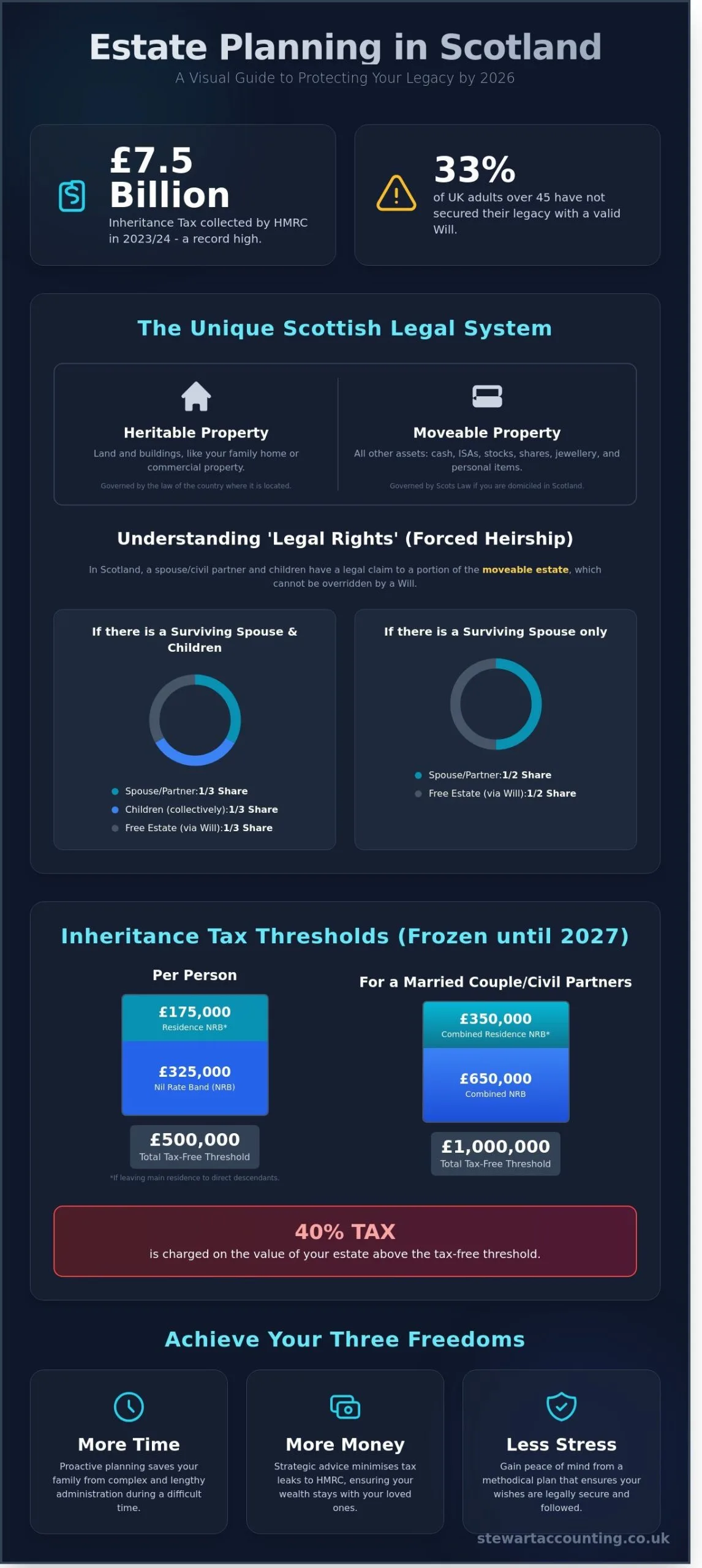
Scottish law makes a sharp distinction between heritable and moveable property. Heritable property refers to land and buildings, such as your family home in Stirling or a commercial unit in Alloa. Moveable property encompasses everything else, including cash, ISA accounts, stocks, shares, and personal belongings like jewellery. This distinction is vital because Scots succession law treats these two categories differently during the distribution process.
Your domicile status determines which laws apply to your estate. If you are domiciled in Scotland, Scots Law governs the distribution of all your moveable assets, regardless of where in the world they are located. However, your heritable property is generally governed by the laws of the country where the land is situated. Misunderstanding these definitions can lead to a Will being partially ineffective, especially if you own property across different borders.
Legal Rights in Scotland: Protecting Your Family
One of the most significant aspects of estate planning advice Scotland involves “Legal Rights.” These rights act as a form of forced heirship. In Scotland, a surviving spouse, civil partner, and children have a legal claim to a specific portion of the deceased’s moveable estate. You cannot simply “write someone out” of your Will if they have a claim to these rights. They are entitled to these shares by law, which can often surprise those moving to Scotland from other parts of the UK.
- Legal Rights only apply to the net moveable estate, not heritable property like the family home.
- A surviving spouse or civil partner is entitled to one-third of the moveable estate if there are children, or one-half if there are no children.
- Children are collectively entitled to the same proportions (one-third if there is a spouse, one-half if not).
If you do not plan for these claims, they can disrupt your intended distribution and create liquidity issues for your executors. We help you calculate these potential claims now so you can structure your assets to meet your wishes while satisfying your legal obligations. This clarity reduces stress for your beneficiaries during a difficult time.
Calculating Your Estate Value and Inheritance Tax (IHT) Liability
Getting an accurate picture of what you own is the vital first step in seeking estate planning advice Scotland. It’s not just about your home. You need to account for savings, investments, jewellery, and any business interests you’ve built over the years. We often see families struggle with DIY valuations that lead to HMRC penalties or overpaid tax. Our team at Stewart Accounting Services aims to take this burden off your hands, ensuring every asset is documented at its fair market value so you can focus on what matters most.
For the 2025/26 and 2026/27 tax years, the individual Nil Rate Band remains frozen at £325,000. If you’re leaving a main residence to direct descendants like children or grandchildren, you might also access the Residence Nil Rate Band of £175,000. This creates a potential tax-free threshold of £500,000 per person, or £1 million for a married couple. Anything above these limits is usually taxed at a flat rate of 40%. This can take a massive bite out of the legacy you intended for your family, but early planning identifies these risks before they become a problem.
When someone passes away, the Scottish Succession and Confirmation Process requires a formal inventory of all property. Getting this right from the start prevents delays in the Sheriff Court. Professional valuation services are essential here, especially for complex assets like unquoted shares or land. Our role is to provide the expertise and reliability needed to ensure your estate is valued correctly, giving you more time and less stress.
Business Property Relief (BPR) for SME Owners
For business owners in Stirling, Alloa, or Falkirk, BPR is a vital shield. It can reduce the taxable value of a business or its assets by 50% or even 100%. To qualify, the business must be a trading company rather than an investment vehicle, and you generally need to have owned it for at least two years. “Business Property Relief is a powerful tool that allows family-run firms in Scotland to pass between generations without being dismantled by tax bills.” This relief applies to unquoted shares and whole businesses, protecting the three freedoms we want all our clients to enjoy. It ensures your hard work benefits your heirs rather than the taxman.
The Role of Gifts and the Seven-Year Rule
Gifting is a simple way to reduce your estate value and is a core part of estate planning advice Scotland. Potentially Exempt Transfers (PETs) allow you to give away unlimited amounts, provided you survive for seven years after the gift. If you pass away between three and seven years after making a large gift, taper relief reduces the tax rate on a sliding scale. This means the 40% rate can drop significantly based on the time elapsed. You also have immediate annual allowances to use:
- Annual Exemption: You can give away £3,000 each year tax-free.
- Small Gift Allowance: You can give up to £250 to as many people as you like.
- Wedding Gifts: Parents can give £5,000 to children as a wedding present without tax implications.
If these calculations feel complicated, we can help you calculate your potential liability and find ways to protect your wealth. We’re here to provide the supportive, local expertise you need to secure your family’s future.
Strategic Advice for Wills, Trusts, and Power of Attorney
A Will is the foundation of your future security. Without one, you’re “intestate”. This means the Law of Succession (Scotland) Act 1964 dictates who inherits your assets, regardless of your personal wishes. Many residents in Stirling and Falkirk wrongly believe their spouse automatically inherits every penny. That isn’t how it works in Scotland. Under prior rights, a spouse is entitled to the house up to a value of £473,000, furniture up to £29,000, and a specific cash sum. If your estate exceeds these limits, other relatives like children or even siblings have a legal claim. This often creates unnecessary friction during an already painful time.
We focus on giving you “more mind” by taking these complex tasks off your hands. While a solicitor drafts the legal wording, a chartered accountant ensures the plan aligns with your tax position. This collaborative approach ensures your estate planning advice Scotland is robust and tax-efficient. Our team works alongside legal specialists to look at the big picture, making sure your business interests and personal assets are treated as one cohesive plan. It’s about more than just a document; it’s about the relief that comes from knowing your family won’t face a legal tangle later.
The emotional benefit of a clear plan is hard to overstate. It reduces family stress by 60% according to some industry surveys, as it removes the guesswork from inheritance. You’re not just passing on money; you’re passing on a clear set of instructions that prevents disputes. We aim to deliver the “three freedoms” by making this process smooth and easy. By handling the technical details, we let you focus on what matters most to you.
Using Trusts to Manage and Protect Assets
Trusts act as a protective layer for your wealth. In a Scottish context, a Trust is a fiduciary arrangement where you give assets to trustees to hold for your beneficiaries. They’re excellent for protecting vulnerable family members or managing tax liabilities. A Discretionary Trust offers maximum flexibility because the trustees decide when and how much to distribute. This is often used to protect assets from a beneficiary’s potential divorce or bankruptcy. A Liferent Trust is different; it allows someone to benefit from an asset, like living in a house, for their lifetime before the property passes to someone else. This is a common strategy for couples in Alloa who want to protect their children’s inheritance while providing for a surviving spouse.
Power of Attorney: Protecting Your Mind
You need a Continuing and Welfare Power of Attorney (PoA) to protect your interests if you can’t make decisions yourself. This document covers both your financial affairs and your personal medical care. If you lose capacity without a PoA in place, your family must apply for a Guardianship Order through the sheriff court. This process is slow, often taking over six months, and creates a significant financial burden. Legal fees for guardianship frequently exceed £2,000 plus ongoing annual fees to the Office of the Public Guardian.
Getting your PoA sorted now is a simple way to achieve the “more mind” promise we make to our clients. It ensures that people you trust are in control, rather than a court-appointed official. It’s a pragmatic step that removes a massive potential worry from your horizon. Our estate planning advice Scotland service ensures that these documents are integrated into your wider financial strategy, giving you total peace of mind for the years ahead.
The Step-by-Step Process of Scottish Succession and Confirmation
Dealing with the loss of a loved one is a heavy burden, and the added weight of legal paperwork can feel overwhelming. In Scotland, the process of winding up an estate follows a specific legal path known as succession. It’s designed to ensure the deceased’s wishes are respected while satisfying HMRC requirements. Seeking professional estate planning advice Scotland residents can trust is the first step toward a smooth transition. Following these five steps helps provide the “three freedoms” we value: more time, more money, and less stress for your family.
- Step 1: Locate the Will and Appoint Executors. The first priority is finding the latest version of the Will to identify who is in charge. If no Will exists, the Succession (Scotland) Act 1964 dictates who can apply to the court to become an “executor dative.” Approximately 40% of UK adults still don’t have a Will, which makes this initial stage more complex for many families in Central Scotland.
- Step 2: Compile a Full Inventory. You must list every asset and liability as of the exact date of death. This includes property valuations in Stirling or Falkirk, bank balances, stocks, and even outstanding utility bills. Getting these figures right is vital; HMRC requires precision to ensure the correct tax is calculated.
- Step 3: Apply for Confirmation. This is the Scottish equivalent of Probate. You submit your inventory to the local Sheriff Court. Once the Sheriff grants Confirmation, it acts as the legal “green light” for banks and insurance companies to release funds to the Executors.
- Step 4: Settle Debts and Inheritance Tax (IHT). Before any money reaches beneficiaries, you must pay off creditors and HMRC. If the estate exceeds the £325,000 Nil Rate Band, IHT must typically be paid within six months of the death to avoid interest charges.
- Step 5: Distribute the Remaining Estate. Once you have a “Clearance Certificate” from HMRC and all debts are cleared, the Executors can finally distribute the assets. This must be done strictly according to the Will or Scottish intestacy laws to avoid personal liability for the Executors.
What is Confirmation and Why is it Necessary?
Confirmation acts as the official voucher of authority. Without this document from the Sheriff Court, most financial institutions in the UK won’t release assets exceeding £5,000 to £10,000. It protects the banks by ensuring they’re paying the right person. While the court process itself usually takes 4 to 8 weeks, the entire administrative journey often spans 6 to 12 months. We focus on making this period as smooth as possible, taking the technical burden off your hands so you can focus on your family.
Dealing with HMRC and Tax Clearances
Tax compliance is often the most daunting part of the process. Even if you believe no tax is due, you’re often required to file IHT205 or IHT400 forms. Our team provides the expert estate planning advice Scotland families need to handle these complex financial filings efficiently. We assist in obtaining a “Clearance Certificate,” which is a vital document from HMRC confirming that no further tax is owed. This provides the Executors with peace of mind, knowing they won’t be held personally responsible for future tax claims.
If you’re feeling overwhelmed by the paperwork, let us help you find the “three freedoms” during this difficult time. Contact Stewart Accounting Services today to discuss how we can manage the financial aspects of Scottish succession for you.
Securing Your Legacy with Professional Estate Planning Advice
Effective estate planning isn’t a one-time event. It’s a continuous process that works best when your accountant and your legal plans are in sync. By choosing a co-ordinated approach, you ensure your business assets and personal wealth are protected from high tax rates that can reach 40% on estates valued over £325,000. Professional estate planning advice Scotland helps you navigate these rules so your heirs aren’t left with a bill they can’t pay. It’s about your family’s security.
Our firm operates on the principle of the “Three Freedoms”. First, we give you more time. You won’t spend hours trying to understand complex HMRC regulations or filing paperwork. Second, we aim to put more money back in your pocket. We use legal tax exemptions and reliefs, such as Business Relief, to reduce your liability. Third, we provide “more mind”. This means less stress for you and your family. An unplanned estate is a recipe for worry. We remove that burden by creating a clear, actionable roadmap for your assets.
Getting professional support prevents the common pitfalls of do-it-yourself planning. Many people assume a basic Will is enough. However, without looking at the tax implications of your business structure or your property portfolio, a Will can sometimes trigger unexpected tax charges. We look at the whole picture to ensure your legacy remains intact.
Why a Chartered Accountant is Essential for Estate Planning
A simple Will writer might document your wishes, but they rarely look at the tax flow of your business or your annual income. As Fully Qualified Chartered Accountants, we see the broader financial landscape. We use your Year End Accounts and Self Assessment data to identify potential Inheritance Tax liabilities before they become a crisis. This proactive tax planning is something a standard legal service often misses.
Our approach is client-centric and approachable. We don’t hide behind complex jargon or cold, corporate structures. We’re a CA firm that values real relationships. For business owners in Central Scotland, this means having an advisor who understands the local market and your specific business goals. We provide a tailored strategy that reflects your life, not a template. Whether you’re managing a family farm or a tech startup, the advice you receive is specific to your circumstances.
Next Steps: Your Free Consultation in Central Scotland
Don’t leave your future to chance. An unplanned estate often leads to legal disputes and unnecessary tax payments that can drain a family’s resources. We provide local, face-to-face support across our offices in Alloa, Stirling, and Falkirk. We want to “take it off your hands” so you can focus on enjoying the life you’ve built. Our team handles the complicated tax affairs and ensures your records are always up to date with the latest UK regulations.
We invite you to book a consultation to discuss your specific needs. We’ll review your current position and show you how a co-ordinated plan can save you money and stress. It’s a simple step that provides long-term certainty for your loved ones. You’ve worked hard to build your wealth. We’ll work hard to help you keep it. Contact Stewart Accounting Services today for tailored estate planning advice in Scotland.
Secure Your Legacy for 2026 and Beyond
Securing your family’s financial future shouldn’t feel like a burden. By understanding how Scots Law governs your assets, you can prevent the automatic distribution of your estate through the laws of intestacy. Remember that the current Inheritance Tax nil-rate band of £325,000 is frozen until April 2030; this makes strategic gifting and trust structures essential for many Scottish households. Taking the time to appoint a Power of Attorney today ensures your welfare and finances stay under your control if your health changes. It’s about gaining more time, more money, and less stress for you and your loved ones.
Our team of Fully Qualified Chartered Accountants at Stewart Accounting Services specialises in SME tax and business growth. We operate from our local offices in Alloa, Stirling, and Falkirk to take the complexity off your hands. Don’t leave your 2026 legacy to chance when you can access professional estate planning advice Scotland right now. Get expert estate planning advice to secure your family’s future and find the peace of mind you deserve. Let’s work together to protect everything you’ve worked so hard to build.
Frequently Asked Questions
Is estate planning different in Scotland compared to England?
Yes, estate planning in Scotland is governed by Scots Law, which differs significantly from the legal system in England and Wales. The most vital difference is the concept of Legal Rights, which prevents you from completely disinheriting a spouse or children. These rights apply to your moveable estate, such as cash and investments, regardless of what your Will says. Our team in Central Scotland helps you navigate these rules to ensure your assets are protected.
What happens if I die without a Will in Scotland?
If you die without a Will in Scotland, your estate is distributed according to the Succession (Scotland) Act 1964. This means the law, not you, decides who receives your property and savings. Often, this leads to results people don’t expect, such as a partner you aren’t married to receiving nothing at all. It creates unnecessary stress for your family during a difficult time, which is why we aim to take that burden off your hands.
How much is Inheritance Tax in Scotland for 2026?
Inheritance Tax is currently charged at a flat rate of 40% on any part of your estate that sits above the £325,000 nil-rate band. This rate is set to remain at 40% through the 2025/26 tax year. You can reduce this rate to 36% if you choose to leave at least 10% of your net estate to a registered charity. We help you plan effectively so you can keep more money for your beneficiaries and less for the taxman.
Can children be disinherited under Scottish law?
You cannot fully disinherit your children in Scotland because they have a statutory claim to your moveable estate. Children are entitled to a one-third share of the moveable assets if there’s a surviving spouse, or a 50% share if there isn’t. Moveable assets include bank accounts and jewellery but don’t include land or buildings. These claims can be made for up to 20 years after the death, making clear professional advice essential.
What is the difference between Probate and Confirmation?
Confirmation is the Scottish equivalent of Probate and is the legal document issued by the Sheriff Court. It gives your executors the official authority to move money from your bank accounts or sell your house in Stirling or Falkirk. While the English system uses the term Probate, the Scottish process requires a very specific inventory of every asset owned at the date of death. We assist in making this process smooth and efficient for your loved ones.
How can I reduce my Inheritance Tax bill on my small business?
You can significantly lower your tax liability by using Business Property Relief, which offers either 50% or 100% tax relief on qualifying assets. To benefit from this, you must have owned the business for at least two years. Seeking professional estate planning advice Scotland ensures your business is structured correctly to meet HMRC’s strict criteria. This level of planning gives you more mind and less worry about the future of your company.
Do I need a solicitor or an accountant for estate planning advice?
It’s best to use both because they offer different types of expertise for your future. A solicitor is needed to draft the legal documents, but a Chartered Accountant is vital for calculating tax liabilities and finding ways to save you money. Our role is to provide the financial strategy that gives you the three freedoms: more time, more money, and less stress. We work alongside your legal advisors to ensure your plan is robust.
What are the current IHT thresholds for a married couple in Scotland?
A married couple in Scotland can currently pass on up to £650,000 without paying any Inheritance Tax. If you own your home and leave it to your children or grandchildren, you can also claim the residence nil-rate band of £175,000 per person. This creates a total potential tax-free threshold of £1,000,000 for a couple. We help you track these figures to ensure your estate remains as tax-efficient as possible for the next generation.
Recent Posts
22 Oct, 2026
21 Oct, 2026