

How is Tax on Dividends for Directors Calculated in 2026?

What if the way you pay yourself in 2026 is actually costing you more than the taxman requires? As a limited company director, it’s natural to feel a sense of dread when thresholds shift and allowances shrink. You’ve worked hard to build your business in areas like Alloa, Stirling, or Falkirk. The last thing you need is a surprise tax bill or the overwhelming administrative burden of a complex self-assessment. We understand that managing your own tax on dividends for directors UK can feel like a heavy weight on your mental well-being.
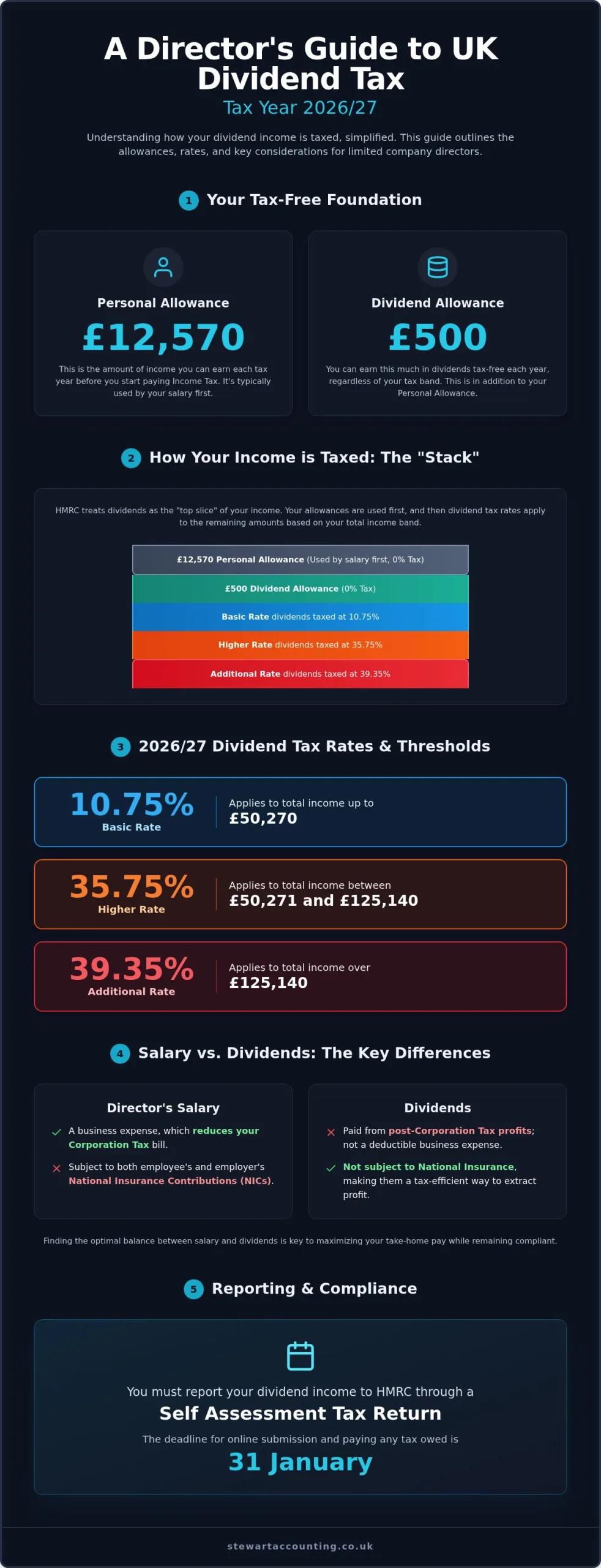
We agree that you shouldn’t have to spend your precious time worrying about HMRC thresholds. This guide provides a definitive roadmap for the 2026/27 tax year. We promise to clarify exactly how your income is taxed, ensuring you keep more of your hard-earned money while staying fully compliant. Our goal is to restore your professional liberty by simplifying these complex rules. We will preview the £500 dividend allowance, explain the updated tax bands ranging from 10.75% to 39.35%, and outline the most efficient salary-dividend split to protect your £12,570 personal allowance.
Key Takeaways
- Learn how the £500 tax-free allowance reduces your initial tax liability on company distributions.
- Discover the 2026/27 dividend tax rates for basic and higher earners to prevent year-end financial surprises.
- Identify the most efficient balance between salary and dividends to optimize your tax on dividends for directors UK and protect your personal allowance.
- Understand the Self Assessment reporting requirements and the essential 31 January deadline to remain fully compliant with HMRC.
- Explore how delegating your tax planning can restore your mental clarity and liberate your time for business growth.
What is the Tax on Dividends for Directors in 2026?
Dividends are the reward for your hard work, paid directly from your company’s profits after Corporation Tax has been settled. For a typical limited company director, the tax on dividends for directors UK in 2026 is a personal liability calculated based on how much income you’ve received above the tax-free thresholds. It’s a system designed to tax the wealth you extract from your business, but it requires careful navigation to avoid overpaying. In 2026, your dividend tax obligation is the total tax due on any profit distributions you receive that exceed your £500 allowance and any remaining Personal Allowance.
Your tax obligation only begins once you’ve exhausted both your £12,570 Personal Allowance and your specific £500 dividend allowance. This means you could potentially receive a small amount of dividend income without paying a penny in tax, provided your other income hasn’t already used up your tax-free limits. Understanding these thresholds is the first step toward removing the anxiety of a surprise year-end bill.
To better understand this concept, watch this helpful video:
How Dividends Differ from Salary
The distinction between a salary and a dividend is fundamental to your financial health. A salary is considered a business expense. It reduces your company’s taxable profit, which in turn lowers your Corporation Tax bill. Dividends, however, are a distribution of what’s left after the taxman has taken his share of company profits. Managing the tax on dividends for directors UK becomes much simpler when you view it as part of a wider strategy rather than an isolated cost.
The primary reason many SME owners in Stirling and Falkirk prefer dividends is that they don’t attract National Insurance contributions. By choosing the right mix, you address our “Thematic Triad”: saving money, protecting your time, and reducing the mental strain of complex calculations. Delegating the oversight of your Year End Accounts ensures this balance is struck perfectly every year, giving you the liberty to focus on your business growth.
The 2026/27 Dividend Allowance
For the 2026/27 tax year, the government has maintained the dividend allowance at £500. This is a dedicated tax-free slice of income specifically for shareholders. Even if you’re a high earner, the first £500 of your dividend income is taxed at a 0% rate. It’s a small but vital buffer that protects a portion of your drawings from immediate taxation.
It’s vital to remember that while this £500 is tax-free, it still counts toward your total income when determining which tax band you fall into. For instance, if your total income is £50,500, those dividends might push you into the higher rate bracket, even if the first £500 itself isn’t taxed. Gaining a deeper perspective by understanding dividend tax history shows how these allowances have tightened over time, making professional planning more essential than ever for directors in Alloa and beyond.
The 2026/27 Dividend Tax Rates and Thresholds
HMRC uses a progressive system for dividend tax. Once you pass your specific allowances, the rates you pay depend on your total taxable income for the year. For the 2026/27 tax year, the 2026/27 dividend tax rates are set at the following levels:
- Basic Rate: 10.75% for total income up to £50,270.
- Higher Rate: 35.75% for total income between £50,271 and £125,140.
- Additional Rate: 39.35% for total income exceeding £125,140.
This “stacking” method often leads to anxiety for directors who fear falling into a higher bracket by mistake. Your tax band isn’t just determined by your dividends; it’s calculated by adding your dividend income on top of all other sources of income, such as your director’s salary or rental income. This cumulative approach means every pound of dividend income could potentially be taxed at a higher rate if your other earnings have already filled up the lower tax bands.
Determining Your Tax Band
HMRC treats dividends as the “top slice” of your income. In practice, this means your salary uses up your £12,570 Personal Allowance first. Any dividends you draw are then added on top. Your Self Assessment Tax Return is the mechanism that calculates this final liability by looking at your combined total for the year.
Consider a practical example. Imagine a director takes a salary of £12,570 and dividends of £40,000. The salary is tax-free because it matches the Personal Allowance. The first £500 of dividends is also tax-free. However, the total income of £52,570 pushes the director into the higher rate band. In this scenario, £37,200 of the dividends are taxed at 10.75%, while the final £2,300 is taxed at the 35.75% higher rate. Understanding how this tax on dividends for directors UK is tiered is essential to avoid year-end shocks.
The Scottish Context: Salary vs. Dividends
For directors based in Central Scotland, the rules have an extra layer of complexity. If your company is located in Alloa, Stirling, or Falkirk, you’re subject to Scottish Income Tax on your salary. However, dividend tax rates remain consistent across the entire UK. This creates a dual-tax environment where your salary might be taxed under Scottish bands while your dividends follow UK thresholds.
Managing these two systems simultaneously can feel like an administrative burden. We specialize in helping local business owners navigate this specific Scottish challenge. We ensure your salary-dividend split is optimized for both systems, giving you peace of mind that your affairs are handled professionally. If you’re feeling overwhelmed by these overlapping rules, you can speak with our team for personalized tax planning.
Salary vs. Dividends: Finding the Most Tax-Efficient Balance
How do you decide the exact split between salary and dividends? Choosing the right payment structure is a delicate balancing act. Most directors find that taking a small salary supplemented by dividends is the most effective way to manage their tax on dividends for directors UK. For the 2026/27 tax year, setting your salary at the Primary Threshold of £12,570 is a strategic starting point. This specific figure allows you to utilize your full Personal Allowance while ensuring you maintain your National Insurance record for state pension purposes without actually paying employee NI contributions.
Once your salary is set, you can use dividends to “top up” your remaining income. This approach is highly flexible. It allows you to adjust your drawings based on your company’s real-time performance. For bespoke advice on how this applies to your specific business goals, our Limited Company Accounting Services provide the tailored planning you need to stay ahead of changing regulations.
The ‘Sweet Spot’ Strategy for 2026
Why is £50,270 such a critical number for your 2026 tax planning? This is the threshold where the basic rate ends and the 35.75% higher rate for dividends begins. Staying within this “sweet spot” prevents a significant jump in your personal tax liability. However, you must also consider the Corporation Tax impact. A salary is a deductible business expense. This means it reduces your company’s taxable profits and your resulting Corporation Tax bill. Dividends, by contrast, are paid from profits that have already been taxed at the corporate level.
Balancing these two elements is central to our “Thematic Triad”. When you optimize this split, you aren’t just saving money. You’re also protecting your time and boosting your mental well-being by removing the constant worry of overpaying HMRC. It’s about creating a sustainable financial lifestyle that supports your professional liberty and personal long-term objectives.
Common Pitfalls in Director Remuneration
Even the best strategies can fail if you overlook the legal requirements of the Companies Act. One major risk is declaring “illegal dividends”. You can only pay dividends if your company has sufficient distributable profits after all tax liabilities are accounted for. If you draw money when the company doesn’t have the profit to cover it, HMRC can reclassify those payments as salary. This leads to unexpected National Insurance and income tax charges that can cripple your cash flow.
Another common trap is the “January surprise”. Because dividend tax isn’t deducted at the source via PAYE, many directors forget to set aside funds for the bill due on 31 January. Delegating these complex calculations to a Chartered Accountant in Scotland removes this administrative burden entirely. We ensure your distributable profits are accurately tracked throughout the year. This prevents HMRC inquiries and gives you the peace of mind that your financial affairs are handled with professional precision.
Reporting and Paying Your Dividend Tax to HMRC
Unlike your monthly salary, which is processed through PAYE, the tax on dividends for directors UK is not deducted before the money reaches your bank account. You receive the gross amount, and the responsibility for calculating and paying the tax lies entirely with you. This shift in responsibility is a primary source of anxiety for many business owners who fear a large, unexpected bill. To stay compliant, you must register for Self Assessment and file a tax return every year. The deadline for reporting and paying tax on dividends received during the 2026/27 tax year is 31 January 2028.
Failing to prepare for this deadline can lead to unnecessary stress and financial strain. Because the money is already in your personal account, it’s easy to forget that a portion of it belongs to HMRC. Establishing a clear process for tracking these distributions throughout the year is the best way to maintain your professional liberty and keep your mental well-being intact.
The Self Assessment Process for Directors
Managing the administrative burden doesn’t have to be overwhelming. Following a structured approach ensures you meet your obligations without the last-minute panic. We recommend a four-step cycle to keep your affairs in order:
- Record-keeping: Maintain a clear file of all dividend vouchers and the corresponding board minutes to prove the legality of each distribution.
- Income Consolidation: Total your income from every source, including your director’s salary, dividends, and any personal interest or rental income.
- Submission: Submit your finalized return to HMRC using professional accounting software to minimize errors and ensure accuracy.
- Settlement: Pay the remaining tax balance plus any required payments on account by the 31 January deadline.
The ‘Payment on Account’ Surprise
Many directors in Stirling and Falkirk are caught off guard by the “Payment on Account” rule, which can feel like a trap for the unprepared. If your annual tax bill exceeds £1,000, HMRC assumes you’ll owe a similar amount the following year. Consequently, they require you to pay half of your estimated next bill in advance on 31 January, with the second half due by 31 July. This can effectively double your expected tax payment in your first year of drawing higher dividends, creating a significant cash flow challenge for your household.
We help you avoid this shock by using your Year End Accounts to predict these liabilities months in advance. By seeing the figures early, you can set aside the necessary funds without impacting your business operations or personal lifestyle. This pragmatic approach removes the fear of the unknown and allows you to focus on growth. If you want to delegate the stress of HMRC deadlines to a professional partner, contact Stewart Accounting Services to manage your tax affairs.
Why Professional Tax Planning Liberates Your Business
Is your current approach to tax on dividends for directors UK truly serving your long-term goals? We believe that effective tax planning is a lifestyle improvement rather than a simple compliance task. When you view your finances through this lens, you stop seeing tax as a seasonal hurdle and start seeing it as a tool for personal liberty. Professional oversight ensures that your extraction strategy is not just legal, but optimized to protect your wealth and your time.
By delegating the preparation of your Year End Accounts to our team, you’re choosing to transfer the entire administrative burden of HMRC correspondence to us. This physical removal of tasks from your desk is a key part of our service. It allows you to reclaim the mental clarity needed to drive your business forward without the constant background noise of impending deadlines. Knowing that your tax is ‘sorted’ provides a level of professional freedom that few self-managed directors ever experience.
The Stewart Accounting Services Approach
We are proud to serve the business communities of Alloa, Stirling, and Falkirk with a focus on sustainable SME growth. Our philosophy centers on our “Thematic Triad”: liberating your time, your finances, and your mental energy. We don’t believe you should have to wait until the end of the financial year to understand your liabilities. Instead, we use real-time accounting tools like Xero to provide ongoing tax estimates. This proactive visibility means you can make informed decisions about your drawings throughout the year, ensuring your strategy remains efficient as your profits fluctuate.
Our regional expertise is particularly valuable for Central Scotland directors who must manage the interplay between Scottish salary tax and UK dividend rates. We ground our expert advice in the practical realities of running a local business. This pragmatic approach ensures that your tax planning is tailored to your specific regional context while maintaining full compliance with national regulations.
Take the Next Step Toward Financial Liberty
Don’t wait until the January deadline to discover what you owe HMRC. A proactive review of your current remuneration structure can often identify opportunities to save thousands in Higher Rate tax. By looking at your salary and dividend split early, we can help you stay within the most efficient tax bands and protect your personal allowance. This isn’t just about the numbers on a spreadsheet; it’s about ensuring your business rewards you for your hard work in the most effective way possible. For medical professionals, this reward often includes investing in a home, and you can explore Specialist Mortgage Advice to find a lender who understands your unique dividend-based income.
Secure Your Financial Liberty for the 2026/27 Tax Year
Managing your tax on dividends for directors UK doesn’t have to be a source of year-end anxiety. By understanding the £500 allowance and the critical £50,270 threshold, you can proactively protect your personal allowance and avoid the jump to higher rate tax. We’ve explored how a strategic salary-dividend split not only saves you money but also preserves your mental well-being by simplifying your HMRC obligations. Whether you’re based in Alloa, Stirling, or Falkirk, having a clear roadmap for your distributions is the first step toward reclaiming your professional freedom.
As ICAS Chartered Accountants and Xero Platinum Partners, we specialize in removing the administrative weight from your shoulders. We ensure your board minutes, dividend vouchers, and self-assessments are handled with expert precision. Don’t let complex thresholds distract you from growing your business. Book a consultation with our Chartered Accountants in Alloa and Stirling to optimize your tax today. We’re here to help you restore the balance between your professional success and personal time. You’ve worked hard for your profits; let’s make sure you keep as much of them as possible.
Frequently Asked Questions
How much is the dividend allowance for the 2026/27 tax year?
The dividend allowance is £500 for the 2026/27 tax year. This means the first £500 of your dividend income is taxed at a 0% rate. While this threshold has decreased significantly from previous years, it still provides a small buffer. Any amount you receive above this figure will be taxed according to your total income band. We help directors in Alloa and Stirling track these distributions to ensure they never exceed their intended thresholds.
Do I pay National Insurance on dividend income as a director?
No, you don’t pay National Insurance (NI) on dividend income. This lack of NI contributions is the primary reason why many limited company owners choose to supplement a lower salary with dividends. It reduces the overall cost of extracting money from the business. However, you must still pay a director’s salary at the correct level to ensure you continue to qualify for the UK state pension and other essential benefits.
What is the basic rate of tax on dividends in 2026?
The basic rate of tax on dividends for the 2026/27 tax year is 10.75%. This rate applies to your dividend income if your total taxable income falls within the basic rate band, which currently goes up to £50,270. If your combined earnings from salary and dividends exceed this amount, you’ll move into the higher rate band of 35.75%. Managing your tax on dividends for directors UK effectively involves staying within these specific tiers.
Can I pay dividends if my company is making a loss?
No, you cannot legally pay dividends if your company is making a loss and has no retained profits. Dividends must only be paid from “distributable profits” after all tax liabilities, such as Corporation Tax, are accounted for. If you ignore this rule, HMRC may reclassify the payments as salary. This leads to unexpected tax and National Insurance bills. We provide management accounts to help you confirm your profit levels before you declare a distribution.
How do I report my dividend income to HMRC?
You must report your dividend income through the annual Self Assessment system. Even if your company has already paid Corporation Tax, you’re personally responsible for declaring the dividends you’ve received. This involves registering for a Unique Taxpayer Reference (UTR) and submitting your return online. Most directors choose to delegate their tax on dividends for directors UK reporting to us to ensure every figure is accurate and submitted well before the 31 January deadline.
Is dividend tax different in Scotland than in the rest of the UK?
Dividend tax rates are the same in Scotland as they are in the rest of the UK. While the Scottish Government sets its own rates and bands for Income Tax on earned income, such as your salary, dividend taxation remains a reserved matter. This means a director in Falkirk pays the same 10.75% or 35.75% as someone in London. Navigating how these two different tax systems interact is a core part of our expert advisory service.
What happens if I take more dividends than the company has profit?
Taking more dividends than your company has profit results in an illegal dividend or an overdrawn director’s loan account. HMRC views these payments as a debt you owe back to the company. If not repaid within nine months of your year-end, the company may face a Section 455 tax charge of 33.75%. To avoid this administrative burden and financial penalty, it’s vital to have professional oversight of your company’s real-time financial position.
Do I need to pay tax on dividends held within an ISA?
You don’t need to pay tax on dividends if they are held within an Individual Savings Account (ISA). Any income generated from investments within an ISA, including dividends from UK companies, is completely tax-free and doesn’t need to be reported on your Self Assessment return. This makes ISAs a highly efficient tool for long-term saving. However, most directors find that the dividends they draw from their own limited companies fall outside of these specific ISA protections.