

How to Do Double Entry Bookkeeping for Small Businesses

It's Friday evening, the bank feed doesn't match your spreadsheet, a supplier says an invoice is unpaid, and your VAT quarter ends on Monday. That muddle is exactly where learning how to do double entry bookkeeping stops being theory. Done properly, it tells you what you own, what you owe, and whether a figure in front of you can be trusted.
Why Double Entry Bookkeeping Is a Control System, Not Just Maths
Many owners first meet debits and credits as a classroom puzzle. In a real business, they're a control system. Every transaction changes at least two places, and recording both sides creates a trail a bank manager, an investor, or HMRC can follow from invoice to ledger to accounts.

That isn't abstract compliance talk. HMRC's enquiry manual on accounting records describes double entry as a system built around at least two linked ledger entries per transaction, with company records required to include day-to-day entries of money received and spent and the reason for each receipt or payment. If you can't show the reason, a balanced total won't save you.
What the Control Actually Gives You
- A self-check: Total debits must equal total credits, so an obvious posting slip shows up quickly.
- An audit trail: Each source document connects to a journal, a ledger balance, and a figure in the accounts.
- Useful reports: Clean ledgers feed cash-flow monitoring, VAT analysis, and management accounts, not just year-end accounts.
Practical rule: If you can't explain where the other side of an entry went, you haven't finished the entry.
The trade-off is discipline. A single list of bank payments is faster on day one, but it can't tell you whether a payment reduced a loan, bought equipment, or settled a supplier. Double entry forces that distinction at the time you post, when you still remember the transaction. That's why loan applications and VAT quarters get easier. You're not reconstructing history from bank narrations months later, you're reviewing records that already explain themselves.
The Core Principle of Every Double Entry Transaction
The method has lasted because the logic is simple. The University of Nottingham accounting research guide notes that Luca Pacioli's 1494 Venetian treatise provided the first full printed description of double-entry bookkeeping, although research hosted by the University of Aberdeen indicates the technique itself dates back to at least 1211.
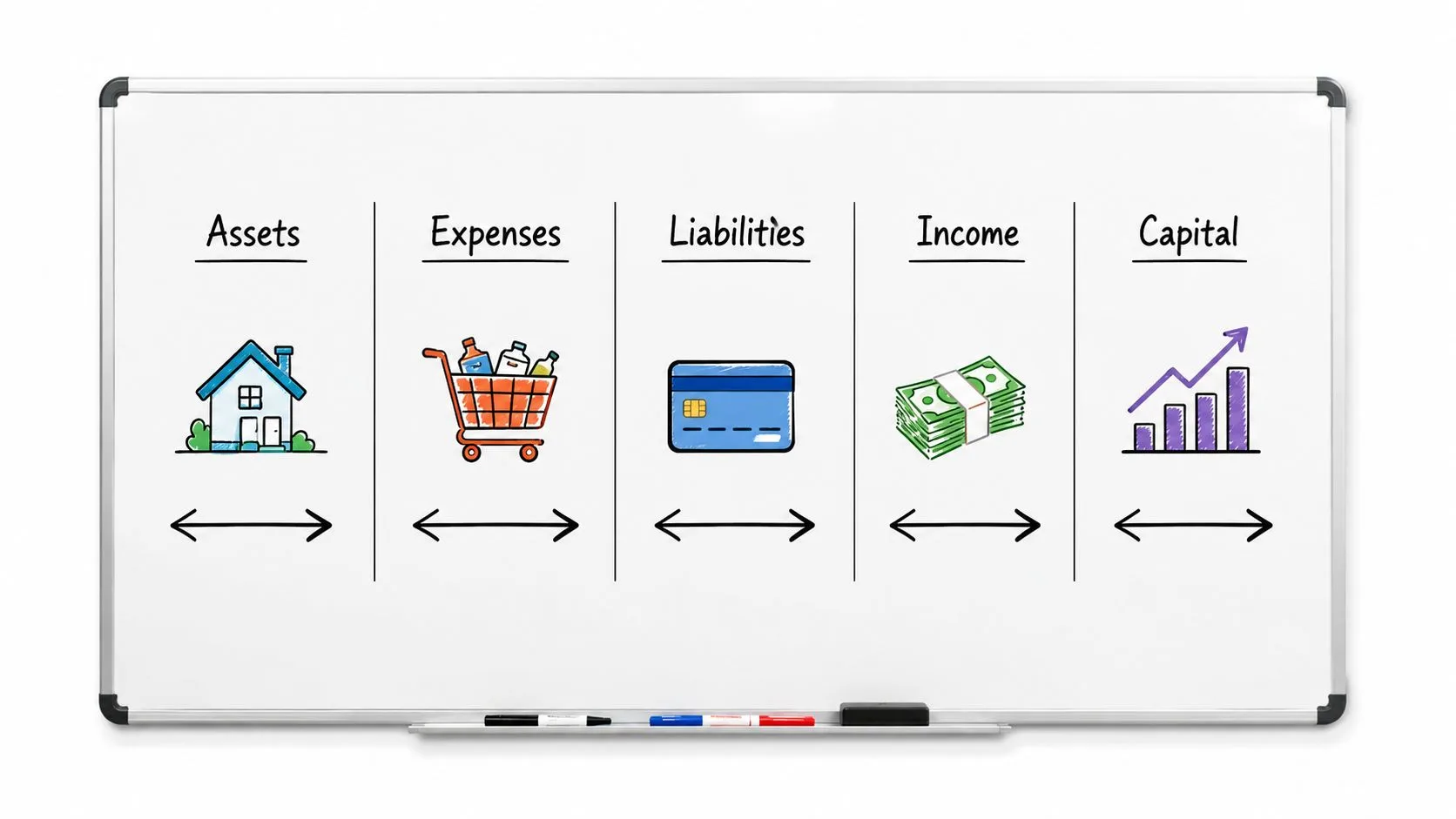
Every account sits in one of five buckets. Assets are what you own, such as bank, equipment, and amounts customers owe you. Expenses are day-to-day costs. Liabilities are what you owe, income is what you earn, and capital is the owner's stake.
The Rule Worth Memorising
Assets and expenses increase with a debit. Income, liabilities, and capital increase with a credit. Decreases go the opposite way. That's the whole predictive model, and it handles most small business transactions without a textbook.
Take a £1,200 purchase of equipment paid from the bank. Equipment, an asset, increases, so you debit equipment £1,200. Bank, also an asset, decreases, so you credit bank £1,200. A £500 customer invoice works differently. Trade receivables increase with a debit, and sales income increases with a credit.
For a bank loan, debit bank when the money arrives and credit loans payable, because the liability has increased. When you repay part of it, debit the loan liability to reduce what you owe and credit bank. Owners often trip here by treating the whole repayment as an expense. It isn't. Only interest is an expense, the capital element reduces the liability.
Watch this short walkthrough, then test each example against the rule above before looking at the answer.
Recording Transactions Through Journals, Ledgers and the Trial Balance
Start with the source document, not the software screen. Identify the transaction, its date, the accounts that change, and whether each change is a debit or credit. Then post equal amounts to both sides and reconcile the result to bank statements, invoices, and supporting documents.
The core books work together. The cash book tracks bank and cash, the sales ledger holds customer accounts, the purchase ledger holds supplier accounts, and the nominal ledger covers expenses, assets, loans, and everything else. A well-structured chart of accounts explained for small businesses keeps those ledgers consistent, so you don't end up with three codes for motor expenses and none for subscriptions.
Five Linked Transactions and Their Double Entry
| Transaction | Debit (£) | Credit (£) | Ledger affected |
|---|---|---|---|
| Capital introduced into bank | Bank | Capital | Cash book, nominal ledger |
| Equipment bought from bank £1,200 | Equipment £1,200 | Bank £1,200 | Nominal ledger, cash book |
| Customer invoice £500 | Trade receivables £500 | Sales £500 | Sales ledger, nominal ledger |
| Supplier invoice on credit | Expense and input VAT | Trade creditors, gross | Purchase ledger, nominal ledger |
| Supplier later paid | Trade creditors, gross | Bank, gross | Purchase ledger, cash book |
Post the journal first if your software allows it, especially for unusual items. Journals let you write a narrative, attach evidence, and see both sides before committing. Routine sales and purchase invoices usually create the journal behind the scenes in Xero or QuickBooks, but you should still know what it's doing.
What a Trial Balance Does and Doesn't Prove
A trial balance lists every ledger balance and checks that debits equal credits. If they don't, you've made a mathematical or posting error. If they do, you've only proved the maths.
A trial balance won't detect an omitted invoice, a duplicated bank receipt, or rent posted to repairs. It proves balance, not truth.
That's why reconciliation matters more than the trial balance itself. Agree bank to the statement, debtors to unpaid sales invoices, and creditors to supplier statements. Investigate differences when they're small. In client files, a tiny unreconciled bank item in month one is often the thread that unravels into duplicated income by month nine.
Common Entries for Sales, Purchases, Payments and Payroll
Say a £1,200 standard-rated supplier invoice lands in your inbox. Under the record-keeping approach in HMRC VAT Notice 700/21 on record keeping, you post Dr expense £1,000, Dr input VAT £200, Cr trade creditors £1,200, and when you pay it, Dr trade creditors £1,200, Cr bank £1,200. The expense is the net figure, not the amount that left the bank. Get that split wrong and your VAT return is wrong before you've even run it.
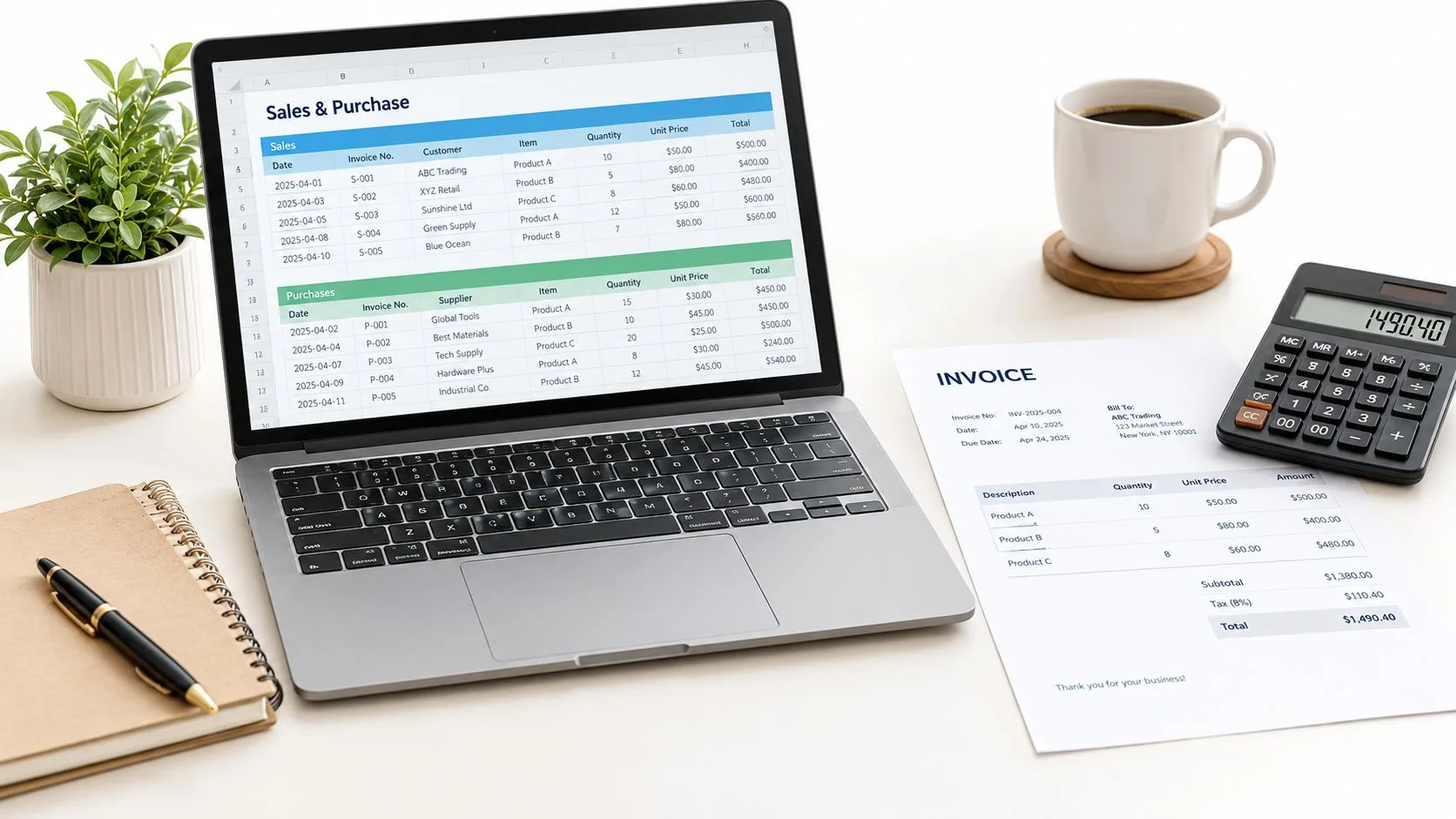
Sales reverse the logic. Debit trade debtors for the gross amount, credit revenue for the net, and credit output VAT for the VAT charged. When the customer pays, debit bank and credit trade debtors. Zero-rated sales keep the same shape but drop the output VAT line, and your VAT code must show why.
Cash items follow their own patterns. Card settlements arrive net of fees: debit bank for what you received, debit card fees where they're deducted at source, and credit the clearing or sales control account for the gross sale. Petty cash works the same way in miniature, with a debit to petty cash and credit to bank when you withdraw the float, then a debit to each expense and credit to petty cash as receipts come in.
Two balances deserve their own mention. Money you personally introduce is a credit to the director's loan account, not sales, and money you take out debits that account. Mixing it with income creates avoidable tax confusion at year end. Your VAT control account carries input VAT as a debit and output VAT as a credit, and the net balance should agree to the return before you submit. That agreement is what keeps your quarterly Making Tax Digital filing honest.
Payroll needs the same discipline. Gross wages and employer's National Insurance and pension costs are debited as expenses. Net pay, PAYE, employee National Insurance, and pension contributions are credited to separate liability accounts until they're paid. When HMRC and the pension provider are paid, you debit those liabilities and credit bank. Posting only the net pay from the bank feed understates wages and leaves liabilities invisible, which is why payroll should always start from the payroll report, not the bank statement.
Month-End Checks That Keep Your Books Audit-Ready
You file a VAT return built on a trial balance that balanced to the penny. A few weeks later an HMRC query lands, because the VAT control account never agreed to the return workings and nobody looked. That is the failure month-end exists to catch. Every check below feeds something downstream: the quarterly Making Tax Digital submission, the year-end accounts, or the basic question of whether your numbers are reliable enough to make decisions on.

| Check | What you're really looking for |
|---|---|
| Reconcile every bank and card account to an independent statement | Old unreconciled items, duplicated feed lines, timing gaps between clearing accounts and the bank |
| Review aged debtors and creditors | Invoices nobody chased, credit notes never applied, duplicate supplier balances |
| Agree the VAT control account to the return workings | Mismatched VAT codes and postings that hit the ledger after the return was drafted |
| Tie payroll liabilities back to the payroll reports | PAYE and pension liabilities still sitting on the books after HMRC and the provider were paid |
| Clear suspense, unidentified receipts and unclear postings | A parking account that only grows, which usually means missing paperwork |
Order matters less than consistency. Run the same checks in the same order each month, then lock the period so nothing slips in afterwards. If a balance refuses to agree, find the reason rather than posting a journal to force it.
The trial balance is where this review starts. It won't prove the books are right, but it points at balances that look wrong: negative sales, a director's loan account sitting in debit, a fixed asset line that creeps up every time someone buys stationery. Our guide to what a trial balance shows in accounting walks through how to read it for exactly these signals.
The same routine carries straight into Making Tax Digital. VAT records need the tax point, net value, VAT rate, adjustments and reverse-charge entries for each supply, and where figures move between systems they must travel through digital links rather than being re-keyed or pasted across. A ledger that balances but carries the wrong VAT codes still produces a wrong submission.
Marketplace sellers feel this most sharply, because platform fees and refunds are netted out before the payout ever reaches the bank. The approach in TikTok Shop P&L essentials is a useful parallel: gross sales, fees and refunds each need their own entry rather than one net receipt, or your income will never reconcile back to the platform reports.
One last habit worth building. Each quarter, sample-test in both directions: pick a ledger entry and trace it to the invoice to check validity, then pick an invoice and trace it into the ledger to check completeness. The first catches fiction. The second catches gaps.
Frequent Mistakes We See in Small Business Books
A café owner hands me a year of books that reconcile perfectly. Bank matches, trial balance agrees, every nominal account tidy. The accounts are still wrong, because a wrong entry carries a debit and a credit just like a right one. Balance proves the arithmetic. It says nothing about whether the figures landed in the right place.
The errors that cost money fall into a short list I see repeatedly:
| Mistake | What it does to your reports | The fix |
|---|---|---|
| Posting the gross figure as the expense | Profit drops, input VAT is lost, and the VAT control account stops agreeing | Split net and VAT from every invoice, with separate codes for standard rate, zero rate, exempt, outside scope, reverse charge and blocked input tax |
| Loan repayments hitting profit in full | The loan balance never falls while expenses look inflated | Split capital, interest and charges using the loan statement |
| No accruals or prepayments | One annual insurance bill wrecks a month and flatters the next eleven | Post a prepayment and release it monthly |
| Capital mixed with repairs | A new machine sits in expenses, or a routine repair lands on the balance sheet | Judge economic substance, not invoice size |
| Duplicate bank-feed lines | Cash or income quietly inflates | Review unreconciled items monthly, not at year-end |
| A suspense account that only grows | Unexplained balances compound until nobody remembers what they were | Treat it as temporary parking and clear it monthly |
Dating errors cause quieter damage than any of these. An invoice posted in the wrong period can shift income between VAT quarters and tax years even when the amount is correct. Lock closed periods in your software, and require invoice-level evidence for unusual journals, especially anything touching the director's loan account.
Watch your margins for the same reason. A jump in gross profit with no price rise and no change in supplier usually means something is miscoded, omitted or duplicated. Check the control accounts before you celebrate it.
Each of these mistakes flows straight into your VAT workings and your quarterly Making Tax Digital submission, so a ledger that balances but carries wrong codes still files wrong figures. When the same correction keeps appearing quarter after quarter, the bookkeeping has outgrown whoever is doing it.
Choosing Between Spreadsheets, Cloud Software and Outsourced Bookkeeping
The right setup depends on volume, VAT status, payroll, and how much you value your Friday evenings. There's no virtue in the most complex option.
Spreadsheets can work for a very small, non-VAT-registered sole trader with few transactions and no staff. They're cheap and transparent, and you can see every formula. They fail when bank reconciliation becomes manual detective work, when VAT codes multiply, or when you need an audit trail that shows who changed a figure and when.
Cloud software such as Xero or QuickBooks pays for itself when you have regular invoicing, VAT, payroll, or a bank feed worth reconciling weekly. Our comparison of Xero versus QuickBooks versus Sage covers the practical differences, and this independent accounting software selection guide is a sensible cross-check on features versus cost before you commit.
Making Tax Digital tilts the decision further. HMRC's Making Tax Digital for Income Tax service guide states that businesses with annual turnover below £90,000 may report total income and expenses in quarterly updates without further breakdown, but accurate underlying digital records are still expected and entries can be amended throughout the year. Quarterly updates are summaries of those records, not final tax calculations.
Outsourced bookkeeping suits owners who want monthly reports without doing the posting, or whose time earns more elsewhere. Stewart Accounting Services is one option for firms that want bookkeeping handled alongside VAT, payroll, and year-end accounts, with Xero set up so you can still see your numbers. The test isn't the monthly fee alone. It's whether errors, late filings, and your own hours currently cost more.
Choose spreadsheets only if the business is simple. Choose software if you're growing, VAT-registered, or employing people. Outsource when bookkeeping is consistently late, because late books usually mean decisions are being made on stale figures.
If your trial balance balances but your VAT control, bank, or director's loan account doesn't make sense, don't wait for year-end to untangle it. Book a bookkeeping review with Stewart Accounting Services in Alloa, Stirling, or Falkirk, or arrange remote support anywhere in the UK, and we'll map your current entries, fix the control accounts, and set up a monthly routine you can maintain.
Recent Posts
17 Oct, 2026
17 Oct, 2026