

Inheritance Tax in Scotland: A Clear Guide to Rules and Allowances

Navigating the financial side of a loved one’s estate is one of life’s most challenging tasks. The rules can seem complicated, and the fear of making a mistake or leaving beneficiaries with an unnecessary tax bill only adds to the stress. This is particularly true when it comes to understanding inheritance tax scotland, where UK-wide regulations meet the unique aspects of Scots law.
But it doesn’t have to be a source of worry. We’re here to help make sense of it all. In this clear and practical guide, we will walk you through everything you need to know. We’ll break down the key thresholds and tax rates, explain legitimate ways to reduce your family’s potential IHT bill, and clarify the steps involved in the process. Our goal is to give you the confidence and peace of mind that comes from knowing your financial affairs are in order.
What is Inheritance Tax? The UK-Wide Rules Explained
Inheritance Tax (IHT) can seem complicated, but at its core, it’s a tax on the value of a person’s estate-their property, money, and possessions-when they die. While this guide focuses on the specifics of inheritance tax scotland, it’s crucial to know that IHT is a reserved UK-wide tax. This means the fundamental rules, rates, and allowances are the same whether you live in Alloa, Stirling, or elsewhere in the UK. Understanding this foundation is the first step towards effective estate planning.
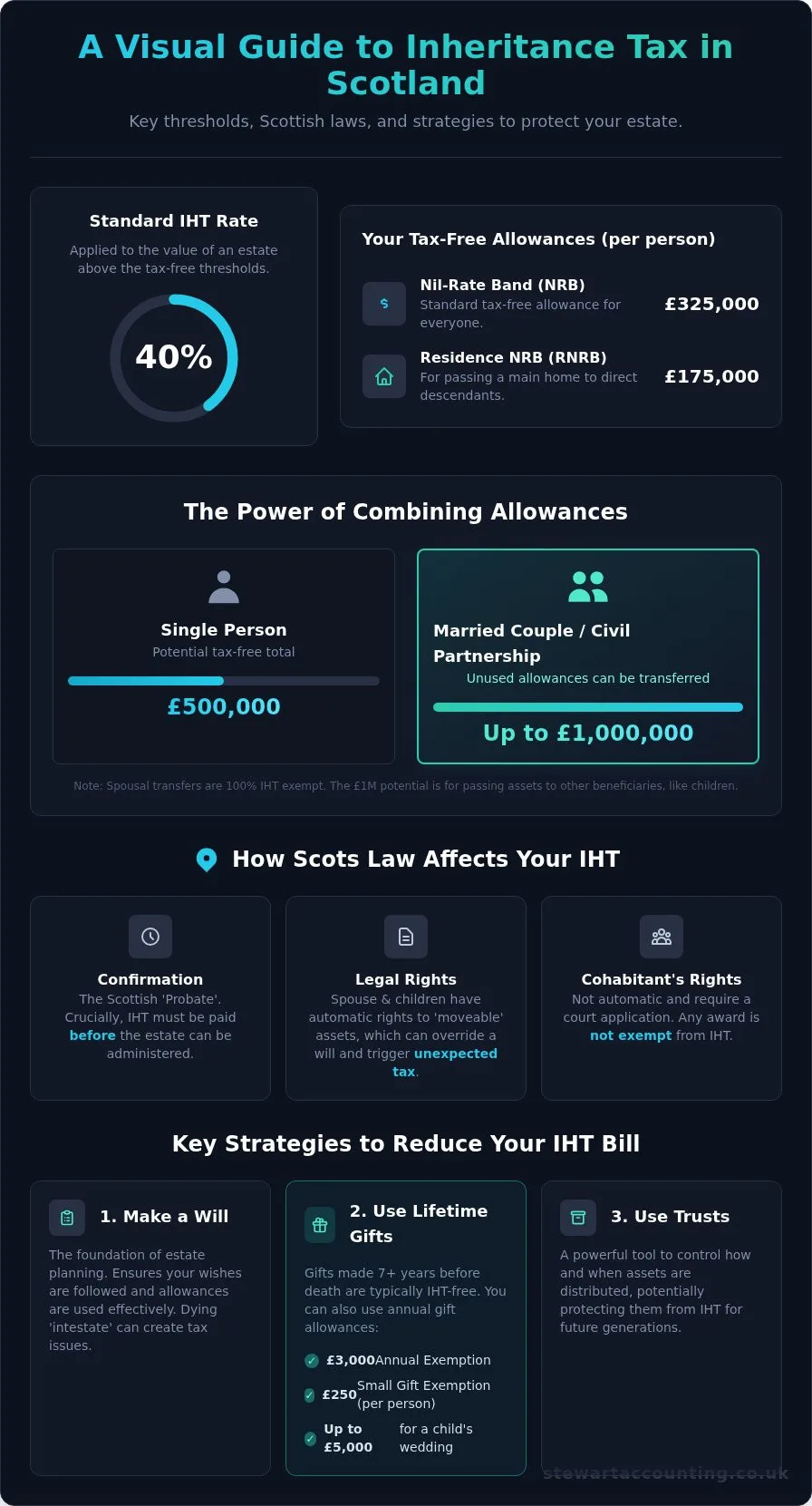
The standard rate for Inheritance Tax is 40%, but this is only charged on the portion of your estate that exceeds your available tax-free allowances. For many people, a significant part of their estate can be passed on without any tax being due at all. Most importantly, assets left to a spouse or civil partner are typically completely exempt from IHT.
Here are the key thresholds for the current tax year:
- Standard Nil-Rate Band (NRB): £325,000
- Residence Nil-Rate Band (RNRB): £175,000
- Standard IHT Rate (on value above thresholds): 40%
The Nil-Rate Band (NRB)
Everyone has a tax-free allowance called the Nil-Rate Band (NRB), currently set at £325,000. This is the amount you can pass on to your beneficiaries without any IHT being charged. A key feature of the NRB is that if it’s not fully used when the first person in a marriage or civil partnership dies, the unused percentage can be transferred to the surviving partner, potentially doubling their tax-free allowance to £650,000.
The Residence Nil-Rate Band (RNRB)
The Residence Nil-Rate Band (RNRB) is an additional £175,000 tax-free allowance. This is specifically for when you pass your main home to your direct descendants, such as children (including step-children and adopted children) or grandchildren. These allowances are central to the current UK Inheritance Tax rules and can allow a married couple to potentially pass on up to £1 million tax-free. However, be aware that for estates valued at over £2 million, the RNRB is gradually reduced.
How Scots Law Affects Your Estate and Inheritance Tax
While Inheritance Tax (IHT) is a UK-wide tax, the legal framework for how your estate is managed and distributed is fundamentally different in Scotland. This is arguably the most critical area where seeking local, professional advice is essential for effective estate planning. The core tax-free allowances and rates are set by the UK government, and you can find the official IHT thresholds and rules on the GOV.UK website. However, the unique principles of Scots succession law can directly influence who inherits your assets and, as a result, the final IHT bill.
Failing to account for these differences can lead to unexpected tax consequences and may mean your final wishes are not carried out as you intended. Let’s explore the key distinctions that make planning for inheritance tax scotland a specialist subject.
Confirmation: The Scottish Process for Administering an Estate
In Scotland, the legal process to release and distribute the assets of someone who has died is called ‘Confirmation’. It is the Scottish equivalent of ‘Probate’ in England and Wales. The executor of the will (or a court-appointed administrator) must apply to the Sheriff Court for Confirmation, which grants them the legal authority to manage the estate. As part of this process, a complete inventory of the estate must be submitted along with the appropriate IHT form. Crucially, any IHT due must typically be paid to HMRC before the court will grant Confirmation.
Legal Rights: A Key Difference in Scotland
A unique and powerful feature of Scots law is the concept of ‘Legal Rights’. These are automatic entitlements for a surviving spouse or civil partner and any children to a share of the deceased’s ‘moveable’ estate (assets like cash, shares, and personal belongings, but not land or buildings). These rights exist regardless of what is written in a will. This can have a significant IHT impact; for example, if a child claims their Legal Rights from an estate left entirely to a surviving spouse, the portion they receive will no longer be covered by the 100% spousal exemption, potentially creating an unexpected tax liability.
Cohabitant’s Rights in Scotland
Scots law also provides certain rights for cohabiting partners if their partner dies without a will (intestate). A surviving cohabitant can apply to the court for a financial award from the estate. However, unlike the rights of a spouse, these are not automatic and require a court application within a strict six-month time limit. From an IHT perspective, it’s vital to note that any award made to a cohabitant is not exempt from Inheritance Tax, unlike transfers between married couples or civil partners.
7 Key Strategies for Reducing Your Inheritance Tax Bill
Thinking about inheritance tax can feel daunting, but with careful, early planning, you can significantly reduce the potential bill and give your family peace of mind. Taking proactive steps ensures more of your hard-earned wealth passes to your loved ones. These strategies are some of the most effective ways to protect your legacy and manage your estate efficiently.
Making a Will
A legally valid will is the absolute foundation of all estate planning. It provides clear instructions on how your assets should be distributed, ensuring your wishes are followed. A well-structured will helps make full use of available allowances and exemptions. Dying without a will in Scotland (known as dying ‘intestate’) means the law dictates who inherits your estate, which may not align with your intentions and can lead to unnecessary complications and tax liabilities.
Lifetime Gifts and the 7-Year Rule
Gifting assets during your lifetime can be a straightforward way to reduce the value of your estate. Most gifts are considered ‘Potentially Exempt Transfers’ (PETs). If you live for seven years after making the gift, it becomes fully exempt from IHT. You can also use several annual allowances:
- Annual Exemption: Gift up to £3,000 each tax year.
- Small Gift Exemption: Make unlimited gifts of up to £250 per person.
- Gifts for weddings or civil partnerships: Up to £5,000 from a parent.
If you pass away between three and seven years after making a large gift, ‘taper relief’ may apply, reducing the IHT due on it.
Using Trusts for Estate Planning
Trusts can be a powerful tool for managing inheritance tax in Scotland. By placing assets into a trust, you legally remove them from your estate while still retaining a degree of control over how they are managed and distributed. A simple Bare Trust gives the beneficiary an absolute right to the assets at age 18, while a Discretionary Trust gives trustees flexibility over who benefits and when. Setting up a trust is a complex area, so seeking expert legal and financial advice is essential.
Pensions and Life Insurance Policies
Your pension is often one of your most valuable assets, yet most defined contribution pension pots sit outside your estate for IHT purposes. It is vital to keep your death benefit nomination forms updated to ensure the funds go to your chosen beneficiaries. Additionally, a life insurance policy written ‘in trust’ can be an effective solution. The payout from such a policy can be used directly by your beneficiaries to pay the IHT bill, preventing them from having to sell family assets to cover the cost.
Business and Agricultural Property Relief
For business owners and farmers, passing on your life’s work to the next generation is a primary concern. Fortunately, HMRC provides two extremely valuable reliefs designed to protect these assets from a significant Inheritance Tax (IHT) bill: Business Property Relief (BPR) and Agricultural Property Relief (APR). These reliefs can reduce the value of a qualifying asset by up to 100%, meaning no IHT is payable on it.
However, the rules for qualifying can be complex and require careful analysis of your specific circumstances. Navigating the regulations for inheritance tax in Scotland is a core part of effective estate planning, and these reliefs are a powerful tool when used correctly.
Business Property Relief (BPR)
BPR can offer either 50% or 100% relief on the value of relevant business assets. The goal is to allow a family business to continue without having to be sold to cover an IHT liability. Assets that may qualify for 100% relief include:
- A business or an interest in a business, such as a partnership.
- Shares in an unlisted company.
- Shares in a company listed on the Alternative Investment Market (AIM).
It’s important to note that not all businesses qualify. The relief is generally not available for businesses that deal wholly or mainly with investments, such as stocks, shares, land, or property letting.
Agricultural Property Relief (APR)
APR is specifically for those who own agricultural property, such as farmland, pasture, or certain farm buildings and cottages. This relief can also be 50% or 100%, depending on the circumstances. A key point to understand is that APR only covers the agricultural value of the land-not its full market value if it has potential for development.
To qualify for APR, minimum ownership periods must be met. Typically, the property must have been owned and occupied for farming purposes for at least two years before the transfer, or owned for seven years and occupied by someone else for farming.
Understanding whether your assets qualify for BPR or APR is crucial for protecting your legacy. The rules are detailed and strict. If you need help navigating the complexities of inheritance tax in Scotland and want to ensure your estate is structured as efficiently as possible, contact our team of experts today. We can help take the worry off your hands.
How a Chartered Accountant Can Help You Navigate IHT
Understanding the rules of Inheritance Tax (IHT) is one thing, but creating a practical, tax-efficient plan is another challenge entirely. This is where professional advice becomes invaluable. A Chartered Accountant acts as your financial strategist, bridging the gap between complex regulations and a clear, actionable plan that saves your estate money and gives you peace of mind.
While a solicitor is essential for drafting legal documents like your will, an accountant focuses on the financial mechanics. We work alongside your legal advisor to ensure your estate is structured in the most effective way possible, protecting your assets for the next generation.
Expert Estate Valuation
One of the first and most critical steps in managing IHT is accurately valuing the deceased’s estate. Getting this wrong can cause significant problems. Undervaluing assets can lead to investigations and penalties from HMRC, while overvaluing them means your beneficiaries could pay more tax than necessary. We meticulously assess everything from property and investments to more complex assets like business shares, ensuring the valuation submitted is both accurate and defensible.
Strategic Tax Planning
Effective planning is the key to minimising your IHT liability. We go beyond the basics to identify every available relief and exemption you’re entitled to, such as Business Property Relief or Agricultural Property Relief. Our goal when planning for inheritance tax scotland is to create a long-term strategy that may include:
- Structuring lifetime gifts to make use of annual exemptions.
- Advising on the use of trusts to protect assets.
- Ensuring your will is structured for maximum tax efficiency.
This isn’t a one-off task; it’s an adaptive plan that can change as your circumstances or legislation does.
Compliance and Administration
When the time comes, the administrative burden of IHT can be overwhelming for executors. We can take this stress completely off your hands. Our team will handle the complex IHT forms, perform the final tax calculations, and liaise directly with HMRC on your behalf. This ensures everything is filed correctly and on time, preventing costly errors and delays during an already difficult period.
Let us take the stress out of IHT planning. Contact us today.
Secure Your Legacy: A Clear Path Through Inheritance Tax
Understanding Inheritance Tax is the first step toward protecting your estate for future generations. As we’ve covered, from the nil-rate band to specific reliefs like Business and Agricultural Property Relief, there are many established ways to manage your liability. The key is proactive, well-informed planning that considers both UK-wide rules and the unique aspects of Scots Law.
But you don’t have to navigate the complexities of inheritance tax scotland on your own. The worry and administrative burden can be significant, but our team is here to take it off your hands. As Fully Qualified Chartered Accountants with local offices in Alloa, Stirling, and Falkirk, we provide reassuring, expert support tailored to your circumstances. Our deep expertise in both the UK tax system and the Scottish legal context ensures your planning is both compliant and effective.
Take the first step towards securing your family’s future and gaining complete peace of mind. Get expert help with your Inheritance Tax planning. Schedule a free consultation.
Frequently Asked Questions About Inheritance Tax in Scotland
Do I have to pay Inheritance Tax in Scotland if I live in England?
Inheritance Tax (IHT) is a UK-wide tax based on the deceased’s permanent home (domicile), not where the beneficiary lives. If the person who passed away was domiciled in Scotland, their worldwide estate is assessed for UK IHT. Therefore, even if you live in England or anywhere else, if you are a beneficiary of a Scottish estate that is liable for tax, that liability still stands. The key factor is the status of the deceased person’s estate.
How long do you have to pay Inheritance Tax after a death in Scotland?
The deadline for paying Inheritance Tax is the same across the UK. Payment is due to HMRC by the end of the sixth month after the person’s death. For example, if the person passed away in February, the IHT payment would be due by 31st August of the same year. It is crucial to meet this deadline, as HMRC will charge interest on any late payments, which can add a significant and unnecessary cost to the estate.
Are gifts to charity exempt from Inheritance Tax?
Yes, gifts made to qualifying charities are entirely exempt from Inheritance Tax. This exemption applies whether the gift was made during the person’s lifetime or left as part of their will. Furthermore, if at least 10% of the net value of an estate is left to charity, the Inheritance Tax rate on the rest of the estate can be reduced from the standard 40% down to 36%. This can provide significant tax relief while supporting a good cause.
What happens if my estate is worth less than the £325,000 threshold?
If the total value of the estate is below the £325,000 threshold, known as the Nil-Rate Band, then generally no Inheritance Tax will be payable. While you may still need to complete IHT forms to report the estate’s value to HMRC, there will be no tax to pay. It’s also worth noting that any unused portion of this allowance can often be transferred to a surviving spouse or civil partner, potentially increasing their own threshold.
Can I give my house to my children to avoid Inheritance Tax?
This is a complex area. If you give your house to your children but continue to live in it without paying a full market-rate rent, this is classed as a ‘gift with reservation of benefit’. In this situation, the property would still be considered part of your estate for IHT purposes. For the gift to be fully outside your estate, you must not benefit from it, and you must survive for seven years after making the gift.
What is the process for valuing an estate for IHT purposes?
Valuing an estate involves identifying all the deceased’s assets and liabilities at the date of their death. Assets include property, money in bank accounts, investments, and valuable personal items, which must be assessed at their ‘open market value’. From this total, any liabilities such as a mortgage, loans, or outstanding bills are deducted. The resulting figure is the net value of the estate, which is used to calculate if any IHT is due.
Recent Posts
22 Oct, 2026
21 Oct, 2026