

What Are the Allowable Expenses for Sole Traders in the UK?

What if the key to a lower tax bill isn’t working more hours, but simply identifying which of your current costs HMRC actually expects you to claim? It’s a common worry for small business owners in Central Scotland and across the UK. You likely feel the pressure of overpaying tax or the nagging fear that an accidental error might lead to a penalty. Understanding the rules for allowable expenses for sole traders uk shouldn’t feel like a guessing game that keeps you up at night.
We understand that your focus should be on your business, not drowning in receipts and complex regulations. You deserve the peace of mind that comes from knowing your filing is accurate and your finances are optimized. This article provides a clear, pragmatic breakdown of exactly what you can deduct from your turnover. We’ll cover everything from office costs and travel to the nuances of dual-purpose items. Our goal is to help you liberate your time, finances, and mental well-being through smarter, compliant tax planning that keeps you on the right side of HMRC.
Key Takeaways
- Master the “wholly and exclusively” rule to ensure your claims for allowable expenses for sole traders uk are fully compliant with HMRC regulations.
- Discover how to use the Annual Investment Allowance to deduct 100% of the cost of large equipment purchases in a single tax year.
- Compare simplified flat-rate expenses against actual costs for travel and home offices to find the most time-efficient and tax-effective method for your business.
- Prepare for the 2026 Making Tax Digital transition by understanding the new requirements for digital record-keeping and quarterly updates.
- Recognize that professional fees, such as accountancy and tax planning services, are themselves allowable expenses that reduce your overall tax liability.
Understanding the “Wholly and Exclusively” Rule
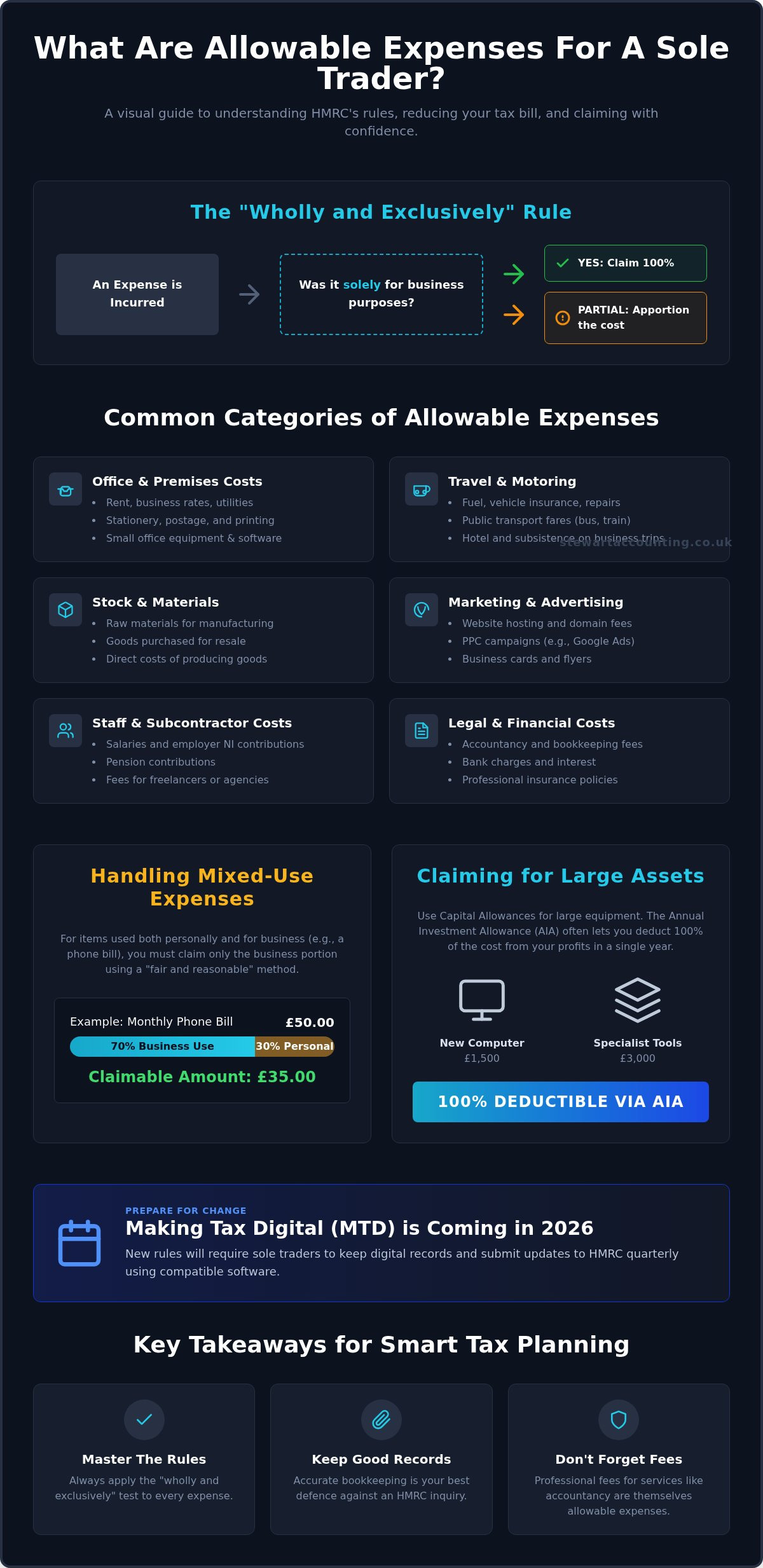
HMRC’s gold standard for tax relief is the “wholly and exclusively” principle. This means that for a cost to be considered one of the allowable expenses for sole traders uk, it must be incurred solely for the purpose of your trade. If a cost doesn’t meet this specific criteria, you cannot legally deduct it from your turnover to reduce your taxable profit. It’s a binary rule that leaves little room for ambiguity in the eyes of a tax inspector.
Personal costs are strictly off-limits. Buying a new suit for a client meeting might feel like a business expense, but because the suit also provides “human warmth and decency,” it’s considered a personal cost. Understanding these boundaries is the first step toward reclaiming your financial liberty. When you know exactly what qualifies, you can stop guessing and start filing with confidence. Working with experts who understand the nuances of Taxation in the United Kingdom ensures you stay compliant while maximizing your returns.
To better understand how these rules apply in practice, watch this helpful video:
Many sole traders in places like Alloa and Stirling feel a sense of dread when categorizing costs. This anxiety often leads to “under-claiming,” where you pay more tax than necessary because you’re afraid of an audit. Professional guidance removes this burden. By delegating your tax planning to experts, you ensure every penny of allowable expenses for sole traders uk is captured accurately. This pragmatic approach doesn’t just save money; it restores your mental well-being and allows you to focus on growth.
What Happens if an Expense is Part-Business and Part-Personal?
HMRC recognizes that life and business often overlap. If you use something for both work and personal life, you can still claim the business portion. The key is to use a method of calculation that is “fair and reasonable.” You don’t need a complex formula, but you do need a logical basis for your split. Common examples include mobile phone bills and home broadband. A dual-purpose expense occurs when a single cost serves both business and personal needs, such as a £40 monthly broadband bill where you use the connection for work during the day and streaming movies in the evening, requiring a 50/50 split for the claim.
The Consequences of Incorrectly Claimed Expenses
Incorrect claims can lead to unwanted attention from HMRC. Penalties are typically based on the amount of tax underpaid and the nature of the error. A “careless” mistake might result in a lower percentage fine, but “deliberate” errors can lead to much heavier financial hits. Accurate, real-time bookkeeping is your first line of defence. It provides the evidence needed to justify your claims if you’re ever questioned. For total peace of mind, many business owners opt for tax investigation protection, which covers the professional costs of defending you during an HMRC inquiry. This protection ensures that an unexpected letter from the tax office doesn’t become a financial crisis.
Common Categories of Allowable Expenses for Sole Traders
Identifying the specific allowable expenses for sole traders uk can feel like solving a complex puzzle. However, most business costs fall into predictable categories that HMRC expects to see on your tax return. From the stamps on your mail to the hosting for your website, these deductions are essential for calculating your true profit. Referencing the official government guidance on expenses is a great starting point, but understanding how these rules apply to your specific trade is where you’ll find the most value.
Most day-to-day costs fit into these core groups:
- Office Supplies: Stationery, postage, and small tech items like laptops or tablets.
- Advertising: Website hosting, business cards, and online marketing campaigns like PPC.
- Stock: The raw materials or finished goods you purchase specifically for resale.
- Specialist Clothing: Protective gear or branded uniforms that wouldn’t be worn for everyday use.
HMRC is particularly strict about clothing. You can’t claim for “work clothes” that you would also wear outside of business, such as a standard suit or a pair of jeans, even if you only wear them for client meetings. By capturing every legitimate cost, you aren’t just following the rules; you’re actively reclaiming your financial freedom by ensuring you don’t pay a penny more in tax than you legally owe.
Professional and Financial Costs
Your business relies on protection and financial structure. Premiums for professional indemnity or public liability insurance are fully allowable. You can also claim for bank charges, interest on business loans, and credit card fees, provided the account is used exclusively for business purposes. One of the most beneficial deductions is that your accountancy fees are themselves a fully allowable tax deduction. This effectively reduces the net cost of professional support while ensuring your records remain beyond reproach.
Training and Subscriptions
Staying current in your field is vital for growth. HMRC allows you to claim for refresher courses that update your existing knowledge or for professional body memberships and trade journal subscriptions. A course to learn a completely new skill is often considered a capital cost because it provides an enduring benefit to the business rather than simply maintaining your current trade. If you’re feeling overwhelmed by the complexity of your receipts, reaching out for a professional review can help you identify missed opportunities and restore your peace of mind.
Working from Home and Travel: Simplified vs. Actual Costs
Choosing how to claim for your home office and vehicle usage is often a balancing act between saving time and maximizing your tax relief. HMRC offers a choice between “actual costs,” which requires meticulous record-keeping of every receipt, and “Simplified Expenses,” which uses flat rates based on usage. For many busy business owners, the simplified method is a pragmatic way to reduce the administrative burden. As highlighted in the FSB guide to business expenses, selecting the right method is a key part of managing your allowable expenses for sole traders uk efficiently.
The Sole Trader Mileage Guide
The mileage allowance is one of the most straightforward allowable expenses for sole traders uk. For the 2026/2027 tax year, you can claim 45p per mile for the first 10,000 business miles and 25p per mile thereafter. It’s vital to distinguish between a “business journey” and a regular commute. HMRC defines a commute as travel between your home and a permanent place of work; these trips are not claimable. To stay compliant, you should maintain a mileage log. Digital tools like Xero can automate this process, but a simple manual record of the date, destination, and purpose of the trip is also acceptable.
Claiming for a Home Office in Scotland
If you work from home for at least 25 hours a month, you can use simplified flat rates. This ranges from £10 to £26 per month depending on your hours. For example, working 101 hours or more per month allows for a £26 deduction. However, if your home-running costs are high, calculating actual costs might be more beneficial. This involves looking at your rent, mortgage interest, utilities, and council tax, then apportioning them based on the number of rooms used for work and the time spent working. If these calculations feel overwhelming, our sole trader accounting services can help you determine which method leaves more money in your pocket while keeping you fully compliant.
Capital Allowances: Claiming for Large Equipment
While previous sections focused on day-to-day costs like stationery or marketing, your business also grows through significant investments. Understanding capital allowances is just as important as tracking your recurring allowable expenses for sole traders uk. HMRC distinguishes between “revenue” expenses, which are the daily running costs of your trade, and “capital” expenditure, which refers to assets that provide a long-term benefit. Items like heavy machinery, delivery vans, and high-spec computer hardware fall into this second category. These are not deducted from your turnover in the same way as a packet of printer paper; instead, you claim for their wear and tear over time.
The rules change slightly if you use “Cash Basis” accounting. Under this simplified system, most capital purchases are treated exactly like regular expenses and are deducted in the year you pay for them. However, cars remain a notable exception and must still be handled through the traditional capital allowance rules. This distinction is vital for maintaining your financial liberty and ensuring your tax return accurately reflects your business growth without triggering unnecessary HMRC queries.
The Annual Investment Allowance (AIA)
The AIA is a powerful tool for reducing your tax bill when you invest in your business. The Annual Investment Allowance (AIA) functions as a way to deduct the full value of a qualifying item from your business profits before tax is calculated. For the 2025/2026 tax year, the AIA limit remains at a generous £1 million. This means most sole traders can write off the entire cost of new equipment in the year of purchase. If you use an asset for both work and personal life, such as a laptop you also use for home admin, you must reduce your claim to reflect the business-use percentage only.
Cars vs. Vans: Different Tax Treatments
Vehicles often represent a sole trader’s largest capital outlay, but HMRC treats them very differently. Vans are generally viewed as plant and machinery, meaning they usually qualify for the full AIA deduction. Cars, however, do not qualify for AIA. Instead, you claim for them using “Writing Down Allowances” (WDA). The rate you can claim depends on the car’s CO2 emissions. From 6 April 2026, the WDA for the main pool of plant and machinery assets is reduced from 18% to 14%, making it even more important to time your purchases correctly. A new 40% First-Year Allowance was also introduced in January 2026 for specific equipment, providing additional relief for those looking to modernize their operations.
Deciding between a car and a van can have a massive impact on your immediate tax position. It is often wise to seek advice from Chartered Accountants in Stirling before signing a lease or purchase agreement. Professional guidance removes the stress of complex tax calculations and ensures you maximize your resource optimization. If you are planning a major purchase and want to ensure you claim every penny possible, you can book a tax planning consultation to secure your financial future.
Making Tax Digital (MTD) and Record Keeping for 2026
The classic “shoebox of receipts” approach is no longer just a headache for your accountant; it’s a significant risk to your business compliance. From 6 April 2026, the way you report your allowable expenses for sole traders uk will change forever. HMRC’s Making Tax Digital (MTD) initiative requires you to move away from manual spreadsheets and paper records toward a fully digital system. This shift is designed to reduce errors, but we know it can feel like another weight on your already busy shoulders.
The most significant change is the move from a single annual Self Assessment filing to a system of quarterly updates. This means you’ll need to submit a summary of your business income and expenses to HMRC every three months. Properly categorizing allowable expenses for sole traders uk is no longer an annual task you can put off until January. It must become a seamless part of your weekly or monthly routine to ensure you meet the new deadlines without the last-minute panic.
Transitioning to online accounting services is the most pragmatic way to stay ahead of these changes. Software like Xero, combined with receipt-scanning tools like Dext, allows you to capture costs the moment they happen. You simply snap a photo of a receipt on your phone, and the data is automatically extracted and categorized. This doesn’t just satisfy HMRC; it gives you a real-time view of your profitability and ensures no deductible cost is ever forgotten or lost.
Preparing for MTD for Income Tax
This new regulation doesn’t affect everyone at once, but the rollout is fast approaching. From April 2026, sole traders with a qualifying income over £50,000 must comply. The first quarterly updates for this group are due by 7 August 2026. The threshold then drops to £30,000 in April 2027 and £20,000 in April 2028. Moving to a digital-first approach today prevents a stressful scramble when your business reaches these limits. Beyond compliance, real-time bookkeeping offers a massive advantage for your cash flow management, allowing you to see exactly how much tax you owe throughout the year rather than facing a surprise bill.
How Stewart Accounting Restores Your Freedom
At Stewart Accounting Services, we specialize in removing the administrative burdens that hold you back. Our core mission is built around a three-part promise to liberate your time, your finances, and your mental well-being. We don’t just provide software; we offer a partnership that allows for the total delegation of your bookkeeping and tax worries. By physically removing these tasks from your to-do list, we empower you to focus entirely on growing your business in Central Scotland or anywhere across the UK.
You don’t have to face the 2026 transition alone. We’re here to ensure your records are pristine, your expenses are optimized, and your peace of mind is restored. Contact Stewart Accounting today to discover how we can simplify your path to MTD compliance and protect your hard-earned income.
Secure Your Financial Freedom Today
Mastering the rules around allowable expenses for sole traders uk is more than just a compliance task; it’s a vital step toward reclaiming your time and mental well-being. By applying the “wholly and exclusively” principle and preparing for the 2026 Making Tax Digital transition, you ensure your business remains resilient and tax-efficient. Whether you’re choosing between simplified mileage rates or calculating complex home-office costs, accuracy is your best defense against HMRC penalties.
As Chartered Accountants with offices in Alloa, Stirling, and Falkirk, we specialize in providing MTD-ready digital solutions tailored for small businesses. We remove the burden of record-keeping so you can focus on growth. Don’t let the complexity of tax law stand in the way of your personal liberty. Get expert help with your Self Assessment today and gain the peace of mind that comes with professional tax planning. You’ve worked hard for your income; let’s work together to protect it.
Frequently Asked Questions
Can I claim for my gym membership as a sole trader?
Is my lunch an allowable expense when I am working?
Generally, you cannot claim for your daily lunch or coffee. HMRC argues that everyone must eat to live, regardless of whether they are working or not. You can only claim for food and drink if you are traveling on a business trip that involves an overnight stay. Another exception is if your journey is significantly outside your normal working pattern, such as a one-off trip to a distant client site.
How long must I keep my expense receipts for HMRC?
You must keep your records for at least five years after the 31 January submission deadline of the relevant tax year. For example, for the 2024/25 tax year, you should keep your receipts until at least 31 January 2031. Digital copies are perfectly acceptable and highly recommended. Storing them electronically helps you prepare for the digital record-keeping requirements of allowable expenses for sole traders uk and reduces physical clutter.
Can I claim for a laptop I bought before I started my business?
Yes, you can claim for equipment purchased before your business officially launched. You should introduce the item at its current market value on the day you started trading rather than using the original purchase price. This is a pragmatic way to ensure your initial setup costs are reflected in your tax return. It helps lower your initial tax bill by recognizing the value you’ve brought into the business from the start.
Are charitable donations an allowable business expense?
No, sole traders cannot deduct charitable donations as a business expense from their profits. Instead, you should claim these donations through Gift Aid on your Self Assessment tax return. This method reduces your personal tax bill rather than your business’s taxable profit. It’s an important distinction that ensures you still receive the financial benefit of your generosity while staying fully compliant with the specific rules for unincorporated businesses.
Can I claim for the cost of a suit or smart clothes for meetings?
No, you cannot claim for everyday clothing, even if you only wear it for business meetings. HMRC rules state that clothing that could form part of an “everyday wardrobe” has a dual purpose. You can only claim for branded uniforms, protective clothing like steel-toed boots, or costumes required for a specific role. If you could reasonably wear the item to a social event, it is not an allowable deduction.
What is the £1,000 Trading Allowance and should I use it?
The Trading Allowance is a tax-free threshold for small amounts of income. If your gross business income is £1,000 or less, you don’t even need to register for Self Assessment. If it’s higher, you can choose to deduct this flat £1,000 instead of your actual allowable expenses for sole traders uk. This is often beneficial for businesses with very low overheads, as it simplifies your filing and may offer a larger deduction.
Can I claim for my commute to my regular place of work?
No, travel between your home and a permanent place of business is considered a personal commute. HMRC does not allow deductions for these journeys because they are not incurred “wholly and exclusively” for business. You can only claim for travel to temporary workplaces or trips to see clients. This rule applies even if you live in a rural area and have no choice but to drive to your office or workshop.
Recent Posts
21 Aug, 2026
21 Aug, 2026
20 Aug, 2026