

Scotland Salary Calculator: How to Work Out Your Take-Home Pay

Understanding your payslip can often feel like trying to decipher a complex code. You see your headline salary, but the amount that lands in your bank account is always different. This is especially true in Scotland, where the income tax system has its own unique bands and rates. If you’ve ever found yourself wondering where your money goes, you’re in the right place.
This simple guide will walk you through the key deductions on a typical Scottish payslip. We’ll explain how to accurately calculate your net income (or take-home pay) after tax, National Insurance, and other common deductions, giving you the clarity and confidence to manage your finances effectively.
Understanding Your Scottish Payslip: What Gets Deducted?
Your payslip is a detailed breakdown of your earnings and the deductions made before you get paid. While it might look complicated, it’s built around two key figures: your gross pay and your net pay. Your gross pay is your total salary before any deductions are taken, and your net pay is the final amount you take home. Let’s break down the main deductions that turn your gross pay into your net pay.
Scottish Income Tax: The Key Difference
The most significant difference for employees in Scotland is the Scottish Income Tax system. Unlike the rest of the UK, Scotland has its own set of tax bands and rates, which means the amount of income tax you pay can differ from someone earning the same salary in England, Wales, or Northern Ireland. Your total income determines which tax bands you fall into, and you pay the specified rate for the portion of your income within each band.
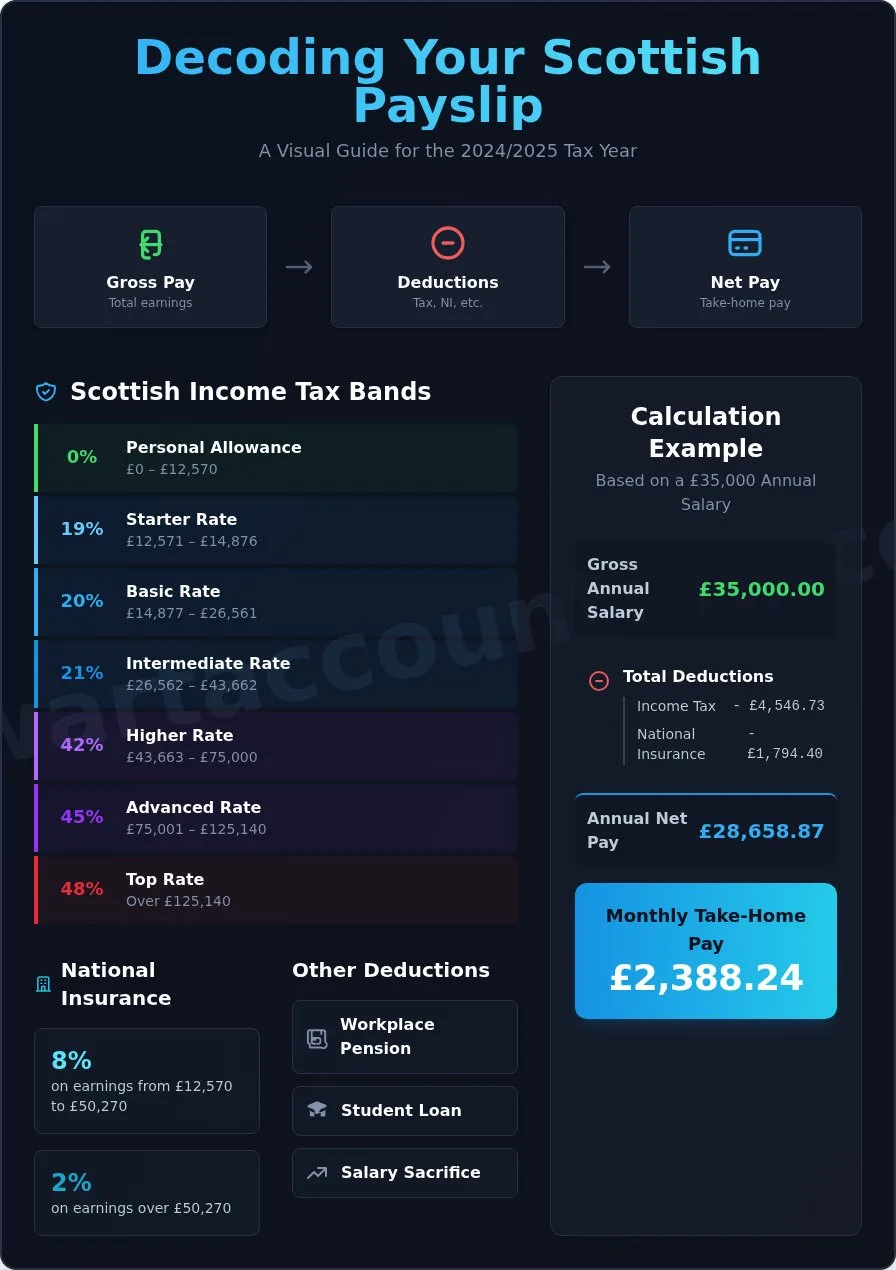
Here are the Scottish Income Tax bands and rates for the 2024/2025 tax year:
- Personal Allowance: £0 – £12,570 (0% Tax)
- Starter Rate: £12,571 – £14,876 (19% Tax)
- Basic Rate: £14,877 – £26,561 (20% Tax)
- Intermediate Rate: £26,562 – £43,662 (21% Tax)
- Higher Rate: £43,663 – £75,000 (42% Tax)
- Advanced Rate: £75,001 – £125,140 (45% Tax)
- Top Rate: Over £125,140 (48% Tax)
Note: These figures are for the 2024/25 tax year. Tax bands and rates are subject to change in future government budgets.
National Insurance (NI) Contributions
National Insurance is a UK-wide tax that funds state benefits, including the State Pension, Jobseeker’s Allowance, and the NHS. It is calculated based on your gross earnings and is separate from Income Tax. For most employees (on NI Category A), you pay contributions on earnings above the Primary Threshold. As of 2024/25, you pay 8% on earnings between £12,570 and £50,270, and 2% on any earnings above that.
Other Common Deductions
Beyond tax and NI, several other items may reduce your gross pay. These are some of the most common:
- Workplace Pension Contributions: Under auto-enrolment, most employees contribute a percentage of their salary to a workplace pension, which is often topped up by employer contributions.
- Student Loan Repayments: If you have a student loan, repayments are automatically deducted once you earn over a certain threshold. Graduates who studied at a Scottish university will typically be on ‘Plan 4’.
- Salary Sacrifice Schemes: Some employers offer benefits like childcare vouchers or a cycle-to-work scheme, where the cost is deducted from your gross salary, often providing tax and NI savings.
How to Calculate Your Scottish Salary: A Simple Example
Now, let’s put it all together. To make things clear, we’ll walk through a calculation for someone earning a gross annual salary of £35,000. This example will show how the different deductions are applied to determine the final take-home pay.
Step 1: Calculate Your Annual Income Tax
Using the Scottish tax bands, we apply the rates to the £35,000 salary:
- The first £12,570 is tax-free (Personal Allowance).
- £2,305 (£14,876 – £12,571) is taxed at the Starter Rate (19%) = £437.95
- £11,684 (£26,561 – £14,877) is taxed at the Basic Rate (20%) = £2,336.80
- £8,438 (£35,000 – £26,562) is taxed at the Intermediate Rate (21%) = £1,771.98
- Total Annual Income Tax = £4,546.73
Step 2: Calculate Your National Insurance
Next, we apply the current NI rates to the example salary:
- The first £12,570 is not subject to NI.
- The remaining earnings (£35,000 – £12,570 = £22,430) are subject to the main rate of 8%.
- Total Annual NI Contribution = £22,430 x 8% = £1,794.40
Step 3: Determine Your Final Take-Home Pay
Finally, we subtract the deductions from the gross salary:
- Start with the gross salary: £35,000.00
- Subtract the total Income Tax: – £4,546.73
- Subtract the total National Insurance: – £1,794.40
- Annual Net Pay = £28,658.87
- Monthly Take-Home Pay = £2,388.24
If this seems complicated, remember you don’t have to do it alone. For businesses looking for accuracy and peace of mind, our team can help. Let us handle your payroll calculations for you.
Frequently Asked Questions About Scottish Salaries
It’s natural to have questions about your pay. Here are answers to some of the most common queries we receive about salaries in Scotland.
What is a tax code and how does it affect my pay?
A tax code is a series of numbers and letters used by your employer or pension provider to work out how much Income Tax to take from your pay. For most Scottish taxpayers, the code will start with an ‘S’ to ensure the correct Scottish rates are applied. The numbers in the code usually refer to your tax-free Personal Allowance. If you think your tax code is wrong, you could be paying too much or too little tax, so it’s important to contact HMRC to get it corrected.
How are bonuses taxed in Scotland?
Bonuses are treated as part of your earnings and are subject to the same deductions as your regular salary, including Scottish Income Tax and National Insurance. Because a bonus increases your earnings for that pay period, it can sometimes push you into a higher tax band, meaning a larger proportion of your overall pay for that month will be taxed at a higher rate.
Do I pay more tax in Scotland than in England?
It depends on how much you earn. Due to the different bands, lower earners in Scotland may pay slightly less Income Tax than their counterparts in the rest of the UK. However, those on higher salaries in Scotland will generally pay more Income Tax, as the higher and top rate thresholds are lower and the rates themselves are higher.
My salary is complex. When do I need an accountant?
Online calculators are excellent for straightforward salaries with standard deductions. However, if your financial situation is more complex-for example, if you are self-employed, have multiple sources of income, receive dividends, or want to ensure you are maximising tax efficiencies-it’s wise to consult an expert. An accountant can provide tailored advice to ensure you are paying the correct amount of tax and help you plan your finances effectively. Schedule a free consultation to discuss your needs.
Understanding your salary is the first step towards taking control of your financial future. While the rules can seem complex, knowing how your take-home pay is calculated allows for better budgeting and planning. If you run a business and find payroll a constant source of stress, our friendly team of chartered accountants is here to help.
Need help with payroll or tax returns? Contact our friendly team. We can take the burden off your hands, giving you more time, more money, and less stress.
Recent Posts
22 Oct, 2026
21 Oct, 2026