

VAT Flat Rate Scheme: A Complete Guide

“Join the VAT Flat Rate Scheme because it saves money” is advice worth challenging. The scheme can reduce VAT administration, but it doesn't automatically reduce your VAT bill. For many consultants, contractors and other service businesses, the Limited Cost Trader rule can replace an attractive sector rate with 16.5%, changing the calculation completely. HMRC's guidance on the VAT Flat Rate Scheme makes the mechanics clear, but deciding whether it suits you requires more than choosing the simplest-looking option.
What Is the VAT Flat Rate Scheme
VAT administration can take disproportionate time. A business must record VAT charged on sales, check VAT on eligible purchases, match supplier invoices and reconcile each return with its bookkeeping. For a web designer, that may mean reviewing expense receipts when the greater priority is client work.
The VAT Flat Rate Scheme offers smaller businesses a simpler way to handle those calculations. Rather than working out VAT separately across every sale and purchase, you pay HMRC a percentage of your VAT-inclusive turnover, meaning total sales including VAT. HMRC introduced the scheme in 2002, and its guidance sets the eligibility limit at annual VAT-exclusive taxable turnover of £150,000 or less.
The scheme changes how you account for VAT, while the VAT rate charged to customers follows the normal rules. You continue issuing VAT invoices, then calculate the amount paid to HMRC using the percentage assigned to your main trade. The arrangement can make bookkeeping more predictable, but it does not guarantee a lower VAT bill.
The practical question: does the simpler calculation compensate for the input VAT you can no longer reclaim?
That depends on your costs, sector and whether the Limited Cost Trader rule applies. A business with few VAT-bearing purchases may benefit from a straightforward calculation. A company buying equipment, materials or stock may find standard VAT accounting more suitable, because its recoverable input VAT can be substantial. The Limited Cost Trader rule can also replace an attractive sector percentage with 16.5%, so checking that point belongs near the start of any decision.
For wider background before comparing schemes, Stewart Accounting Services' complete guide to VAT for businesses explains the surrounding VAT system in plain English.
How the Flat Rate Scheme Works
The scheme changes the VAT calculation, not the VAT you charge customers. You continue adding the applicable VAT rate to standard-rated supplies and showing that amount on each invoice. For each VAT period, total the amount customers paid, including VAT, then apply the percentage for your main business activity. The resulting figure is the amount normally paid to HMRC.
Under standard VAT accounting, the calculation usually starts with output VAT and subtracts recoverable input VAT. The Flat Rate Scheme works more like a fixed percentage applied to gross turnover. You therefore avoid calculating the VAT on every routine expense, although that simpler method can hide a costly trade-off for businesses with substantial purchases.
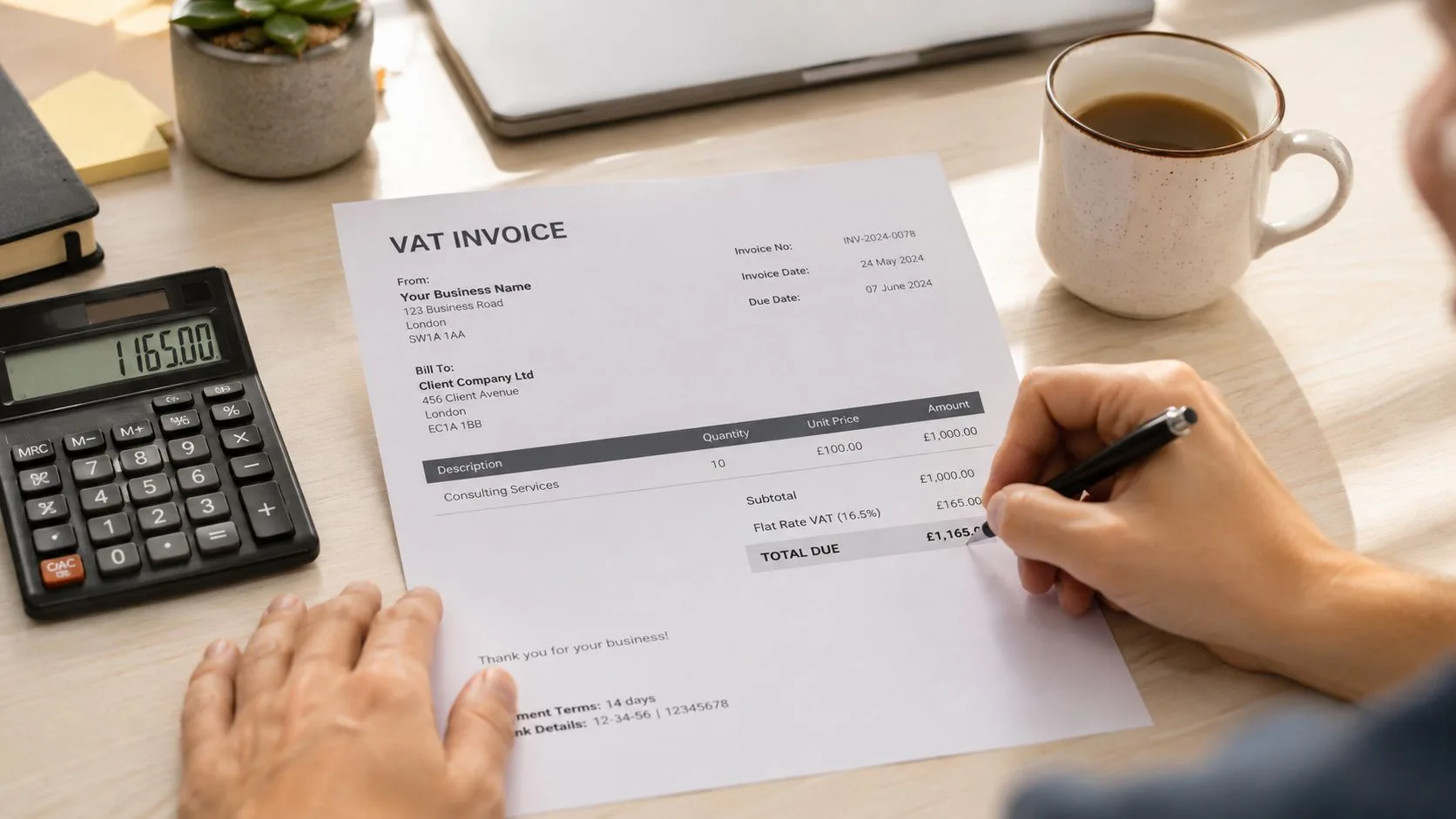
Businesses generally can't reclaim VAT on purchases while using the scheme. The narrow exception covers certain capital assets costing more than £2,000, as noted in HMRC's guidance linked earlier. Compare the flat-rate payment with the input VAT you could recover under standard accounting before deciding. This comparison matters particularly for businesses buying equipment, materials or stock.
A first-year discount changes the calculation for some new VAT registrations. HMRC introduced a 1% reduction for the first year of VAT registration from 1 April 2009. A qualifying newcomer uses the reduced percentage during that initial period, then returns to the ordinary sector rate afterwards.
You can leave the scheme when you choose, subject to the rules applying to your business. Voluntary departure generally prevents rejoining for at least twelve months. Keep the flat-rate calculation distinct from the wider filing process. This guide to VAT returns explains the records and return steps that sit around it.
Eligibility and Current Flat Rate Sectors
Published rates range from 4% to 14.5%, so the percentage attached to your sector can affect the result more than a small change in turnover. Eligibility also depends on forecast taxable turnover, measured before VAT. A business can join when its annual VAT-exclusive taxable turnover is £150,000 or less. Check the forecast before applying, rather than relying only on historic sales.
That limit applies when joining. After registration, a business may remain on the scheme if turnover later rises above it, provided the separate conditions for staying are still met.
HMRC uses different rates for different activities. The appropriate rate depends on the work that represents the business, so check HMRC's sector guidance if your main activity changes or your services do not fit neatly into one category.
| Sector or trade | Flat Rate % |
|---|---|
| Lower-rate sectors | 4% |
| Many unspecified business services | 12% |
| Accountancy and book-keeping | 14.5% |
| Highest published sectors | 14.5% |
Classification deserves careful attention. Two businesses with the same turnover can make very different payments if their activities fall into different categories. Choose the rate that reflects the work you mainly perform, rather than the rate that produces the most attractive calculation. This sector choice is one of the places where the scheme's apparent simplicity can hide a costly mistake.
A narrow premises exception
VAT on electricity and gas used to heat, light or power business premises may fall within a limited exception. Treat that treatment as a specific rule to verify, not as permission to recover VAT on ordinary operating costs.
Before applying, record your main income-producing activity, forecast taxable turnover and regular VAT-bearing purchases. Compare the relevant sector percentage with the input VAT you currently reclaim under standard accounting. That review will show whether the scheme merits closer consideration, although it does not replace advice suited to your records.
VAT Flat Rate Calculation Examples
A percentage can look attractive until it is applied to real sales and costs. These examples show the calculation method for hypothetical businesses. They do not predict the result for every web designer or tradesperson.
Example one, a web design consultancy
Suppose a consultancy has annual VAT-inclusive turnover of £80,000 and uses a 12% business services rate. The figures are illustrative, based on the sector information in HMRC's published sector guidance.
| Calculation | Amount |
|---|---|
| VAT-inclusive turnover | £80,000 |
| Flat-rate percentage | 12% |
| Payment to HMRC | £80,000 × 12% = £9,600 |
Standard VAT accounting would produce a different calculation. The business would work out output VAT on its sales, then deduct recoverable input VAT on eligible purchases. If its VAT-bearing costs produced £1,500 of recoverable input VAT, the standard payment would be the output VAT figure less £1,500.
The comparison depends on the business's sales mix and expense records. The Flat Rate Scheme avoids the work of calculating that £1,500 as input VAT, but it also removes the right to reclaim it.
A first-year VAT registration can affect the illustration. If the first-year reduction applied, the rate would fall by 1 percentage point, so the calculation would use 11% rather than 12%. The payment would then be £8,800. That reduction ends after the first year.
Example two, a tradesperson
A tradesperson with the same turnover may reach a different result because the cost profile is different. Materials and equipment may generate recoverable VAT, while labour, insurance, transport and professional services may have different VAT treatment.
Under standard accounting, qualifying input VAT reduces the amount paid to HMRC. Under the Flat Rate Scheme, the calculation starts with gross turnover and the assigned sector rate. It does not change because the business had a quiet month, bought extra supplies or paid for a large repair.
That fixed approach can make cash planning easier. It can also become expensive when recoverable input VAT is substantial. The apparent simplicity of the percentage is therefore not the same as a guaranteed saving.
Compare the scheme against your actual VAT records, not against a generic percentage.
Capital expenditure needs separate attention. Input VAT is generally not reclaimed under the scheme, but certain capital assets costing more than £2,000 may fall within an exception. A planned purchase can change the result for one VAT period, although it does not automatically make the scheme unsuitable overall.
Advantages and Disadvantages vs Standard VAT
The Flat Rate Scheme earns its appeal from administration. It replaces many purchase-level calculations with a percentage applied to VAT-inclusive turnover. That can make quarterly work easier for an owner who handles bookkeeping personally, particularly when the business has straightforward sales and modest expenses.
Where the scheme can help
Standard VAT accounting requires a business to identify recoverable input VAT and retain suitable records. The Flat Rate Scheme generally removes that routine exercise for ordinary purchases, so there are fewer supplier invoices to review for VAT recovery.
| Flat Rate Scheme | Standard VAT accounting |
|---|---|
| Applies a fixed sector percentage to VAT-inclusive turnover | Calculates output VAT less recoverable input VAT |
| Usually doesn't reclaim VAT on ordinary purchases | Reclaims eligible input VAT under the normal rules |
| Can make the liability easier to forecast | Reflects actual VAT on qualifying costs |
| Reduces routine VAT calculation work | Requires detailed purchase and VAT records |
The fixed percentage can also make cash planning more predictable. A business can estimate the payment from its gross sales without first reviewing every expense. That doesn't guarantee a lower liability, but it can reduce uncertainty.
Where standard VAT may win
The sacrifice is the loss of most input VAT recovery. Equipment, stock, materials and other VAT-bearing purchases can become more expensive in effective terms because the business pays the supplier's VAT but generally can't deduct it from the Flat Rate calculation.
The scheme can also create a mismatch. HMRC's percentage reflects a broad sector category, while your actual business may have an unusual cost structure. If your recoverable input VAT would normally be high, standard accounting may better reflect the way your business operates.
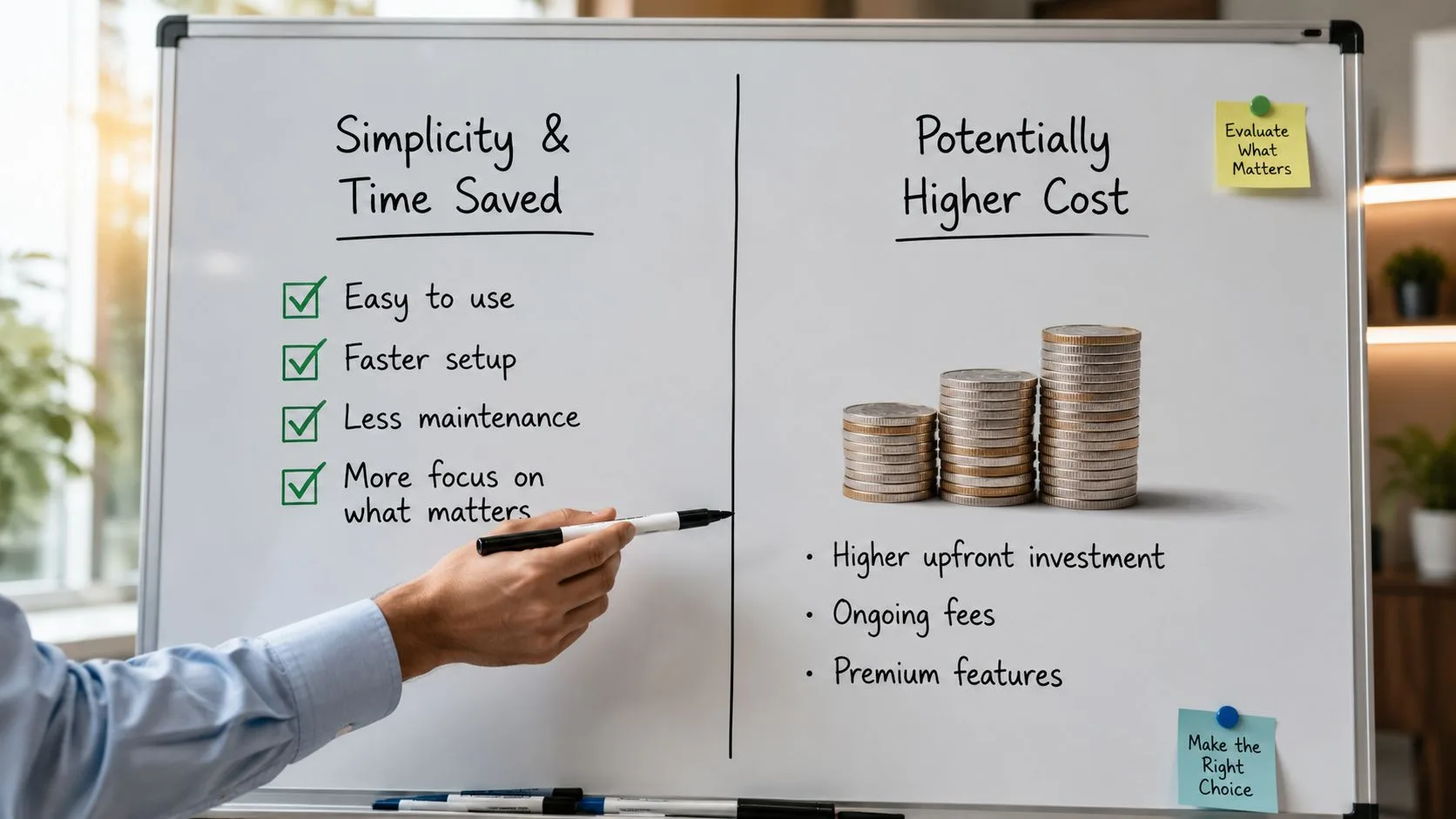
A useful first filter is your purchase profile. Low VAT-bearing costs may make the scheme worth modelling. Significant stock, materials or equipment costs point towards a careful standard-VAT comparison.
Simplicity has a price. Treat the value of saved bookkeeping time as one part of the decision, not proof that the tax calculation will be cheaper.
The Limited Cost Trader Trap
The Limited Cost Trader rule is the point many otherwise sensible comparisons miss. Since April 2017, a business can be forced onto a 16.5% flat rate if its spending on relevant goods falls below the required test. HMRC's Business Income Manual explains that the test looks at relevant goods as a proportion of VAT-inclusive turnover, with a further annual spending condition.
A business is treated as a Limited Cost Trader where it spends less than 2% of VAT-inclusive turnover on relevant goods, or less than £1,000 a year for the longer relevant period. The rule overrides the ordinary sector rate. A consultancy that expected to use 12% may therefore have to use 16.5% instead.
What counts as relevant goods
Relevant goods are generally tangible items used in the business. Depending on the circumstances, that can include physical stationery, cleaning products or goods bought for resale. The test isn't based on every cost appearing in your accounts.
Costs that commonly fail to help include:
- Services: professional fees, rent and many contractor costs don't count as relevant goods.
- Software subscriptions: cloud applications and subscription tools are services rather than physical goods.
- Capital assets: capital expenditure is excluded from the relevant-goods test, even though certain qualifying assets may have separate VAT treatment.
- Labour-heavy spending: wages and payments for services don't increase the relevant-goods total.
That distinction catches IT contractors, consultants and other service businesses. Their accounts may show substantial expenditure, but much of it consists of labour or services, not the physical goods required by the test.
The rate change in practice
Using the illustrative £80,000 turnover from the earlier example, a move from 12% to 16.5% changes the Flat Rate payment from £9,600 to £13,200. That is a difference of £3,600 before considering any other facts, and both calculations use the same VAT-inclusive turnover. The percentages and rule are confirmed in HMRC's published manual.
Check your invoices, not just your profit and loss categories. Separate physical goods from software, rent, accountancy, subcontracted services and capital purchases, then test the relevant-goods total against VAT-inclusive turnover. This explanation of the Limited Cost Trader rule can help you organise that review.
Joining Leaving and Managing the Scheme
Joining the Flat Rate Scheme is not automatically a saving. The calculation should come first, especially because the Limited Cost Trader rule can replace the rate you expect with a higher one. Confirm that you're VAT-registered, compare your expected VAT-exclusive taxable turnover with the £150,000 joining limit and identify the rate for your main activity using current HMRC guidance.
A practical joining process
You can request the scheme during VAT registration or apply after registration through the relevant HMRC process. Wait for HMRC to confirm the effective date before using the percentage on a VAT return. An application does not authorise you to backdate the calculation.
After acceptance, configure your bookkeeping system and retain the working papers:
- Set the correct flat-rate percentage: Use the rate for your main activity, while checking whether the Limited Cost Trader rule changes it.
- Show VAT-inclusive turnover: The payment is based on gross turnover, so sales reports must include VAT.
- Record purchases accurately: Ordinary input VAT is usually not reclaimed under the scheme, but purchase records still support your accounts, cash-flow planning and any qualifying exception.
- Document the decision: Keep the rate assessment, turnover forecast and Limited Cost Trader review with your VAT records.
Xero, QuickBooks and similar cloud systems can calculate or report Flat Rate VAT if configured correctly. They cannot decide whether your sector classification or Limited Cost Trader assessment is correct. Check the VAT settings, review the first return manually and confirm how business premises energy costs should be treated.
For broader operational guidance, Mastering VAT Tax Compliance 2026 provides a compliance resource to use alongside HMRC's instructions.
A short video can reinforce the workflow when you first set up your bookkeeping system.
Leaving without losing control
You can leave voluntarily by notifying HMRC. From the effective exit date, return to standard VAT accounting and restore the process for identifying and reclaiming eligible input VAT. Reconcile the final Flat Rate return carefully, then check that the next return uses the standard method.
You also generally cannot rejoin for at least twelve months after leaving. A rushed decision can therefore create an extended administrative problem, as well as affecting the VAT paid.
Before joining or leaving, ask a qualified accountant to compare both methods using your actual turnover, purchase VAT and relevant-goods position. Stewart Accounting Services can support VAT return preparation, bookkeeping and cloud accounting setup. Xero or QuickBooks can hold the underlying records, but an independent review is still needed for rules the software cannot interpret.
Review your latest VAT records, confirm your main sector, separate relevant goods from services and test whether the Limited Cost Trader rule applies. If the outcome is unclear, speak with a qualified accountant before submitting the application. The wrong choice can affect each return until the position is corrected.
Recent Posts
22 Oct, 2026
21 Oct, 2026