

Why Don’t I Understand the Reports My Current Accountant Sends?

What good is a business report if it doesn’t help you decide what to do next? If you’ve thought, “I don’t understand the reports my current accountant sends,” you’re not alone. Unfamiliar terms and figures can be hard to connect to everyday decisions. You should be able to ask what the numbers mean without feeling you need an accounting qualification.
Clear reporting should do more than record what has happened. It should help you understand your business’s position and consider your next steps. This article explains what key figures show, how to ask more focused questions and how to assess whether you need clearer explanations or ongoing support.
We’ll look at profit and loss statements, balance sheets and cash-flow information, including the practical questions each can help answer. You’ll also find ways to raise concerns constructively and understand how management accounts and real-time financial data can support decisions. With useful explanations, accounting can help give you more time, more money, more mind and less stress.
Key Takeaways
- Identify a report’s purpose, the period it covers and the decision it should help you make.
- Profit, cash and money owed tell different parts of your business’s financial story.
- If you’re thinking, “I don’t understand the reports my current accountant sends,” use a specific example to explain what is unclear and what you need to know.
- Look for repeated gaps in clarity, relevance, timing or follow-up, rather than judging the service by one difficult report.
- Management accounts and Xero support can help make financial information easier to use in business decisions.
Understanding Accountant Reports: What to Clarify First
Reports can be difficult to use when they include unfamiliar terms without explanation, have no clear purpose or leave you unsure what to do next. If you’re thinking, “I don’t understand the reports my current accountant sends,” start by asking what the report is designed to help you understand or decide. That question connects the document to the decisions you make when running your business.
Check the period covered as well. A report might show a month, a quarter or a financial year, while another may be a snapshot at a particular date. Comparing figures from different periods without noticing this can lead to the wrong conclusion. The figures may be correct even if the format or explanation isn’t clear to you.
This video offers an overview of what key financial statements can tell you:
What kind of report have you received?
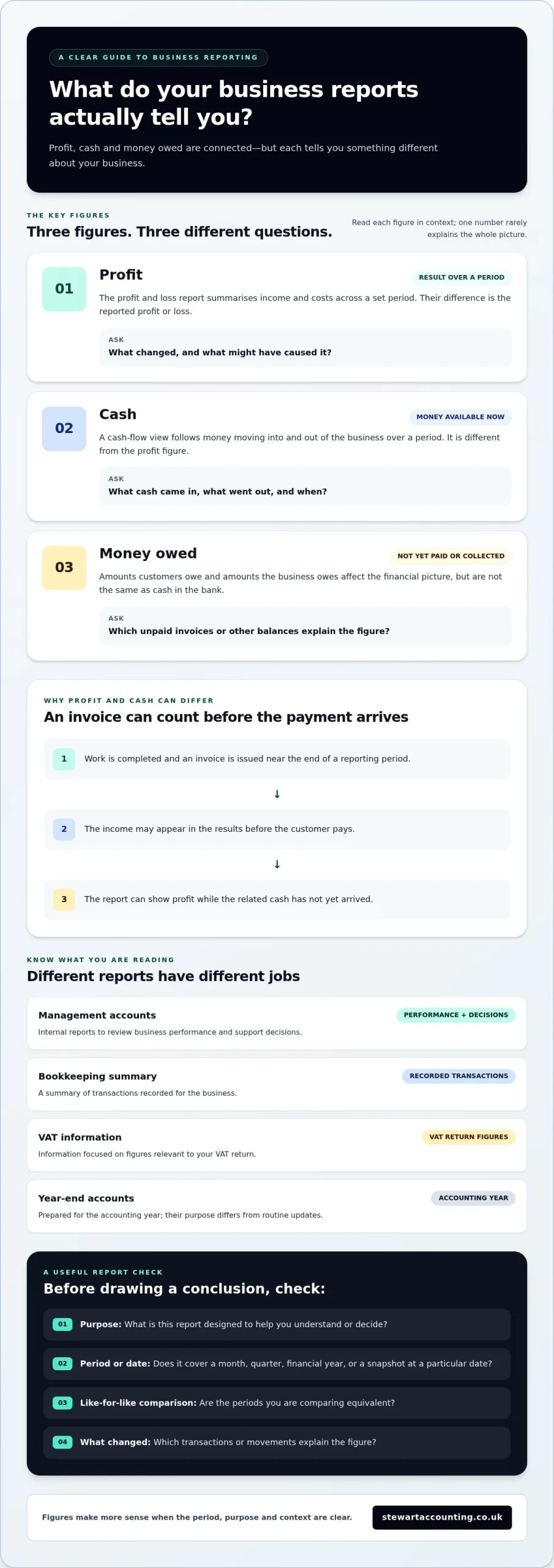
Start by identifying the document. Management accounts are internal reports that help you review performance and make business decisions. A bookkeeping summary may show recorded transactions, while VAT information focuses on figures relevant to your VAT return. Year-end accounts are prepared for the accounting year and serve a different purpose from routine updates. For more on those accounts, see our year-end accounts preparation information.
These documents aren’t interchangeable. Ask what each one covers and what it leaves out. For a general overview of how financial statements are structured, see financial statements.
What should a helpful explanation include?
A useful explanation should identify the reporting period, the key figures, any notable movements and why they matter. Ask which figures need your attention and what action, if any, they suggest. For example: “What changed compared with the previous period, and does it affect a decision I need to make?”
It helps to separate what the report states from what your accountant concludes. The document may show income, costs or balances; interpretation explains what those figures could mean for your plans. Advice adds a possible response, such as reviewing a cost or watching cash flow. Ask your accountant to distinguish between these and explain any terms you don’t recognise.
Before raising a question, note the report’s name, the dates it covers and the line or figure that puzzles you. Then connect it to a practical issue: “Can I afford this planned expense?” or “Why does the reported profit differ from the money in my bank account?” A specific question makes it easier to get an answer you can use. Being unsure what a figure means doesn’t automatically mean something is wrong.
How to read the figures in your accountant’s business reports
Management accounts are internal reports that help you review how your business is performing and make decisions. They may bring together information about income, costs, assets, debts and cash, but each figure answers a different question. Profit, cash in the bank and money customers owe you are related, but they aren’t interchangeable.
Profit shows the result recorded over a period; cash shows money available now, and amounts owed show what has yet to be paid or collected. Keep those distinctions in mind as you read. One figure alone rarely explains the whole financial picture.
Profit and loss: what is the business earning or spending?
A profit and loss report summarises income and costs across a set period. Income is what the business has earned, while costs are amounts recorded against running it. The difference is the reported profit or loss for that period. It can help you see whether trading is generating a surplus, but it doesn’t show by itself how much money is available in the bank.
If the report includes comparisons, check that you’re looking at equivalent periods, such as one month against the previous month. A change in income or costs can point to something worth investigating, but the figure alone may not explain the cause. Ask what drove an unusual movement and whether it is a one-off or part of a pattern.
Balance sheet and cash flow: what do they tell you?
A balance sheet summarises the business’s assets, liabilities and equity at a particular point in time. Assets are what the business owns or is owed; liabilities are what it owes; and equity represents the owners’ residual interest after liabilities. Because it’s a snapshot, the date matters. A clear balance sheet explanation should connect those categories to the business’s position, rather than leave you to interpret account names alone.
A cash-flow view focuses on money moving into and out of the business over a period. It helps you follow cash receipts and payments, which is different from the profit figure shown in a profit and loss report. For example, a business might complete work and issue an invoice near the end of a reporting period. The income may appear in its results before the customer pays, so the report can show profit while the related cash hasn’t arrived. Payment timing, unpaid invoices and other cash movements can all affect the amount available.
When a figure surprises you, ask what it measures, which dates it covers and what transactions explain the movement. If you’d like support making management accounts easier to understand and use, you can discuss your reporting needs with Stewart Accounting Services.
How to assess whether your current accountant’s reports meet your needs
A report can be technically detailed and still leave you unsure what it means for your business. Complexity alone doesn’t prove that the figures are wrong or that your accountant has done poor work. The key question is whether the reports, explanations and follow-up give you information you can understand and use.
Assess the service against what you need from it. Can you identify the report’s purpose and period? Does it cover the figures that matter to your decisions? Does it arrive at a useful time, and can you get clarification? If you’ve caught yourself thinking, “I don’t understand the reports my current accountant sends,” treat that as a reason to ask for clearer explanations, not as proof that something is wrong.
Signs the reports may need clearer explanation
Look for recurring patterns rather than judging the relationship on one difficult document. You may need more explanation if you can’t tell what period a report covers, what its main message is or how the figures answer a practical business question. Notice whether you feel comfortable asking follow-up questions and whether the replies help you understand what to do next.
A one-off misunderstanding may be resolved with a quick explanation or a different presentation of the information. If the same confusion returns across several reports, or your questions repeatedly go unanswered, there may be a wider communication gap. Keep a short record of what you asked, when you asked and whether the reply addressed your concern. Specific examples make it easier to explain what needs to change.
Questions to ask before deciding whether to change
Before deciding what to do, explain what you need the reports to help you manage. Ask whether the reporting can focus more clearly on the figures relevant to your decisions, and whether notable changes can be explained in straightforward language. You could also ask how often reporting and review conversations can take place, so you know when you’ll have a chance to discuss the figures.
Compare those needs with your current agreed scope of work. A service focused on preparing records or year-end accounts may not include regular management reporting or review discussions. Clarifying what’s covered can show whether you need a clearer explanation of existing work, a change to your support or a different reporting arrangement.
For example, if you need to make regular spending or staffing decisions, ask whether management accounts could give you more relevant information between year ends. If you simply need to understand a particular report, begin by asking for a plain-English explanation of its key figures. A focused conversation can help you work out whether the issue can be resolved before you decide what to do next.
Useful accounting support should help you feel informed, not hesitant to ask questions. If you’d like to discuss clearer, decision-focused reporting, talk with Stewart Accounting Services about your reporting needs.
Next Steps When Accountant Reports Are Still Unclear
If you’re still thinking, “I don’t understand the reports my current accountant sends,” take a measured next step before deciding whether to change accountants. A specific conversation may resolve a misunderstanding or show that your reporting needs have changed. Focus on the decisions you need to make, rather than trying to interpret every line on your own.
- Identify the report. Note its name and the period it covers.
- Mark what you don’t understand. Highlight unfamiliar terms, figures or changes, and note what seems unclear.
- State the business question. Explain what decision you’re trying to make, such as whether cash flow can support a planned expense.
- Request an explanation. Ask for the relevant figures to be explained in plain English and how they relate to your question.
How to prepare for a useful conversation
Keep your questions together and bring the report, its reporting period and a short list of the points you want to discuss. Ask what unfamiliar terms mean and what caused the movements you’ve marked. Focus first on the figures that matter most to an upcoming business decision. Before you finish, agree what further information or reporting would help you make similar decisions in future.
A focused discussion can also help you understand whether your current support matches what you need. Ask for a review of the figures most relevant to your decisions, rather than trying to cover every line in one conversation. If you’re in Scotland and want to understand the professional title, this guide to Chartered Accountants provides background.
When a different accounting relationship may be worth considering
Changing accountants isn’t the automatic answer to unclear reports. First consider whether you’ve explained what you need and whether communication improves after raising the concern. If questions remain difficult to resolve, or the agreed service doesn’t cover the reporting and conversations your business needs, it may be time to discuss a different arrangement.
Stewart Accounting Services offers a free initial consultation to discuss your accounting needs. You can meet in person at an office in Alloa, Falkirk or Stirling, or remotely via email or Skype. If you decide to proceed, fees are agreed in advance, and the firm never undertakes work without agreeing the fee in advance.
Use the conversation to explain what you want from your reports: clearer explanations, information focused on business decisions or regular management accounts. Stewart Accounting Services can discuss tailored accounting support that takes reporting tasks off your hands, helping you work towards more time, more money, more mind and less stress. Arrange a free initial consultation to talk through what would help you make confident decisions.
How Stewart Accounting Services can make business reporting clearer
If you’re thinking, “I don’t understand the reports my current accountant sends,” clearer ongoing support may help you put the figures to work. Stewart Accounting Services provides management accounts and online accounts to help you review financial information and use it to guide business decisions. The aim is not simply to produce reports, but to explain what they show in a way that relates to your business.
Tailored reporting and practical accounting support
Bookkeeping helps keep your financial records organised, while management accounts can bring key information together to review performance and plan ahead. The right focus depends on the questions you need to answer, such as how costs are changing or how cash flow may affect a planned decision. Stewart Accounting Services tailors support to your business, helping you understand the figures and take routine accounting tasks off your hands.
As a Xero-accredited firm, Stewart Accounting Services provides Xero implementation, training and support. Cloud accounting can make real-time financial data available, helping you see current information rather than relying only on older figures. The software is a tool, not a replacement for professional explanation or advice. Support can help you understand the information and consider what it means for your next steps. You can also explore how bookkeeping services can help maintain organised records for reporting.
For clarity from the outset, fees are agreed in advance, and the firm never undertakes work without agreeing the fee in advance. Fixed fees cover the agreed scope of work; Xero is available on a monthly subscription. You’ll know the agreed cost before work starts.
A straightforward first conversation
Use a free initial consultation to explain what you find difficult about your reports and what you need them to help you decide. Bring a recent report and note the figures or terms you’d like explained. The conversation can focus on whether management accounts, bookkeeping or online accounting support would better fit your needs.
Meet in person at Stewart Accounting Services’ offices in Alloa, Falkirk or Stirling, or remotely via email or Skype. The firm serves businesses locally and remotely across the UK. Client testimonials praise prompt replies to calls, emails and queries, reflecting the value of clear, responsive contact when you have questions.
Clearer reporting can help you make decisions with greater confidence, while tailored accounting support can create more time, more money, more mind and less stress. Talk through the accounting support you need.
Make your next business decision with greater confidence
If you’re still thinking, “I don’t understand the reports my current accountant sends,” choose one upcoming decision and write down what you need to know before making it. That could be whether to delay a purchase, review a business cost or plan for a quieter trading period. A clear question gives you a practical way to turn financial information into action.
You don’t need to resolve every reporting concern at once. Start with the issue that matters most, note what information would help and use that to guide your next conversation. Over time, this can make financial information feel less like a collection of unfamiliar figures and more like a useful part of running your business.
Clearer understanding can give you more confidence to plan, adapt and focus on the work ahead. Take the next step towards accounting support that fits the decisions you need to make. Arrange a free initial consultation with Stewart Accounting Services.
Frequently Asked Questions
Is it normal not to understand the reports my accountant sends?
Yes, it’s not unusual to need help interpreting accounting language. Your familiarity with terms can depend on your role and experience, and some reports are prepared for specific accounting purposes rather than as a plain-English guide. You don’t need to decode every line alone. Ask your accountant to explain a term you’re unsure about, such as what a creditor balance represents in your particular report.
What should I do if my accountant does not explain my reports?
Send a concise request that names the report and the point you want clarified. For example: “Could you explain what this balance relates to and whether I need to take any action?” If you have several questions, group them in one message and identify the one that affects an immediate decision. Keep a copy of the response with your report so you can refer back to it later.
Can I ask my accountant to make reports easier to understand?
Yes. You can ask for practical changes to how information is presented, such as a short glossary for recurring terms, brief notes beside unfamiliar entries or an annotated copy of a report. If a conversation works better than written notes, request a walkthrough. Explain which parts you use most, so the discussion can focus on making those figures easier to interpret without removing detail you still need.
What is the difference between management accounts and year-end accounts?
Management accounts help guide decisions during the year, while year-end accounts relate to a completed accounting period and formal reporting. One useful distinction is who will use them and for what purpose: management information can support internal planning, while year-end accounts are prepared for external reporting needs. Ask which type you’ve received and whether it answers the question you’re currently working through.
How can I tell whether a report shows profit or available cash?
Check the report heading, date range and whether it includes a bank balance or a profit figure. Then compare the cash figure with your bank statement for the same date, and ask how unpaid customer invoices or supplier bills are shown. This can help you identify which report or supporting detail you need. If the labels aren’t clear, ask your accountant to point out the relevant line.
Should I change accountants if I do not understand my reports?
Not solely because one report is hard to follow. First decide what support would make the relationship work better, such as a scheduled review or explanations in writing, and raise that preference clearly. If you later explore a change, think through practical handover points too, including access to accounting records, the status of ongoing work and any upcoming commitments. That can help you plan a considered transition.
Can a new accountant help me understand reports from my previous accountant?
Yes, Stewart Accounting Services can help you review previous reports. Provide the original files where possible, along with relevant bookkeeping records and any notes that explain unusual transactions. The firm can discuss what the reports show and identify areas that need more context. If a figure cannot be explained from the documents available, it can explain what additional information would help clarify it.
Do I have to pay for an initial conversation with Stewart Accounting Services?
No. Stewart Accounting Services offers a free initial consultation, in person or remotely. Describe your business, the reports you find difficult and the decisions you want clearer information to support. It may help to have one report and a few questions ready, so the discussion stays focused. You can also outline the accounting help you’re looking for and learn whether it fits your needs before deciding on any next step.
Recent Posts
12 Oct, 2026
12 Oct, 2026
10 Oct, 2026