

What are the essential questions to ask an accountant for a small business?

Are you certain your current financial setup is actually fueling your growth, or is it just a source of constant anxiety? Many business owners feel trapped by complex tax jargon and the persistent fear of HMRC penalties. When you’re searching for the right support, knowing the specific questions to ask an accountant for a small business is the only way to separate a basic compliance filler from a true strategic partner. In 2026, with MTD regulations becoming more rigorous, you need a chartered professional who doesn’t just record your history but actively protects your future.
We understand that your time is your most valuable asset. You’ve likely felt the frustration of an accountant who isn’t proactive enough, leaving you to handle the heavy lifting yourself. This article provides a clear roadmap to finding a trustworthy partner who can take over your accounts completely. We’ll outline the critical inquiries that reveal an accountant’s expertise in tax efficiency and their ability to restore your personal and professional liberty. By the end of this guide, you’ll have the confidence to choose a partner who delivers peace of mind and allows you to focus on your core business tasks.
Key Takeaways
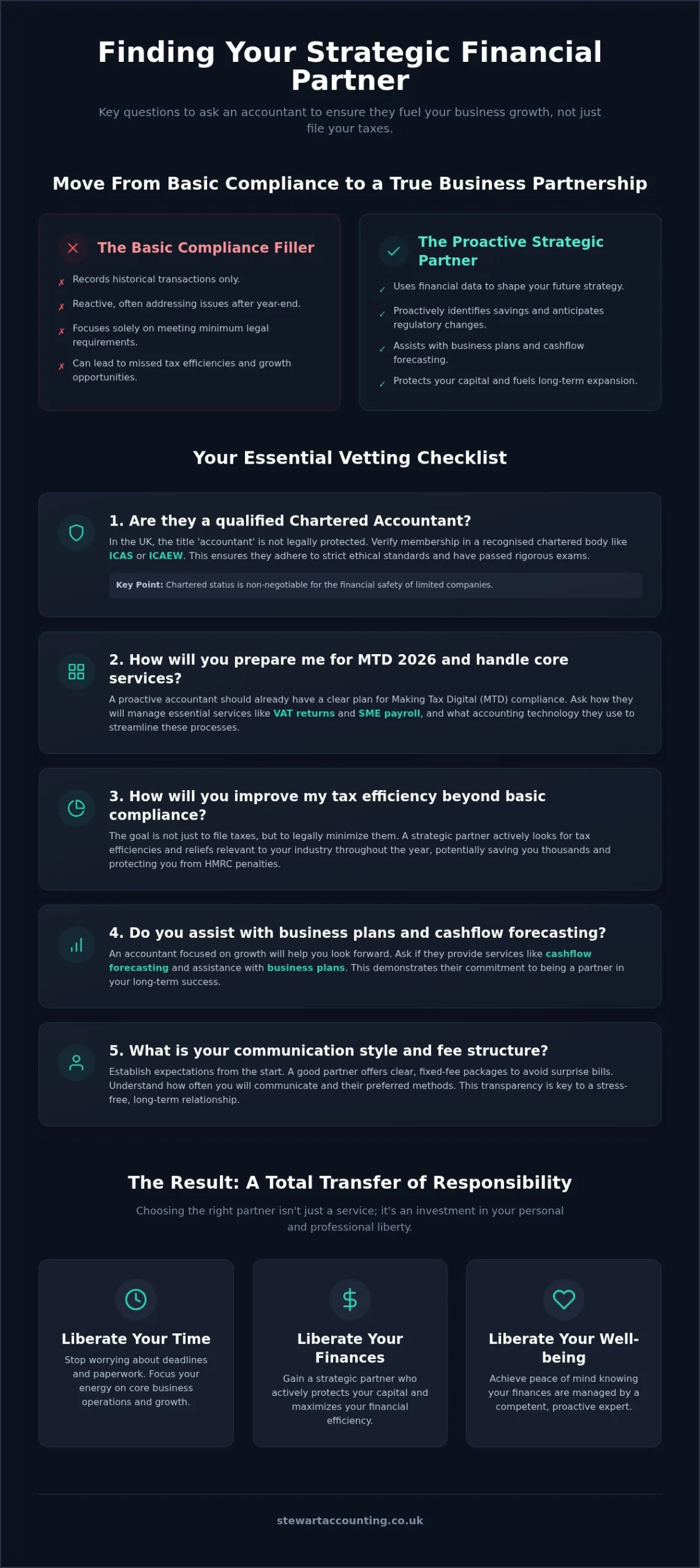
- Understand why verifying membership in a chartered body like ICAS or ICAEW is vital, as the title ‘accountant’ is not legally protected in the UK.
- Master the specific questions to ask an accountant for a small business to ensure they provide the proactive support and tax efficiency your enterprise deserves.
- Evaluate how a potential partner handles essential services like VAT returns and payroll while ensuring you are fully prepared for MTD 2026 compliance.
- Discover how to identify a strategic partner who assists with business plans and cashflow forecasting to fuel long-term growth rather than just recording history.
- Gain clarity on fee structures and communication styles to establish a relationship that removes the burden of accounts and restores your mental well-being.
Why choosing the right accountant is a strategic business decision
Why do so many business owners settle for a service that only looks backward? While a bookkeeper handles the day-to-day recording of transactions, a proactive Chartered Accountant uses that data to shape your future. If you only look at the lowest price, you might save a few pounds on monthly fees but lose thousands in missed tax efficiencies or HMRC penalties. Choosing a partner is about more than just filing papers; it’s a strategic move to safeguard your hard-earned capital. When you begin researching the right questions to ask an accountant for a small business, you’ll quickly see that compliance is just the bare minimum. The real value lies in a relationship that fuels your expansion.
Moving from compliance to business partnership
In 2026, a strategic financial advisor does more than just meet deadlines. With MTD requirements becoming more complex for UK businesses, you need someone who anticipates changes before they impact your cash flow. Proactive advice identifies potential HMRC errors during the year, not six months after your year-end. A strategic accountant is a partner who manages both today’s taxes and tomorrow’s growth. This requires a deep understanding of accounting principles to ensure your business remains resilient against economic shifts. Instead of just reacting to the past, your accountant should provide the clarity needed to make bold, informed decisions for the future.
The impact of professional delegation on SME owners
We focus on a core promise called the ‘Thematic Triad’. This is the liberation of your time, your finances, and your mental well-being. For business owners in Alloa, Stirling, and Falkirk, local expertise provides a layer of trust that a faceless national firm simply cannot match. By physically removing the burden of accounts from your desk, you achieve a total transfer of responsibility. This delegation allows you to stop worrying about VAT returns or SME payroll and start focusing on your core operations. When considering the best questions to ask an accountant for a small business, remember that you aren’t just buying a service. You’re investing in the freedom to grow without the constant weight of financial stress holding you back. This partnership restores your personal liberty by ensuring your finances are in expert hands.
How do I verify an accountant’s qualifications and industry experience?
Did you know that in the UK, the title ‘accountant’ is not legally protected? This means anyone can set up a practice regardless of their training or expertise. This lack of regulation makes it your responsibility to verify who you’re trusting with your livelihood. One of the most vital questions to ask an accountant for a small business is whether they are a member of a recognised chartered body, such as ICAS or ICAEW. Choosing a Chartered Accountant ensures you’re working with a professional who has passed rigorous exams and adheres to strict ethical standards. This level of qualification is non-negotiable for complex limited companies, where the risks of non-compliance are significantly higher.
Understanding professional credentials
In 2026, as tax regulations continue to tighten, a qualified professional also carries professional indemnity insurance. This provides a safety net for your business if an error occurs, offering a level of security that an unqualified bookkeeper simply cannot provide. You should also feel comfortable checking a firm’s regulatory history or asking about their disciplinary record. Gaining a clear perspective on the role and importance of a qualified accountant helps you understand that their credentials are the foundation of your business’s financial safety. We believe that true peace of mind starts with transparency and proven competence.
Industry-specific expertise
Every business structure has its own set of rules. A sole trader’s needs differ wildly from those of a partnership or a corporation. You need to ensure your accountant has deep experience in your specific sector. For example, contractors often deal with IR35 complexities, while landlords must navigate specific property tax reliefs. A generalist might miss these nuances, leading to higher tax bills or missed opportunities for growth. When you are preparing your list of questions to ask an accountant for a small business, ask about their current client portfolio and success stories within your industry.
Regional knowledge is equally important, particularly for businesses operating in Scotland. Scottish tax rates and local business grants can vary from the rest of the UK. We understand the unique challenges faced by SMEs in Alloa, Stirling, and Falkirk. If you want to ensure your firm has the right credentials and local expertise to support your growth, you can speak with our team today to learn how we protect Scottish businesses and restore your professional liberty.
Which accounting services and technology are essential for my business?
Modern accounting is no longer a paper-based exercise. As we approach 2026, the shift toward digital compliance is mandatory, and you cannot afford to be left behind. When considering questions to ask an accountant for a small business, you must evaluate how they integrate technology into their service delivery. It isn’t enough for them to just file your Year End Accounts. They must ensure your digital records are robust enough to withstand HMRC scrutiny under the new Making Tax Digital (MTD) rules. This digital-first approach is essential for any firm aiming to protect your finances effectively.
Core compliance and statutory obligations
Every business has statutory duties that cannot be ignored. You need to know exactly what is included in your annual package to avoid hidden costs later. Does it cover VAT returns and SME payroll? Managing HMRC registrations and Companies House filings can be a significant administrative drain on your time. Ask if they handle Self Assessment for directors as part of their standard service. This total transfer of responsibility is part of our commitment to your mental well-being. By delegating these tasks, you ensure deadlines are met without the stress of last-minute panics.
Leveraging cloud accounting for real-time data
The era of the “year-old spreadsheet” is over. Modern online accounting services provide real-time insights into your cash flow, which is vital for agile decision-making. If you’re looking into how to find a small business accountant, prioritize firms that offer Xero training and ongoing technical support. Real-time data allows you to make informed decisions today rather than reacting to financial reports from six months ago. This transparency is a key part of our “Thematic Triad,” helping you regain control over your professional liberty.
From April 2026, MTD for Income Tax Self Assessment (ITSA) will apply to self-employed individuals and landlords with total business or property income above £50,000. For those earning above £30,000, the deadline is April 2027. Your accountant should already be preparing you for these specific thresholds. Ask them: “How will you help me stay compliant with digital record-keeping?” If they don’t have a clear plan for software integration or training, they aren’t the right partner for your growth. We focus on making this transition smooth and efficient for our clients across the UK.
How can an accountant help with tax planning and business growth?
Are you paying more tax than necessary because your current provider only records what has already happened? Real growth requires a forward-looking perspective that turns financial data into a roadmap. One of the most important questions to ask an accountant for a small business is: “What proactive tax planning strategies can you implement to improve my monthly cash flow?” If the answer only focuses on filing deadlines, you aren’t getting the strategic support your business deserves. A true partner looks at your entire financial landscape to identify savings you might have missed.
Proactive tax efficiency
Tax planning should be a year-round activity, not a last-minute rush in January. Moving beyond basic compliance means looking at Corporation Tax optimization, VAT strategies, and the most efficient way to pay yourself through dividends. For our clients in Alloa and across Central Scotland, this includes managing regional nuances like the Land and Buildings Transaction Tax (LBTT). You can learn more about Why Your Scottish Business Needs a Chartered Accountant to see how regional expertise protects your bottom line. This level of care is part of our commitment to your financial liberation.
Advisory and growth support
How do you know when it’s the right time to hire a new employee or invest in new equipment? This is where management accounts and financial forecasting become indispensable. Growth isn’t accidental. By providing monthly or quarterly health checks, your accountant helps you identify expansion opportunities before they pass you by. They should also be an active participant in developing your business plans and assisting with funding applications. When you’re considering the right questions to ask an accountant for a small business, focus on their ability to act as a strategic advisor who understands your long-term vision.
Delegating your financial strategy to an expert doesn’t just save money; it restores your mental well-being. It removes the stress of uncertainty and allows you to focus on the core tasks that drive your business forward. If you’re ready to secure your financial future with a partner who cares about your growth as much as you do, reach out to our business advisory experts for a personalized strategy session.
What should I expect from the day-to-day working relationship?
Have you ever felt like just another number in a giant database? Once you’ve verified qualifications and software, the human element becomes the most important factor in your success. The final questions to ask an accountant for a small business should focus on the practical rhythm of your partnership. You need a firm that speaks your language, not “accountant-ese,” and provides a clear timeline for your financial obligations. A successful relationship should feel like a relief, not an additional administrative chore. Our goal is always to restore your professional liberty by making the financial side of your business run smoothly in the background.
Communication and accessibility
Will I have a dedicated point of contact? This is essential because you don’t want to explain your business history to a different junior staff member every time you call. You should know exactly who is responsible for your file and how often you’ll meet to discuss performance. In 2026, with the rapid pace of digital tax changes, a proactive partner should be reachable for more than just a year-end check-in. Ask about their typical response time for urgent queries. Knowing that an expert is only a phone call away provides the mental well-being you need to focus on your core business tasks.
Transparent pricing and value
Fear of the “ticking clock” often prevents small business owners from seeking the advice they need. This is why understanding fee structures is a critical part of your vetting process. While some firms still use hourly rates, fixed-fee models provide much better certainty for SME budgeting. You should ask for a clear breakdown of what is and isn’t included in your quote. Does it cover ad-hoc advice, or will you be charged for every five-minute phone call? Transparency here is vital for building a foundation of trust and reliability.
Many owners worry about the hassle of switching accountants, but it’s actually a very straightforward process. We handle the professional clearance and the transfer of records entirely, so you don’t have to manage the transition yourself. You should also establish a clear timeline for your year-end accounts and tax return preparation. Knowing your figures will be ready well in advance of deadlines avoids the stress of last-minute panics. Ready to partner with a firm that puts your growth first? Contact Stewart Accounting Services today to see how our dedicated team can support your journey.
Secure your financial future through strategic partnership
Finding the right support is about more than just checking boxes. It’s about choosing a partner who understands that your business is your life’s work. By mastering the right questions to ask an accountant for a small business, you ensure your finances are protected by a Chartered Accountant who prioritises your growth. You now have the tools to verify professional credentials, evaluate tech stacks for MTD 2026, and demand proactive tax planning that keeps cash in your business rather than just reacting to the past.
Our team provides more than just year-end accounts; we offer a complete transfer of responsibility that restores your personal and professional liberty. As specialists in small business growth and tax efficiency, we deliver a personalised service tailored to the unique needs of SMEs across Central Scotland and the wider UK. Don’t let financial anxiety hold you back from your next big milestone. We’re here to help you navigate the complexities of the tax system with ease and confidence.
Book a consultation with our expert team in Alloa, Stirling, and Falkirk to start your journey toward financial freedom today. We look forward to helping you fuel your business growth.
Frequently Asked Questions
Is it worth having an accountant for a very small business?
Yes, hiring a professional is a strategic investment that often pays for itself through tax efficiencies and time savings. Even for a sole trader, an expert identifies specific reliefs and ensures you don’t overpay HMRC. This partnership restores your mental well-being by removing the burden of deadlines and complex compliance. It allows you to focus entirely on your core business tasks while we protect your hard-earned finances.
What is the difference between a bookkeeper and an accountant?
A bookkeeper focuses on the daily recording of financial transactions and administrative accuracy. A Chartered Accountant provides high-level analysis, strategic tax planning, and statutory year-end reporting. While bookkeeping is about maintaining history, accounting is about shaping your future. When researching the best questions to ask an accountant for a small business, focus on their ability to provide proactive growth advice rather than just basic data entry.
How much does a small business accountant typically cost in the UK?
Accounting fees vary significantly based on your business structure, transaction volume, and the level of advisory support you require. Most modern firms have moved away from hourly billing in favour of fixed-fee models. This approach provides budget certainty and prevents the fear of unexpected bills. You should request a transparent breakdown of services to ensure your quote covers everything from VAT returns to annual accounts preparation.
Can I change my accountant mid-year if I’m not happy?
You can switch your accountant at any point during the financial year. The process is much simpler than most owners imagine because your new firm handles the professional clearance and transfer of records on your behalf. You don’t need to wait for your year-end to seek a more proactive partner. If your current provider isn’t fueling your growth, a total transfer of responsibility can happen smoothly at any time.
What documents do I need to provide to my accountant for year-end?
You typically need to provide bank statements, sales invoices, purchase receipts, and payroll records for the full financial year. If you use cloud software like Xero, your accountant can access this data automatically throughout the year. This digital approach reduces the administrative pressure on you. Providing these documents early ensures your accounts are prepared well in advance of HMRC deadlines, giving you total peace of mind.
Do I need a local accountant in Alloa or Stirling, or can it be remote?
While remote accounting is efficient, having a local partner in Alloa, Stirling, or Falkirk provides a layer of trust and regional expertise. Scottish businesses often face different tax nuances and grant opportunities compared to the rest of the UK. We serve clients across the country, but our roots in Central Scotland allow us to provide a more personalised, dependable service for SMEs who value a supportive regional expert.
How does Making Tax Digital (MTD) affect my choice of accountant in 2026?
From April 2026, MTD for Income Tax applies to individuals and landlords with income over £50,000. This regulation requires digital record-keeping and quarterly updates to HMRC. You must choose an accountant who is an expert in cloud technology and MTD compliance. One of the vital questions to ask an accountant for a small business is how they will transition your records to ensure you meet these rigorous new digital requirements.
What questions should I ask about HMRC tax investigation protection?
Ask if the firm offers a dedicated service to cover professional fees in the event of an HMRC inquiry. Tax investigations can be incredibly stressful and expensive, even if you’ve done nothing wrong. Knowing you have expert representation without the worry of additional costs is a key part of protecting your mental well-being. A trustworthy partner will provide clear options for this protection to safeguard your business’s financial stability.
Recent Posts
25 Oct, 2026