

Limited company director responsibilities UK: 6 record types

TL;DR: UK directors must follow seven statutory duties under the Companies Act 2006, including promoting company success and maintaining six mandatory record types for compliance.
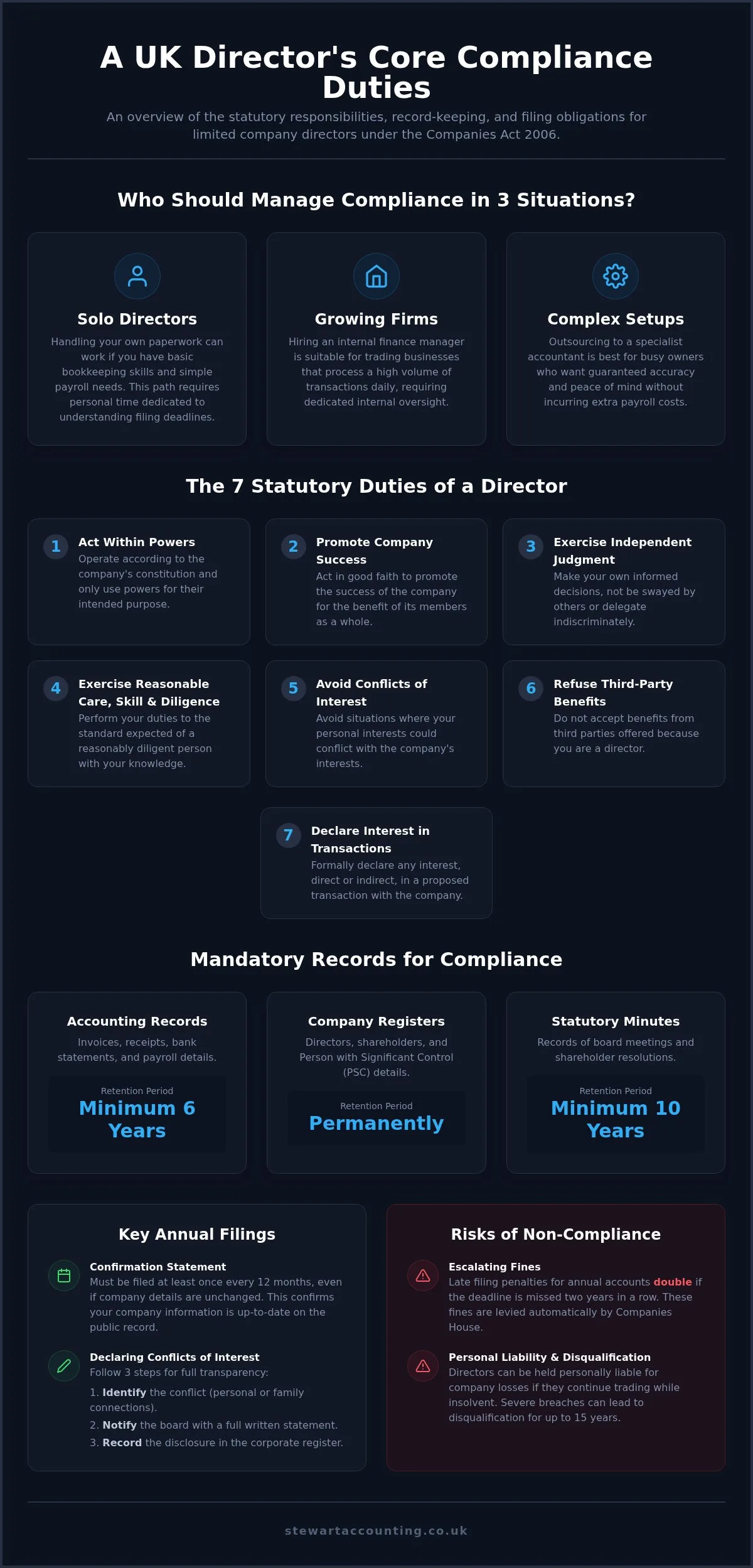
- Accounting records including invoices and receipts must be retained for at least 6 years.
- Late filing penalties for annual accounts double if the deadline is missed two years running.
- Directors must file a confirmation statement every 12 months, even if company details remain unchanged.
- Personal liability risks include contributing to company losses if trading continues during insolvency.
As a UK limited company director, you are legally responsible for maintaining 6 mandatory record types and meeting statutory filings. Professional accounting support across the UK market varies based on your business complexity. You can delegate daily tasks, but ultimate legal accountability rests with you. The decision questions that run through this guide are simple: who should own compliance day to day, which records and duties keep you protected, and when does outside support cost less than a missed filing.
Who should manage compliance in 3 situations
You can manage your limited company tax, accounting, and self-employment filing obligations yourself, assign them to an internal employee, or outsource to a professional. Taking on all statutory reporting personally often creates unnecessary stress for new business owners, and hours spent studying corporate filings are hours you cannot use to grow operations.
Here is how to handle compliance across three typical scenarios:
- Solo directors: Handling your own paperwork works if you have basic bookkeeping skills and simple payroll needs. Read Your Guide to Limited Company Tax in 2026 to understand your main deadlines.
- Growing firms: Hiring an internal finance manager suits trading businesses that process high transaction volumes daily.
- Complex setups: Outsourcing to a specialist works best for busy owners who want accuracy without extra payroll costs.
Choosing the right path depends on your confidence with tax rules. If compliance feels like a maze, professional support is the safer route.
7 Statutory duties that define your legal accountability
UK directors must follow seven statutory duties set out in the Companies Act 2006 Part 10 Chapter 2 to act legally.
These duties require you to act within your company powers, promote its success, and exercise independent judgment. Exercising reasonable care, skill, and diligence is another core obligation. Avoiding conflicts of interest, refusing third-party benefits, and declaring interests in proposed transactions complete the list. Failing to follow these rules brings serious legal risks, so treat the duties as the fixed frame for every board decision.
Managing these responsibilities alongside complex tax filing often feels overwhelming. Looking through our Limited Company Archives helps clarify your legal position. Professional guidance reduces the chance of costly mistakes with statutory records and turns compliance into a repeatable routine.
A commenter in an online thread on affordable accountant support for startups (from £23.70 a month) wrote:
"As a first-year sole trader, I was a little unsure about the accounting side of things, but James has been incredibly helpful throughout the whole process." (source)
Situation: a first-year owner unsure about the accounting side. Solution: named practitioner support through the full process. Result: the director could move forward without carrying the compliance load alone. Expert guidance helps you stay aligned with the Companies Act and still keep attention on the business itself.
Record types that keep your limited company audit-ready
Limited company directors must store statutory records and financial accounts to meet Companies House and HMRC compliance rules. Organised books protect you against severe fines. Digital accounting software is stronger than paper filing because physical documents are easily lost or damaged over time.
One requirement that slips past many boards: your statutory books must remain at the registered office address unless Companies House receives formal notification of a different inspection site. Missing these administrative updates often triggers unnecessary compliance audits.
Your company must track all commercial transactions, asset purchases, and bank statements. Claiming valid tax reliefs requires strict proof, so review Allowable Limited Company Expenses You Can Claim to see what paperwork you need. Clear storage of those details supports lower, defensible tax bills.
| Record Type | Description | Retention Period |
|---|---|---|
| Accounting Records | Invoices, receipts, bank statements, and payroll details | Minimum 6 years |
| Company Registers | Directors, shareholders, and PSC register details | Permanently |
| Statutory Minutes | Records of board meetings and general resolutions | Minimum 10 years |
Tip: Keep your accounting receipts and dividend counterfoils digitalised for at least 6 years to avoid missing tax records.
3 Steps to declare conflicts of interest cleanly
You must formally declare any personal or financial interest in a transaction before your business enters into the agreement. Minor personal connections are frequently ignored by directors, and unchecked personal ties can leave you exposed to legal breach claims from shareholders.
Follow these key steps:
- Identify the conflict: Check whether a proposed deal touches your personal interests or family connections.
- Notify the board: Send a full written statement to your fellow officers detailing the exact situation.
- Record the decision: Ensure the details are officially logged into the corporate register.
Record these disclosures properly when Buying a Limited Company: What You Need to Know. Full transparency shields you from personal liability on the transaction.
Fines and disqualification risks that follow missed filings
Failing to meet statutory filing deadlines triggers automatic penalties from Companies House and HM Revenue and Customs. Late filing fees for annual accounts start immediately after the deadline passes, doubling if you are late two years in a row. Missing your Corporation Tax return deadline brings separate financial penalties, alongside potential interest on unpaid taxes.
Personal liability poses a larger risk during insolvency. If you continue trading when the business cannot pay its debts, courts can order you to contribute directly to company losses. Directors face disqualification for up to 15 years for severe misconduct.
When tax deadlines loom, delay only adds interest and pressure on personal assets. Working with qualified accountants keeps returns accurate and submissions on time.
A commenter in an online thread on affordable accountant support for startups wrote:
"Kieran McCann provided outstanding support in helping me file my corporation tax return within an extremely tight timeframe." (source)
Situation: a corporation tax return due in a tight window. Solution: targeted filing support from a named practitioner. Result: the return went in before penalties compounded. Fast professional intervention resolves urgent compliance issues before statutory penalties escalate.
Confirmation statements: file at least once every 12 months
You must file a confirmation statement at least once every 12 months, even if your business details remain unchanged.
The review period covers a maximum of 12 months starting from your incorporation date or the end date of your last return. You have 14 days after this period ends to submit the document to Companies House.
You can file early to align your reporting timeline with your annual accounts, and filing more frequently is entirely permitted.
As detailed in the UK Government’s changes to UK company law 2024 guidance, new rules require companies to supply a registered email address and confirm their lawful activities. Directors must keep these details accurate. Missing the deadline risks legal action against the business officers, so on-time filing is the practical way to keep the company in good standing.
When DIY compliance fails your business
DIY bookkeeping often crumbles when a previous accountant leaves you stranded with a messy paper trail and unpaid tax liabilities.
Directors often face sudden penalty notices because a former advisor missed crucial Companies House filings. That administrative oversight quickly leads to stress and unexpected tax bills.
Managing compliance without expert help takes precious time away from running your company. Paying a professional to correct past accounting mistakes costs far more than hiring proper support from the start.
Professional oversight on your financial accounts keeps filings current. If you plan to fix complex tax errors yourself, remember that incorrect HMRC filings usually trigger immediate, costly investigations.
How indemnity insurance shields your directors
Directors and Officers (D&O) insurance pays your legal defence costs and personal losses if someone sues you for management mistakes.
Standard policies cover claims from shareholders, regulators, or employees. A liability gap often exists for deliberate statutory breaches, fraud, or claims raised before your policy starts: cover is built for honest error, not intentional misconduct.
Securing the right policy protects your personal property from corporate legal actions and gives each director a defined financial backstop.
Market rates for director filing support
Delegating your annual administrative tasks saves time and keeps your company compliant. Professional assistance simplifies complex corporate filings so you are not decoding each form under deadline pressure.
Professional fees vary based on company complexity, and delegating reduces exposure to costly missed deadlines.
The market price band for administrative support spans from low-cost options to comprehensive management according to industry sample data. A simple company suits standard support, while active traders need full service. Ask for a personalised quote if you want figures matched to your filing load.
Frequently asked questions
What are a director’s responsibilities?
Your main duties include promoting company success, keeping statutory records, and managing taxes under UK limited company rules. You must act in good faith to benefit the business and its shareholders.
What records must a limited company keep?
You must keep accounting records alongside statutory registers of directors, shareholders, and people with significant control. These documents need to be stored safely for several years to satisfy legal audit requirements.
How often must a confirmation statement be filed?
You must file a confirmation statement at Companies House at least once every 12 months. Missing this annual deadline can lead to serious legal penalties or risk the business being struck off.
What fines apply for non‑compliance?
Fines range from late-filing penalties for accounts up to severe court prosecution for criminal breaches. Financial penalties grow over time, so resolve gaps as soon as you spot them.
What are the 7 statutory duties of a UK company director?
The duties are acting within powers, promoting success, exercising independent judgment, and exercising reasonable care, skill, and diligence. You must also avoid conflicts of interest, refuse third-party benefits, and declare interests in proposed transactions.
Staying Compliant with Company Duties
Fulfilling limited company director responsibilities across the UK still comes down to the same choices set out at the start: who owns compliance, which of the 6 record types and seven duties you can evidence, and how you avoid penalty-driven catch-up work. Missing filing dates leads to immediate penalties, and administrative oversight often slips when business owners handle corporate filings alone.
Managing these statutory obligations keeps your business protected in 2026. Stewart Accounting Services brings expert clarity to small business owners across the UK. Contact the Stewart Accounting Services team today for a tailored quote on limited company filings.
Recent Posts
03 Sep, 2026