

Contractor expenses guide UK: allowable travel and mileage costs

TL;DR: Contractors can deduct travel, equipment, and office costs from taxable profit provided they are incurred wholly and exclusively for business purposes under HMRC rules.
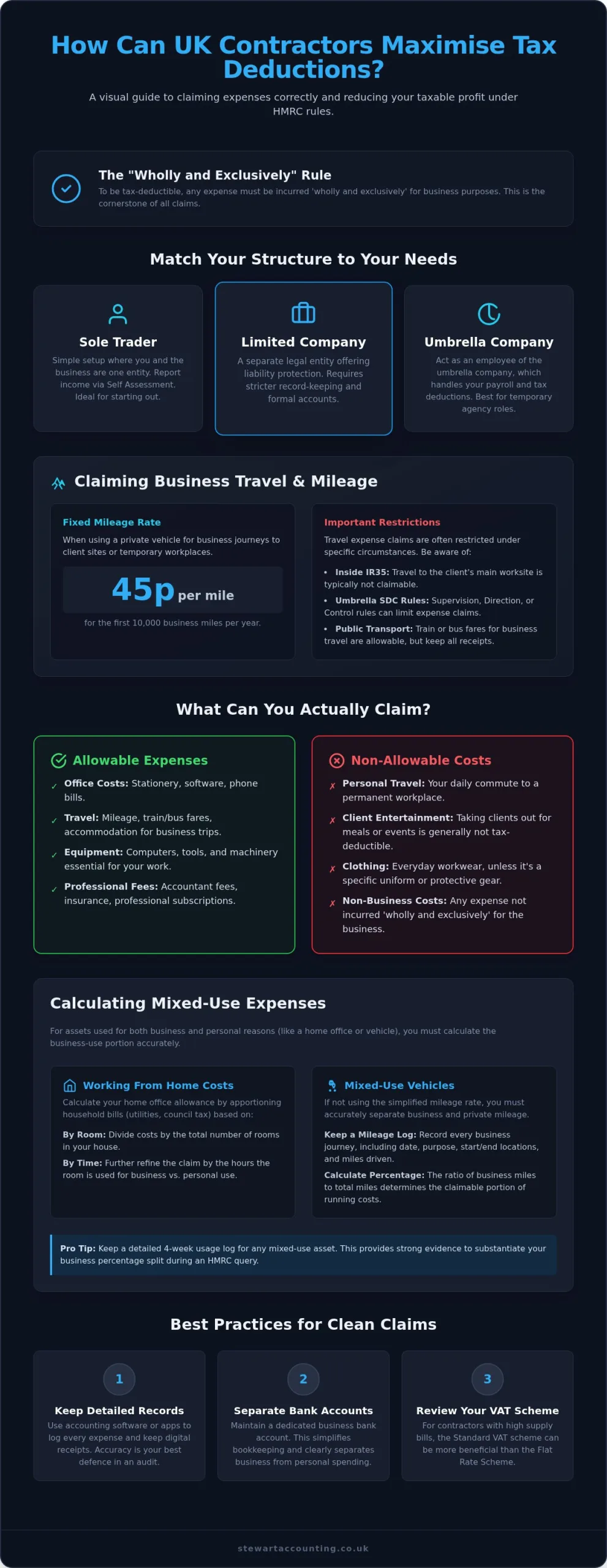
- Claim 45p per mile for the first 10,000 miles using the fixed mileage rate method.
- Except when working inside IR35 or under umbrella SDC rules which restrict travel claims.
- Calculate mixed-use home office costs by dividing total rooms and tracking exact operational hours.
- Standard VAT schemes often outperform flat rate schemes for contractors with high supply bills.
Operating as a UK contractor lets you offset legitimate business travel and mileage against tax when costs meet HMRC’s wholly and exclusively rule. The decisions that matter most are which operating structure you use, which journeys you can deduct, and how you evidence mixed-use and mileage claims so compliance holds while your tax bill falls. Dedicated accounting software helps you track those claims correctly across the year.
3 Contractor setups: match structure to how you claim
Your operating structure dictates how you claim allowable expenses through the company and how you meet tax requirements. Typical paths look like this: a new sole trader who wants simple Self Assessment reporting should start unincorporated and log travel as they go; a contractor winning longer client work who needs clearer separation of personal and business costs is usually better inside a limited company with Companies House-grade records; a temporary agency role where you want payroll handled for you fits an umbrella, with the agency deducting tax at source. With clients we see that new business owners often struggle to choose between sole trader, limited company, or umbrella worker, and the wrong setup leads to tax inefficiencies or unexpected compliance burdens.
Setting up as a sole trader keeps filing simple. If you operate this way, you report income through Self Assessment. Incorporating a limited entity creates a separate legal person and requires strict record-keeping under Companies House 2023 regulations. For those managing complex tax requirements, targeted Accounting Services UK For Contractors streamline compliance across all structures. Umbrella structures suit temporary roles where the agency manages payroll tax directly.
Understanding these operational frameworks helps you select the setup that fits your contracts and your expense pattern.
A commenter in an online thread on accountants for startups (affordable support from £23.70 a month):
"As a first-year sole trader, I was a little unsure about the accounting side of things, but James has been incredibly helpful throughout the whole process." (source)
This feedback shows how proper support eases the move into sole trader life and helps early-stage contractors handle tax obligations with more confidence.
Claim travel and mileage to cut tax
You reduce your corporation tax bill by deducting legitimate business journeys from your trading income.
Many directors find business expenses confusing. Failing to separate professional travel from private trips leads to HMRC compliance issues and tax penalties. Fixed mileage rates can be claimed when you use a private vehicle for client locations or temporary worksites. If you travel by train or bus, routing those fares as allowable company expenses keeps profits tax-efficient.
Keeping accurate records protects your firm during a routine tax review. Explore our Factsheets | Expert Guides on Tax & Business Topics to navigate deduction rules with confidence. Clear documentation removes anxiety from end-of-year reporting: log every trip as it happens and track regular business routes in a dedicated app so you secure each allowable deduction.
Allowable costs cut tax; non-allowable costs do not
Claiming allowable expenses reduces your taxable profits when costs are incurred wholly and exclusively for business purposes. Keep detailed records and digital receipts to support every claim during an audit. Accurate VAT logs prevent costly penalties.
Maintaining distinct personal and commercial bank accounts is an often overlooked step that immediately streamlines bookkeeping. Looking for accountants in Alloa, Stirling can help you stay compliant, because strong records lower audit risk and cut the cost of putting things right later.
The table below outlines common expenses and their tax treatment:
| Expense Type | Tax Treatment | Description |
|---|---|---|
| Office Supplies | Allowable | Full tax relief available |
| Personal Travel | Non-allowable | Cannot reduce taxable profit |
| Client Entertainment | Non-allowable | Strict HMRC restrictions apply |
When you claim through the company, accuracy matters. Separate business costs from personal spending, distinguish working-from-home costs (home office allowance) from private bills, and keep clear proof for every claim.
Calculate mixed-use assets with exact ratios
You calculate dual-purpose expenses by dividing usage time or floor space between personal and business activities. Our hands-on work with clients shows that apportionment ratios have to match real-world business use to withstand official scrutiny. You can separate working-from-home costs by counting total rooms and calculating exact operational hours. For vehicles, record exact mileage instead of guessing proportions.
Unresolved accounting issues often create stress. Clean division of expenses prevents sudden tax penalties.
Explore our Business Growth Services: A Guide to Scaling Your SME to optimise your trading structure safely and gain clearer control over dual-use costs.
Tip: Keep a 4-week detailed usage log to substantiate your business percentage split during an HMRC query.
A commenter in an online thread on accountants for startups:
"He is very knowledgeable, patient, and took the time to guide me through everything, making it much less stressful than I expected." (source)
Accurate usage records make tax compliance clearer and reduce audit anxiety, while professional guidance simplifies ratio calculations.
5 Steps to claim contractor expenses cleanly
Claiming allowable expenses needs a systematic routine so your limited company records stay accurate for HMRC.
In our daily practice, contractors who record transactions immediately spend significantly less time fixing year-end books. A tidy process prevents missed deductions and reduces compliance stress.
- Keep proof Save every digital receipt, invoice, or physical slip immediately for your company records.
- Log transactions Enter every expense into your accounting software promptly to avoid forgetting key details.
- Separate costs Split personal usage from business items to ensure clean tax reporting.
- Reconcile accounts Match your logged expenses against your business bank account statements every month.
- Review claims Check your totals before you submit allowable expenses through the company.
This routine protects your accounts: a few minutes each week saves hours later, and clean books help you claim what you are legally entitled to receive.
How are contractors paid inside IR35?
Working inside IR35 means your end client or umbrella company processes your pay through PAYE, deducting tax and National Insurance before you receive it.
If a previous accountant left you without proper guidance, this shift can feel overwhelming. Many contractors face complex tax situations when they move between structures without clear advice. Inside IR35, the scope for allowable company expense claims drops significantly. HMRC views you as an employee for tax purposes, which restricts standard claimable costs.
Paying for equipment directly out of pocket often yields zero tax relief under off-payroll working rules. Ask your agency to supply necessary tools directly instead. This setup reduces administration and suits risk-averse contractors. If you are resolving past accounting messes, Stewart Accounting Services can help clarify your real tax position.
Why flat rate schemes can cost you money
Opting for a flat rate VAT scheme often increases overall costs if your business incurs substantial expenses.
From client work we see that buying expensive tools or paying high sub-contractor fees makes the standard VAT scheme far more profitable, because the flat rate method prevents you from reclaiming tax on small everyday purchases. Choosing standard VAT remains the right choice for businesses with heavy supply bills.
You pay a fixed percentage under flat rate regardless of what you actually buy. Claiming allowable expenses under standard rules usually saves more cash when spend is high.
CIS and umbrella SDC rules change what you can claim
Buying a firm vehicle under standard mileage rates (bike money) often yields lower tax relief than claiming the actual allowable costs directly through the company. Operating under Construction Industry Scheme rules allows immediate tax offsets on genuine material costs. Umbrella contractors facing Supervision, Direction, or Control rules cannot claim travel or subsistence.
From client work we see contractors losing money by choosing weak tax structures. Misjudging your working arrangements triggers heavy penalties during standard audits.
Comparing strategies requires care. The UK Open Government Licence v3.0 (2014) documents how public sector information remains accessible for tax compliance research. Flat rates suit low spenders, while actual costs benefit heavy drivers: match the method to your real spend pattern.
Accounting tools cost 125 to 600 GBP yearly
Software pricing varies with functionality. Your annual software expense depends on the features you choose and your operational needs.
Selecting specialised software is an investment in business infrastructure. Basic packages suit straightforward sole traders, while more capable tools suit limited companies, and costs scale as feature requirements grow.
Pick a plan that fits your current business size rather than paying for unused features. To find exact options for your business, ask for a personalised quote. Treating software subscriptions as allowable company expenses keeps you tax-efficient and helps hold overhead down.
Frequently asked questions
What expenses can I put through my limited company?
You can claim any costs incurred wholly and exclusively for business operations, including software subscriptions, office equipment, professional insurance, and accountancy fees. Keep business purchases separate from personal spending to avoid accounting complications. Stewart Accounting Services can help you structure these claims correctly.
Can I claim travel expenses?
Yes, travel to temporary workplaces is fully deductible against your company profits. You can claim public transport tickets, fuel, parking, and necessary overnight hotel stays, provided your assignment lasts under twenty-four months at a single location. Always keep precise logs of your destination and business purpose.
Can I claim bike or motorbike mileage?
You can claim set rates for business journeys made on motorbikes or bicycles. Bike money (mileage rates) lets you claim twenty-four pence per mile for motorcycles and twenty pence per mile for bicycles. Record the date, reason, and exact distance of every journey so the standard claims stay supportable.
Is buying a company car tax‑efficient?
Buying a vehicle through your business depends heavily on its total carbon emissions. A tax-efficient car (benefit-in-kind rates) usually points toward modern electric vehicles, which attract minimal benefit-in-kind (non-cash perks with tax implications) charges compared with petrol alternatives. Stewart Accounting Services can assess your exact vehicle choice before you buy.
Do I need receipts for expense claims?
You must keep valid proofs of purchase for all company costs. HMRC requires official receipts or invoices showing the supplier name, date, and amount spent. Electronic copies or clear phone scans are acceptable for your record keeping and keep storage light.
Master your contractor expenses guide uk
Managing costs accurately keeps you compliant with tax rules in 2026. The same decisions you started with (structure, travel and mileage evidence, and clean allowable claims) still decide whether hard-earned margins stay protected.
Correct allowable claims through the company shield those margins from unnecessary tax hits. Advisers at Stewart Accounting Services support self-employed professionals with structured financial care and help each valid business cost work for your bottom line.
Unclear rules should not reduce your income: contact stewartaccounting.co.uk for advice tailored to your business operations.
Recent Posts
03 Sep, 2026
01 Sep, 2026