

How to File Tax Returns for Stirling Driving Instructors

What if the hours you spend stressing over dual-control car expenses between back-to-back driving lessons are actually costing you money instead of saving it? When trying to manage tax returns for driving instructors Stirling roads keep you busy enough without the added anxiety of complex HMRC deadlines and late filing penalties. It’s easy to feel confused by the numbers, especially since HMRC explicitly excludes dual-control vehicles from simplified mileage rates, forcing you to meticulously calculate actual running costs instead.
We understand how exhausting it is to balance a packed diary of student lessons with precise financial tracking. This guide will show you how to simplify your self-assessment, maximize your legitimate business deductions, and keep more of your hard-earned cash under the latest Scottish tax rates. By learning how to delegate these stressful financial burdens to a local Stirling expert who can take it off your hands, you will finally achieve total peace of mind along with more time, more money, more mind. Here is a look at how to navigate your upcoming tax requirements with complete confidence.
Key Takeaways
- Understand why HMRC classifies self-employed driving instructors as sole traders and how this affects your annual filing responsibilities.
- Discover the specific vehicle rules for dual-control cars so you can claim every legitimate tax deduction when handling tax returns for driving instructors Stirling.
- Learn why automated software cannot replicate the tailored tax planning and local insights provided by a qualified chartered accountant.
- Establish simple record-keeping habits using cloud bookkeeping tools to track your income and expenses seamlessly between student lessons.
- Find out how transferring your compliance burdens to a trusted local expert grants you more time, more money, and complete peace of mind.
Understanding Self-Assessment Tax Returns for Driving Instructors
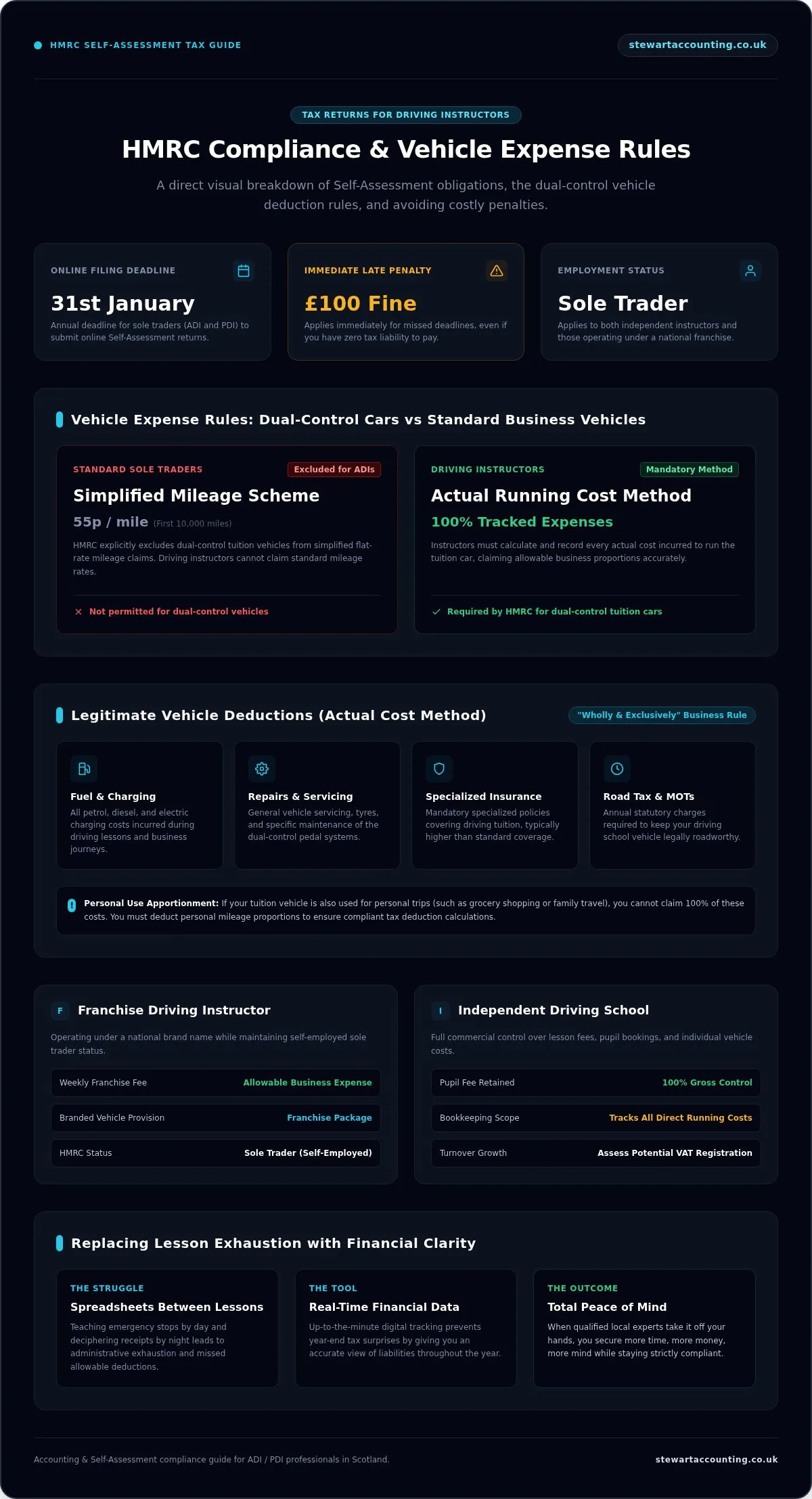
For an Approved Driving Instructor (ADI) or a Potential Driving Instructor (PDI), a Self Assessment tax return is the formal way you report your annual earnings and expenses to HM Revenue and Customs (HMRC). Most people in this profession are classified as sole traders. This means you’re personally responsible for your business’s profits and debts. When you’re busy managing tax returns for driving instructors Stirling pupils keep you on the road all day, it’s easy to overlook the legal requirement to register and file by the annual 31st January online deadline.
Missing this date isn’t just a minor administrative slip; it triggers an immediate self-assessment late filing penalty of £100. This fine applies even if you don’t have any tax to pay. As the delay grows, these charges can escalate significantly, eating into your hard-earned profits. Staying compliant ensures you avoid these unnecessary costs while maintaining a good standing with the tax authorities. To better understand this concept, watch this helpful video:
Are You a Franchise Instructor or Independent Business?
Your specific tax obligations depend on how you’ve structured your career. Many instructors in Stirling choose to work under a national franchise, paying a weekly fee for a branded car and pupil leads. While this provides a steady stream of work, you’re still considered self-employed in the eyes of HMRC. If you run a completely independent driving school in Central Scotland, you have full control over your fees, but your bookkeeping becomes more complex as you manage every single business cost yourself. Regardless of your structure, accurate record-keeping is vital, and if your turnover grows, you may eventually need to consider VAT returns for your business.
The Reality of Managing Taxes Between Driving Lessons
The emotional toll of balancing back-to-back student lessons with late-night spreadsheet tracking is a common struggle. It’s exhausting to spend your day teaching emergency stops, only to face a mountain of receipts when you get home. We focus on restoring your personal and professional liberty by letting us take it off your hands. Real-time financial data prevents year-end tax surprises by giving you a clear view of your liabilities throughout the year. When handling tax returns for driving instructors Stirling professionals often find that professional support provides more time, more money, and more mind.
Allowable Expenses: What Can a Stirling Driving Instructor Claim?
When you’re preparing Self Assessment tax returns, the golden rule from HMRC is that an expense must be incurred “wholly and exclusively” for your business to be considered a legitimate tax deduction. For a driving instructor, identifying these deductions is the most effective way to reduce your taxable profit and keep more of your earnings. However, instructors face a more complex landscape than many other sole traders, particularly regarding vehicle costs. Over-claiming or miscalculating these figures can trigger an HMRC compliance check, leading to unnecessary stress and potential fines.
Vehicle and Running Costs: The Major Deductions
While many self-employed individuals use simplified mileage rates (currently 55p per mile for the first 10,000 miles), HMRC explicitly excludes driving instructors with dual-control cars from this scheme. You must use the “actual cost” method. This involves tracking every penny spent on your vehicle, including:
- Fuel and Oil: All petrol, diesel, or charging costs for business journeys.
- Maintenance: Repairs, servicing, and the specific costs of maintaining dual-control systems.
- Specialized Insurance: Policies that cover driving tuition, which are often higher than standard premiums.
- Road Tax and MOTs: The annual costs of keeping your tuition vehicle legal.
If you use your tuition car for personal trips, such as grocery shopping or weekend travel, you cannot claim the full amount. You must calculate the business-use percentage. For example, if 80% of your mileage is for student lessons and 20% is personal, you can only claim 80% of the total running costs as a tax deduction. If this sounds like an administrative headache, you can speak with our team to see how we can simplify the process for you.
Franchise Fees, Marketing, and Pupil Management
Beyond the car, your operational costs are significant. If you operate under a national brand, your weekly franchise fees are fully deductible. These fees often cover pupil leads and brand marketing, making them a vital part of your business structure. For independent instructors in Central Scotland, you can claim for local advertising, website hosting, and even the cost of theory test apps or pupil progress software you provide to your students.
Don’t forget the smaller, specific items that are essential to your daily work. Test day fees, dual-control roof signs, and even the cost of cleaning your car to maintain a professional environment for pupils are all valid expenses. Managing these details correctly ensures you achieve more time, more money, and more mind. Our goal is to take it off your hands entirely, ensuring your tax returns for driving instructors Stirling filings are accurate and optimized for maximum savings. If you’re feeling overwhelmed by receipts, it might be time to reach out for professional support.
Why Local Stirling Accounting Expertise Beats Generic Software
Many automated software platforms promise a quick fix for your annual tax return, claiming that an app can handle everything effortlessly. However, generic software cannot replace human insight or provide the tailored tax planning required for your business. When managing tax returns for driving instructors Stirling professionals need a partner who truly understands the local business ecosystem. A local chartered accountant spots missing allowable expenses that rigid software algorithms completely overlook. Choosing Stewart Accounting Sole Trader Services gives you access to regional experts who understand the exact challenges faced by self-employed instructors in Central Scotland, ensuring you don’t miss out on valuable deductions.
The Pitfalls of the DIY Accounting Approach
Rushing through software inputs between student lessons often leads to simple data entry mistakes. Ticking the wrong box or misinterpreting a complex tax rule can cause costly corrections and unexpected tax bills down the line. There is also a distinct, hidden anxiety that comes with hitting ‘submit’ on a DIY platform without a professional secondary review. Instead of achieving peace of mind, you’re left worrying about potential HMRC inquiries. Generic programs don’t know the nuances of your local franchise fees or specific vehicle setups. Handing this responsibility to an experienced professional removes the stress entirely, letting us take it off your hands.
Preparing for Making Tax Digital (MTD) for Income Tax
The upcoming rollout of making tax digital (MTD) for income tax will fundamentally change how your driving school interacts with HMRC. Beginning 6 April 2026, self-employed individuals with a qualifying gross income over £50,000 must maintain digital records and submit quarterly updates using approved software. By 6 April 2027, the income threshold drops to £30,000, bringing even more local instructors into the scheme. A local accounting partner ensures your business remains fully compliant well ahead of schedule. We set up the right systems for you, providing a problem-solving framework that delivers more time, more money, and more mind.
Organizing Your Financial Records for a Stress-Free Tax Return
Organizing your finances doesn’t have to be a late-night chore. When handling tax returns for driving instructors Stirling pupils keep you on the move, so your record-keeping needs to be just as mobile. A structured approach prevents the January panic and ensures you don’t miss out on legitimate deductions. By following a clear routine, you can transform a mountain of receipts into a streamlined system that delivers more time, more money, and more mind.
- Step 1: Implement cloud bookkeeping tools to log your income and expenses instantly after each lesson.
- Step 2: Maintain a dedicated business bank account to keep your tuition earnings separate from personal finances.
- Step 3: Track every single mile driven for lessons, driving tests, and even business admin trips to the bank or post office.
- Step 4: Retain digital copies of all receipts for fuel, vehicle maintenance, and tuition equipment using your smartphone camera.
- Step 5: Hand your organized digital records over to a trusted professional to file your return accurately.
Best Practices for Daily Income Tracking
Logging your revenue accurately is essential, especially when dealing with block bookings. If a student pays for ten hours upfront, you must track that income carefully to ensure your year-end figures are correct. It’s also vital to stay on top of cash payments. While bank transfers are easier to trace, cash can easily be forgotten if it isn’t logged immediately. Using Stewart Accounting Bookkeeping Services can help you set up a system that captures every penny, whether it’s a single lesson payment or a large block booking.
Navigating Car Purchases and Capital Allowances
Buying a new dual-control car is likely your biggest business investment. The way you finance this vehicle, whether through a lease or a hire purchase agreement, significantly affects your tax position. Instructional vehicles are specialized assets, and you can often claim capital allowances to deduct a portion of the car’s value from your taxable profits. However, the rules change if you decide to sell or upgrade your tuition vehicle. Professional guidance is essential here to ensure you calculate any balancing charges or allowances correctly. We can help you navigate these complex rules and take it off your hands entirely. If you want to ensure your vehicle records are audit-proof, get in touch for a record-keeping review.
Let Stewart Accounting Services Take Tax Returns Off Your Hands
You’ve spent your day navigating the busy streets around Stirling Castle and the university, teaching the next generation of drivers. The last thing you need is an evening spent wrestling with complex tax codes and HMRC portals. At Stewart Accounting Services, we act as your dedicated partner, physically removing the stress of compliance so you can focus entirely on your pupils. We don’t just file forms; we provide a problem-solving framework that restores your professional liberty. Our commitment is to offer clear, expert guidance with zero hidden accountancy jargon, ensuring you always understand your financial position without the headache. By letting a regional expert handle your tax returns for driving instructors Stirling, you avoid the cold, corporate feel of national providers and gain a reliable partner who understands the local economy.
Our Tailored Self-Assessment Process
Our Stewart Accounting Services Tax Return process follows a methodical, reassuring framework designed to alleviate your stress. We start with a deep dive into your financial records, ensuring that every legitimate tax deduction is captured. As we highlighted in previous sections, the specific rules for dual-control cars and franchise fees require a level of precision that generic software often misses. We handle all direct communications with HMRC, effectively taking the burden off your hands. This bespoke service is tailored to the unique operational realities of Stirling instructors, providing a level of customization that ensures you keep more of your hard-earned profits.
Get Started with a Local Stirling Expert Today
Now is the ideal time to delegate your bookkeeping and tax return duties, particularly as HMRC moves toward more frequent digital reporting requirements. By acting now, you secure the three core freedoms we promise every client: more time, more money, and more mind. You shouldn’t have to sacrifice your weekends to manage spreadsheets. You can arrange an initial consultation at our local Stirling office to discuss your business in person, or we can easily connect via a remote video call if your diary is full of back-to-back lessons. The peace of mind that comes from high-level expertise is just a conversation away. Contact Stewart Accounting Services today to secure your financial future and ensure your tax returns for driving instructors Stirling are submitted accurately and on time.
Secure Your Professional Freedom Today
Managing tax returns for driving instructors Stirling requires more than just basic data entry. It demands a deep understanding of HMRC’s specific rules for instructional vehicles, from actual running costs to complex capital allowances. By moving away from generic software and implementing the digital record-keeping habits we’ve discussed, you place your business on a much firmer financial footing. You don’t have to spend your evenings worried about late filing penalties or missing out on legitimate tax deductions that could lower your bill.
Stewart Accounting Services is here to provide the dependable, regional support you need. As Chartered Accountants with local offices in Stirling, Alloa, and Falkirk, we have a proven track record of helping sole traders achieve more time, more money, and more mind. We take the entire compliance burden off your hands, ensuring your records are audit-ready and your tax position is optimized. It’s time to stop teaching emergency stops and start enjoying your weekends again. Take tax returns off your hands, Contact Stewart Accounting Services today. We look forward to helping your driving school thrive.
Frequently Asked Questions
What expenses can I legally claim as a self-employed driving instructor?
You can claim for any cost incurred wholly and exclusively for your business. Common deductions include franchise fees, fuel, dual-control car maintenance, and specialized tuition insurance. You can also deduct the cost of theory test apps, pupil progress software, and local marketing materials. When preparing tax returns for driving instructors Stirling professionals should ensure they keep all receipts for these items to reduce their taxable profit and keep more of their hard-earned earnings.
Can I claim the full cost of purchasing a new dual-control tuition car?
You cannot usually claim the full purchase price in one year, but you can claim Capital Allowances. This allows you to deduct a portion of the vehicle’s value from your profits each year. Because you likely use the car for personal trips too, you must only claim the business-use percentage of the allowance. If your car is used 80% for lessons, you claim 80% of the allowance to ensure your tax return remains accurate.
How do I calculate business mileage vs personal mileage on my vehicle?
To calculate this, you must keep a detailed record of your total annual mileage and your business-specific journeys. Since HMRC excludes dual-control cars from simplified mileage rates, you need to track the actual business proportion of all vehicle costs. Subtract your personal miles from the total mileage to find your business percentage. Applying this percentage to your total fuel, insurance, and repair bills ensures you claim the correct tax deduction for your tuition business.
What happens if I miss the HMRC self-assessment filing deadline?
Missing the 31st January online filing deadline triggers an immediate £100 self-assessment late filing penalty. This fine applies even if you have no tax to pay or have already paid what you owe. If the return is more than three months late, HMRC can add daily penalties of £10. You will also be charged interest on any unpaid tax from the deadline date, which can quickly erode your business profits and cause unnecessary stress.
Do I need to register for VAT as a driving instructor in Stirling?
You only need to register for VAT if your annual taxable turnover exceeds the current threshold of £90,000. Most independent driving instructors in Stirling operate below this level, but it’s important to monitor your gross income if you run a larger school or multiple franchises. If you do reach the threshold, you must charge VAT on your lessons and file regular returns. We can help you monitor your turnover to ensure you stay compliant.
How will Making Tax Digital (MTD) affect my driving school business?
Making Tax Digital (MTD) for Income Tax requires you to keep digital records and send quarterly updates to HMRC instead of a single annual return. This becomes mandatory on 6 April 2026 for those with a qualifying income over £50,000, and 6 April 2027 for those earning over £30,000. This shift means using approved software to track your finances. We help Stirling driving schools transition to these new systems smoothly, providing total peace of mind.
Why should I hire a local Stirling accountant instead of using DIY tax software?
A local expert provides bespoke tax planning and human insight that generic DIY software simply cannot match. When we manage tax returns for driving instructors Stirling pupils keep busy, we spot specific deductions like dual-control maintenance that algorithms often overlook. Hiring Stewart Accounting Services allows you to delegate the entire compliance burden to a trusted partner. This delivers the ultimate reward of more time, more money, and more mind while ensuring your business stays fully protected.