

Choosing Tax Advice for Freelance Photographers in Alloa
What if the generic accounting apps you rely on are quietly costing you hundreds of pounds in missed equipment deductions? Finding tailored tax advice for freelance photographers Alloa professionals can trust shouldn’t feel harder than framing the perfect shot. You started your business to create compelling visual work, not to spend late nights worrying about HMRC deadlines, distinct Scottish Income Tax bands, or whether that new lighting rig is tax deductible.
You already know that keeping on top of business travel, camera gear, and changing digital record-keeping rules steals valuable shooting time. In this guide, you will discover how to claim every allowable expense accurately, plan for Scottish tax rates, and choose a qualified local specialist ready to take it off your hands. We will outline the essential steps to protect your earnings, bringing you more time, more money, and more mind.
Key Takeaways
- Understand your exact HMRC obligations under Scottish Income Tax bands so you never pay more than you owe on client commissions.
- Learn how to claim essential camera bodies, lenses, studio hire, and travel as allowable expenses to reduce your taxable profit.
- Get ready for the digital record-keeping rollout and discover how quarterly updates will impact your annual filing routine.
- Compare trading as a sole trader versus forming a limited company to protect your profits and match your business growth.
- Find accessible tax advice for freelance photographers Alloa specialists provide locally at Alloa Business Centre to free up your shooting schedule.
What Tax Obligations Apply to Freelance Photographers in Scotland?
Operating your camera across Clackmannanshire brings creative freedom, but it also carries direct legal responsibilities with HM Revenue and Customs (HMRC). When you work for yourself, you must calculate your own taxable profit, submit annual tax returns, and make payments on time. Transitioning away from employed work can feel overwhelming, which is why obtaining clear tax advice for freelance photographers Alloa professionals rely on removes stress from your daily routine.
Staying organized from day one ensures that January payment deadlines do not disrupt your business. Alongside income tax, self-employed creators must track shifting reporting rules. The government’s gradual introduction of Making Tax Digital requires many business owners to maintain electronic records and adjust how they submit updates.
To better understand the deductions that protect your hard-earned profits, watch this helpful video:
Registering as a Sole Trader with HMRC
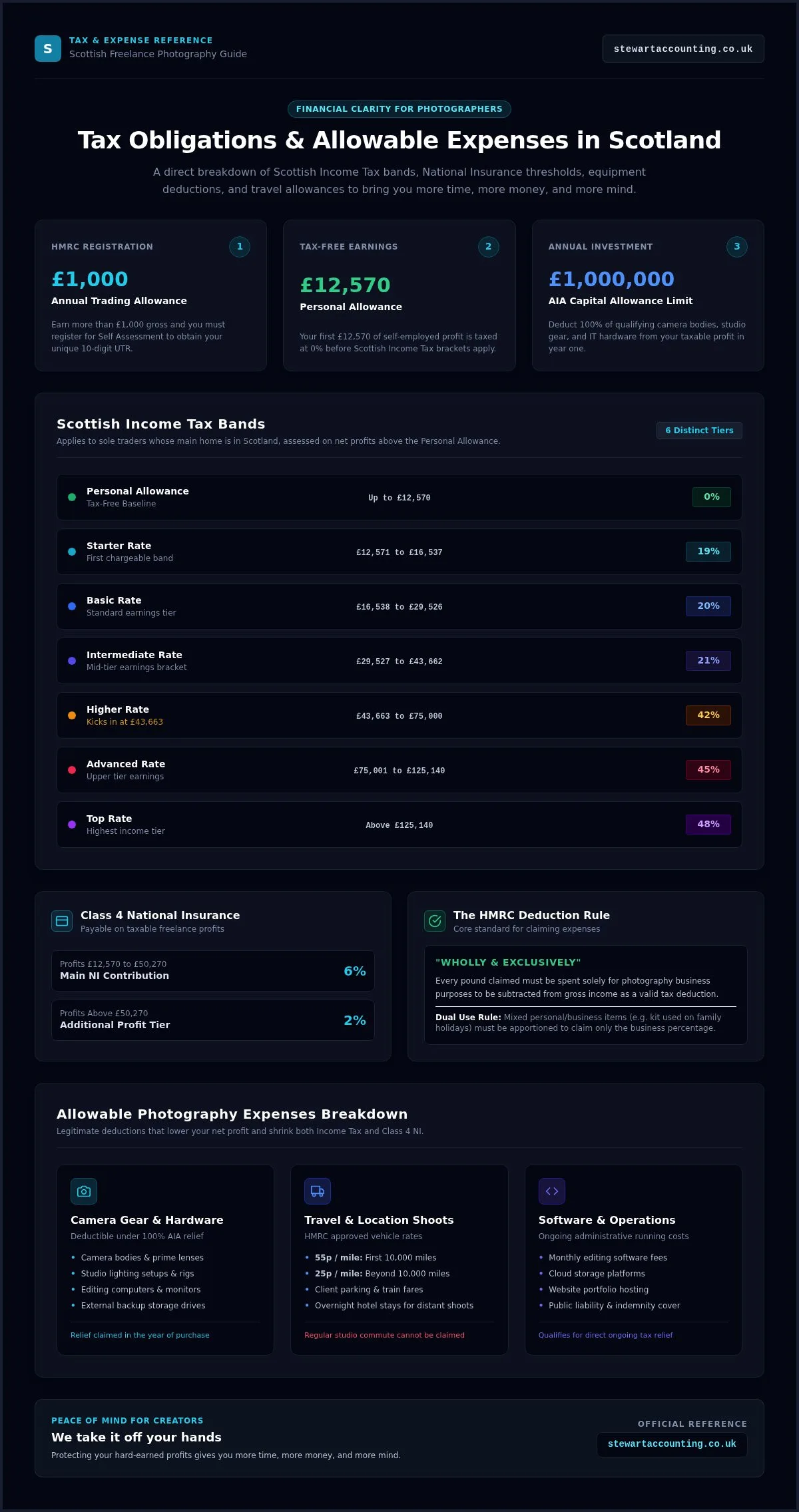
Once your gross photography earnings exceed the £1,000 annual trading allowance, you must register for Self Assessment with HMRC. Following registration, HMRC issues a unique 10-digit Unique Taxpayer Reference (UTR) that stays with you permanently. Dedicated sole trader accounting services can set up your business registration correctly, handling the initial paperwork so you avoid administrative delays.
Understanding Scottish Income Tax Rates
If your main home is in Alloa, you pay Scottish Income Tax on your self-employed profits rather than UK-wide rates. Following the £12,570 tax-free Personal Allowance, your earnings are taxed across six bands: Starter Rate (19% up to £16,537), Basic Rate (20% up to £29,526), Intermediate Rate (21% up to £43,662), Higher Rate (42% up to £75,000), Advanced Rate (45% up to £125,140), and Top Rate (48% above £125,140).
Because the Scottish Higher Rate kicks in at £43,663, setting aside adequate reserves each month protects your studio cashflow. Freelancers also pay Class 4 National Insurance at 6% on profits between £12,570 and £50,270, plus 2% on profits beyond that. Establishing proactive tax advice for freelance photographers Alloa specialists tailor to local rules provides you with more time, more money, and more mind.
How Can You Claim Allowable Expenses on Photography Gear and Shoots?
Every pound you spend on necessary kit and location shoots can directly reduce your tax bill, provided it meets HMRC’s “wholly and exclusively” test. Claiming these costs as a valid tax deduction lowers your net profit, which directly shrinks both your income tax and National Insurance payments. Knowing which purchases qualify as allowable business expenses ensures you keep more money inside your business to fund future creative projects.
Camera Equipment, Lenses, and Studio Hardware
Professional camera bodies, prime lenses, and studio lighting setups represent substantial investments. Fortunately, the Annual Investment Allowance (AIA) allows you to deduct 100% of qualifying equipment purchases from your profits up to £1,000,000 in the purchase year. High-spec editing computers, calibration monitors, and external backup drives qualify under these capital allowance rules too. If you also use a specific camera body for family holidays, you simply apportion the cost to claim only the business percentage.
Travel, Location Shoots, and Travel Costs Around Central Scotland
Travelling between wedding venues across Clackmannanshire or commercial shoots in Stirling adds up quickly. If you use your personal vehicle for client assignments, you can claim HMRC approved mileage rates of 55p per mile for the first 10,000 business miles, and 25p per mile after that. You can also expense client parking, rail tickets, and overnight accommodation for distant editorial assignments. Regular commuting from your home to a permanent studio space cannot be claimed.
Software, Props, Insurance, and Professional Fees
Day-to-day administrative overheads also qualify for immediate tax relief:
- Monthly editing software subscriptions, cloud storage platforms, and website portfolio hosting.
- Commercial photography insurance, professional indemnity, and public liability coverage.
- Specific styling props, studio backdrops, and professional association membership fees.
Missing out on these routine claims leaves cash on the table. Securing tailored tax advice for freelance photographers Alloa specialists deliver ensures every receipt works to your advantage. If sorting through expense logs is draining your shooting schedule, you can speak with our Alloa accounting team to take it off your hands and protect your peace of mind.
How Do You Prepare for Making Tax Digital in 2026?
The days of stashing paper receipts in shoe boxes and scrambling through spreadsheets every January are drawing to a close. Under making tax digital (MTD) for income tax, HMRC is overhauling how self-employed professionals maintain financial records. Starting 6 April 2026, qualifying sole traders must record their transactions digitally and submit regular updates through approved software. Getting ahead of this transition removes administrative friction and keeps you fully compliant.
Instead of filing a single annual Self Assessment return, you will provide quarterly summaries of your business income and expenses. Adopting a structured approach early gives you real-time financial data, helping you track your true studio margins across wedding seasons and commercial projects.
Step 1: Check Your Qualifying Self-Employed Turnover
The first phase of the rollout affects self-employed individuals and landlords with a total gross qualifying income above £50,000. HMRC evaluates your 2024/25 tax return to decide if you must join in April 2026, with the first quarterly submission due by 7 August 2026. This threshold applies to gross turnover, not your net profit. If you manage multiple revenue streams, our Self Assessment tax return services can review your exact earnings to confirm when these digital mandates apply to you.
Step 2: Transition to Compatible Cloud Bookkeeping
Manual spreadsheets will no longer suffice on their own. You will need MTD-compatible cloud accounting software like Xero to record client invoices and track equipment outlays. Linking your business bank account creates automated transaction feeds, ensuring no deductible travel or studio hire slips through the net. Our tailored bookkeeping services keep your digital records accurate, taking the entire data entry burden off your hands.
Step 3: Establish a Stress-Free Quarterly Reporting Routine
Submitting quarterly summaries requires steady habit changes rather than end-of-year panic. A workable routine involves three simple practices:
- Reconcile invoice payments and shoot deposits at the end of each week.
- Snap digital photos of paper expense receipts immediately using cloud apps.
- Review your quarterly figures with a qualified professional before each HMRC deadline.
Working with local specialists who provide tax advice for freelance photographers Alloa creatives rely on transforms digital reporting from a headache into an advantage. With organized digital workflows in place, you gain more time behind the lens, more money through claimed deductions, and more mind to focus on artistic growth.
Sole Trader or Limited Company: Which Structure Fits Your Photography Business?
Deciding how to legally frame your photography business is one of the most significant choices you will make. The right structure directly affects how much tax you pay, how much paperwork you handle, and your level of personal financial risk. As your client bookings expand across Central Scotland, evaluating your setup ensures your business operates efficiently.
Operating as a Self-Employed Sole Trader
Working as a sole trader is the simplest way to run a photography venture. It requires minimal administrative setup, lower annual compliance overheads, and straightforward accounting. You can transfer money between your business and personal accounts freely as drawings.
The main trade-off is unlimited personal liability. Because there is no legal separation between you and your business, you remain personally responsible for studio commercial leases, equipment financing, or client disputes. In addition, you pay Scottish Income Tax and Class 4 National Insurance on all net profits generated each year, which can become costly once your earnings reach the higher tax brackets.
Forming a Private Limited Company in Scotland
Incorporating a private limited company creates an independent legal entity separate from yourself. This structure provides limited liability protection, shielding personal assets like your home or personal savings if unexpected commercial liabilities arise during major shoot contracts.
From a tax perspective, a company pays UK Corporation Tax at the small profits rate of 19% on annual profits up to £50,000. Directors often draw income via an optimal mix of a modest director’s salary and dividends, utilising the £500 dividend allowance before basic rate dividend tax applies at 10.75%. However, running a company introduces stricter reporting rules. You must file statutory annual accounts with Companies House and submit corporate tax returns to HMRC. Working with our team for your year end accounts service keeps your corporate filings accurate and fully compliant.
Every photographer’s commercial situation is unique. Seeking tailored tax advice for freelance photographers Alloa specialists offer helps you calculate whether incorporation genuinely saves you money or simply adds unnecessary administration. When you are ready to review your structure, contact our team at Stewart Accounting Services to explore the right path for your goals.
How Can Stewart Accounting Services Support Your Photography Business in Alloa?
Freelance photography rarely follows a predictable monthly salary. Summer wedding rushes and autumn commercial campaigns often transition into quieter winter periods, making cashflow management tricky to balance against upcoming tax liabilities. Generic accounting apps and remote call centres cannot appreciate these distinct rhythms. Partnering with a dedicated local practice ensures you receive genuine tax advice for freelance photographers Alloa creatives can depend on throughout every season.
Accessible Local Support on Whins Road
Convenience matters when your production schedule is packed with edits and shoots. Our practice operates directly from Office 90 at Alloa Business Centre on Whins Road, giving you direct access to experienced professionals right on your doorstep. You don’t have to battle automated chat bots or wait days for an email reply from an anonymous account manager.
Instead, you can drop off physical paperwork, discuss major equipment investments in person, or review your figures over a warm cup of coffee. With over a decade of experience supporting Central Scotland sole traders and limited companies, our team brings both CPA and Institute of Certified Bookkeepers (ICB) credentials. We deliver practical tax planning and software support tailored around your daily artistic workflow.
Complete Financial Peace of Mind for Creatives
Managing client expectations, equipment maintenance, location scouting, and post-production takes enough energy without adding late-night tax worries. Trying to figure out complex deductions and digital reporting rules on your own only drains your creative focus.
Professional financial support should alleviate pressure rather than add to it. When you partner with us, you can delegate your Self Assessment returns, expense logs, and quarterly obligations so our chartered specialists can take it off your hands completely. Handing over these administrative burdens delivers our core promise: more time behind the lens, more money retained in your business, and more mind to focus on what you love.
Ready to establish a reliable financial foundation? Book an introductory consultation with Stewart Accounting Services today to discover how our tailored tax advice for freelance photographers Alloa team can help your studio thrive.
Protect Your Creative Time and Simplify Your Tax Today
Running a successful photography business in Central Scotland means focusing on capturing striking visuals, not losing sleep over complex HMRC rules. Accurately claiming your camera gear, budgeting for Scottish Income Tax bands, and adopting digital bookkeeping keeps your hard-earned profits secure. Managing these tasks properly ensures you don’t leave money on the table or face stressful surprises when tax season arrives.
When you need dependable tax advice for freelance photographers Alloa professionals can count on, our practice is ready to step in. Operating from Office 90 at Alloa Business Centre on Whins Road, Stewart Accounting Services brings over a decade of experience supporting local sole traders and growing creative enterprises. Backed by CPA and Institute of Certified Bookkeepers (ICB) accreditations, our friendly team can take the bookkeeping burden off your hands entirely.
Delegating your tax affairs frees up your schedule, delivering more time behind the lens, more money retained in your business, and complete peace of mind. Speak with our Alloa tax team today to arrange an introductory chat and protect your creative future.
Frequently Asked Questions
Can I claim the cost of my camera lenses on my tax return?
Yes, you can claim the full purchase cost of camera lenses through the Annual Investment Allowance. Lenses count as plant and machinery for your photography business, permitting a 100% deduction against your profits in the tax year you bought them. If you also use a lens for personal family photos, you simply apportion the cost to claim only the business percentage.
Do Scottish photographers pay different tax rates than those in England?
Yes, freelance photographers living in Scotland pay Scottish Income Tax on their self-employed earnings. While England applies three broad tax bands, Scotland uses a six-tier structure ranging from the 19% Starter Rate to the 48% Top Rate. Because the Scottish Higher Rate begins at £43,663, regional planning is essential to ensure your tax reserves cover your January liabilities.
What happens if I use my photography vehicle for personal family travel?
You can still claim travel deductions, but you must exclude any personal mileage from your calculations. The simplest approach uses HMRC approved mileage rates of 55p per mile for your first 10,000 business miles and 25p per mile thereafter. Keeping a simple mileage log for client shoots across Central Scotland ensures you only deduct genuine commercial journeys.
When do I need to register for VAT as a freelance photographer?
You must register for VAT if your total taxable turnover exceeds £90,000 across any rolling 12-month period. This threshold doesn’t reset at the end of the tax year, so tracking monthly receipts is vital. You can also register voluntarily if your commercial clients are VAT-registered, which lets you reclaim VAT on expensive equipment and studio costs.
Can I claim home office expenses if I edit photos in my spare room?
Yes, HMRC allows you to claim expenses if you run an editing workspace from your home. You can use simplified flat-rate deductions based on hours worked each month, or apportion actual domestic bills including heating, electricity, and broadband. Working out the exact proportion based on room size and business use often yields higher tax savings for full-time retouchers.
How will Making Tax Digital affect my freelance photography business in 2026?
Starting 6 April 2026, self-employed creators with gross turnover above £50,000 must store digital records and submit quarterly summaries to HMRC. Moving to approved platforms like Xero keeps your business compliant. Seeking professional tax advice for freelance photographers Alloa specialists provide ensures your digital records are structured accurately well before your first quarterly update deadline arrives.
Why should I hire a local Alloa accountant instead of using an online app?
Software apps can record transactions, but they cannot identify missed deductions or offer bespoke advice for Scottish tax brackets. Partnering with Stewart Accounting Services at Alloa Business Centre gives you direct access to experienced Chartered Accountants on Whins Road. We take the paperwork off your hands completely, bringing you more time, more money, and more mind.