

How to Separate Personal and Business Finances in the UK

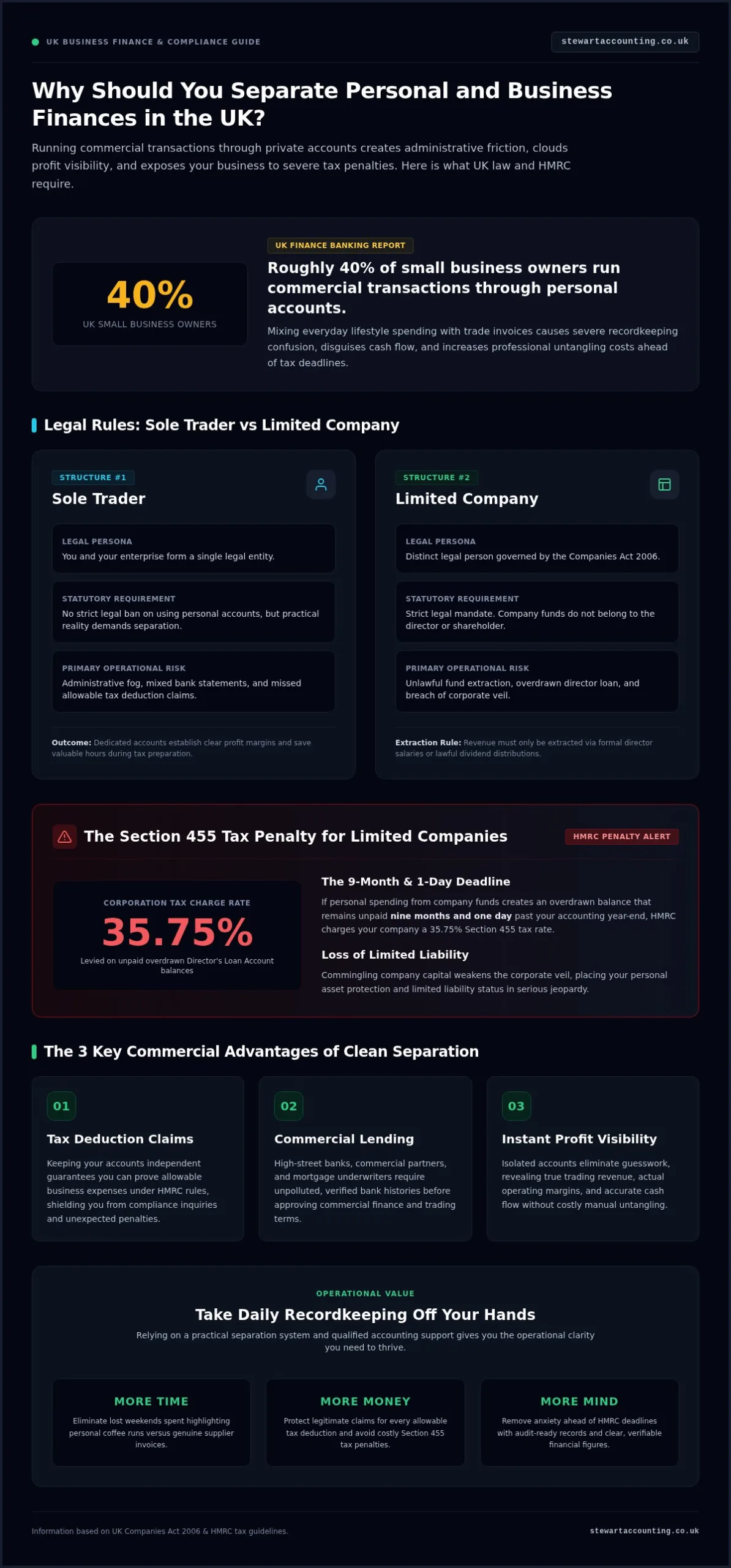
According to a UK Finance banking report, roughly 40% of UK small business owners run commercial transactions through their personal accounts. If you are currently juggling customer payments alongside private expenses, you already know the frustration it causes. Sifting through bank statements ahead of tax deadlines drains your energy, especially when you feel unsure about your actual profit margins. Mastering separating personal and business finances uk is the most reliable way to remove that guesswork and protect your hard-earned enterprise.
Separating your money does far more than satisfy regulations. It gives you complete financial clarity, protects you against compliance headaches, and ensures you claim every allowable tax deduction with confidence. This guide walks you through establishing dedicated banking, cleanly dividing sole trader or company funds, and setting up simple day-to-day records. By putting a practical system in place, you can take administrative stress off your hands and gain more time, more money, and more mind to focus on running your business.
Key Takeaways
- Establishing a dedicated business bank account forms the foundation of separating personal and business finances uk, giving you instant clarity over your trading profit.
- Limited company directors face strict legal obligations to keep corporate and personal funds apart, avoiding accidental director loans and costly Section 455 tax charges.
- Keeping your accounts independent guarantees you can prove allowable business expenses under HMRC rules, shielding you from compliance inquiries and unexpected penalties.
- Relying on qualified accounting support can take daily recordkeeping off your hands, delivering more time, more money, and more mind to invest back into your business.
Why Is Separating Personal and Business Finances Vital in the UK?
Running a small business involves endless daily decisions, but running your trading revenue through a private bank account creates invisible friction. While the traditional legal structure of a sole proprietorship technically merges you and your business into one legal persona, mixing everyday lifestyle spending with trade invoices causes severe recordkeeping confusion. You lose line-of-sight on real company profits. Over time, that administrative fog fuels chronic anxiety whenever HMRC deadlines approach.
To see how UK banking rules and compliance expectations intersect in practical terms, watch this helpful overview:
When you commit to separating personal and business finances uk, you establish a solid operational foundation. It protects your legitimate claims for every allowable tax deduction, provides audit-ready records, and liberates your mental energy. Ultimately, clear separation gives you more time, more money, and more mind.
The True Cost of Blurred Financial Boundaries
What does commingling actually cost you? Sorting through dozens of pages of mixed PDF bank statements drains entire weekends. You spend precious hours highlighting which card payments were genuine supplier purchases and which were family supermarket trips. When your bookkeeper or accountant has to untangle personal coffee runs, your professional fees rise unnecessarily. Worse, messy accounts disguise your true cash flow, leaving you vulnerable to sudden cash shortages when tax bills land.
Building Credibility with Suppliers, Lenders, and HMRC
Clean accounts build immediate credibility across your commercial network. Serious suppliers and commercial partners expect B2B transactions to flow through formal business facilities rather than personal names.
- Commercial lending: High-street banks, lenders, and commercial finance brokers like TMS Finance require unpolluted, verified bank histories before approving commercial finance.
- Audit protection: HMRC compliance reviews focus heavily on questionable expense claims. Blended accounts draw intense scrutiny, whereas isolated business accounts deliver clear, verifiable evidence.
- Strategic growth: Clean ledgers allow your accountant to deliver proactive bookkeeping services based on pure numbers.
Operating through a dedicated business account instantly proves you take your enterprise seriously, protecting both your compliance standing and your peace of mind. For business owners managing international revenue or dealing with cross-border tax considerations, such as how foreign earnings are treated for Australian tax residents, click here to read a helpful breakdown.
Sole Trader vs Limited Company: What Are the UK Legal Rules?
How does your business structure change the legal necessity of keeping your money separated? Many entrepreneurs assume business accounts are strictly reserved for large corporations, but your legal form dictates your exact compliance responsibilities. Mastering the rules around separating personal and business finances uk protects you against avoidable tax penalties and statutory violations under UK law.
Limited Companies and the Corporate Veil
When you register an incorporated enterprise, the business becomes an entirely distinct legal person under the Companies Act 2006. Company funds do not belong to you, even if you are the sole director and 100% shareholder. Reviewing the official responsibilities of running a limited company demonstrates that corporate revenue remains company property until extracted through formal channels, such as director salaries or lawful dividend distributions.
Spending company money on private groceries or personal holidays breaches that separation. It creates an overdrawn Director’s Loan Account balance. If that balance remains unpaid nine months and one day past your accounting year-end, HMRC charges your company a Section 455 Corporation Tax rate of 35.75%. Commingling company capital also weakens the corporate veil, placing your limited liability status in jeopardy. You can review our dedicated support for limited companies to ensure your corporate board procedures and balance sheets remain fully compliant.
Sole Traders: Legal Permission vs Practical Reality
Sole traders operate under a completely different statutory setup. Legally, no distinction exists between your business and your personal identity. HMRC allows you to receive customer payments into a private bank account, but treating that flexibility as a long-term strategy causes serious practical problems:
- Bank account restrictions: High-street personal current accounts specifically forbid commercial trade in their standard terms, putting your account at risk of suspension.
- Digital reporting rules: With making tax digital (MTD) for income tax applying to sole traders earning over £50,000, quarterly digital summaries require clean audit trails that personal accounts cannot support.
- Reporting stress: Sifting through blended transactions makes completing your annual self assessment exhausting.
Our experienced team regularly assists UK sole traders in building structured boundaries that protect their time and mental well-being. If you want reassurance that your current entity structure and banking setups meet HMRC rules, feel free to speak with our friendly accounting team for tailored guidance.
How Do You Set Up Clean Financial Separation Step by Step?
Setting up clear boundaries does not require complex corporate structures. Following a sequence of practical steps brings order to your daily transactions. When putting separating personal and business finances uk into practice, real operational control begins with separating your incoming trading revenue from private domestic spending.
Choosing and Connecting the Right Business Bank Account
Begin by opening a dedicated business current account registered in your trading name or registered company name. Most digital and high-street banks now offer streamlined business accounts that link straight into cloud platforms using secure Open Banking feeds. This integration pulls in real-time financial data automatically, ensuring your transaction ledgers mirror your banking records exactly as required by official GOV.UK guidance on company and accounting records. Ordering a separate business debit card ensures you never pay for commercial supplies with a domestic card.
Paying Yourself the Right Way
How should you transfer funds for everyday household living costs? Creating a disciplined payment routine prevents accidental confusion:
- Sole traders: Transfer a predictable, regular amount to your personal current account once or twice a month as personal drawings. Avoid treating your business balance as a personal petty cash pot.
- Limited company directors: Organise withdrawals through formal monthly payroll salaries, declared dividend distributions from post-tax profits, or verified expense reimbursement forms.
- Internal transfers: Clearly label every transfer within your online banking app, distinguishing formal drawings from reimbursable business expenses.
Tracking Receipts and Business Expenses Digitally
Paper receipts stuffed into glove boxes fade quickly, making digital capture vital for compliance. Snap pictures of paper receipts on your phone immediately after purchase so each claimed tax deduction remains backed by clear digital proof. Ensuring every receipt has a genuine commercial purpose protects your deductions if HMRC asks questions.
If categorising receipts and reconciling bank feeds feels like a tedious distraction, you can let our qualified specialists manage your bookkeeping. Our team can take it off your hands, establishing dependable systems that grant you more time, more money, and more mind.
What Happens If You Mix Personal and Business Expenses?
Allowing domestic transactions to wander into trade ledgers quickly snowballs into compliance traps. In fact, HMRC’s Measuring Tax Gaps report attributes 35% of the UK tax gap directly to a failure to take reasonable care, including poor recordkeeping and blurred boundaries. When you neglect separating personal and business finances uk, minor oversights can rapidly become costly statutory errors.
HMRC Compliance Inquiries and Disallowed Expenses
UK tax law enforces the strict wholly and exclusively rule under Section 34 ITTOIA 2005 for sole traders and Section 54 CTA 2009 for companies. If an expense carries a dual personal and commercial purpose, HMRC will disallow the deduction outright during a compliance check.
The financial consequences escalate quickly. Schedule 24 Finance Act 2007 allows tax inspectors to impose penalty fines reaching up to 30% of underpaid tax for careless behaviour, rising to 100% for deliberate concealment. Mixing personal items also muddles your taxable turnover calculations, making it easy to misjudge mandatory thresholds for registering and submitting VAT returns.
The Hidden Pitfalls of Director’s Loan Accounts
If you run an incorporated company, dipping into corporate cash for private expenses triggers intricate Director’s Loan Account rules:
- Beneficial loan interest: Should an overdrawn loan exceed £10,000 at any point without you paying HMRC’s official interest rate, it becomes a taxable Benefit-in-Kind (BIK), creating personal Income Tax via Form P11D and employer Class 1A National Insurance liabilities.
- Corporation Tax surcharge: If overdrawn balances remain uncleared within nine months and one day of your financial year-end, the company faces that punitive Section 455 tax charge.
- Anti-avoidance restrictions: HMRC’s 30-day bed-and-breakfasting anti-avoidance rule prevents you from clearing an overdrawn balance of £5,000 or more simply to withdraw it again immediately.
How to Correct Accidental Personal Purchases
Mistakes happen. If you accidentally tap your business card at a grocery till, address it immediately. Post the purchase in your accounting software as personal drawings if you are a sole trader, or code it against your director’s loan account if operating as a company. Then, transfer the exact sum from your private bank account back to the business account with a clear memo reference.
Correcting transactions before statutory filing deadlines protects your business standing. If you need expert guidance to resolve entangled accounts or tidy historical ledgers, you can reach out to Stewart Accounting Services today.
How Can Professional Accounting Support Free Your Time and Mind?
Do you find yourself spending late evenings cross-checking bank records instead of focusing on growing your business? Managing the routine discipline of separating personal and business finances uk can easily feel like a second job. Partnering with a dedicated accountancy practice changes that dynamic, turning a source of ongoing administrative friction into an efficient, automated financial system.
The Value of Letting Experts Take It Off Your Hands
Handing over complex bookkeeping routines immediately removes stress from your workweek. Professional Chartered Accountants and Institute of Certified Bookkeepers (ICB) accredited specialists structure your digital accounts to capture every incoming invoice and trading cost accurately. Instead of spending your weekends matching statements or calculating disallowable items, you can let an expert team take it off your hands.
Qualified practitioners maintain continuous oversight of your accounts. They categorise expenses accurately, ensure your cloud software mirrors your bank ledgers, and prepare precise year end accounts well ahead of filing deadlines. Having seasoned professionals oversee your reporting means you never have to worry about missing compliance changes or facing unexpected HMRC enquiries.
Gaining the Three Freedoms: Time, Money, and Mind
A well-managed financial structure does more than balance your balance sheet. It restores personal independence through three distinct benefits:
- More time: Reclaim valuable hours previously lost to manual receipt hunting. You can redirect this time toward winning clients, developing products, or enjoying personal downtime.
- More money: Ensure you claim every allowable deduction legally available to your business. Clean books prevent costly filing errors, HMRC penalties, and unnecessary corporation tax charges.
- More mind: Enjoy genuine peace of mind. Knowing that qualified experts maintain audit-ready ledgers removes the persistent dread surrounding statutory deadlines and surprise tax assessments.
With an ongoing business advisory focus, clean ledgers become a valuable forward-looking asset. Accurate numbers reveal true profitability, showing you exactly when to invest, hire, or adjust your pricing. If you are ready to eliminate financial confusion and run your business with total confidence, contact Stewart Accounting Services today to discuss how our team can help.
Transform Your Financial Clarity and Peace of Mind
Establishing clean financial boundaries is one of the most rewarding steps you can take for your growing enterprise. Successfully separating personal and business finances uk protects you against unexpected tax charges, ensures effortless HMRC compliance, and gives you an accurate picture of your true trading profitability. With distinct bank accounts, automated digital receipts, and structured withdrawals, daily recordkeeping stops feeling like an uphill battle.
You don’t have to navigate these rules alone. Based in Central Scotland and serving ambitious businesses across the UK, Stewart Accounting Services combines Chartered Accountants and ICB accredited bookkeeping support to manage your compliance seamlessly. Our experienced team can take routine financial administration off your hands, establishing dependable systems that deliver more time, more money, and more mind. When you are ready to remove bookkeeping stress and focus entirely on your commercial goals, book a consultation with our chartered accountants today.
Frequently Asked Questions
Is it illegal to mix personal and business finances in the UK?
No, it is not illegal for sole traders, but it violates company law for limited companies. A limited company exists as a separate legal entity, meaning corporate funds belong strictly to the company rather than the directors. For sole traders, commingling is legally permissible under UK tax law, but it frequently breaches your bank’s retail account terms and complicates proving legitimate deductions to HMRC.
Do sole traders legally need a separate business bank account?
Sole traders do not have a statutory legal duty to hold a business bank account, but keeping one is vital in practice. Most high-street banks prohibit commercial transactions on standard personal accounts. Without clear boundaries, isolating your business transactions becomes tedious. Committing to separating personal and business finances uk ensures you track true profitability cleanly, saving substantial time when completing your annual Self Assessment return.
What happens if I accidentally pay for a personal item with my business card?
Accidental personal card transactions will not trigger HMRC penalties if you correct them promptly in your accounting software. For a limited company, code the transaction against your Director’s Loan Account and transfer personal funds back to the business account using a matching reference. Sole traders should simply log the purchase as owner drawings rather than a business expense, keeping tax deduction claims clean.
Can I pay myself from my business account whenever I want?
As a sole trader, you can transfer money whenever you like as personal drawings because tax is calculated on your net trade profits. Limited company directors must follow strict legal procedures. Company funds can only leave the business through formal PAYE payroll, verified expense repayments, or dividend distributions declared from post-tax profits. Withdrawing unrecorded funds creates an overdrawn director loan with potential tax consequences.
How do I separate finances if I have already been trading using one personal account?
What records does HMRC require me to keep for business expenses?
HMRC requires verifiable proof of purchase for every expense you claim, including till receipts, supplier invoices, bank statements, and mileage records. Sole traders must keep records for at least five years after the 31 January submission deadline for the relevant tax year. Limited companies must keep records for six years from their accounting period end. Inadequate accounting records can attract HMRC fines reaching up to £3,000.
How does separating personal and business finances prepare me for Making Tax Digital?
Digital tax submissions require clean transaction records that feed directly into HMRC-compatible software via Open Banking. When managing separating personal and business finances uk, a distinct business account ensures only trade transactions appear in your digital ledger. This clean separation stops private transactions from cluttering your cloud software, making mandatory quarterly digital summary updates and year-end declarations completely straightforward.
Recent Posts
22 Oct, 2026
21 Oct, 2026