

Micro Entity Accounts Template: How to Fill It In

You've downloaded a micro entity accounts template, opened the balance sheet tab, and the first cell wants a figure you can't place without opening three other spreadsheets. Your filing deadline is a few weeks out, the trial balance your bookkeeper sent in April hasn't been touched since, and somewhere at the back of your mind is a question you keep postponing. Were you even allowed to use the short version this year?
That question decides everything else. A template is a set of headings with statutory wording bolted on. It can't tell you whether your company qualifies, which of three separate documents each recipient needs, or whether the filing route you used last year still exists. The work on micro-entity accounts is the checking around the template, not the typing into it.
Work through it in this order. Each step gets checked against the rules in force for your specific accounting period, so you never build a set of accounts on a service that's closed or a requirement that's been paused.
Check You Qualify Before Using the Template
A company is a micro-entity for an accounting period only if it meets at least two of three limits for that period. That one sentence decides whether you open the template at all. For periods beginning on or after 6 April 2025, GOV.UK's guidance on micro-entity accounts sets the three tests at annual turnover of no more than £1 million, a balance-sheet total of no more than £500,000, and an average of no more than 10 employees.
Micro-entity limits for accounting periods starting on or after 6 April 2025
| Test | Limit | Where to find the figure |
|---|---|---|
| Annual turnover | No more than £1 million | Total turnover for the year from the profit and loss figures |
| Balance-sheet total | No more than £500,000 | Total assets on the year-end balance sheet |
| Average employees | No more than 10 | Average headcount across the year from payroll records |
The Two-of-Three Test in Practice
Numbers make the rule obvious. A company with £850,000 turnover, a £420,000 balance sheet and six staff passes all three tests and has room to spare. A company with £1.2 million turnover, a £400,000 balance sheet and eight staff fails on turnover, but passes on balance-sheet total and headcount, so it still qualifies. Both companies use the same template.
Read the direction of the test: failing one limit doesn't disqualify you. Failing two does, and then you're on the small-company format with its fuller disclosures.
When the Numbers Fit but the Company Doesn't
Group membership and subsidiary status can take a company outside the reduced regime even when all three figures sit comfortably inside the limits. So can exclusion from the small-companies regime, which blocks the micro-entity provisions entirely. Check those conditions against your structure, not just your arithmetic.
The limits also moved. For accounting periods that began before 6 April 2025, the earlier figures applied: annual turnover of no more than £632,000, a balance-sheet total of no more than £316,000, and the same test of no more than 10 employees, as set out in the Small Companies (Micro-Entities' Accounts) Regulations 2013, which applied to financial years ending on or after 30 September 2013. You still need two of the three.
Pull all three figures from your year-end accounts before you open any template. If you fail two tests, stop and use the small-company format instead. Drafting first and testing afterwards is how companies end up with accounts that have to be redone from the notes upwards.
Gather These Records Before You Start
A micro-entity set asks for roughly a dozen figures. Every one of them should already exist in your records before you open the file, and if one doesn't, that gap is the actual work of the week. Assemble everything in one folder first, so drafting becomes transcription rather than detective work.
- Year-end trial balance. The spine of the whole set. Every balance-sheet heading in the template traces back to a line here, so reconcile the two before you draft and you won't be reworking the notes later.
- Sales and purchase ledgers. These support the turnover figure in the profit and loss account and let you test that cutoff was applied properly at the year-end date.
- Bank statements with completed reconciliations. An unreconciled bank balance is the most common reason a drafted balance sheet refuses to tie out.
- Fixed asset register showing cost and depreciation. Feeds the fixed assets line at net book value and gives you the depreciation charge for the profit and loss account.
- Debtors and creditors schedules at the year end. Feed current assets and both creditors lines, the one due within a year and the one due after more than a year.
- Payroll records showing headcount through the year. Not a balance-sheet line at all, but the average employees figure comes from payroll records, and that figure decides your eligibility.
- Share capital and director details. Called-up share capital sits inside capital and reserves, and the names and shareholdings must match the statutory register.
- Prior-year closing figures. They become this year's comparatives, and a missing comparative produces accounts that look finished but don't balance.
Say a sole-director consultancy runs its own bookkeeping and finds, during the bank reconciliation, a £1,240 difference that was never cleared. The temptation is to post it to a suspense account and carry on. Clear it properly instead, to the invoice it relates to or to the director's loan account if that's what it was, because a suspense balance sitting in the file will either break the balance sheet or end up hidden in sundry creditors.
Our guide to preparing company accounts sets out the order of preparation if you want the sequence in more detail.
Run one check before you move on. Every heading in the template should map to a record you already hold. If a heading has nothing behind it, close that gap now rather than during the final review, when you'll be tempted to plug the number and hope.
Which Document Goes to Which Recipient
One set of accounting records produces three different documents, and only one of them goes to Companies House. Getting this straight before you file prevents the error that shows up most often: a director files the short public version and assumes the tax side is somehow handled by the same submission.
| Recipient | What it needs | Filing note |
|---|---|---|
| Companies House | Balance sheet and notes in micro-entity format | Filed through approved software or WebFiling; confirm the current profit-and-loss position for your period |
| Members (shareholders) | Full statutory accounts including profit and loss | Sent directly to members, even though the public filing is shorter |
| HMRC | Accounts with the Company Tax Return and corporation tax computation | Submitted with the CT600; the Companies House copy does not replace it |
The Mistake That Costs the Most
The rule is blunt. GOV.UK's guidance on filing your Companies House accounts confirms that a qualifying micro-entity may prepare simpler accounts and send only a balance sheet, with less information, to Companies House, but must still send statutory accounts to its members and provide accounts to HMRC as part of its Company Tax Return.
Every UK-registered company must file annual accounts, including companies that are dormant or not trading. Micro-entity accounts can be submitted through approved software or Companies House WebFiling. A reduced public filing reduces none of that.
Practical rule: the Companies House copy is a public extract. The members' copy and the HMRC copy are the statutory accounts. They're built from the same records but they aren't interchangeable.
If a shareholder asks for the full accounts and all you hold is the public extract, your statutory records are incomplete. That happens more often than it should, because the balance-sheet-only version looks finished on screen once it has been through the template.
Where the Profit-and-Loss Position Stands
Company law has been moving towards requiring micro-entities and small companies to file profit-and-loss accounts publicly, and the timetable for that change has been under review. Treat the public filing position as something to verify against current rules, not something the template settles for you. Check the requirement for your accounting period on GOV.UK before you submit, because guidance written even a year ago may describe a position that has since shifted.
Our guide to submitting accounts to Companies House covers the mechanics of the filing itself once the figures are settled.
Before you file anything, list the three recipients and tick each document against them. Balance sheet and notes to Companies House. Full statutory accounts to the shareholders. Accounts plus corporation tax computation with the CT600. Any unticked line means something is missing.
How to Fill In the Template Step by Step
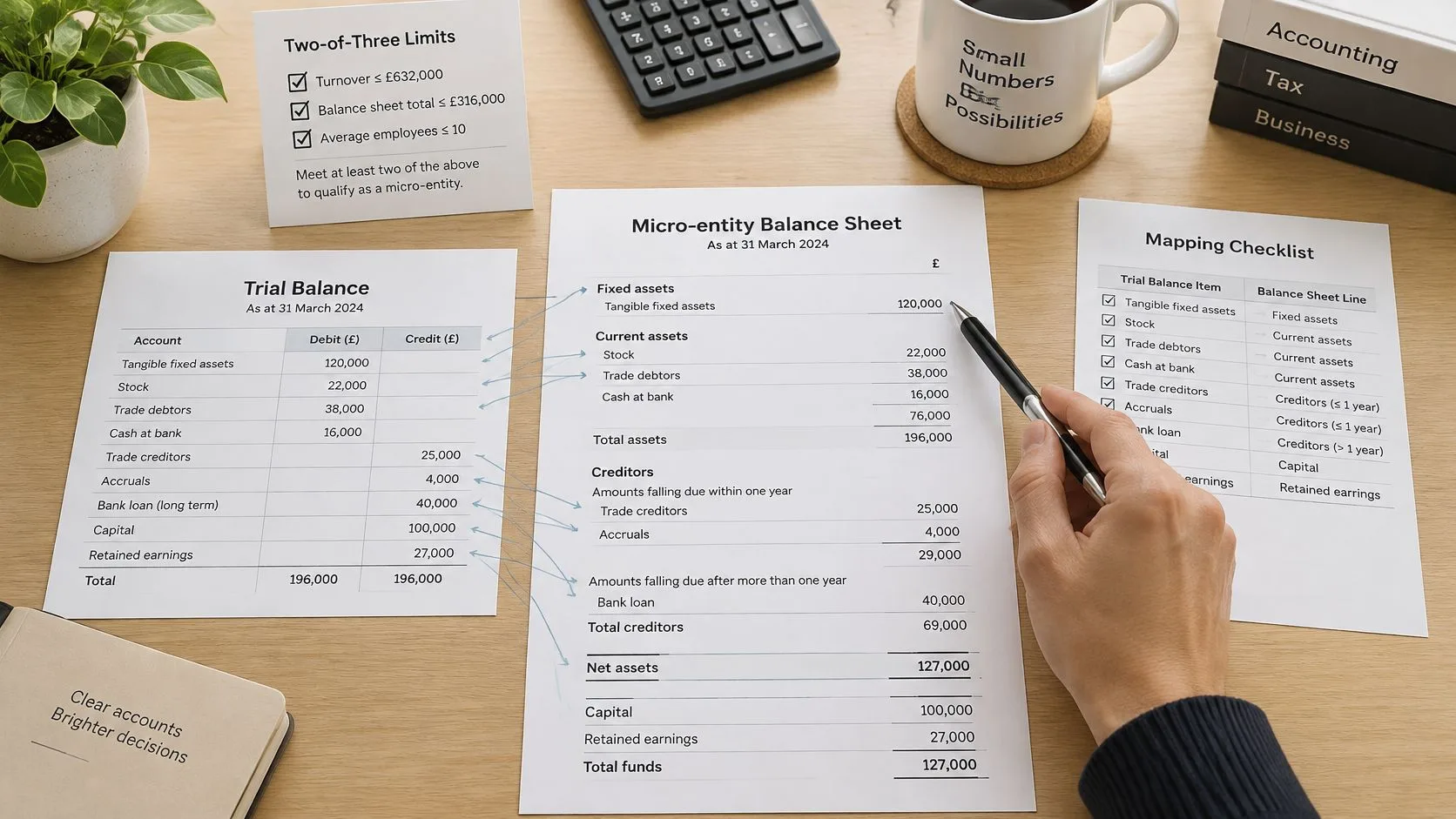
The sequence below is the one that produces a clean set on the first pass. Follow it in order, because each step depends on the one before it being right.
Confirm eligibility for the period. Run the two-of-three test against this year's figures, not last year's, and check the group and subsidiary conditions. The common slip is assuming status carries forward automatically.
Reconcile the trial balance to the statutory balance-sheet headings. Every balance needs to sit under the correct line, with no combined figures and no suspense. The slip here is copying the trial balance total instead of the balance-sheet heading total, which shifts a figure by a digit and leaves you hunting for it later.
Prepare the profit and loss account. The public Companies House filing may not include it, but the statutory accounts for members and HMRC still need it. Skipping this step because the public version doesn't show it is the error that causes the most rework.
If you want to see the balance-sheet headings being mapped to source records before you start, this walk-through covers the same ground.
Complete the notes and accounting policies. They must describe the treatment you applied, including depreciation rates and how stock is valued. Copying another company's policy note is a common slip, and it produces accounts that contradict their own figures.
Apply the prescribed micro-entity wording and decide on the directors' report. Micro-entities keep the option not to prepare one, so make the decision deliberately rather than by omission.
Prepare the Companies House version separately. It contains the balance sheet and notes in the reduced format, drawn from the same working papers rather than retyped from memory.
Cross-check all three documents. Every figure shared between the members' copy, the HMRC copy and the Companies House copy must agree. The slip here is submitting a public version that was drafted before the last adjustment and never re-checked against the final accounts.
Micro-entity balance-sheet headings and their source records
| Heading | What it holds | Source record |
|---|---|---|
| Fixed assets | Intangible, tangible and investment assets at net book value | Fixed asset register |
| Current assets | Stock, debtors, investments and cash at the year end | Stock count, debtors schedule, bank reconciliation |
| Creditors due within one year | Trade creditors, tax and social security, accruals and other amounts payable within twelve months | Creditors schedule |
| Net current assets or liabilities | Current assets less creditors due within one year | Calculated from the two lines above |
| Creditors due after more than one year | Long-term loans and similar amounts owed | Loan agreements |
| Provisions | Provisions for liabilities and charges | Provision calculations |
| Net assets | Total assets less total liabilities | Calculated; must equal capital and reserves |
| Capital and reserves | Called-up share capital and profit and loss account | Share register and prior-year closing accounts |
What a Finished Set Looks Like
A checked set is three documents that agree on every shared number, and a balance sheet that totals on its face without a plug. Net assets equal capital and reserves, the profit and loss reserve rolls forward from last year's closing figure plus this year's result, and every note has a number behind it that you can point to in a working paper. If any of that isn't true, you're not finished, whatever the template says about completeness.
Where a Template Falls Short
A template can speed up drafting, but it cannot decide the filing route for you. Eligibility, accounting policies, statutory notes and the route itself depend on the accounting period and the company's circumstances. The rules can also move. Companies House's update on accounts filing from April 2028 shows why a downloaded form should be checked against current guidance before you rely on it. Treat the template as a drafting aid, then check every filing date and requirement against the rules that apply to your period.
Two misconceptions survive even after the eligibility test appears settled.
The first is that micro-entity status means no audit. An auditor's report is still required unless a valid small-company audit exemption applies. Settle that question before you commit to the reduced format, because the disclosure route and the supporting work can change.
The second is that a micro-entity stays one. A company that qualified last year can grow past the turnover and headcount limits and need the small-company format this year. A static template will not flag that change. It will not flag a subsidiary relationship that removes the option either. Nor will it deal with the practical question of whether the figures still support the reduced disclosures once adjustments have been made.
There is also a limit to what a form can do with imperfect records. A template can arrange headings, but it cannot turn unreconciled bank balances, unsupported accruals or missing prior-year comparatives into reliable accounts. Those are judgement calls, and they matter most when figures sit close to a threshold or a filing decision depends on them.
Call in an accountant when you have a group or subsidiary structure, figures sitting close to any limit, an unresolved audit question, records that don't reconcile, or a first year of trading with comparatives you can't substantiate.
Decide Whether to Fill It In Yourself or Hire Help
Start with the dates, because the ground has already shifted under static templates. Government guidance set the closure of the online service for filing accounts and a Company Tax Return at 31 March 2026, with micro-entity accounts filed through software or WebFiling and future filing expected to move toward commercial software, according to GOV.UK's guidance on filing your Companies House accounts. Confirm the current position on GOV.UK before you build a process around any route.
The same guidance also covers changes connected with the Economic Crime and Corporate Transparency Act 2023, so check which provisions apply to your accounting period rather than the rules in force when your template was drafted. Mandatory profit-and-loss filing was announced and then paused while alternative options were considered, which means a template built around it could send you preparing figures nobody has asked for yet.
Fill in the template yourself only if all four of these hold. Your company is a single entity with no group involvement. All three figures sit clearly inside the limits rather than hovering at them. Your records reconcile without plugs. You've confirmed the current filing route for your period.
If any one of those fails, hire help. Growing companies approaching a threshold should bring an accountant in months before year-end, because the decisions that keep you inside the regime are usually made earlier in the year, not when the accounts are being drafted.
Stewart Accounting works with clients from the very beginning, well before year-end accounts are due, and that earlier conversation is usually the cheaper one: structure, tax obligations and cash flow sorted before they become a filing problem. If you'd rather weigh up the two routes first, read our piece on whether you need an accountant or can file your limited company accounts yourself.
This week, run the eligibility test on your latest figures, confirm the filing route on GOV.UK, and book a review if any test is borderline. Three checks, one afternoon.
If your year-end falls in the next few months and you're not certain which set of limits applies to your period, send Stewart Accounting Services your latest trial balance and balance sheet. We'll run the two-of-three test, tell you plainly whether the micro entity accounts template is the right vehicle this year, and flag anything in your records that needs clearing before drafting starts. Call the Alloa office or email us with your year-end date and we'll take it from there.