

How to Prepare Company Accounts: A UK Year-End Checklist

Your year end was weeks ago, the bank feed still has unreconciled items, and a Companies House reminder has landed in your inbox. You know accounts are due, but you're not sure which deadline drives the work, which format you can file, or whether the ledger is clean enough to trust. That's the usual starting point, and it's fixable. Learning how to prepare company accounts properly means treating the year end as a data readiness exercise. Reconcile monthly, keep a tidy chart of accounts, and the statutory close becomes routine rather than a scramble.
Deadlines You Must Meet for Company Accounts
Take a private company with a 31 March 2025 year end. Its accounts were due by 31 December 2025, nine months later. Work back from that receipt date and every other step falls into place.
The GOV.UK guidance on annual accounts states that the Companies House filing deadline is normally 9 months after the company's financial year end, while public companies generally have 6 months. Filing is only complete when Companies House receives acceptable accounts, not when you post them. The same guidance confirms that even dormant or non-trading companies must file annual accounts.
Key UK Company Filing Deadlines
| Obligation | Deadline | Filed with |
|---|---|---|
| Annual accounts, private company | 9 months after year end | Companies House |
| Annual accounts, public company | 6 months after year end | Companies House |
| First annual accounts | 21 months after incorporation | Companies House |
| Corporation Tax payment | 9 months and 1 day after period end | HMRC |
Your Company Tax Return runs on a separate clock, due twelve months after the end of the Corporation Tax accounting period. The Companies House date arrives first for most private companies, so it controls your timetable. If you are checking your own dates, read our guide explaining when your company accounts are due and compare it with your accounting reference date.
Put both statutory deadlines in the calendar today. Then set an internal director approval date about a month before the earlier one. Directors must approve the accounts before filing. That buffer gives you time to clear unreconciled bank items, tidy the ledger for software filing, and fix errors without penalty risk.
Practical rule: The deadline is met on receipt of acceptable accounts, not on the day you press submit.
Which Accounts Format Your Company Qualifies For
Size decides format. Get this wrong and you'll either disclose more than you must or file accounts that Companies House rejects. A company qualifies as small or as a micro-entity when it meets at least two of three tests.
The Companies House accounts criteria sets out that, for accounting periods beginning on or after 6 April 2025, a company is generally classified as small when it meets at least 2 of 3 tests, namely annual turnover of no more than £15 million, a balance sheet total of no more than £7.5 million, and an average workforce of no more than 50 employees. A micro-entity must meet at least two lower thresholds, turnover of £1 million or less, a balance sheet total of £500,000 or less, and no more than 10 average employees.
Size Thresholds for Periods Starting on or After 6 April 2025
| Test | Micro-entity | Small company |
|---|---|---|
| Annual turnover | £1 million or less | £15 million or less |
| Balance sheet total | £500,000 or less | £7.5 million or less |
| Average employees | 10 or fewer | 50 or fewer |
| Rule to qualify | Two of three tests met | Two of three tests met |
Check the period start date before you apply these figures, because earlier periods used lower micro-entity limits. Qualifying status is assessed for the period you're filing, not for today.
What the Classification Changes
Micro-entities can prepare simpler accounts and may submit only a reduced balance sheet and notes to Companies House. Small companies may qualify for audit exemption and may choose abridged accounts if all members agree. Larger companies face fuller disclosure and may need an audit. Our notes on micro-entity accounts and what you file explain the reduced filing in more detail.
Say a Stirling consultancy has £1.2 million turnover, a £420,000 balance sheet total and eight staff. It fails the turnover test but passes the other two, so it still qualifies as a micro-entity. Grow turnover to £1.6 million and the balance sheet to £600,000 and it passes only the employee test, so it moves up to small company accounts.
Don't mistake a shorter public filing for less accounting. You still need reliable records, adjustments, supporting schedules and a tax computation for members and HMRC. Confirm the size class at the period end, then build the pack for that format and nothing else.
How to Close the Books and Build a Trial Balance
Start by confirming basics that cause disproportionate trouble later. Check the accounting period, the accounting reference date and that the company name on your draft matches the Companies House record exactly. A wrong period end invalidates otherwise good work.
This workspace is where the close happens, ledger by ledger rather than from memory.

The Six Close Steps in Order
- Reconcile every bank and card account. Include loan accounts and agree the closing balance to the bank on the year end date, not the statement date. Using the wrong date is a common slip that leaves uncleared items unexplained and a balance that won't agree.
- Clear suspense and unallocated items. Work through unallocated receipts and payments until the suspense account is nil. Unexplained balances distort profit and signal to any reviewer that the ledger isn't finished.
- Reconcile control accounts. Agree debtors, creditors, VAT, PAYE and pension liabilities to the underlying ledger and aged reports. If the control account and the aged listing differ, find out why now, not during drafting.
- Agree the director's loan account. Reconcile advances, repayments, dividends and benefits in kind. An overdrawn loan carries tax consequences, so you need the exact balance and the dates money moved.
- Update fixed assets and stock. Bring the fixed asset register up to date for additions and disposals, then count stock or value work in progress as at the year end date. A count taken two weeks later without adjustment won't support the figure.
- Run the trial balance. Confirm debits equal credits and save a copy. That's your audit trail for every number that follows.
I would not draft a single statement until these six steps are done. Adjustments built on an unreconciled ledger just move errors around.
For a plain English walk through the mechanics, ledger balance checks explained by CEFCore are worth reading alongside our own guide on what a trial balance is in accounting. Both reinforce the same point. The trial balance proves arithmetic, not accuracy, so reconciliations do the heavy lifting.
What Clean Looks Like
A clean close has no suspense balance, reconciled control accounts and a short written list of open queries with owners and dates. Queries are fine. Hidden queries aren't.
The video below walks through the close process visually, which helps if you're delegating parts of it to a bookkeeper for the first time.
You don't need to do all of this in one month. We set up Xero and supporting apps so clients can do their own bookkeeping more efficiently, with bank, VAT and payroll reconciliations handled monthly. Do that through the year and the year end close shrinks to checking, not reconstructing.
A trial balance that balances can still be wrong. Reconciled control accounts are what make it reliable.
Adjustments and Drafting the Statutory Accounts
Your trial balance records transactions. It doesn't yet show the true year end position. Adjustments bridge that gap, and each one needs a reason you can explain six months later.
Year End Adjustments to Work Through
- Accruals. Costs incurred but not yet invoiced, such as utilities used in March or professional fees for work already done.
- Prepayments. Costs paid in advance, such as annual insurance or software subscriptions that cover next year.
- Depreciation. Charged under your stated policy from the fixed asset register, consistently with last year unless you disclose a change.
- Bad debt provisions. Specific amounts for aged or doubtful debtors you don't expect to collect in full.
- Stock valuation. At the lower of cost and net realisable value, writing down damaged or obsolete lines.
- Unusual items. Grants, asset disposals or one off costs that need separate thought and clear notes.
Keep a journal log as you go. One line per adjustment, with the amount, the reason and the evidence. When a director or lender asks why profit moved, you'll have the answer on one page.
Practical checks while you adjust include these three habits.
- Explain large movements. Note why any material line moved significantly year on year before anyone asks.
- Tie notes to totals. Check that fixed asset, creditor and loan notes add back to the balance sheet figures.
- Keep evidence attached. File the invoice, contract or calculation behind each journal so it's findable later.
Choosing the Framework and Drafting
Confirm which framework applies to the period before you draft. Most small companies use FRS 102, micro-entities use FRS 105, and some companies apply UK-adopted IFRS where that framework is required or chosen. Private companies prepare statutory statements under UK-adopted International Financial Reporting Standards or new UK Generally Accepted Accounting Practice, so don't assume last year's basis automatically carries forward if the company has changed size or structure.
Draft in the order a reviewer reads. Start with the profit and loss account, then the balance sheet, then a statement of changes in equity where needed. Follow with notes covering accounting policies, creditors, fixed assets and directors' loans, plus a directors' report where your size class requires one.
A director must approve and sign the balance sheet, and the approval date must be recorded. Unsigned accounts will be rejected, however accurate the numbers are.
The discipline here also pays off outside compliance. If you ever sell the company, buyers will test these same adjustments hard, which is why understanding completion accounts in acquisitions is useful context for directors thinking ahead. Clean accruals and a clear journal log make that scrutiny far less painful.
Corporation Tax Computation and Filing With HMRC and Companies House
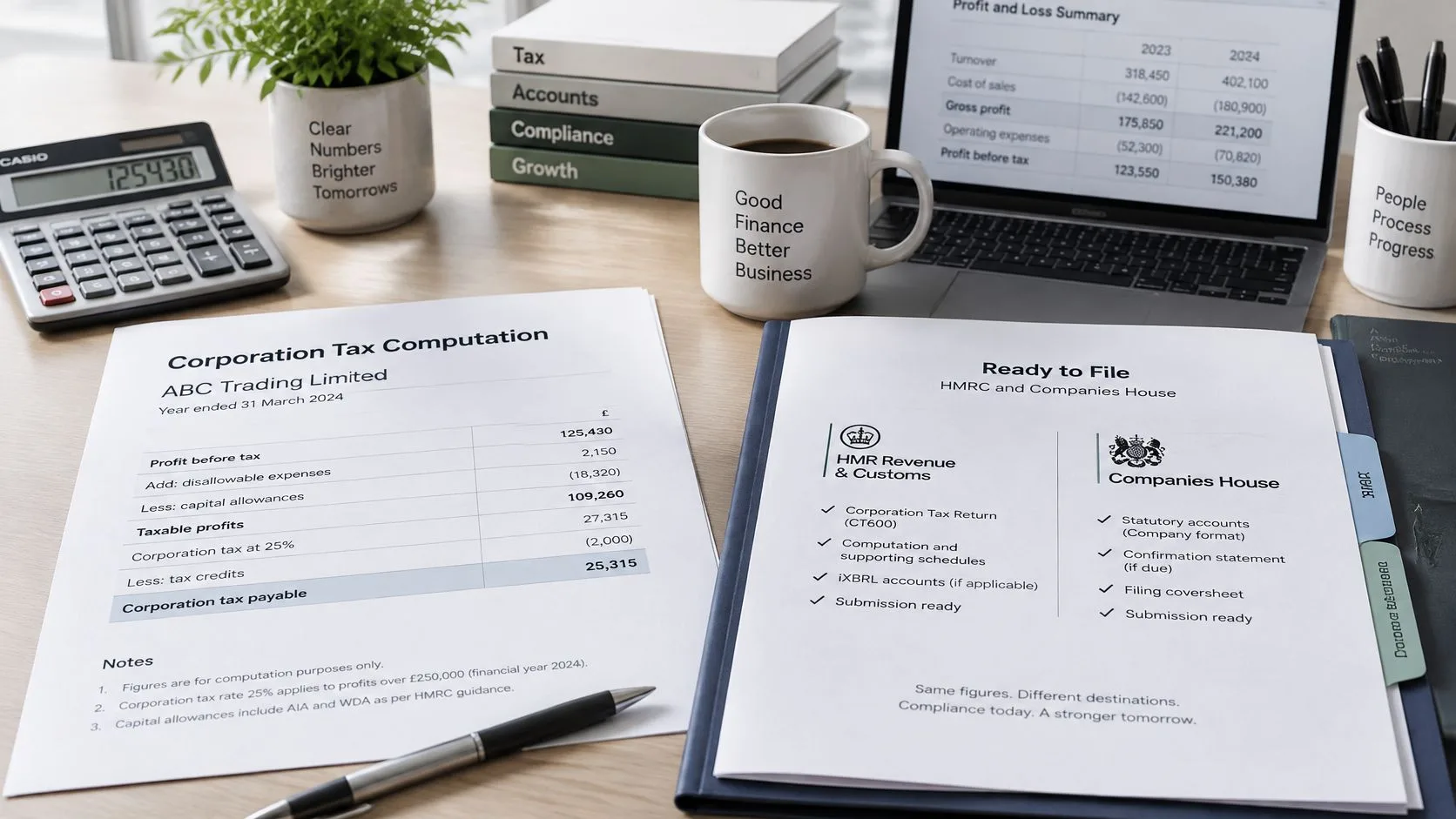
A reconciled trial balance still leaves two separate filings. Companies House records the statutory accounts for the public record. HMRC assesses taxable profit through the Company Tax Return. Each uses its own format and timetable.
The Five Filing Steps
- Build the tax computation. Start from accounting profit, add back disallowable items such as entertaining and most depreciation, deduct capital allowances and apply any losses brought forward.
- Apply the correct tax treatment. Use the rate that applies to your profit band and calculate marginal relief where your profits fall between the lower and upper bands.
- Prepare and submit the CT600. Attach the computation and file the Company Tax Return with HMRC by its twelve month deadline, and pay any tax due by the earlier payment date.
- File accounts with Companies House. Prepare them in iXBRL form using commercial software, record director approval and submit before the earlier Companies House date.
- Keep the evidence. Save submission receipts, payment references and payment dates where they can be found at a later review.
Accounting profit follows your reporting framework. Taxable profit follows tax law, which is why depreciation comes out and capital allowances go in. Reconcile the two figures in the computation so a reviewer can trace each adjustment back to the ledger.
Getting Ready for Software Only Filing
Companies House is moving all company accounts filing to commercial software, so web-based and paper routes will close. Check the guidance on using software to file company information on GOV.UK for the current cut-off date. That change applies whether directors file themselves or use an accountant.
Treat the change as a data test. Monthly bank, payroll, VAT and director loan reconciliations, plus a clean chart of accounts, make tagging straightforward. I recommend directors confirm three points now. The ledger maps cleanly to iXBRL tags, the software supports their accounts type and comparatives, and one named person controls the filing credentials with cover if they leave. Then run one sample filing well before the statutory deadline to catch mapping or notes errors while there is time to fix them.
Common Errors and Your Next Steps
A missed accounting reference date ruins more year ends than any technical adjustment. Check the Companies House record first. If the period is wrong, every reconciliation and note that follows is wasted work.
Common Year End Errors Consequences and Fixes
| Error | Consequence | Fix |
|---|---|---|
| Wrong period end or accounting reference date | Accounts filed for the wrong period | Check the reference date on the Companies House record before drafting |
| Balance sheet not signed by a director | Companies House rejects the filing | Record director approval and sign before submission |
| Accounts do not reconcile to the ledger | Queries and possible rejection | Agree the trial balance to the statements before drafting |
| Missing notes or required reports | Incomplete or rejected accounts | Use a disclosure checklist for the company's size class |
| Filing close to the deadline | Late filing penalties | Set an internal deadline a month before the statutory date |
Run that table as a pre-submission check. Then lock three habits into the monthly routine. Reconciled ledgers make the close routine. So give one person ownership of filing credentials, compare comparatives to last year's filed accounts line by line, and work from a disclosure checklist matched to your size class.
Who Should Do What
Clear ownership prevents last minute scrambles. The bookkeeper keeps bank, payroll, VAT and director loan balances reconciled each month with evidence filed. The accountant drafts the statutory accounts and computes the tax position from that clean ledger.
That split also prepares the company for commercial-software filing from 1 April 2028. Mapped charts of accounts, current reconciliations and tested logins carry straight into iXBRL software. Accountants who also want to turn client introductions into referral income will recognise the same principle. Good systems create capacity for better work.
Stewart Accounting Services Limited can assist with the preparation of year-end annual accounts, and businesses can start working with the accountant from the very beginning, not only when year-end accounts are due. Ask for a fixed fee quote before work starts. Stewart Accounting Services offers guaranteed fixed fees that are linked to the value of what it provides.
Your Actions This Week
- Write both deadlines in the calendar. Set director approval a month before the earlier statutory date.
- Confirm your size class. Use the threshold table and your period start date, not last year's answer.
- Start the close. Reconcile bank and control accounts now and clear suspense items while the paperwork exists.
Late filing penalties rise with delay at both Companies House and HMRC, so the earlier deadline controls the plan. Do not let the twelve month tax date make the nine month accounts date feel distant.
Gather your bank statements, current trial balance, last filed accounts and director's loan balance, then contact Stewart Accounting Services through stewartaccounting.co.uk for a first call about your year end. You will confirm deadlines and size class, agree who owns each part of the close, and receive a guaranteed fixed fee before work starts.