

CIS tax return help for builders in Falkirk: deductions and obligations

Builders seeking CIS tax return help in Falkirk need to understand two related filings: contractors report subcontractor payments and deductions on a monthly CIS Return, while subcontractors report their income and CIS deductions through Self Assessment. Contractors must submit the monthly return by the 19th of each month for payments made in the preceding tax month. CIS deductions count as advance payments towards a subcontractor’s tax.
When you’re busy on site, payment statements, invoices and CIS deductions can be hard to reconcile. Clear records and suitable accounting software help you track what contractors have deducted and what you need to include in your tax return.
This guide explains which construction work falls under CIS, what contractors must report each month and what to do if deductions appear unpaid to HMRC. It also covers records to keep and the difference between a subcontractor’s tax return and a contractor’s monthly duties, so you can manage your CIS responsibilities with more confidence.
Key Takeaways
- CIS deductions are advance payments towards your tax, and the rate depends on your registration status.
- Construction work covered by CIS can include building, repairs, decorating, site preparation and work on utility systems.
- Contractors must report subcontractor payments and provide payment and deduction statements within 14 days after the tax month ends, according to HM Revenue & Customs.
- Keep payment statements, invoices, receipts and records of work-related costs to support accurate tax reporting.
- If deductions seem missing or your records are difficult to reconcile, accounting support can help clarify what belongs in your return.
What if it looks like my contractor hasn’t reported or paid my CIS deductions to HMRC?
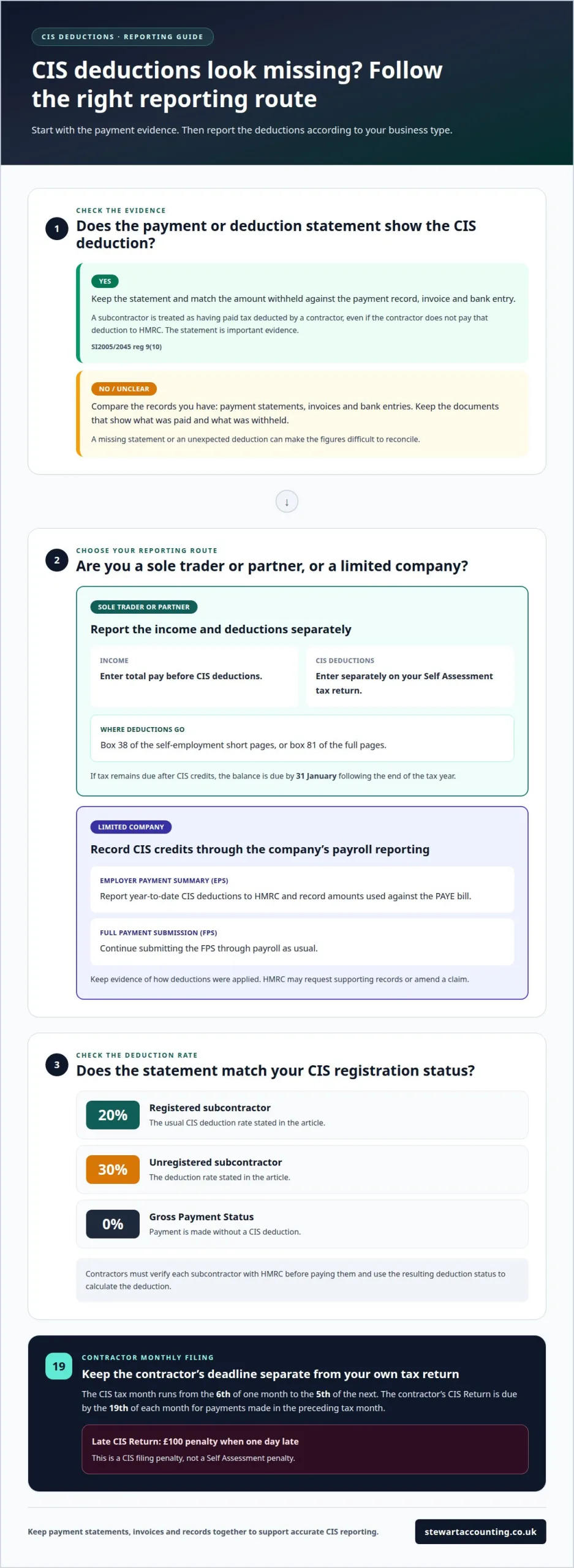
A missing payment statement or unexpected deduction can make your records difficult to reconcile. First, separate the contractor’s reporting duties from your own tax return, then compare the deductions shown in your records.
Claiming deductions against tax and National Insurance
CIS deductions are advance payments towards a subcontractor’s tax, rather than a business expense. Registered subcontractors usually have 20% deducted, while the rate for unregistered subcontractors is 30%; Gross Payment Status means a 0% deduction.
Contractors must verify each subcontractor with HMRC before paying them and use the resulting deduction status to calculate the deduction. For example, a registered subcontractor’s payment should show the 20% rate, while a subcontractor with Gross Payment Status should receive payment without a CIS deduction. Keep each payment statement so you can match the amount withheld to the payment record.
If you’re a sole trader or partner, report your total pay before deductions as income and enter the deductions separately on your Self Assessment tax return. CIS deductions go in box 38 of the self-employment short pages or box 81 of the full pages. Your return brings your income and CIS credits together to work out the tax and National Insurance position. You can use this Self Assessment tax return service for help with the filing.
A limited company handles CIS credits differently. It reports year-to-date CIS deductions to HMRC through an Employer Payment Summary (EPS), which records amounts used against its PAYE bill. The company should continue submitting its Full Payment Submission (FPS) through payroll as usual. Keep evidence of how CIS deductions were applied, as HMRC may request supporting records or amend a claim.
Risks of incorrect returns and missed claims
Incorrect CIS returns can create inaccurate deduction records, while missed expense claims can leave your business profit incorrectly reported. A contractor that files its CIS Return late may face a £100 penalty when it is one day late, so complete monthly reporting matters.
If a contractor has deducted tax but you cannot see it reflected in your records, keep the payment and deduction statements and compare them with your invoices and bank entries. Under SI2005/2045 reg 9(10), a subcontractor is treated as having paid tax deducted by a contractor even if the contractor does not pay that deduction to HMRC. The statement remains important evidence of what was withheld.
For a sole trader or partner, include the deductions in Self Assessment rather than reporting only the amount received after deductions. If the return still shows tax to pay after the CIS credits are included, the balance is due by 31 January following the end of the tax year. Correctly recording income, deductions and expenses helps prevent avoidable mismatches and shows how you reached the figures in your return.
Construction work covered by CIS
The Construction Industry Scheme (CIS) applies to a broad range of construction work across the UK. Whether a payment falls within the scheme depends on the work being done, not simply on whether a builder or limited company is involved.
For Self Assessment, distinguish the return filing deadline from the deadline for paying tax. A sole trader or partner who still owes tax after CIS deductions must pay by 31 January following the end of the tax year. A late CIS Return can incur a £100 penalty when it is one day late; that is a CIS penalty, not a Self Assessment penalty.
CIS-covered work includes building, demolition, alterations, repairs and decorating. It also covers construction of permanent or temporary buildings and civil engineering work, such as roads and bridges. For example, a contract to repair a building or construct a road may involve work covered by the scheme.
Covered activities can take place before or after the main building work. Site preparation includes laying foundations and creating access works. Installing heating, lighting, power, water or ventilation systems is also covered, as is cleaning the inside of a building after construction.
These examples can help you identify relevant work, but a contract may combine different tasks. In your records, separate construction activities from other services and note what each payment covers. A limited company’s involvement does not by itself determine whether a task falls within CIS. The type of construction work is the key factor.
The CIS tax month runs from the 6th of one month to the 5th of the next. Contractors must submit a CIS Return by the 19th of each month for payments made during the preceding tax month. For example, a return due on the 19th relates to the tax month that ended on the 5th. Keep the payment date and work description together, so each transaction can be assigned to the right reporting period.
Contractors should plan for the return deadline rather than wait until it is due. A monthly record organised by subcontractor and payment date helps identify which transactions belong in the return. If there are no relevant payments in a month, the contractor still needs to deal with the filing requirement. Missed CIS returns can lead to penalties, so classify payments correctly from the outset.
If you’re unsure how a construction contract should be reflected in your records, discuss your CIS reporting needs with an accountant before filing.
Accounting support and software for CIS
For builders, useful CIS software does more than store figures. It gives you a consistent way to organise activity, review patterns and prepare information for business decisions. Builders looking for CIS tax return help in Falkirk can benefit from an accounting setup that reflects how they manage jobs and subcontracting.
Accounting support and CIS software
A well-planned accounting setup gives each transaction a consistent category and makes reports easier to follow. This helps you see which jobs contribute to income and where business costs are increasing.
For example, a builder can group activity by project or work type and use the same categories each period. Consistent categorisation makes it easier to compare job performance and spot spending changes without rebuilding reports. Clear project names also help you find specific records quickly.
Accounting support can help set up your chart of accounts, the structure used to group income and costs. It can also help establish a regular review routine, such as checking management reports before planning upcoming work. The aim is to make everyday bookkeeping useful for decisions, rather than leaving figures untouched until year end.
Choose software to suit the way you work. Consider whether you need access across devices, a way to share information with your accountant, or reports that support job planning. Set user access according to each person’s role and use a consistent process for entering transactions. These steps help keep your records reliable as the business changes.
Professional help compared with online filing
Online filing lets you complete and submit forms yourself. Professional support can help you interpret the accounting information behind them. This distinction matters if you’re unsure how your bookkeeping should reflect the way your construction business operates.
Filing yourself may suit you if you’re confident using the relevant online systems and your accounting process is clear. Support can help if reports are difficult to interpret, categories have changed over time, or you want regular reviews of how your records inform business decisions. CIS tax return help for builders in Falkirk can include guidance on making the accounting process easier to manage.
Before deciding, consider how much time you can spend maintaining your system and whether you can explain how its figures are organised. A clear process can make online filing more manageable, while professional input can help refine it when it no longer fits your business. Choose an approach that gives you useful information without adding unnecessary work.
Contractors’ monthly return obligations
Each CIS contractor must report subcontractor payments and deductions to HMRC through a monthly CIS Return. The return records who was paid, the amount paid and the deductions made during the tax month.
Before paying a subcontractor, contractors must verify them with HMRC. The verification result confirms the subcontractor’s status and deduction rate, which the contractor uses when calculating payment. A registered subcontractor generally has 20% deducted, an unregistered subcontractor has 30% deducted, and Gross Payment Status means no CIS deduction is taken. Use the verified status for the payment, rather than relying on an older record.
For each subcontractor payment, record the gross amount, the cost of materials where relevant and how the deduction was calculated. Keep these details with the invoice and payment record. This creates a clear basis for the figures on the return and helps explain the difference between the gross payment and the amount received by the subcontractor.
Contractors must provide payment and deduction statements to subcontractors within 14 days after the end of the tax month, according to HM Revenue & Customs. Each statement should show the payment and deduction details for that subcontractor. The subcontractor can then use it to reconcile their own records, while the contractor retains matching information for the monthly return.
The CIS Return is due by the 19th of each month and covers payments made during the preceding tax month. Contractors paying deductions electronically have until the 22nd after the end of the tax month to pay HMRC. Filing the return and paying deductions are separate tasks, so completing one does not complete the other. A calendar reminder for both dates can help prevent a missed deadline.
If no subcontractors were paid during a period, the contractor may still need to manage the monthly filing requirement. Contractors can notify HMRC of inactivity through the CIS online portal to pause monthly filing for up to six months. When work resumes, review the records and restart the required reporting so payments are not missed.
Late returns can lead to penalties, and leaving out a subcontractor makes the figures incomplete. Before filing, reconcile the subcontractor list against invoices and payment records for the tax month. Check each verified status, confirm that deductions match the calculations and ensure the statements agree with the return. Keep the submitted return with payment evidence so you can answer later queries using the same records.
Records needed for a builder’s CIS tax return
Accurate CIS records link each payment, deduction and business cost to supporting evidence. Organise paperwork by tax year and subcontractor so you can trace the figures when preparing a return or responding to an HMRC query.
As a sole trader or partner, gather records of income before deductions, CIS deductions and business expenses. Contractors’ monthly payment and deduction statements show the amounts withheld. Match each statement to the relevant invoice and bank entry. If a statement is missing, record the payment details and follow up with the contractor to support the deduction.
Keep these records together for each job or payment:
- Invoices issued and received, showing the work and payment dates.
- Contractor payment and deduction statements, grouped by tax month.
- Receipts for tools, equipment, protective clothing and materials.
- Travel records, including mileage costs linked to business journeys.
- Insurance and home office cost records where those expenses apply.
Receipts help explain the amount and business purpose of each cost. For example, link a materials receipt to the job where the materials were used. A mileage record should show the business purpose of the journey, not a personal trip. This detail helps keep income and expenses distinct in your accounts.
Contractors also need records of subcontractor verification results. Keep the HMRC reference number and confirmation of each subcontractor’s deduction status. These records explain why a particular deduction was applied and help reconcile the monthly CIS Return with payment records.
For a limited company, keep a separate record of CIS deductions used against its monthly or quarterly PAYE bill. Form CIS132 can help record those amounts. The company should also retain details supporting its year-to-date CIS deductions reported through an Employer Payment Summary (EPS). If HMRC asks for evidence or changes the claim, the supporting figures and records can be provided together.
Use a consistent filing method, whether you choose digital folders or paper files. Label each document with the tax month, subcontractor or supplier, and transaction type. For example, one folder for a tax month could contain the statement, invoice, receipt and bank entry for a payment. This makes discrepancies easier to trace without mixing records from different contractors.
Before filing, reconcile total income, deductions and expenses against the records for the tax year. Keep the final figures linked to the statements and receipts used to prepare them. If organising CIS paperwork is taking time away from running your building work, talk to an accountant about support with your CIS records.
Stewart Accounting Services: Self Assessment Tax Returns
Stewart Accounting Services prepares Self Assessment Tax Returns for builders who need to report income and CIS deductions accurately. If payment statements, expenses and bookkeeping records are difficult to bring together, support can help organise the figures for your return and ease the filing process.
Gather your contractor statements, income records and receipts for business costs. Stewart Accounting Services can use these records to prepare your return and explain how CIS deductions affect the calculation. Bookkeeping Services can help keep records organised for future reporting, while Year End Accounts Preparation is available to limited companies that need annual accounts.
With the right records in place, you can spend less time sorting paperwork and more time on your building work. Contact Stewart Accounting Services to discuss your Self Assessment Tax Return.
Make your CIS records work for your next decision
A clear picture of your CIS position can support more than tax filing. It can help you plan for quieter periods, assess the cost of upcoming work and decide when to set money aside. Keeping accounts organised throughout the year makes these decisions easier than reconstructing figures at filing time.
If you need CIS tax return help in Falkirk, Stewart Accounting Services can assist with Self Assessment Tax Returns, Bookkeeping Services and Year End Accounts Preparation. This support can help connect your day-to-day records with your reporting needs, so you can focus more of your attention on running your building business.
Choose the support that fits your current records and responsibilities. Contact Stewart Accounting Services to discuss your CIS and tax return needs, and take a practical next step towards more time, more money, more mind.
Frequently Asked Questions
What are CIS Returns?
A CIS Return is a contractor’s monthly report to HMRC on payments made to subcontractors and deductions taken. It records subcontractor details, amounts paid and deductions, allowing HMRC to track CIS activity. It is separate from a subcontractor’s personal tax return. For example, a builder who hires subcontractors handles the monthly CIS Return, while each subcontractor reports their own income through the relevant tax process.
Can I skip a CIS return if I didn’t pay anyone?
Having no payments does not automatically mean you can stop dealing with CIS returns. If a contractor has no subcontractor payments to report, they may need to submit a nil return. Contractors can notify HMRC of inactivity through the CIS online portal to pause monthly filing for up to six months. This can be useful during a genuine break in subcontracting, but filing must resume when work starts again.
I’m a CIS subcontractor, what expenses can I claim?
You may be able to claim work-related costs such as tools and equipment, protective clothing or uniforms, travel, insurance and home office costs where applicable. Link each cost to your construction business rather than personal use. Keep receipts and note the business purpose, such as equipment bought for a specific job. CIS deductions are separate from expenses, so record them in the correct categories.
Who does the Construction Industry Scheme (CIS) apply to?
CIS applies to construction contractors and subcontractors involved in covered construction work. Contractors must register for the scheme, while subcontractors can choose whether to register. A business spending more than £3 million on construction over a rolling 12-month period is classed as a CIS contractor. The type of work also matters: building, alterations and civil engineering are examples of activities within the scheme.
What is a CIS tax return for builders in the UK?
There is no separate annual “CIS tax return” for every builder. Contractors submit monthly CIS Returns reporting subcontractor payments and deductions; subcontractors report their own income and deductions through their tax returns. For a sole trader, the annual return brings together income before deductions, CIS credits and business expenses. Keeping these figures distinct helps show how the final tax calculation accounts for amounts already withheld.
Who needs to file a Self Assessment tax return under the Construction Industry Scheme?
CIS subcontractors may need to report their income and deductions through a tax return, depending on their circumstances. This includes a sole trader or partner reporting construction income personally. A limited company handles its CIS deductions differently, rather than treating them as a sole trader’s Self Assessment figures. The business structure determines where deductions are recorded and how they affect the tax position.
What expenses can builders claim on a CIS tax return?
Builders can include eligible business costs such as tools, equipment, protective clothing, travel, insurance and applicable home office costs. Keep evidence of expenses separate from subcontractor deduction statements. For example, record a tool purchase with its receipt and business purpose, and keep travel records that explain the work journey. Good supporting detail helps distinguish business spending from personal costs when preparing the return.
How do builders claim back CIS tax deducted by contractors?
A sole trader or partner claims CIS deductions through their Self Assessment tax return, where the deductions are set against their tax calculation. If the calculation shows an overpayment, a subcontractor can claim a CIS refund directly from HMRC. A limited company handles deductions differently, using them as a credit against its Corporation Tax bill or relevant PAYE liabilities. Keep contractors’ statements as evidence of amounts withheld.