

CIS Nil Return: A Practical Guide for UK Contractors

Mike, a sole-trader joiner in Stirling, had a month he'd rather forget. Two loft conversions were cancelled, a site froze, and he paid no subcontractors at all. By 14 February, he was looking at his CIS calendar and asking the sensible question: if no money went out, does HMRC really need a return?
For a mainstream contractor, the answer from 6 April 2026 is yes. A month with no subcontractor payments still needs either a CIS nil return or a formal notification of inactivity. The return is due by the 19th of the following month, and ignoring the obligation can create fixed penalties even when the CIS tax due is zero. HMRC's CIS filing guidance confirms both the deadline and the reinstated requirement.
Why a Quiet Month Still Demands Paperwork
A CIS nil return is easy to overlook because it reports no payments, no deductions and no tax due. That apparent simplicity is precisely why contractors miss it. Busy firms remember to report a payment to a subcontractor, but a quiet month can disappear into the background while the CIS registration remains active.
Mike's January illustrates the practical risk. His business had no subcontractor activity, but that didn't automatically cancel his monthly CIS responsibilities. From April 2026, he'll need to tell HMRC about the zero-activity month by submitting a nil return or notifying a period of inactivity through the CIS service.
The rule has a long history. HMRC guidance records that contractors who made no construction payments were relieved of the nil-return requirement from 6 April 2015, but the obligation is being reinstated for mainstream contractors from 6 April 2026. HMRC's CIS reform manual sets out that change and confirms the continuing filing date.
Practical rule: A zero-payment month still needs a deliberate compliance decision. Don't let silence make that decision for you.
This guide deals with the points that cause the most trouble in practice:
- what a CIS nil return records;
- who has to file it;
- how the April 2026 change affects older advice;
- how the 19th-of-the-month deadline works;
- what can happen if you do nothing; and
- whether HMRC, software or an accountant is the most sensible filing route.
The cheapest nil return is the one submitted on time. It usually takes far less effort than reconstructing missed months and dealing with penalty notices later.
What a CIS Nil Return Actually Is
A CIS nil return is a normal monthly CIS return that tells HMRC the contractor made no payments to subcontractors during the relevant tax month. It isn't a special tax form and it doesn't create a tax bill. The contractor uses HMRC's online CIS service to select the no-payments option and submit the confirmation.
That differs from a standard CIS return, which reports payments made to subcontractors and the deductions taken from those payments. The contractor's monthly filing obligation belongs to the business making the payments, not to the tradesperson receiving them. A subcontractor still needs to keep deduction statements and account for those deductions through Self Assessment, but that's a separate responsibility.
| Element | Standard CIS Return | CIS Nil Return |
|---|---|---|
| Activity reported | Payments made to subcontractors | No subcontractor payments made |
| Payment figures | Completed with relevant payment and deduction details | Reported as zero activity |
| Tax deductions | Reports deductions made under CIS | No CIS deduction liability for the month |
| Person responsible | Contractor making payment | Contractor with the CIS filing obligation |
| Purpose | Tells HMRC what was paid and deducted | Confirms that the month was inactive |
The nil return matters because it closes the compliance loop. HMRC can see that the contractor has considered the month and confirmed there was no activity, rather than failing to file. Contractors reviewing how labour costs, payroll and subcontractor payments fit together may also find job costing payroll advice useful when organising records across projects.
A contractor can also use HMRC's inactivity process where there won't be subcontractor payments for a period. That option can be appropriate for a genuine pause, but it doesn't remove the CIS registration itself. The contractor must still understand when the inactive period ends and when normal filing resumes. For a wider explanation of CIS responsibilities from the recipient's perspective, see this CIS tax return guide for UK subcontractors.
Why the April 2026 Rule Change Matters
Advice written before spring 2026 can now mislead contractors. The earlier position followed the relaxation introduced from 6 April 2015, when mainstream contractors who made no subcontractor payments weren't generally required to submit a nil return for that month.
From 6 April 2026, HMRC's guidance reinstates the obligation for mainstream contractors. If no subcontractor payments are made in a tax month, the contractor must either file a nil return or notify HMRC of a period of inactivity. HMRC's CIS 340 guidance explains the revised position.
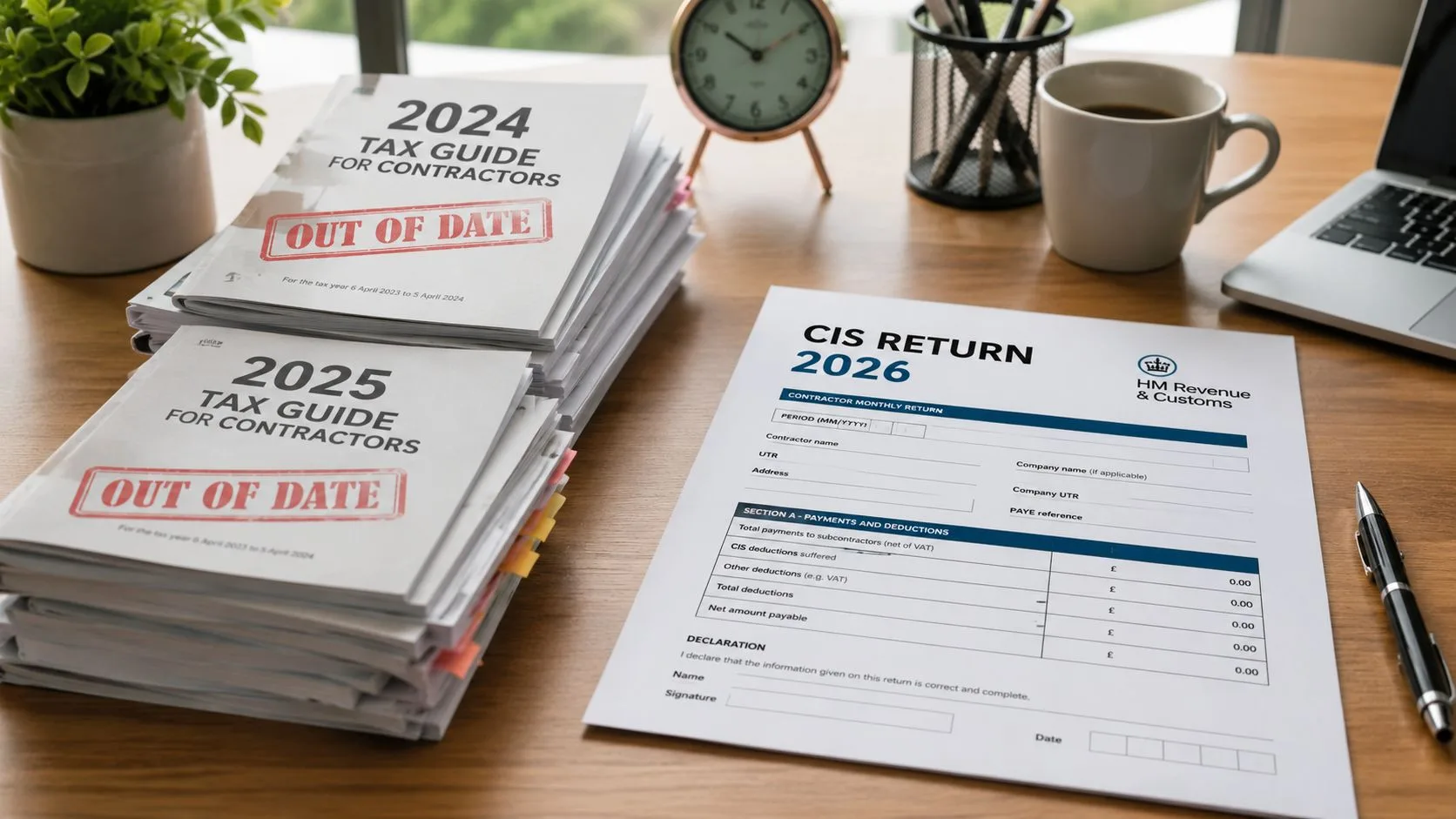
The practical consequence is straightforward. A contractor who has relied on an old blog post saying, “No payments means no return,” needs to change that workflow before the first affected month. The business shouldn't wait for HMRC to remind it, because the filing requirement sits with the contractor.
What changes in the monthly routine
From April 2026, the month-end process needs a specific CIS question:
Did the business pay any subcontractors during the tax month?
If the answer is yes, prepare the ordinary CIS return. If the answer is no, submit a nil return or notify inactivity. That binary check is more reliable than relying on memory or assuming HMRC's online account will remain quiet.
The change was formalised through The Income Tax (Construction Industry Scheme) (Amendment) Regulations 2026, made on 12 March 2026, with HMRC updating its guidance for the April start date. Contractors who want to understand the wider compliance environment can review this practical guide to tackling construction industry fraud, while keeping the nil-return issue separate from broader supply-chain checks.
Filing Mechanics and the 19th-of-the-Month Deadline
The CIS tax month ends before the return deadline. The return for a given tax month must reach HMRC by the 19th of the following month, whether the contractor paid subcontractors or had no activity. For example, the May return is due by 19 June. HMRC's CIS return deadline guidance is a useful reference to keep alongside the monthly bookkeeping calendar.

The online filing sequence
Use the HMRC online CIS service and work through the relevant tax month carefully:
- Sign in using the contractor's Government Gateway credentials or an authorised agent account.
- Select the correct tax month. Choosing the wrong period can leave the intended month open.
- Confirm the payment position. Select the option stating that no payments were made to subcontractors.
- Review the contractor details shown on screen.
- Submit the return and save the confirmation or receipt.
The form still requires an active submission. Leaving the month untouched isn't the same as confirming that there were no payments. That distinction is where many otherwise organised contractors come unstuck.
Using an inactivity notification
Where the contractor expects a genuine period without subcontractor payments, notifying HMRC of inactivity can reduce repetitive monthly filing. It's a management choice, not a permanent exemption. The contractor remains registered under CIS and must restart the normal process when subcontractor payments begin again.
Paper returns aren't the practical route for this process. Contractors should build the online filing into their bookkeeping routine, with one person responsible for checking the submission status and retaining the evidence. A calendar reminder on the 10th or 12th gives time to resolve missing records before the 19th arrives.
The Hidden Cost of Doing Nothing
The uncomfortable point is that zero tax due doesn't mean zero filing risk. HMRC's CIS compliance material treats a late or missing nil return as a late return, so the absence of deductions doesn't automatically protect the contractor from fixed penalties. HMRC's penalty manual explains how the late-return regime applies.
The penalty pattern described in the verified guidance starts with a £100 fixed charge, followed by escalating fixed penalties where the return remains outstanding. A nil return can therefore become expensive even though it contains no CIS deduction liability.
Why the arithmetic catches small firms
A contractor might reason that HMRC has lost nothing because no subcontractors were paid. That reasoning misses the purpose of the return. HMRC is enforcing the filing obligation itself, not only collecting deductions.
If a return remains unfiled, the fixed penalty exposure can continue to increase. The tax-geared element is limited for a nil return because there's no CIS deduction liability on that return, but the fixed penalties still apply. HMRC's manual confirms that a nil return remains subject to late-filing treatment.
The filing decision should be based on the deadline, not on the amount of tax paid.
There can also be practical consequences beyond the initial notice. Repeated missed filings may prompt HMRC to look more closely at the contractor's CIS records, and an incomplete compliance history can create friction when the business takes on new work or changes its subcontractor arrangements. Those outcomes aren't automatic in every case, but they're sensible reasons to remove avoidable gaps.
What to do after missing a month
Don't wait for the penalty letter before acting. Submit the outstanding nil return through the online service, check whether any other periods are open, and keep the submission evidence with the contractor's CIS records. If the business had no subcontractor activity for a longer period, review whether an inactivity notification should have been used.
An accountant can help distinguish an actual nil month from a month where a payment was made but hasn't been entered into the books. That review matters because filing nil when a subcontractor was paid creates a different compliance problem.
Filing Yourself, Through Xero, or With Your Accountant
There isn't one correct filing route for every contractor. The sensible choice depends on how many subcontractors the business uses, whether the bookkeeping is already digital, and whether the owner reliably handles recurring deadlines.
For a sole trader with occasional subcontractors and straightforward records, filing directly through HMRC is usually the simplest option. There's no software subscription for the submission itself, and once the process is familiar, a nil period is quick to complete. The weakness is human memory. If the owner is on site, travelling between jobs or dealing with an interrupted project, a free process can still become an expensive missed task.
Xero can suit a contractor already using its CIS features. A correctly configured CIS setup can reduce duplicate entry and create a visible workflow alongside the bookkeeping records. It still needs proper activation, accurate business registration details and a review that the nil status has been transmitted. Software won't correct an incorrectly configured CIS account or decide whether an inactive period has ended.
Outsourcing gives the contractor a different trade-off. A bookkeeper or chartered accountant can own the deadline, reconcile the records and deal with HMRC queries, but the service carries a recurring fee. For construction businesses considering broader estimating and project controls, Exayard construction estimating software may also help separate job information from the tax filing decision, although estimating software doesn't replace the CIS return process.
| Method | Typical Cost | Time per Return | Best For |
|---|---|---|---|
| HMRC online service | Free filing route | Short once familiar | Sole traders with simple records |
| Xero CIS workflow | Depends on existing software plan and setup | Short after configuration | Contractors already maintaining digital books |
| Accountant or bookkeeper | Agreed recurring service fee | Minimal owner involvement | Businesses with complex records or limited admin capacity |
How I'd choose the route
- Choose HMRC directly if one person can own the calendar and the bookkeeping clearly shows whether subcontractors were paid.
- Choose software if the business already uses Xero consistently and someone checks the submission status rather than assuming automation worked.
- Choose an adviser if the contractor has multiple registrations, frequent subcontractor changes, gross payment status or little time for monthly administration.
Stewart Accounting Services provides CIS support within its payroll offering, including subcontractor verification, record reconciliation, digital submission and HMRC liaison. That's one example of an outsourced arrangement. The important point is to agree who checks the figures, who submits the return and who retains the evidence.
A One-Page CIS Nil Return Checklist for 2026
A good CIS process doesn't depend on remembering the rule at the end of a difficult month. Put the following sequence into the bookkeeping calendar and assign responsibility to a named person.
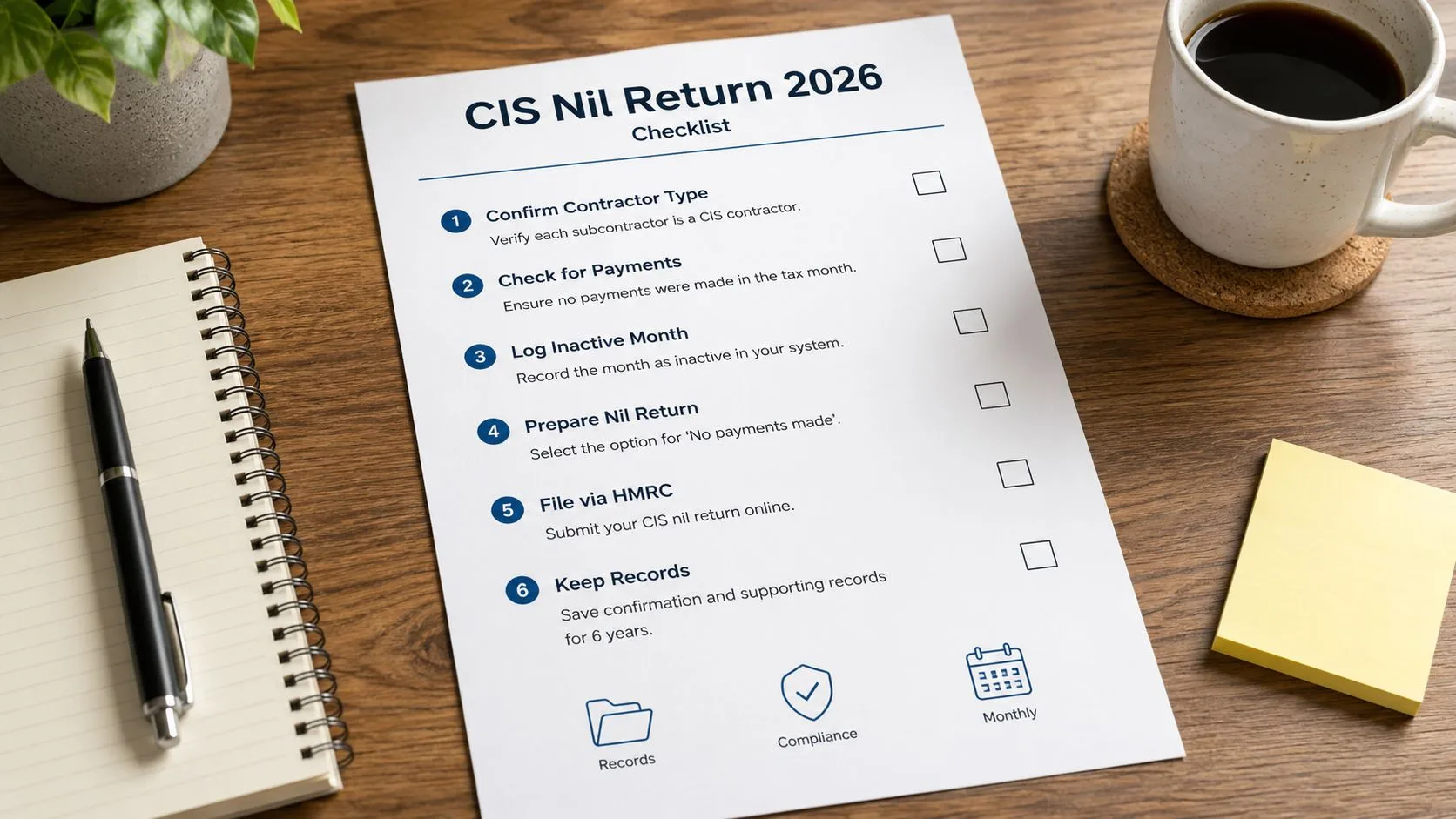
At the close of each tax month
- Confirm the contractor status: Establish whether the business is a mainstream or deemed contractor and keep the CIS registration details accessible.
- Check the payment ledger: Review bank transactions, purchase invoices and subcontractor records. Don't rely only on the nominal CIS report.
- Log inactivity promptly: If no subcontractors were paid, record the inactive month immediately and decide whether to file a nil return or notify HMRC of inactivity.
- Check unusual items: Make sure no subcontractor payment has been coded as materials, wages or a general supplier cost without review.
Before the deadline
- Select the correct period: Open the relevant month in HMRC's CIS online service.
- Submit the nil return: Confirm that no subcontractor payments were made and complete the submission by the 19th of the following month, as set out in HMRC's filing guidance.
- Save the receipt: Store the confirmation with the CIS records. HMRC's guidance and manuals should be treated as the working reference when reviewing the submission history.
- Reconcile the books: Match the submitted nil position against the bookkeeping system so a later adjustment doesn't contradict the return.
Keep the habit digital
A consistent monthly record creates a cleaner base for wider digital tax administration, including future Making Tax Digital for Income Tax requirements. The benefit isn't that a nil return is complicated. It's that the same disciplined process captures the evidence, deadline and business decision in one place.
If your business has already missed a nil month, review the CIS account now rather than waiting for correspondence. Contact Stewart Accounting Services to arrange a check of the open periods, confirm whether each month was inactive, and put a filing calendar in place before the next 19th-of-the-month deadline.
For practical help with CIS nil returns, bookkeeping reconciliation and recurring HMRC deadlines, speak to Stewart Accounting Services and arrange a review of your contractor records before the April 2026 rules create avoidable penalty exposure.
Recent Posts
08 Oct, 2026
07 Oct, 2026
06 Oct, 2026
1 comment