

CIS Return Deadline: Complete Guide to Monthly Filing Dates

The CIS monthly return must reach HMRC by the 19th of every month following the end of the tax month, which runs from the 6th to the 5th. Even a one-day delay triggers an automatic £100 penalty.
It's usually the same moment every contractor dreads. The month has been busy, invoices are spread across emails and accounting software, a subcontractor's details still need checking, and the HMRC deadline has slipped out of view. Then a reminder arrives, or worse, a penalty notice lands.
CIS compliance doesn't work like an annual accounts process. Contractors must report every month in which they make payments to subcontractors, and the penalty system becomes increasingly expensive when a late return remains unresolved. A missed filing can start as an administrative oversight and develop into a serious liability tied to the deductions that should have been reported.
The practical solution is straightforward. Understand the exact filing cycle, separate the return deadline from the payment deadline, and run the same organised workflow every month.
Understanding the CIS Return Deadline Rule
The core rule is simple. The CIS tax month runs from the 6th of one month to the 5th of the next, and the monthly return must reach HMRC by the 19th of the following month. HMRC describes the return as due within 14 days of the end of the tax month, which is why the standard deadline falls on the 19th. You can check the full requirement in HMRC's guidance on filing monthly CIS returns.
Take a practical example. Payments made to subcontractors from 6 May to 5 June belong to one CIS tax month. The return covering those payments must be submitted by 19 June. Payments made on 6 June start the next tax month and belong on the following return.
The rule contractors must apply every month
The deadline applies whenever you've made payments to subcontractors during the relevant tax month. It isn't an annual filing that can wait until your year-end accounts are prepared, and it doesn't disappear because the business has other HMRC obligations under control.
That recurring structure creates the first major compliance risk. A contractor may remember the VAT return or payroll schedule but overlook CIS because the payments are handled project by project. By the time the omission becomes obvious, the filing deadline may have passed.
A reliable system should record three dates for every reporting period:
- Tax month opening date, the 6th.
- Tax month closing date, the 5th.
- CIS return deadline, the 19th of the following month.
Filing and paying are separate duties
Submitting the CIS return and paying CIS deductions to HMRC are separate obligations. Filing the return tells HMRC which subcontractors were paid and what deductions were made. Paying the deductions transfers the amounts withheld from subcontractor payments.
Don't assume that completing one task completes the other. A contractor can submit the return but fail to make the payment, or pay an amount without submitting the corresponding return. Your bookkeeping process should therefore track both tasks independently.
Contractors who want a wider overview of their obligations can review this guide to Construction Industry Scheme responsibilities. The essential habit is to treat the 19th as a fixed monthly control date, not as a loose reminder that can be dealt with when time allows.
How CIS Late Filing Penalties Escalate Over Time
The first penalty is deliberately easy to underestimate. If a return is one day late, HMRC applies an automatic £100 fixed penalty. That amount may seem manageable, especially when a contractor is dealing with a busy site or a temporary administrative problem, but leaving the return unresolved exposes the business to additional penalties.
HMRC's late-filing regime increases the charge as the delay continues. At two months late, a further £200 is added. At six months, HMRC can charge the greater of £300 or 5% of the CIS liability that should have appeared on the return. At 12 months, another penalty can be based on the contractor's behaviour and can rise to 70% or 100% of the liability, with minimum penalties of £1,500 or £3,000 in deliberate cases. These rules are set out in HMRC's Compliance Handbook guidance on CIS late filing penalties.
The escalation in plain terms
| Time late | Penalty amount | Basis |
|---|---|---|
| One day late | £100 | Automatic fixed penalty |
| Two months late | Additional £200 | Further fixed penalty |
| Six months late | Greater of £300 or 5% of the CIS liability | Liability-based penalty |
| 12 months late | Up to 70% or 100% of the liability in relevant cases | Behaviour-based penalty, with minimums of £1,500 or £3,000 in deliberate cases |
The table shows why the CIS return deadline must be treated as a control point. The original mistake doesn't remain a £100 problem because that was the first notice received. The financial exposure grows with time, and the later penalties can reflect the deductions that should have been reported.
Why a missed return can become a major liability
The exact outcome depends on the CIS liability, the length of the delay, and HMRC's assessment of the contractor's behaviour. A return involving substantial subcontractor deductions can therefore create a liability running into the five figures when prolonged non-compliance combines fixed, liability-based and behaviour-based penalties.
Practical rule: If a return is late, file it and address the position immediately. Waiting for a quieter week is a financial decision, not an administrative one.
Contractors should also read HMRC correspondence carefully rather than treating a penalty notice as the end of the matter. Check which return is missing, establish whether the figures are correct, and consider whether a reasonable excuse applies. Keep evidence of the circumstances and the corrective action taken. Ignoring the notice removes the opportunity to resolve the underlying filing problem before the penalty structure advances.
The Monthly CIS Reporting Cycle Explained
A good CIS process starts before the deadline appears in your calendar. During the tax month, record every payment made to subcontractors and retain the supporting invoice or payment record. Separate labour, materials and any other relevant amounts clearly, because the return must reflect the payment information accurately.
Before paying a new subcontractor, verify their CIS status with HMRC. The applicable deduction depends on the subcontractor's status, so relying on an old spreadsheet or an informal assurance creates avoidable risk. The business should also confirm whether the worker is operating as a subcontractor rather than being treated incorrectly where the facts point towards employment.

A repeatable process from payment to submission
Use the following sequence each month:
- Collect payment records. Match subcontractor invoices, payment dates and bank transactions to the correct tax month.
- Check subcontractor information. Confirm names, Unique Taxpayer References and verification details before preparing the return.
- Reconcile deductions. Compare the amounts deducted with the records in your bookkeeping system and investigate differences.
- Prepare the return. Include each relevant subcontractor, the payment details and deductions required for the period.
- Submit digitally. Use HMRC's online service or compatible commercial software, then save confirmation of submission.
- Handle a nil period correctly. If no subcontractor payments were made during the tax month, follow HMRC's process for notifying it rather than assuming no action is needed.
The CIS tax return guide for UK subcontractors can help distinguish contractor reporting duties from the separate tax reporting position of subcontractors.
Keep the payment task separate
After preparing the return, check the amount that must be paid to HMRC. Don't mark the monthly CIS task complete until both the filing record and payment record have been reconciled. Store the submission reference, payment confirmation and supporting calculations together, preferably in a dedicated digital folder linked to the accounting period.
This approach gives you an audit trail and makes the next month easier. It also means an HMRC query can be answered from organised records rather than reconstructed from emails, bank statements and memory.
Common CIS Filing Mistakes and How to Avoid Them
A contractor often misses the deadline for a predictable reason, not because the CIS rules are impossible. The information exists, but it sits in different places and nobody owns the final check. These are the failures I see most often.
The quiet month that gets forgotten
A contractor makes no subcontractor payments and assumes there's nothing to report. The business then ignores the monthly cycle entirely. If HMRC expects a return or notification for that period, the contractor may create a compliance gap by failing to confirm the position.
Fix: Add every CIS period to the calendar, including months in which you expect no payments. Review the period and follow the correct nil-return process rather than relying on memory.
The worker whose status was never settled
A site manager calls someone a subcontractor, so the accounts team adds them to the CIS list without checking the underlying working arrangement. That classification can be wrong, particularly where the individual works under close direction and the business controls the relationship like employment.
Fix: Escalate uncertain status decisions before payment. Don't allow a job title or invoice format to replace a proper review.
The unverified subcontractor
A new subcontractor starts work urgently, and the contractor pays the invoice before completing verification. The return is later prepared from incomplete information, or the deduction is calculated using the wrong status.
Fix: Make verification a payment-control step. The invoice shouldn't move to approval until the relevant details have been checked and recorded.
Labour and materials are mixed together
A subcontractor's invoice includes labour and materials, but the contractor enters one unexplained total into the records. That makes it difficult to confirm the deduction calculation and increases the chance of an inaccurate return.
Fix: Require invoices to show the components clearly. Reconcile materials costs against the supporting records before submission.
CIS is confused with another HMRC deadline
VAT, PAYE and CIS all appear in the same finance calendar, but they don't share the same reporting process. A contractor completes the payroll run and assumes the CIS obligation has been dealt with.
Fix: Give CIS its own recurring task, owner and completion evidence. The person responsible should confirm the return submission separately from VAT, PAYE and the payment of CIS deductions.
Your Monthly CIS Compliance Checklist
A dependable checklist removes the need to remember the whole process under pressure. Start with the tax month, which runs from the 6th to the 5th, and work forwards rather than waiting for the deadline to become urgent.
During the tax month
- Verify new subcontractors: Complete status checks before the first payment and save the outcome with the supplier record.
- Capture invoices promptly: Enter payment details as invoices arrive, not in one rushed batch after the period closes.
- Separate cost categories: Record labour and materials distinctly so the return can be reviewed properly.
- Monitor changes: Flag new subcontractors, corrected invoices, refunds and unusual payment arrangements for review.
Immediately after the 5th
- Close the records: Confirm that all subcontractor payments in the tax month are included.
- Reconcile the bank: Match payments in the bookkeeping system to the bank account and investigate anything missing.
- Review deductions: Check the calculations, subcontractor details and supporting invoices.
- Confirm the reporting position: Decide whether a standard return or nil-return process applies.
Before the 19th
- Prepare early: Give a second person, accountant or reviewer time to identify errors before submission.
- Submit digitally: File through HMRC's online service or compatible software and retain the confirmation.
- Schedule the payment: Track the separate payment obligation and keep evidence once completed.
- Close the month: Store the return, calculations, invoices and confirmations together.
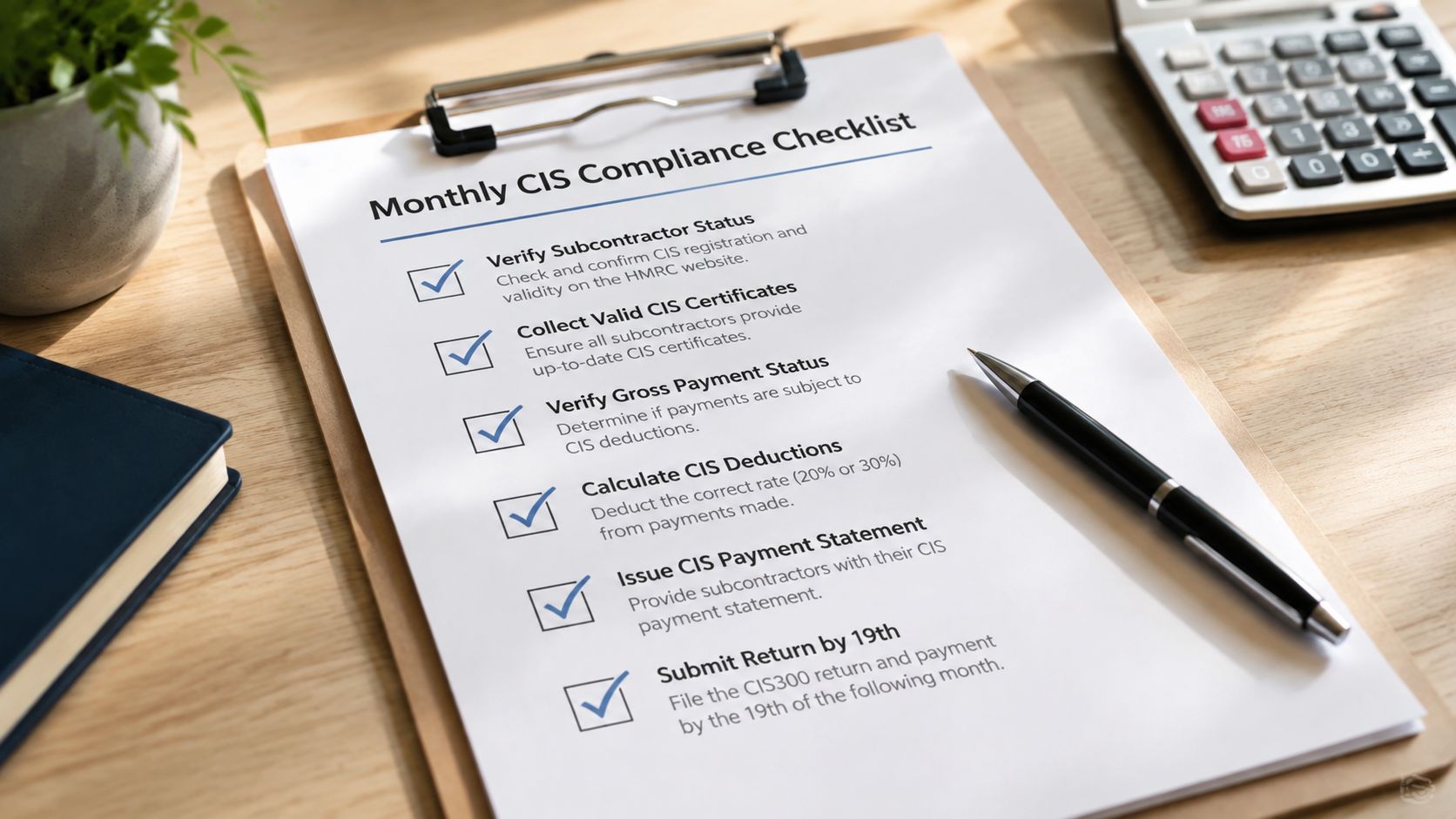
Set calendar reminders for the period close, the internal review and the filing date. Use Xero or another accounting platform to capture invoices and reconcile transactions, but don't assume software alone will identify a missing subcontractor or an incorrect classification. A system helps only when someone owns the review.
Contractors considering gross payment status can read about qualifying for CIS gross payment status, but that status doesn't remove the need to manage CIS obligations properly.
Why Outsourcing CIS Compliance Makes Sense for Growing Businesses
CIS administration becomes harder as the subcontractor list expands. Each new worker brings verification, payment records, deduction checks and monthly reporting. The work may be repetitive, but the consequences of a missed step aren't minor.
Keeping the process in-house also carries a hidden cost. Someone must gather invoices, resolve missing information, reconcile records, submit the return, arrange payment and respond to HMRC queries. If that person is the owner, the business pays for the work through lost time that could have been spent pricing projects, managing clients or developing the team.
What specialist support changes
A specialist accountant can make CIS part of a controlled monthly service rather than an emergency task. The practical benefits include:
- Defined responsibility: Someone outside the site team owns the filing calendar and follows up missing records.
- Earlier error detection: Reconciliations happen before submission, when corrections are easier.
- Cloud visibility: Platforms such as Xero can keep invoices, transactions and reporting records accessible to the contractor and adviser.
- Consistent HMRC handling: Queries and penalty notices are directed to people familiar with the scheme.
The comparison is straightforward. In-house administration gives you direct control, but it also leaves the business exposed to staff absence, competing deadlines and inconsistent record keeping. Outsourcing adds a predictable professional cost and reduces the likelihood that the owner becomes the final safety net for every monthly return.
A growing contractor shouldn't depend on one person's memory to meet a recurring tax obligation.
Professional support isn't a substitute for accurate information. You still need to provide invoices, payment data and subcontractor details. But the specialist can impose structure, identify gaps and ensure the monthly process reaches completion.
How Stewart Accounting Services Keeps Your CIS Returns on Track
Contractors who want the process managed rather than merely explained can use Stewart Accounting Services for CIS support as part of its payroll services. The firm can manage subcontractor verification, monthly record reconciliation, digital return submission and liaison with HMRC, using cloud-based systems such as Xero.
Stewart Accounting Services operates from offices in Alloa, Stirling and Falkirk and supports clients remotely across the UK. That combination suits contractors who want face-to-face advice in Central Scotland or a fully remote arrangement.
The wider value is practical. Delegating the recurring administration gives you more time to manage projects and pursue growth, more money through better control of records and compliance, and a clearer mind because the deadline has an assigned owner.
If your next return is approaching, don't wait until the 19th to find out whether your records are complete. Contact Stewart Accounting Services, explain how you currently handle subcontractor payments, and ask for a monthly CIS process that covers verification, reconciliation, submission and payment tracking.
Set up your CIS compliance system before the next filing deadline. Contact Stewart Accounting Services today to arrange a review of your records and discuss monthly support.
Recent Posts
08 Oct, 2026
07 Oct, 2026
06 Oct, 2026