

VAT Return Payment: A Practical UK Guide for 2026
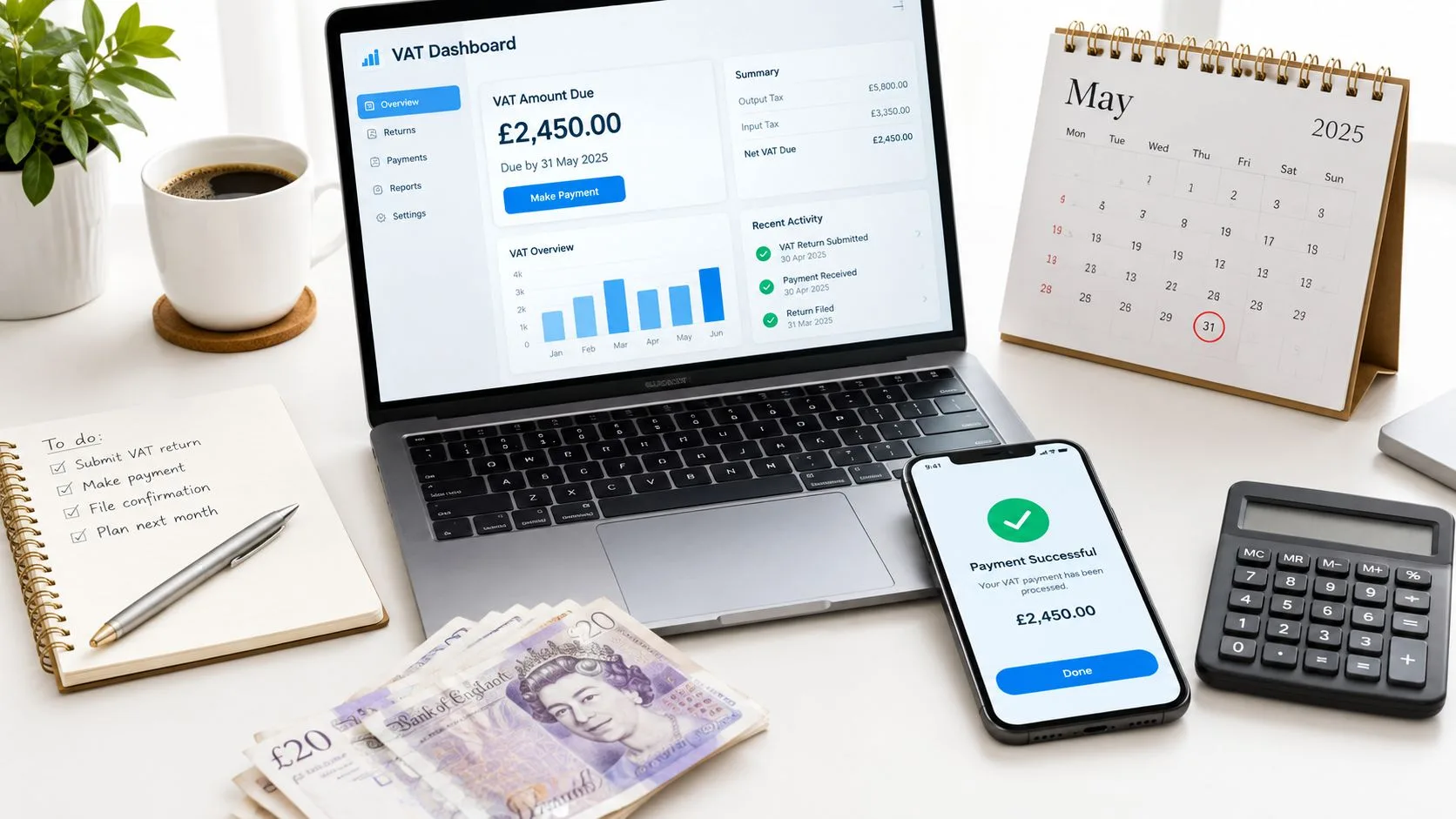
The VAT figure is sitting in your accounting software, the deadline is circled on the calendar, and your business bank account looks less comfortable than it did when the quarter began. You submit the return, press the payment button, and assume the job is finished. That assumption is where many otherwise well-run SMEs get caught.
VAT return payment is not one action. It is a controlled sequence: calculate the correct liability, identify the statutory deadline, choose a payment rail with enough clearing time, and confirm that HMRC has received cleared funds. A payment instruction made on the deadline can still arrive too late.
This guide treats VAT as a banking and cash-flow discipline, not merely a tax filing task. The practical rules are straightforward: know the date, plan the payment method, protect the cash, and retain evidence that the money landed.
The VAT Return Payment Moment Most SMEs Misjudge
Quarter-end often arrives with competing demands. Customers are slow to pay, payroll is approaching, suppliers want settlement, and the bookkeeping file still contains transactions that need review. Meanwhile, the VAT dashboard shows a liability that must leave the business account whether or not the cash is currently available.
The common mistake is to treat submission and payment as the same event. They aren't. Submission tells HMRC what the business owes. Payment is a separate banking process, with its own reference, processing time and failure points.
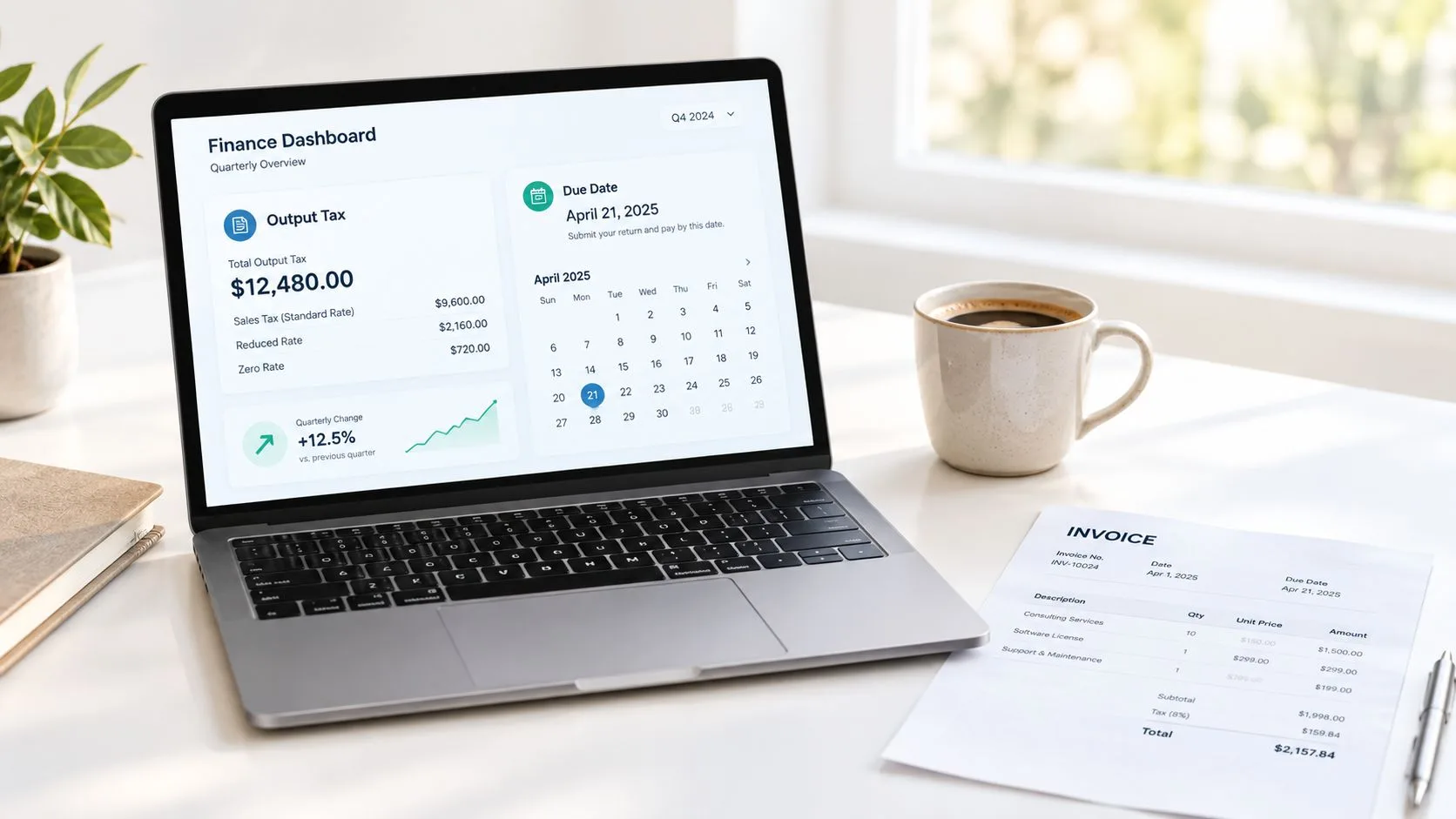
The three controls that protect the deadline
Start with the deadline, calculated from the VAT accounting period rather than from the day you happen to open the software. Then decide how the funds will travel to HMRC. Finally, check the bank and VAT records after submission so you can prove that the payment was made correctly and received.
Those controls answer three different questions:
- When must the return and payment arrive? This is the statutory timing question.
- When must the payment be initiated? This depends on whether you use Faster Payments, Bacs, CHAPS, card or Direct Debit.
- How will you confirm receipt? A bank confirmation proves that your bank accepted an instruction. It doesn't always prove that HMRC has cleared the funds.
Practical rule: Treat the VAT liability as money held for HMRC, not as spare working capital. Move it into a separate reserve as sales receipts arrive, then schedule the payment before the deadline pressure builds.
The right routine is calm and repeatable. Reconcile the liability, submit through compatible Making Tax Digital software, arrange payment with a safe processing buffer, and match the bank transaction back to the VAT payable in your ledger. That routine matters just as much for a nil or repayment return, because late-submission rules can still apply.
UK VAT Return Deadlines and the Bank-Clearing Layer
For VAT accounting periods beginning on or after 1 January 2023, the standard UK deadline is usually one calendar month and seven days after the period end, and payment must reach HMRC's bank account by that date. The date you initiate the transfer isn't the date HMRC uses to assess whether cleared funds arrived on time. See this UK VAT due date guide when checking the calculation for a particular period.
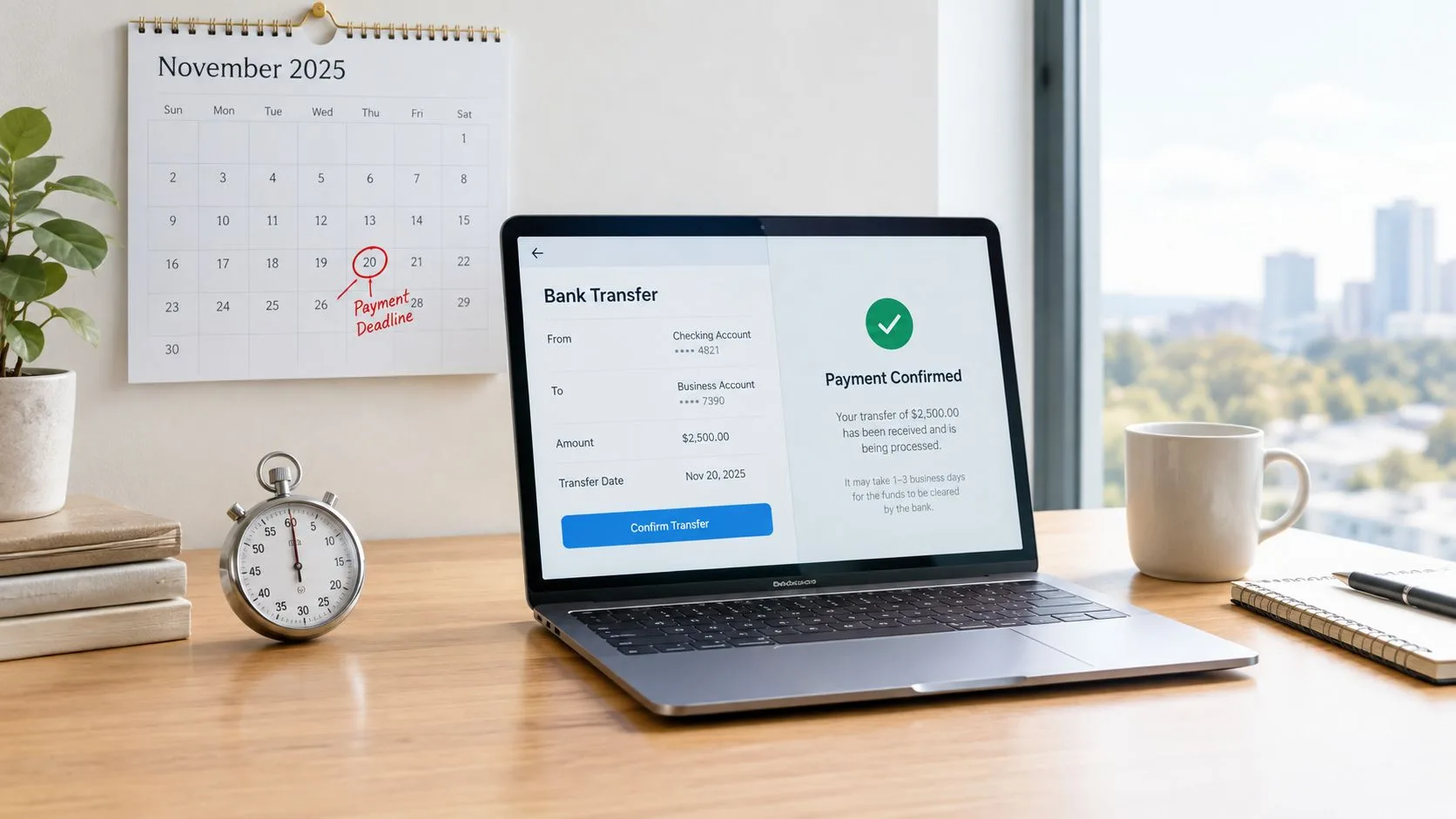
Take a quarterly period ending on 31 March. The usual filing and payment deadline is 7 May, as set out in HMRC's late returns and payment guidance. You shouldn't wait until 7 May to discover whether the payment method you selected can clear in time.
Work backwards from cleared funds
Faster Payments usually arrive the same or next day. Bacs takes about three working days. CHAPS is designed for urgent bank transfers, but it still needs correct bank details, a valid reference and sufficient account funds. These clearing profiles mean the safest initiation date changes with the payment rail.
A sensible operating approach is:
- Calculate 7 May from the period ending 31 March.
- Submit the return early enough to identify any unexpected liability or software issue.
- Schedule Faster Payments at least two working days before the deadline.
- Allow three working days for Bacs, rather than relying on a transfer made on the due date.
- Use CHAPS only when the urgency and cost are justified, after confirming the details with HMRC.
The electronic-payment extension is frequently misunderstood. It doesn't give you permission to file late, and it doesn't protect a payment that hasn't cleared HMRC's account. A cheque sent on the deadline isn't rescued by the electronic-payment rules.
The same principle applies when a deadline falls near a weekend or bank holiday. HMRC's requirement concerns receipt of funds, so calendar dates and banking days must be considered separately. Keep the payment reference and bank confirmation, but also check the HMRC account after processing.
The following explainer is useful if you want a visual reminder of the distinction between submission and payment timing.
Choosing the Right Payment Method for VAT Return Payment
HMRC accepts Faster Payments, Bacs, CHAPS, card and Direct Debit for relevant VAT liabilities. The right choice depends on how predictable your cash position is and how much time remains before cleared funds must arrive, as confirmed in HMRC's VAT payment method guidance.
| Method | Typical Clearing Time | Cost | Weekend/Bank Holiday Handling | Best Use Case |
|---|---|---|---|---|
| Faster Payments | Usually the same or next day | Check your bank's terms | Often operates outside normal working days, but don't rely on same-day receipt | A planned payment made close to the deadline |
| Bacs | About three working days | Check your bank's terms | Allow working-day processing | A scheduled quarterly payment |
| CHAPS | Bank-specific urgent transfer process | Check your bank's terms | Confirm processing arrangements before sending | A time-critical payment where the cost is acceptable |
| Card | Bank or card-provider processing rules apply | Check the applicable charges | Confirm availability before the deadline | A payment where card funding is deliberately part of the cash plan |
| Direct Debit | HMRC normally collects around three working days after the due date once a mandate is established | Check the account and mandate terms | HMRC controls collection timing | Recurring obligations with reliable account funding |
Match the rail to the cash pattern
Use Faster Payments when the return has been reviewed and the bank account is funded, but you still have a short operational window. It is useful for a same-week payment, not an excuse to make deadline day your standard process.
Use Bacs for a planned quarterly run. Initiate it early enough to allow approximately three working days for the funds to reach HMRC. CHAPS may solve an urgent timing problem, but it should be selected knowingly rather than as a last-second panic response.
Direct Debit is convenient for recurring VAT obligations, but it has a critical limitation. HMRC normally collects the payment around three working days after the applicable due date, so the mandate must be established in advance and the return still has to be filed on time. A Direct Debit mandate doesn't remove the filing obligation or fix an underfunded bank account.
Before choosing a method, check the VAT reference, account balance, bank cut-off rules and the date on which HMRC must receive cleared funds. This guide to paying a VAT bill to HMRC is useful when comparing bank transfer, card and Direct Debit procedures.
Reconciling the Return Before You Pay
Don't pay a VAT figure that hasn't been reconciled. The return should be the final output of a controlled review, not a number copied from a dashboard without checking the underlying ledger.
For a standard quarterly return, use three stages. This follows the practical workflow described in HMRC's VAT return notice, where reconciliation, validation and submission each protect a different part of the process.
Stage one, prove the liability
Reconcile the VAT control account to the bookkeeping ledger and bank records. Investigate unreconciled entries, unusual journals and balances that don't agree with the period's transactions. A return can be mathematically tidy while still being based on incomplete postings.
Pay particular attention to:
- Period-end transactions: Check invoices and purchases posted close to the cut-off.
- Credit notes: Confirm that adjustments relate to the correct original transactions.
- Input VAT evidence: Make sure the records support the amounts being claimed.
- Bank movements: Match VAT payments and refunds to the accounting entries.
Stage two, validate the nine boxes
Review all nine VAT return boxes, not just the net amount payable. Check output tax, input tax, the net position, and any EU or import adjustments that apply. Reverse-charge entries deserve a specific review because they can affect both sides of the return.
Also test partial exemption calculations, capital goods, fuel scale charges and reverse-charge purchases. These are the areas where a quick review often misses a treatment issue that changes the liability.
Stage three, submit and record the payable
Submit through Making Tax Digital-compatible software, then record the VAT return liability as a payable. Arrange the bank payment separately and match the cleared transaction back to that payable once it appears.
A second reviewer can be valuable where the return contains partial exemption, imports or complex reverse-charge transactions. If an internal finance resource isn't available, a remote bookkeeper for small business can provide structured ledger support, although VAT treatment still needs appropriate review.
For businesses that want the preparation process documented and repeated each quarter, VAT return preparation support can help create a clear trail from ledger review to submission and payment confirmation.
Cash-Flow Traps Behind the VAT Bill
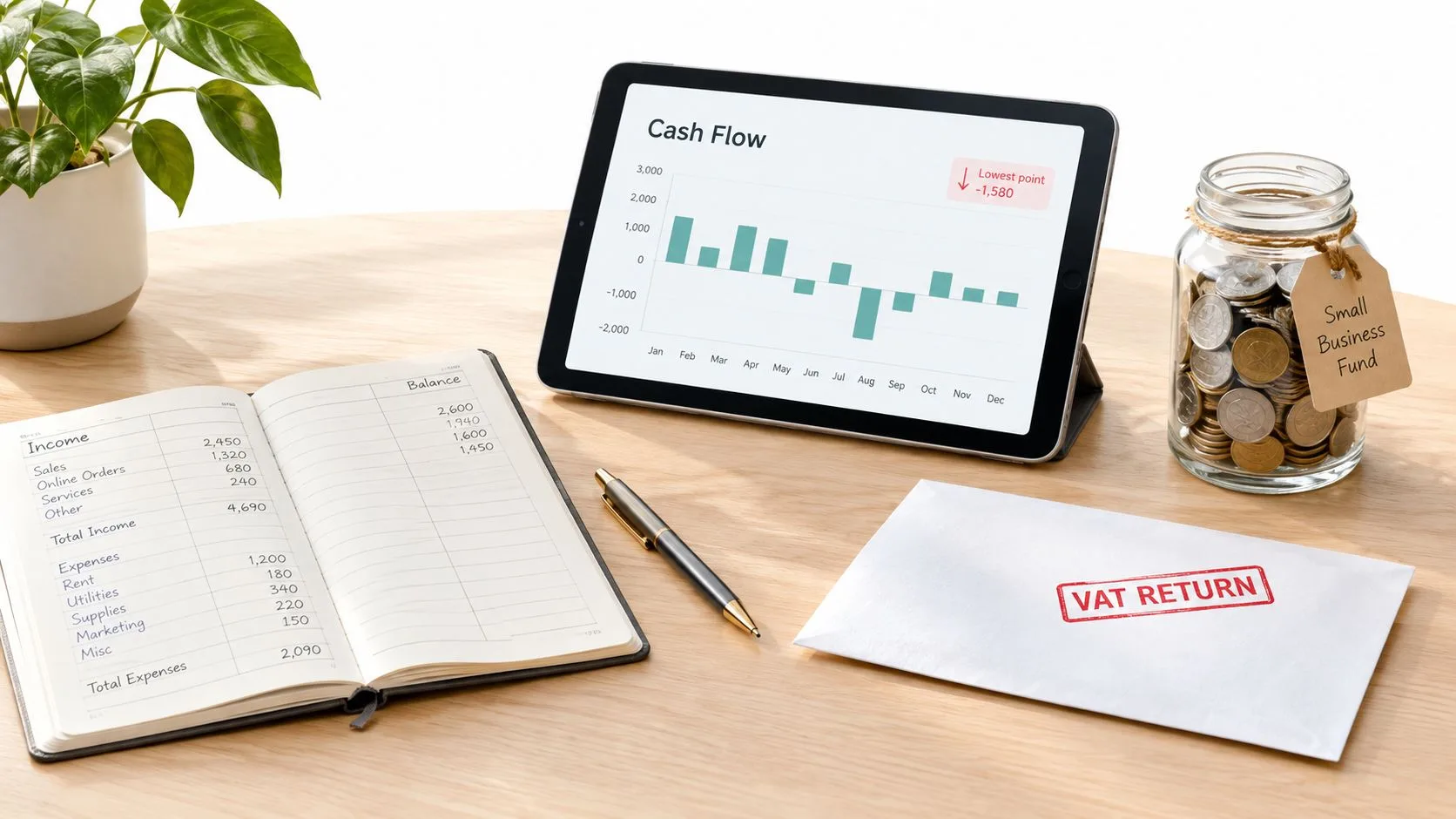
A profitable business can still struggle to pay VAT. The reason is simple: profit is recorded when transactions are accounted for, while the bank account moves when customers and suppliers make their payments.
Standard VAT accounting can leave an SME owing VAT on sales before the customer has settled the invoice. That creates a working-capital gap, particularly where customers take time to pay and suppliers require quick settlement. The solution isn't automatically to switch schemes. It is to model the timing properly.
Cash accounting can improve timing, but not every business
Under the Cash Accounting Scheme, VAT is accounted for when customers pay and suppliers are paid, rather than when invoices are issued. The scheme is available where annual taxable supplies don't exceed £1.35 million, according to HMRC's VAT guide.
That can suit a business with lengthy customer credit terms or recurring bad-debt pressure. It may not suit a business whose customers pay promptly but whose input VAT claims are substantial, or a fast-growing company that needs to plan around the eligibility limit.
Model these questions before changing scheme:
- Debtor timing: How long after invoicing do customers normally pay?
- Supplier terms: Do supplier payments leave the bank before customer receipts arrive?
- Growth path: Is turnover moving towards the scheme's annual taxable-supplies limit?
- Bookkeeping burden: Can the system reliably track VAT by receipt and payment date?
- Reserve policy: How much VAT cash is ring-fenced between return dates?
Cash accounting can align the liability more closely with receipts, but it doesn't make the tax disappear. It also requires disciplined records and forward planning if the business grows beyond the available limit.
Payment timing should sit alongside other working-capital controls. Owners who want practical ideas for how to manage bill timing to skip overdraft fees should apply the same logic to VAT: forecast the cash requirement, protect the reserve and don't wait for the due date to reveal a shortfall.
Troubleshooting Failed and Late VAT Payments
Most payment failures are operational rather than technical. The wrong reference, an underfunded account or a misunderstood deadline can turn a routine VAT return payment into a compliance problem.
Start with the evidence. Check the submitted return, the payment instruction, the bank confirmation, the account balance and the HMRC VAT account. Don't assume that a transaction marked as submitted by your bank has already cleared HMRC's account.
Failure modes to check first
- Wrong reference: Confirm that the payment used the VAT registration reference HMRC requires. A correct amount with an unusable reference can delay allocation.
- Insufficient funds: Check whether the bank rejected, returned or held the payment. Review the account for limits and payment controls.
- Weekend assumption: A weekend or bank holiday doesn't give you permission to wait until the last calendar day.
- Electronic-extension confusion: The electronic-payment extension doesn't allow a late return and doesn't protect a payment that fails to clear.
- Missing confirmation: Retain the bank confirmation, payment date, amount and reference, then compare them with the HMRC account.
If a Faster Payment hasn't appeared after the expected processing window, contact the bank first and ask whether the payment was accepted, rejected, returned or held. Then check HMRC's VAT account and contact HMRC with the VAT registration number, payment amount, intended date, bank reference and confirmation details.
Understand the cost of delay
For VAT periods beginning on or after 1 January 2023, HMRC can apply a late-payment penalty when the liability remains unpaid beyond day 15. If the debt remains unpaid at day 31, a second penalty accrues daily at an annualised 4% rate on the unpaid balance, while late-payment interest runs from the day after the due date at the Bank of England base rate plus 2.5%, as set out in HMRC's penalty and interest announcement.
Contact HMRC promptly if you can't pay. Waiting for the account to become more serious is the worst response.
A Clean VAT Return Payment Checklist and When to Ask for Help
Use this sequence every quarter:
- Calculate the deadline from the VAT period end.
- Reconcile the VAT control account to the ledger and bank.
- Review the nine boxes, including imports, adjustments and reverse charge.
- Submit through MTD-compatible software.
- Choose the payment rail based on its clearing time.
- Initiate early enough for cleared funds to reach HMRC.
- Match the bank transaction to the VAT payable.
- Check the HMRC account and retain the confirmation.
If the cash isn't available, contact HMRC promptly to seek a Time to Pay arrangement. Agreeing an arrangement and meeting its terms can reduce or prevent escalating late-payment penalties. Don't wait until the deadline has passed to start that conversation.
Get professional help when the return involves partial exemption, complicated reverse charges, import adjustments, MTD bridging issues or a recurring mismatch between the VAT control account and the bank. Stewart Accounting Services prepares and submits VAT returns online to HMRC and advises clients on the VAT amount due and payment timing, including bank transfer, Direct Debit and card routes.
VAT return payment is a banking process wearing an accounting label. Build the deadline, clearing date, cash reserve and reconciliation into your normal finance calendar, and the task becomes controlled rather than urgent.
If your next VAT deadline is approaching, book a review with Stewart Accounting Services before submission. The team can reconcile the return, confirm the liability, help select a safe payment method and ensure the payment trail is matched from your bookkeeping records through to HMRC.
Recent Posts
09 Oct, 2026
08 Oct, 2026
07 Oct, 2026