

Bookkeeping for freelance designers in Alloa, from expenses to income

You shouldn’t need to share your online banking password to keep your books in order. For bookkeeping for freelance designers in Alloa, you can provide bank statements or use a secure, read-only feed while keeping control of your account. Keep invoices and receipts organised so you can match income and business costs clearly.
It’s understandable to be cautious about access to your finances, especially when freelance income arrives at different times and design costs include software, equipment and supplies. A clear process helps protect your privacy and makes it easier to see what’s been paid, what’s outstanding and which costs relate to your work.
This guide explains how to record freelance income, manage invoices, separate business and personal spending, and identify expenses that may qualify for tax relief. It also covers UK accounting obligations, helping you make informed decisions and spend less time worrying about paperwork.
Key Takeaways
- Identify which design-related costs may qualify as business expenses, and keep evidence to support your records.
- Understand the key UK filing and record-keeping responsibilities that apply to freelance designers.
- Use a consistent method to track income from different clients and projects, including payments that are still outstanding.
- Set clear payment terms and keep business spending distinct from personal finances to make cash flow easier to follow.
- See how organised bookkeeping can make year-end accounts and Self Assessment easier to manage.
Claiming business expenses, including design equipment and software
Freelance designers need clear records of income, invoices, receipts and business expenses, with personal spending kept separate. Stewart Accounting Services provides bookkeeping support in Alloa for creative freelancers, helping organise records and track project income, software costs and equipment purchases.
Digital Expense Records
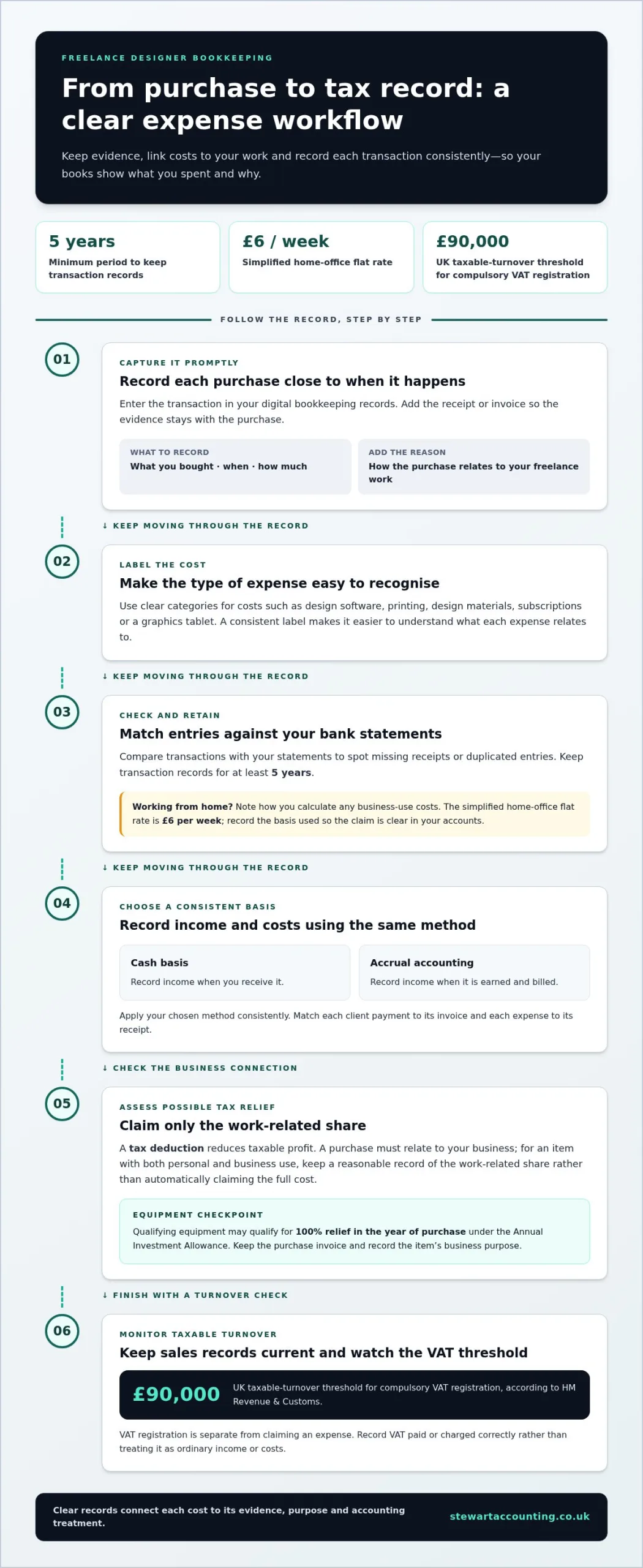
Use digital bookkeeping to record each purchase close to the time it happens. Save receipts or invoices with the transaction, then label the cost clearly, such as design software, printing or a graphics tablet. A useful record shows what you bought, when you bought it, how much it cost and how it relates to your freelance work. Keep transaction records for at least 5 years.
Review entries against your bank statements so missing receipts or duplicated transactions are easier to spot. If you work from home, note how you calculate any business-use costs. The simplified home-office flat rate is £6 per week; record the basis used so the claim is clear in your accounts.
Recording Income and Deductible Expenses
Record every client payment and expense using a consistent accounting basis. Under cash-basis accounting, record income when you receive it; under accrual accounting, record it when earned and billed. Apply your chosen method consistently. Match each payment to its invoice and each expense to its receipt so your income and costs are traceable.
Track expenses related to your freelance work, including subscriptions, design materials and equipment. A tax deduction reduces taxable profit, but a purchase must relate to the business. If an item has both personal and business use, keep a reasonable record of the work-related share rather than automatically claiming the full cost.
Equipment deserves particular attention. Qualifying equipment may qualify for 100% relief in the year of purchase under the Annual Investment Allowance. Keep the purchase invoice and record the item’s business purpose. A limited company also needs clear records of purchases made by the company, rather than mixing them with a director’s personal spending. Similarly, if you furnish a dedicated creative workspace with high-end pieces from specialists like Nwtiques, distinguish between functional business furniture and personal antique investments for your tax records.
Check your taxable turnover as well as your expenses. According to HM Revenue & Customs, the UK taxable-turnover threshold for compulsory VAT registration is £90,000. Keep sales records current so you can see how your turnover compares with that threshold. VAT registration is separate from claiming an expense, so don’t treat VAT paid or charged as ordinary income or costs without recording it correctly.
Review receipts, software renewals, invoices and equipment purchases regularly to spot gaps before year-end. This helps you keep a clearer record of costs that may reduce taxable profit and income that must be reported for income tax.
Accounting obligations for freelance graphic designers
You can manage routine records yourself, use a bookkeeper for regular transaction work, or ask an accountant for tax returns and accounting advice. Choose based on the time you can give bookkeeping, the complexity of your income and whether you operate as a sole trader or limited company.
VAT registration depends on taxable turnover, not profit. According to HM Revenue & Customs, the UK threshold for compulsory VAT registration is £90,000. Keep sales records up to date and monitor your taxable turnover against this threshold, including income from different design clients.
Self Assessment has a fixed filing deadline. According to HM Revenue & Customs, the deadline for the 2025/26 Self Assessment is 31 January 2027. Put that date in your calendar and allow time to gather income records, allowable expenses and details needed for your return. Paying by the deadline is a separate step from submitting the return.
Payments on account can affect the amount due. They are generally instalments towards the following year’s tax bill, due on 31 January and 31 July. They will not normally be required if at least 80% of your tax was collected at source or the relevant amount is £1,000 or less. Review your prior tax calculation so you can plan for any instalments alongside the final balance.
Making Tax Digital for Income Tax changes how some sole traders and landlords report income. According to HM Revenue & Customs, sole traders and landlords with turnover above £50,000 must make quarterly digital submissions from April 2026. HM Revenue & Customs also sets the threshold at more than £20,000 from 6 April 2028. Use compatible accounting software to keep digital records and send the required updates.
Keep bank activity, sales invoices and expense records aligned with your accounting software. Regular reviews can help you spot missing transactions ahead of a Self Assessment deadline or quarterly submission. For client projects, keep a clear record linking each invoice to its payment.
Limited companies have different accounting and company administration tasks from sole traders. Keep company transactions separate, organise year-end figures, and distinguish annual accounts from the confirmation statement process. Set reminders for relevant filing dates and keep company records organised so each task can be handled on time.
Choose support based on what you want handled. A bookkeeper can help maintain transaction records, while an accountant can assist with Self Assessment, year-end figures and tax advice. If you manage records yourself, set a regular schedule and use software that supports digital reporting relevant to your circumstances.
Tracking multiple freelance income streams
Branding projects, ongoing design retainers and illustration licensing can all generate income for a freelance business. Record each stream clearly to see what you’ve earned, what clients still owe and what to set aside for tax.
Recording Multiple Income Streams
Use a separate category for each type of work in your accounting software. For example, label a logo project, a monthly design retainer and a licensing payment separately. Record the client, invoice reference, project type, invoice date and payment received. These details help trace each amount from the original work to your business records.
Choose an accounting basis and apply it consistently. With cash basis, record income when you receive payment. With accrual accounting, record it when earned and billed, even if payment is pending. Either way, note outstanding invoices separately from money received, so your records show both actual cash and expected income.
Review every income source, including smaller projects and one-off creative work. Match bank deposits to invoices and investigate payments without a clear reference. If a client combines several projects in one transfer, keep a breakdown showing which invoices it covers. This helps you prepare accurate accounts and report all freelance income.
Planning for Irregular Income
Freelance work can include lean periods. Build a cashflow view from completed work, booked projects and unpaid invoices, but don’t treat a proposed project as income until it is agreed and recorded appropriately. Update your forecast if a client pays late, cancels work or commissions another project.
Set aside at least 25% of your profits for taxes as a planning guide. Keep that reserve separate from the money available for personal spending or business costs. Your actual income tax and National Insurance bill depends on your circumstances, so use your records to review how profits change rather than relying on a single strong month.
For sole traders, Class 4 National Insurance rates are 6% and 2%. Apply the relevant rate to the appropriate profit bands when estimating your liability. Track profit, not just incoming payments: business expenses affect taxable profit, while unpaid invoices affect cash available. Good records help you distinguish those figures.
Make a weekly appointment of at least an hour to review payments received, outstanding invoices and expenses. During that check, compare accounting software totals with your bank activity, follow up overdue client invoices and update the cashflow forecast. This regular routine helps you spot gaps early and plan for upcoming tax payments without mistaking a busy project schedule for cash already in hand.
Invoicing clients and managing payment terms
A clear invoice helps you record design income and follow up on unpaid work. Agree payment terms with each client before starting, then send the invoice when the agreed work is complete. This links the project agreement, completed work and payment request, making each amount easier to track.
Include enough detail for the client to identify the work and pay correctly: your business details, the client’s details, an invoice reference, a description of the design work, the amount due and the payment deadline. Keep a copy with the project records. If you agree payment within 14 days, state that term clearly and use it consistently in your invoice and reminders.
Use accounting software or an invoice register to note the issue date, due date, amount and payment status. Review it regularly. If a due date passes, send a polite reminder that names the invoice reference and asks for a payment update. Record each follow-up and any revised date the client agrees to, so your cashflow view reflects what is actually outstanding.
Slow payment can leave a busy designer short of working cash. For example, a freelancer who invoices £10,000 in March may not receive that payment until May. A separate example shows why outstanding invoices deserve attention: £60,000 owed by clients taking 90 days to pay can create pressure despite substantial billed work. Keep invoiced income distinct from money received.
For larger projects, break the work into agreed stages and describe each stage and payment point in the contract. This can make progress and billing easier to follow. Mark a planned payment as expected until it appears in your account. If the client changes the project scope, document the change and update the invoice amount and schedule by agreement.
When you pay an independent contractor, keep their invoice, the agreed work description and proof of payment together. Record the cost under a clear category, such as illustration or specialist production, and match the bank transaction to the supplier invoice. This creates a traceable business expense and helps distinguish contractor costs from your own drawings or personal spending.
Plan for tax around the UK Self Assessment timetable rather than assuming quarterly estimated-tax payments. Keep a separate reserve from each payment received and use your income and expense records to estimate tax due. Payments on account may affect cash planning, so align your forecast with the relevant Self Assessment dates. Include received cash, unpaid invoices and expected business costs, not invoices alone.
Separating business and personal finances
Keep freelance project income and work costs distinct from household spending. A dedicated account for business transactions can make this easier: client payments go in, and software or printing costs come out. For a sole trader, record money transferred for personal use separately from business expenses. This helps you see profit without treating personal withdrawals as project costs.
Creative work is a business activity when you take on projects, agree fees and deliver work to clients. Treat each commission as a business transaction: keep the agreement, invoice, payment record and related purchase evidence together. For example, if a branding project includes paid stock images, record the client income and image cost separately to see the project’s actual profit.
Choose a banking routine that fits your work. You might use one account for client receipts and business purchases, then record transfers for personal use separately. Reconcile the account with your bookkeeping records regularly. If a personal purchase appears in the business account, label it as personal rather than claiming it as a business expense.
- Use clear transaction labels, such as “font licence for client project” or “personal transfer”.
- Keep receipts for business purchases, and match them to the relevant bank transaction.
- Record client payments against invoices, including any part-payments.
- Review account activity and bookkeeping entries together, resolving unmatched items promptly.
These habits support accurate filing by helping you separate business income, allowable costs and personal spending. They also show whether a project’s fee covered direct costs, such as a commissioned illustration or print proof. If you use one account for both purposes, clear labels and complete records are especially useful when reviewing transactions.
Separate records matter if your circumstances change. For example, moving from freelance work alongside employment to relying on design income affects how you assess available cash. Keep employment income distinct from client receipts, then review business profit and upcoming commitments before deciding what you can draw. Don’t confuse money in the account with profit available for personal spending.
A regular review can help you spot practical issues: a recurring software charge coded as personal, a client payment missing from your records, or a personal transfer entered as a business cost. Correcting entries while the details are fresh makes year-end figures easier to prepare and gives you a more reliable view of your ability to fund future projects.
If mixed transactions are making your records difficult to follow, contact Stewart Accounting Services about your bookkeeping records and discuss a clearer way to separate business activity from personal spending.
Stewart Accounting Services: Year End Accounts Preparation
Stewart Accounting Services prepares year-end accounts and Self Assessment Tax Returns using your freelance income and expense records. Consider this support when project payments, equipment costs or multiple income sources make your figures difficult to organise, or when you want help preparing for filing.
Bookkeeping Services can keep your transactions and supporting records in order throughout the year, rather than leaving everything until year-end. Clear records mean less time sorting paperwork and more time for design work, supporting the three freedoms: more time, more money and less stress.
For help with your year-end accounts or ongoing bookkeeping, contact Stewart Accounting Services.
Make your next step a clearer financial routine
Your creative work will change as projects, clients and business priorities evolve. Set a routine that still works when you take on a new type of commission or adjust how you work. Clear financial records can help you make decisions with a better view of your business, rather than leaving paperwork until it becomes a distraction.
For bookkeeping for freelance designers in Alloa, Stewart Accounting Services provides Bookkeeping Services, Year-End Accounts and Self Assessment Tax Returns. A free initial consultation, in person at an office or remotely, gives you a chance to discuss support that fits your records and the way you manage your freelance work. Fees are agreed in advance, and the aim is more time for design, more money and less stress.
Contact Stewart Accounting Services to discuss your bookkeeping needs and take a practical next step towards a financial routine that supports your work.
Frequently Asked Questions
Do I need to share my bank login with a bookkeeper?
No, don’t share your online banking password. You can provide statements or grant limited, read-only access through your bank or accounting software, where available. Before enabling access, check what information the bookkeeper can view and whether they can initiate payments. Keep control of payment approvals yourself, and remove access when it’s no longer needed. A bookkeeper can work from transaction records without being able to move money.
Looking for a wide range of accounting support?
Stewart Accounting Services provides accounting support for freelancers, including Bookkeeping Services, Self Assessment Tax Returns, Year-End Accounts, VAT Returns and Payroll. Discuss which support suits your records and business structure in a free initial consultation. You can meet in person at an office or remotely by email or Skype. The firm responds promptly to calls, emails and queries, and fees are agreed in advance.
How much does bookkeeping for a freelance designer cost in Alloa or Clackmannanshire?
The fee depends on the agreed scope of work, such as transaction volume, the state of your existing records, the number of income sources and whether you need ongoing bookkeeping or help preparing year-end figures. Stewart Accounting Services uses fixed fees, agreed in advance, with no extra charges without prior agreement. The firm never undertakes work without agreeing the fee in advance.
When must a freelance designer register for Self Assessment and submit tax returns?
Register for Self Assessment when your freelance circumstances mean you need to declare income to HMRC. The online return deadline is generally 31 January following the end of the tax year. Keep records of when you started trading and when income began, as these details help establish which return period applies. If you’re unsure whether you need to file, get advice based on your income and circumstances.
What bookkeeping software is suitable for freelance designers in the UK?
Choose software that suits your workflow and can organise client income, project costs, invoices and supporting records. Stewart Accounting Services provides Xero implementation, training and support, as well as Dext receipt-processing integration. Consider whether you need invoicing, bank feeds, receipt capture or digital reporting features. The right setup should make it straightforward to trace a payment or purchase back to the client project it relates to.
How should freelance designers track invoices, payments, expenses, and late-paying clients?
Give each project a reference and use it consistently across the contract, invoice and payment records. Track each invoice as sent, part-paid, overdue or settled, and log client replies or disputes. This creates a clear history if payment is delayed. Record supplier costs against the related project where relevant, so you can review project performance without confusing costs with personal spending.