

VAT registration advice in Clackmannan for local businesses
VAT registration can become compulsory sooner than you expect. For VAT registration advice in Clackmannan, the key figure is £90,000: according to HMRC, you must register if your taxable turnover exceeds this in a rolling 12-month period, or if you expect it to exceed £90,000 in the next 30 days.
It can be difficult to tell whether your sales count towards the VAT threshold, and voluntary registration can bring benefits as well as extra reporting work. Making an informed decision helps you meet your responsibilities without losing focus on running your business.
This article explains how to assess the threshold, when voluntary registration may suit your circumstances, and what to expect from applying or deregistering. It also covers late registration penalties and how an accountant can help, so you can understand your options and plan your next step.
Key Takeaways
- According to HM Revenue & Customs, the UK VAT registration threshold was stated to increase to £90,000. Understand which sales count towards your taxable turnover before deciding whether you need to register.
- Voluntary registration may let you reclaim VAT on eligible business purchases, but weigh this against extra record-keeping and how VAT could affect prices for customers.
- If your taxable turnover falls below £88,000, you may be able to apply to HMRC to cancel your VAT registration.
- Plan for the registration application process, as HMRC states applications take around 30 working days to process.
- Missing the registration deadline can lead to an HMRC penalty based on the VAT your business should have collected.
What is the VAT registration threshold?
The UK VAT threshold determines when a business must register, based on its taxable turnover. The same UK rules apply to businesses in Clackmannan as elsewhere in the country.
Turnover Thresholds for UK Businesses
HM Revenue & Customs stated that the UK VAT registration threshold would increase to £90,000 after 1st April 2024. Taxable turnover means sales of goods and services that count towards VAT registration, so it is not always the same as all income entering a business.
Assess the total across a rolling 12-month period, rather than relying only on a calendar or financial year. A business can cross the threshold part-way through either period. HM Revenue & Customs also says businesses must register if they expect taxable turnover to exceed £90,000 in the next 30 days.
Review your turnover regularly as sales change. For example, a seasonal business may cross the threshold during a busy trading period, even if its full-year projection is lower. Exemptions and special VAT treatments can affect how individual sales are handled, so consider the type of supply as well as its value.
Compulsory and Voluntary Registration
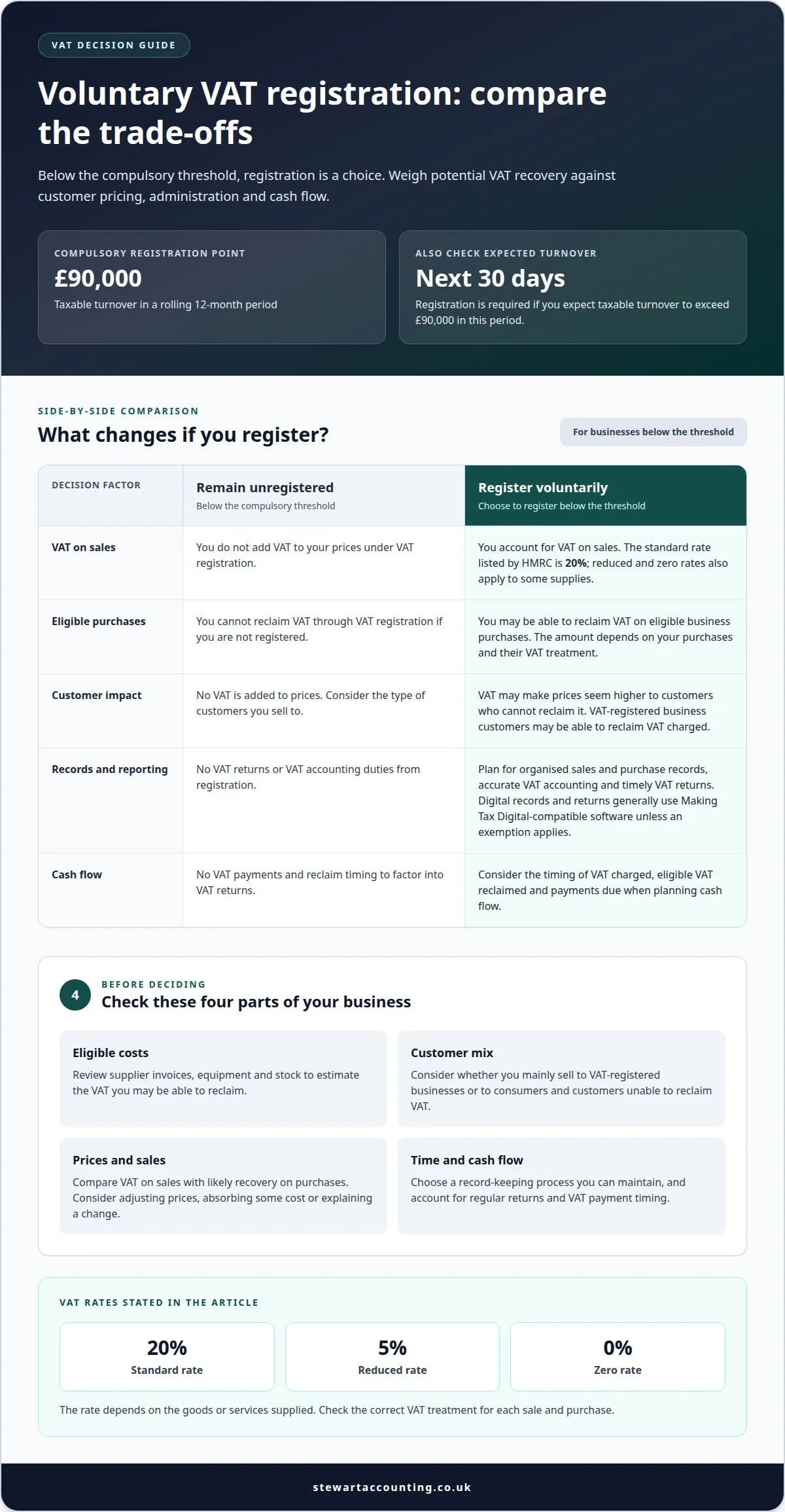
Compulsory registration applies when taxable turnover passes the threshold, or when a business expects to exceed it in the next 30 days. Voluntary registration is an option for businesses below the threshold. It may allow recovery of VAT on eligible purchases, but it also brings record-keeping and VAT return responsibilities.
Consider who buys from you before choosing voluntary registration. VAT may make prices seem higher to customers who cannot reclaim it. VAT-registered business customers may be able to reclaim VAT charged on their purchases, so the impact on their costs can be different.
HM Revenue & Customs lists the UK standard rate of VAT as 20%, the reduced rate as 5%, and the zero rate as 0%. Examples include many food items, books and children’s clothes at 0%; biscuits partly or wholly covered in chocolate are standard-rated at 20%, while cakes and plain biscuits are zero-rated.
Small businesses can use the standard VAT scheme, the flat rate VAT scheme or VAT cash accounting. The flat rate VAT scheme applies a fixed percentage to turnover and generally does not allow VAT recovery on purchases. Under VAT cash accounting, VAT is accounted for when money is received or paid. The financial effect of each option depends on your sales, eligible purchases and payment timing.
For online returns, HM Revenue & Customs says the usual deadline is one calendar month and 7 days after the accounting period ends. Payment is generally due by the return deadline; for example, a quarter ending 31 March normally has a return and payment due by 7 May.
Voluntary VAT registration
Voluntary registration may suit a business whose taxable turnover is below the compulsory threshold. The decision involves more than reclaiming VAT: weigh potential recovery on eligible business purchases against customer pricing, accounting tasks and the effect of VAT payments on cash flow.
Start by reviewing the VAT you pay on goods and services used to run the business. A firm buying equipment or stock may have more eligible input VAT to reclaim than a business with few VAT-bearing costs. Compare supplier invoices with the VAT you expect to charge customers to understand the likely financial effect. Each purchase still needs the correct VAT treatment.
Your customer base matters. If you mainly sell to VAT-registered businesses, those customers may reclaim the VAT you charge. If you sell to consumers or customers unable to reclaim VAT, adding it may make prices seem higher. Before registering, consider whether you can adjust prices, absorb some of the cost or explain the change clearly.
Voluntary registration also brings regular administration. You need organised sales and purchase records, accurate VAT accounting and timely VAT returns. Registered businesses generally use Making Tax Digital-compatible software for digital records and returns, unless an exemption applies. Choose a process your business can maintain, rather than focusing only on potential input VAT recovery.
Compulsory and voluntary registration differ in why you register, not in the need to manage VAT responsibilities. Compulsory registration follows the turnover rules; voluntary registration is a choice below the threshold. Consider expected sales, customer mix, eligible costs and reporting time. Changes in these areas can affect whether registration remains suitable.
For VAT registration advice in Clackmannan, compare VAT charged on sales with reclaimable VAT on eligible purchases. Review a representative range of supplier invoices and sales patterns, rather than relying on an unusually busy or quiet period. Keep your assumptions clear so you can revisit the decision if costs, prices or customers change.
Good VAT registration advice in Clackmannan can help you weigh these trade-offs before choosing. If you want support reviewing your circumstances, discuss your voluntary registration decision with an accountant. A clear review can help you understand the likely effects and plan for reporting alongside day-to-day cash flow.
VAT registration and deregistration
Registration changes how you account for VAT on sales and purchases, so the process affects more than your registration details. HMRC registration applications take around 30 working days to process, according to HM Revenue & Customs. In practice, UK VAT registration can take from a few weeks to three months, depending on the application and circumstances.
Applying and updating your details
Some businesses cannot register for VAT online, including group companies and businesses that trade internationally. The appropriate application route depends on your business structure and trading arrangements. The application should identify the business making the taxable sales, not simply the person handling its accounts.
Once registered, use accounting software and organised records to keep sales, purchases and VAT information together. This provides a clearer basis for preparing returns and identifying eligible VAT on business purchases. Keep records consistent with the registration details, particularly if the business changes its trading name or contact details.
A UK VAT online account lets businesses update their VAT registration details. Use it when relevant information changes, so HMRC’s records remain aligned with the business. Updating registration details is different from cancelling a registration; each serves a separate purpose.
When deregistration may be possible
If taxable turnover falls below £88,000, a UK business may be able to apply to HMRC to cancel its VAT registration. Falling below that figure does not itself cancel the registration. The business remains registered unless HMRC accepts the cancellation application, so continue accounting for VAT while registration remains active.
Before applying to deregister, review current taxable turnover and the business’s expected trading position. Consider outstanding returns, VAT due and purchases on which VAT has been reclaimed. These records help establish the position at cancellation and support an orderly end to VAT accounting.
For example, a business with a quieter trading period may see turnover fall below £88,000, then receive new orders that change its outlook. That makes a single low-sales month a poor basis for a decision. Review the overall trading picture, contracts and expected sales before applying to cancel.
Registration and deregistration can also affect how software records transactions. Keep a clear record of the date HMRC confirms a change, then ensure accounting entries reflect the correct VAT status. If the business makes both taxable and exempt supplies, it may need to divide VAT on purchases between these supplies and reclaim only the amount linked to taxable supplies. Include this in your review.
For businesses in Clackmannan, reviewing turnover, purchases and accounting records carefully makes an application or deregistration easier to manage. Registration may take weeks or longer, while deregistration requires HMRC approval. Organised figures and documents help you make an informed decision and keep VAT records accurate throughout the change.
VAT registration application support
A VAT registration application needs accurate business details and a clear picture of taxable activities. An accountant can help prepare the application, consider suitable VAT schemes and explain what the effective registration date means for your invoices.
How long does VAT registration take, and when can I start charging VAT? HMRC states applications take around 30 working days to process. Processing can vary, and registration may take from a few weeks to three months; use the effective date HMRC provides to decide when VAT should appear on sales invoices.
What application support covers
A professional can review your business structure, trading activity and expected taxable turnover before submitting an application. This helps ensure the registration relates to the right business and accurately describes its activities. Some businesses, including group companies and those trading internationally, cannot register online, so the application route depends on the circumstances.
To prepare, bring together details about the business, its sales and its accounting arrangements. An accountant can use this information to identify gaps, explain what HMRC needs and help align the application with existing records. If the business has more than one activity, each may need consideration when assessing its VAT treatment.
Choosing a scheme is another part of the discussion. The standard scheme, flat rate VAT scheme and VAT cash accounting each handle VAT differently. Under the flat rate VAT scheme, a business pays a fixed percentage of turnover and cannot reclaim VAT on purchases. VAT cash accounting records VAT when money is received or paid. An accountant can compare the schemes with your sales, purchases and cash-flow patterns, without assuming one will suit every business.
Support can also help prepare for VAT returns after registration. VAT-registered businesses generally report VAT charged on sales and VAT paid on eligible purchases through returns. HMRC says the usual online submission deadline is one calendar month and 7 days after the accounting period ends. Planning software and record-keeping before registration can make the first return easier to prepare.
Where can businesses in Clackmannan get local VAT advice or support? Stewart Accounting Services provides accounting support to businesses across the UK, remotely or through its offices in Alloa, Falkirk and Stirling. Its Chartered Accountants can explain the application route, scheme options, effective date and return process in plain language.
If you want help preparing for an application, discuss VAT registration support and the information needed for your business.
Late registration penalties
Missing the VAT registration deadline can lead to an HMRC penalty based on the VAT your business should have collected. The amount relates to the VAT liability arising while registration was overdue, rather than simply to the fact that the application was late.
To establish the position, reconstruct sales from the date registration became due. Compare invoices, payment records and accounting entries, then calculate the VAT that should have been charged. Keep the relevant sales-period details and supporting documents together so you can explain the figures if HMRC asks.
Purchases also matter when calculating a VAT return. The return deducts reclaimable VAT on eligible business purchases and expenses from VAT charged on sales. Keep purchase invoices and records alongside sales evidence, and distinguish eligible business costs from purchases that do not qualify. Accurate records help explain the VAT position, although they do not remove a late-registration penalty.
Act promptly if you discover that the business should already have registered. Prepare the application information, identify the affected sales period and organise the records needed to calculate VAT. Do not leave the issue unresolved while waiting for perfect bookkeeping. Focus on establishing an accurate position and addressing outstanding registration and reporting obligations.
Late registration is different from late VAT returns. Registered businesses can receive one penalty point for each late return under HMRC’s points-based system. Reaching the penalty threshold results in a £200 penalty, and further late returns can result in additional £200 penalties. Late payment can also bring separate penalties and interest charges.
The distinction matters when a business discovers several overdue responsibilities at once. The registration issue concerns VAT that should have been accounted for before registration; return penalties relate to returns submitted late after registration; late-payment charges concern VAT not paid on time. Address each issue separately and keep a clear record of submissions, payments and correspondence.
Errors in sales records can change the VAT calculation, so reconcile invoices against bank and accounting records for each affected period. Note adjustments, such as a corrected invoice or cancelled sale. If records are incomplete, identify what is missing and use available business records to build a consistent calculation instead of guessing.
For Clackmannan businesses, professional support can help organise the overdue period, calculate the VAT position and handle HMRC registration and authorisation. Get help resolving a late VAT registration before further reporting or payment deadlines are missed.
Stewart Accounting Services: HMRC Registration and Authorisation
Stewart Accounting Services provides HMRC Registration and Authorisation to help your business register for VAT or manage HMRC access. The team can explain the information required and help align the registration process with your business records.
Once registered, accurate bookkeeping and timely VAT returns help keep sales, purchases and VAT figures organised. If your records also need attention, Stewart Accounting Services offers Bookkeeping Services to support ongoing accounting and reporting.
Whether you are approaching the registration threshold, considering voluntary registration or resolving a late application, Stewart Accounting Services can help you work through the next steps. Contact Stewart Accounting Services to discuss support for your VAT registration.
Make your next VAT decision with confidence
VAT registration advice in Clackmannan can turn a tax decision into a practical plan for your business. Look beyond the application: consider how VAT fits into pricing, cash-flow planning and regular record-keeping. A clear process makes future decisions easier as your business changes.
Stewart Accounting Services offers Bookkeeping Services, Year-End Accounts and Self-Assessment Tax Returns. These services support your wider accounting needs and help keep business information in order while you focus on what comes next.
With the right support, you can take it off your hands and work towards more time, more money, more mind. Contact Stewart Accounting Services to discuss your next step. A clear plan can help you move forward with greater confidence.
Frequently Asked Questions
When is VAT registration required for my business?
Registration is required when your taxable turnover exceeds £90,000 in a rolling 12-month period, or when you expect it to exceed £90,000 in the next 30 days. HM Revenue & Customs states that the UK threshold increased to £90,000 after 1st April 2024. A sudden contract or large order may change your expected turnover, so include likely sales when assessing whether registration is due.
How much can you turnover before being VAT registered?
The threshold is £90,000 of taxable turnover, not necessarily every payment your business receives. Taxable turnover includes sales that count towards VAT registration, so identify the nature of your goods or services as well as their value. For example, separate business sales from income that does not form part of taxable turnover. This distinction helps you assess your position rather than relying on total bank receipts alone.
Can I register for VAT voluntarily?
Yes. A UK business can choose to register before reaching the compulsory threshold. Voluntary registration may let you reclaim VAT on eligible business purchases, such as equipment or stock. Weigh this against the effect on customers who cannot reclaim VAT and the ongoing need to keep records and submit returns. A business selling mainly to VAT-registered customers may face a different pricing impact.
Is it mandatory for my LTD company in Clackmannan to register for VAT?
Being a limited company in Clackmannan does not, by itself, make VAT registration compulsory. The deciding factors are the company’s taxable turnover and expected sales. If a new contract is likely to push taxable turnover over the relevant threshold, the company may need to register before invoicing for that work. The same UK VAT rules apply in Clackmannan as elsewhere in the UK.
When must a UK business register for VAT, and what is the current VAT threshold?
The current UK threshold is £90,000. Registration is required if taxable turnover exceeds it in a rolling 12-month period, or if the business expects to exceed it in the next 30 days. If turnover goes over the threshold, the business generally has 30 days from the end of that month to register. Keep a record of the date the threshold was crossed to help identify the registration deadline.
Can a business register for VAT voluntarily in the UK?
Yes. A business below the threshold may apply for voluntary VAT registration. Before choosing this route, compare expected VAT on eligible purchases with the VAT you would charge customers. A retailer selling mainly to consumers should consider whether changing prices is practical. A business selling mainly to VAT-registered customers should also consider how those customers treat VAT on their purchases.
How can an accountant register my business for VAT with HMRC, and what information should I provide?
An accountant can review your business details and taxable activities, prepare the application and support you through the HMRC registration process. Provide accurate information about the business structure, sales, expected turnover and accounting records. You may also need to explain whether the business trades internationally or belongs to a group, as some businesses cannot register online. Stewart Accounting Services offers HMRC Registration and Authorisation to help with VAT registration matters.
What penalties apply for late VAT registration, returns or payments?
Late registration can lead to an HMRC penalty based on the VAT your business should have collected while unregistered. Late returns follow a separate points-based system: each late return earns one penalty point, and reaching the penalty threshold results in a £200 penalty. Further late returns can bring additional £200 penalties. Late VAT payments may also incur separate penalties and interest charges.
Recent Posts
21 Nov, 2026
20 Nov, 2026