

How to Trust Your Business Financial Data for Better Decisions

A spreadsheet can balance perfectly and still lead to the wrong decision. To know how to trust the financial data in your business, look beyond whether the figures add up: they should be accurate, consistent, traceable to their source and current enough for the decision you’re making.
It’s reasonable to expect your accounts to give you a clear picture of how the business is doing. But conflicting definitions, manual corrections or gaps in transaction records can make the same figures tell different stories. Data used for a cashflow decision may need different checks from figures prepared for year-end accounts.
This article explains what trustworthy financial data means in practice and why reliability depends on its purpose. You’ll learn how to spot warning signs, protect records from fraud, define key metrics consistently, validate corrections and improve data collection and analysis. These steps give you a clearer basis for decisions and reduce uncertainty about what the numbers show.
Key Takeaways
- Match the accuracy and timeliness checks to how you’ll use each financial figure.
- Set shared definitions for key metrics so reports tell a consistent story across your business.
- Look for recurring manual corrections; they can point to problems in the way data is recorded or processed.
- Keep a clear trail for changes, so corrected figures can be traced and checked against their source.
- Improve the way financial information is collected and combined to make analysis more useful for decisions.
Reliability requirements by data use
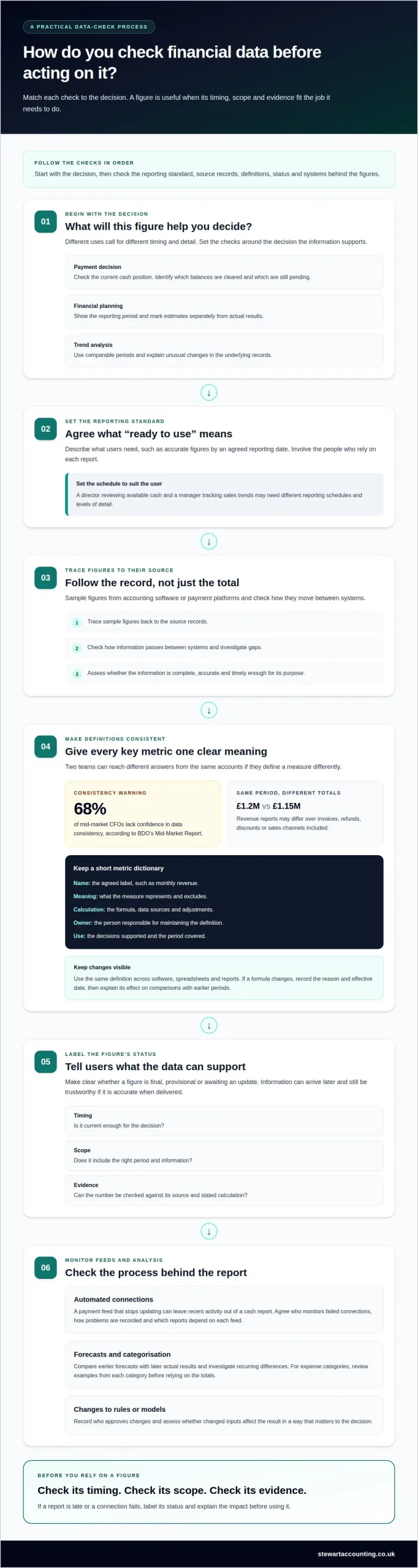
An accountant can assess accounting software or payment platform data by tracing sample figures to source records, checking how they move between systems and investigating gaps. They consider whether the information is complete, accurate and timely enough for its purpose. If you’re asking how to trust the financial data in your business, start by matching the checks to the decision the data supports.
Different decisions call for different levels of timeliness. A payment decision may depend on the current cash position, while a long-term plan can use a report prepared later. Information can arrive later and still be trustworthy if it is accurate when delivered. Make clear whether each figure is final, provisional or awaiting an update.
Set a practical standard for each important report or data feed. Describe what users need, such as accurate figures by an agreed reporting date, and involve the people who rely on the information. A director reviewing available cash and a manager tracking sales trends may need different reporting schedules and levels of detail.
- For payment decisions: identify which balances are cleared and which are still pending.
- For financial planning: show the reporting period and mark estimates separately from actual results.
- For trend analysis: use comparable periods and explain any unusual change in the underlying records.
API (application programming interface) reliability is about whether an automated connection transfers the expected information when needed. If a payment feed stops updating, for example, a cash report may omit recent activity. Agree who monitors failed connections, how problems are recorded and which reports depend on each feed. This helps users recognise when a report may be incomplete instead of mistaking an unchanged dashboard for a stable balance.
Analytics and AI (artificial intelligence, which enables computers to perform tasks that usually require human judgement) also need checks suited to their purpose. For a forecast, compare earlier predictions with later actual results and investigate recurring differences. For a tool that categorises expenses, review examples from each category before relying on the totals. Record who approves changes to a model or its rules, and assess whether changed inputs affect the result in a way that matters to the decision.
Knowing how to trust the financial data in your business means understanding what each figure can and cannot support. Ask whether its timing, scope and evidence suit the decision at hand. If a report is late or a connection fails, label its status and explain the impact before using it. This gives you a sounder basis for action without treating every report as equally dependable.
Consistent definitions for financial metrics
Two teams can produce different answers from the same accounts if they define a metric differently. BDO’s Mid-Market Report 2025 found that 68% of mid-market CFOs lack confidence in data consistency. Shared definitions help build trust because everyone can see what a figure includes and how it was calculated.
For example, one department might report revenue of £1.2M while another reports £1.15M for the same period. The difference could depend on whether invoices, refunds, discounts or sales from a particular channel are included. Until those rules are clear, managers may make decisions using figures that appear comparable but are not.
Define each important metric in plain language, then record its calculation and scope. For revenue, specify the period, which sales are included, how refunds are treated and whether the figure is net or gross of VAT. For gross profit, state which direct costs are deducted. For cashflow, distinguish money received from invoices issued but not yet paid.
Keep a short metric dictionary alongside your reporting processes. It can include:
- Name: the agreed label, such as monthly revenue.
- Meaning: what the measure represents and what it excludes.
- Calculation: the formula, data sources and any adjustments.
- Owner: the person responsible for maintaining the definition.
- Use: the decisions the metric supports and the period covered.
Use the same definition across accounting software, spreadsheets and management reports. If someone changes a formula, record the reason and effective date, then explain how the change affects comparisons with earlier periods. Don’t silently replace an old calculation. Documenting the change helps readers distinguish real business movements from changes in reporting methods.
Definitions should fit the decision. A director reviewing sales performance may need revenue grouped by product or customer type. A lender reviewing financial information may focus on measures presented in formal accounts. The views can differ, provided the underlying terms and calculations are explicit.
Review the dictionary when the business changes its products, sales channels or reporting needs. Adding online sales, for example, may require clear rules for returns and delivery charges. When a number looks unexpected, trace it through the stated formula and source records before relying on it. This turns disagreement into a question about scope, rather than a dispute over whose spreadsheet is right.
If you need support making your reporting definitions clear and consistent, discuss your reporting needs.
To keep these definitions consistent, start with the measures people use most often and agree who will maintain them. Ask report users what decisions they need to make, then check that each measure has a clear meaning, calculation and source. Where a customer experience measure is included, define what it captures and how its results should be interpreted alongside financial metrics. Improving customer experience was considered a high priority by 74% of businesses. A shared definition can help teams discuss the same measure while keeping its purpose visible. When questions arise, revisit the scope and calculation with the metric owner, and document any agreed clarification so future reports remain understandable.
Recurring manual corrections and data validation
Repeated corrections can point to a problem earlier in the data journey, not just an isolated mistake. ACCA’s Global Survey 2024 found that 62% of finance professionals spend significant time fixing data errors rather than analysing results.
Checking Financial Record Accuracy
Checking financial record accuracy means testing whether entries are complete, correctly classified and supported by evidence. A coding error can distort profit, cashflow or tax figures even when the records balance. An accountant can review sample transactions, trace them to invoices or receipts, and look for repeated adjustments. ACCA’s finding shows why investigating the causes of corrections matters as much as fixing individual entries.
Matching Bank Transactions to Accounts
To verify bank transactions, compare the bank statement with the accounting ledger, matching amounts, dates and payees. Investigate unmatched entries, duplicate records, bank charges and payments posted to the wrong account. For example, a supplier payment in the bank feed should match a recorded transaction and supporting invoice. Reconciliation helps identify missing or duplicated entries before they affect reports or decisions.
Recognising Data and Accounting Errors
Unreliable data can show up as unexplained differences, repeated manual adjustments, duplicate transactions or missing supporting documents. A monthly close taking more than five working days is a warning sign of unreliable financial data. An accountant can also look for unusual swings between reporting periods and entries without a clear source. Treat these as prompts for investigation, not proof of fraud or a specific accounting error.
Resolving Incomplete or Inconsistent Records
If records are incomplete or inconsistent, provide the accountant with available bank statements, invoices, receipts, payment-platform exports and prior reports. Explain which periods or transactions are affected, and flag known gaps or changes in how records were kept. This gives the accountant evidence to trace entries, identify missing information and separate confirmed facts from assumptions. Clear controls over corrections can also help prevent the same issue from recurring.
Validation should leave a record of what changed, why it changed and what evidence supports the correction. The database for The Movers & Storage Show had not been validated for more than four years before its reported results, illustrating how unchecked records can persist. AI-powered tools can help classify data, find records and map relationships, but an accountant still needs to assess whether proposed matches make sense. Documented reviews turn corrections into a controlled process and help address recurring causes instead of repeatedly patching symptoms.
The article estimates that 30-50% of finance headcount can be wasted on manual assembly caused by poor data quality. AI-powered tools can assist with data classification, discovery and relationship mapping while reducing manual work. Together, these points make recurring corrections a reason to examine both the quality of inputs and the effort spent preparing them. Teams can use classification and relationship mapping to identify records or connections that need attention, then preserve evidence and explanations for any resulting changes.
Data collection, aggregation and analytics
Reliable analysis starts with how information enters the business, not just the final report. Deloitte CFO Signals Q4 2025 found that 54% of CFOs cite data quality as a top-three barrier to decision-making. A clear framework for collecting, combining and reviewing figures helps teams understand where a number came from.
Map the main sources before combining them. A retailer might collect sales through a payment platform, purchases through supplier invoices and payroll through a separate system. Give each source a defined purpose, owner and reporting period. This makes missing transactions easier to spot and prevents teams from treating separate records as one complete picture.
Aggregation brings information from these sources together. It can speed up reporting, but only if the fields match. A customer’s name, for example, may appear differently in a sales system and an invoice record. A consistent identifier and documented matching rule help link records without combining unrelated customers or counting a transaction twice.
Gartner estimates that the average organisation maintains three to five sources of truth for the same financial data. A central data catalogue can help teams find each dataset and understand its source, meaning and use. Assign ownership of key figures, then document which system provides the agreed version. This governance helps resolve confusion when a sales total differs between reports.
- Collection: record the source, date and purpose of each incoming dataset.
- Aggregation: define how records are matched, combined and handled when fields are missing.
- Analysis: test totals against source records before using them to guide decisions.
Timing also affects usefulness. A monthly report arriving 15 days after the reporting period ends rather than 3 days after it ends may be accurate, yet arrive too late for a decision planned earlier. Agree a reporting timetable based on the decision, then distinguish provisional figures from completed reports. This gives managers context instead of presenting every dashboard as equally current.
Analysis needs ongoing quality checks. Test for missing values, unexpected changes and duplicate records before figures feed forecasts or AI tools. The Hackett Group benchmarks top-quartile finance organisations as spending 30% less time on data reconciliation than peers. That points to the value of reliable processes: less effort resolving conflicting inputs, more time interpreting results.
Choose measures that answer a defined business question. If a company wants to understand customer experience, it could compare refunds, repeat purchases and support costs while keeping each measure’s source clear. Consumer payment information can support useful analysis, but access should match the stated purpose and authorised permissions. Check that combined data still supports the decision instead of collecting extra fields without a clear reason.
How can I check the accuracy of my business financial records?
An accountant checks accuracy by tracing figures to evidence, testing totals and investigating differences. The review should cover the period and records relevant to the decision, such as sales, costs, bank activity and tax figures. This helps establish whether the accounts reflect the business’s transactions, not merely whether the figures add up. The accountant can also clarify which records are included in the review and what its results are intended to support.
First, agree the scope: which accounting periods, accounts and reports need attention. Check whether transactions are recorded in the right period and category, then compare key totals with supporting documents. For example, trace a recorded sale to its invoice and payment, then check whether a credit note or refund changes the reported amount. This gives the figure a clear trail from entry to evidence.
Next, test completeness and accuracy. A transaction in the ledger may still be misclassified, while a missing invoice may leave a cost out altogether. The review can compare selected entries with original records, inspect balances carried forward between periods and trace adjustments to their explanations. The sample and depth of testing depend on the records and the risks identified.
- Source evidence: connect recorded income and costs to invoices, receipts or statements.
- Classification: assess whether each item appears in an appropriate account.
- Period cut-off: check whether entries belong in the reporting period shown.
- Adjustments: review the reason and supporting evidence for changes to figures.
An accountant can also compare reports with related records. For example, sales in a management report can be checked against the sales ledger, while tax figures can be traced to the accounts used to prepare them. Differences may result from timing, a correction or an incomplete record. Recording the explanation helps distinguish a valid difference from an error that needs attention.
Explain the results in a way that supports your next decision. The accountant can distinguish confirmed figures from unresolved items, describe significant adjustments and show how corrections affect reports. For example, moving a cost into the correct period could change the reported monthly result without changing the underlying cash movement. Clear notes help you interpret both figures and understand which decisions they can inform.
For a useful review, provide the accounting records and supporting documents for the agreed period. If a document is missing, identify the affected transaction and explain what you know. The accountant can assess the available evidence, record any limitations and set out what remains unresolved, rather than presenting an estimate as a confirmed figure.
If you want an accountant to review your records and explain discrepancies, arrange a conversation about your financial records.
Stewart Accounting Services: Financial Planning
Stewart Accounting Services can help you connect dependable business records with clearer financial planning. If your reports are difficult to rely on, Year End Accounts Preparation and Bookkeeping Services can bring structure to the figures you use in decisions. Financial Planning can help you consider those figures alongside your business priorities and future plans.
This support may be useful when you’re preparing year-end information, reviewing your financial position or planning a significant business decision. Clear records give you a more useful starting point, while professional guidance can help you understand what the figures mean for your next steps. The aim is more time, more money, more mind, with recordkeeping tasks you can delegate and take off your hands.
Contact Stewart Accounting Services to discuss the support that fits your needs.
Make your next financial decision with clarity
Reliable figures matter most when they help you choose a clear next step. If you’re still considering how to trust the financial data in your business, focus on whether the information gives you a sound basis for the decision ahead, rather than expecting every report to answer every question.
Stewart Accounting Services can support this work through Bookkeeping Services, Year End Accounts Preparation and Self Assessment Tax Returns. These services help organise financial records and prepare them for reporting, giving you less paperwork to manage and more time to focus on business priorities. The right support depends on what you need to understand or prepare.
Good financial information can give you more confidence to plan, while delegating recordkeeping can mean more time, more money, more mind. If you’re ready to discuss the support that fits your situation, contact Stewart Accounting Services. A clear conversation can help you decide what to tackle next.
Frequently Asked Questions
What is data trust?
Data trust is justified confidence that information is fit for a particular purpose. For a business owner, it means knowing who created a figure, what it represents and whether its limitations matter to the decision. A sales forecast, for example, can guide planning without being treated as confirmed income. Trust doesn’t mean assuming every figure is perfect; it means understanding the evidence and using the information appropriately.
What internal controls help prevent fraud and errors in business finances?
Useful controls include separating payment approval from processing, limiting system access according to each person’s role and independently reviewing unusual transactions. For example, one employee can prepare a supplier payment while another approves it against the invoice. Set a clear process for changing supplier bank details, and review changes through a separate channel. Regularly review access permissions and exception reports so unexpected activity receives attention.
Recent Posts
21 Nov, 2026
20 Nov, 2026