

What Is a CIS Return? Deadlines, Rules and Penalties

A CIS return is the monthly report a UK contractor sends to HMRC listing every payment made to subcontractors in the previous tax month and the tax deducted from it.
But if you submit it on time, does that mean you've met your obligations? Not necessarily. If you've deducted tax from the wrong amount, used the wrong rate or treated an employee as a subcontractor, you can still submit an incorrect return.
The useful way to understand CIS is to start with the payment, not the form. Your monthly return should be the final record of decisions you've already checked.
What a CIS Return Is in Plain Terms
A CIS return is the contractor's monthly record of relevant subcontractor payments and the deductions taken from them.
CIS stands for Construction Industry Scheme. Under the scheme, a contractor checks a subcontractor's payment status, makes any required deduction and reports the payment to HM Revenue and Customs.
Think of the return as a bank statement for your construction subcontractor payments, with extra information about tax. A bank statement tells you who received money and how much left your account. Your CIS records also explain what you withheld and why.
Say you run a building business and pay a plasterer, an electrician and a roofing subcontractor during a reporting period. Before preparing the return, you need to establish who you paid, what each payment covered and which deduction treatment applied. Copying the amounts that left your bank account won't necessarily give you the correct return figures.
The terms behind the paperwork
The same words appear throughout CIS records, so it helps to separate them:
- Contractor: The business paying subcontractors for construction work and dealing with the reporting.
- Subcontractor: The person or business receiving payment for that work.
- Gross payment: In everyday discussions, this can mean payment before deductions. Gross-payment status specifically means HMRC has authorised payment without CIS deductions.
- Deduction: Money withheld from the subcontractor's payment and accounted for to HMRC.
- Tax month: The reporting period used for CIS, which doesn't follow an ordinary calendar month.
The distinction between gross payment and gross-payment status matters. An invoice can show an amount before deductions without the subcontractor having HMRC permission to receive it without deductions. Don't infer someone's status from the wording on their invoice.
Organised invoice records make those distinctions easier to check before you pay.

Who handles the return?
The contractor handles the reporting, rather than asking each subcontractor to report the contractor's payments on its behalf. Your business structure doesn't remove the need to consider CIS: a sole trader hiring subcontractors needs a process just as a limited company does.
Don't assume CIS is irrelevant because construction isn't your main trade. Businesses commissioning construction work may also need to establish whether contractor obligations apply.
For a business starting to use subcontractors, the practical order is straightforward: establish whether the work falls within CIS, arrange the appropriate contractor registration, assess the worker's employment status and verify their payment treatment before paying. Leaving those checks until the return is due means you're trying to reconstruct decisions after money has already changed hands.
Filing and Payment Deadlines by Tax Month
CIS return deadlines follow tax months, not calendar months. HMRC's monthly return guidance sets the tax month as the 6th to the 5th, with the return due by the following 19th.
There's also a separate payment deadline: HMRC's Construction Industry Scheme manual specifies the following 22nd for electronic payment or 19th for payment by post. Applying those filing and payment rules gives this calendar:
| Payments made | Return due to HMRC | Deductions due (electronic) | Deductions due (post) |
|---|---|---|---|
| 6 April to 5 May | 19 May | 22 May | 19 May |
| 6 May to 5 June | 19 June | 22 June | 19 June |
| 6 June to 5 July | 19 July | 22 July | 19 July |
Use the payment date, not the invoice date
Suppose a subcontractor invoices you before the end of a calendar month, but you pay them after the next CIS tax month begins. For monthly reporting, you need to identify the period in which you made the payment, rather than placing it in a period because that's when the invoice arrived.
A normal bookkeeping view can be misleading here. An unpaid purchase invoice may appear in your accounts, but that doesn't mean it belongs among the payments reported for the same CIS period.
Keep the invoice date and payment date in separate fields. If you use accounting software, check that your CIS report is drawing from the payment records rather than an ordinary invoice listing.
Practical rule: Preparing the return and paying HMRC are separate jobs. A successful submission doesn't confirm that the money has reached HMRC.
That separation matters when someone else handles part of the process. Your bookkeeper might prepare the figures, an accountant might submit the return, and you might authorise the bank payment. Unless responsibilities are explicit, each person can assume another has completed the final step.
A repeatable monthly routine
Use a short process that leaves evidence of both reporting and payment:
- Close the reporting period. Identify the relevant tax month before extracting transactions.
- Gather the supporting records. Match bank payments to invoices, subcontractor details and deduction calculations.
- Review and submit. Check the return totals, resolve discrepancies and retain the submission confirmation.
- Arrange the HMRC payment. Confirm the amount, payment method and person responsible for authorising it.
- Check completion. Keep payment evidence alongside the return, rather than treating a diary reminder as proof.
Set separate recurring calendar reminders for return preparation, submission and payment authorisation. Schedule the preparation reminder early enough to chase missing invoices or verification details.
Name an owner for each task, including cover when that person is away. A shared calendar is useful, but an assigned responsibility is what turns the reminder into completed work.
What Every CIS Return Must Include
A CIS return connects who you paid, what you paid and how you treated the payment. It isn't a total of deductions for the business.
Consider a contractor paying a registered and verified plasterer, an unregistered labour-only subcontractor and a roofing business with gross-payment status. Their payments need different treatment, but none should disappear from the return merely because the deduction outcome differs.
The gross-paid roofing business is an easy one to overlook. If you build your return only from a list of tax withheld, you can miss payments where nothing was deducted.
Build the return from complete payment records
Your working records should support:
- Subcontractor identity: Enough information to connect each payment to the correct person or business.
- Payment figures: The relevant payment amount, with VAT and qualifying material costs identified separately where applicable.
- Deductions made: The tax withheld from the payment, supported by the calculation.
- Verification treatment: Evidence that you checked and applied the appropriate HMRC payment status.
- Employment-status declaration: Confirmation that the people included were considered subcontractors rather than employees.
Be careful with the payment fields. The total payment excluding VAT and the amount subject to deduction aren't always the same figure. Materials can affect the deduction calculation without disappearing from the payment record.
Follow the field descriptions in HMRC's service or your software. Don't enter the labour-only deduction base into every box labelled payment.
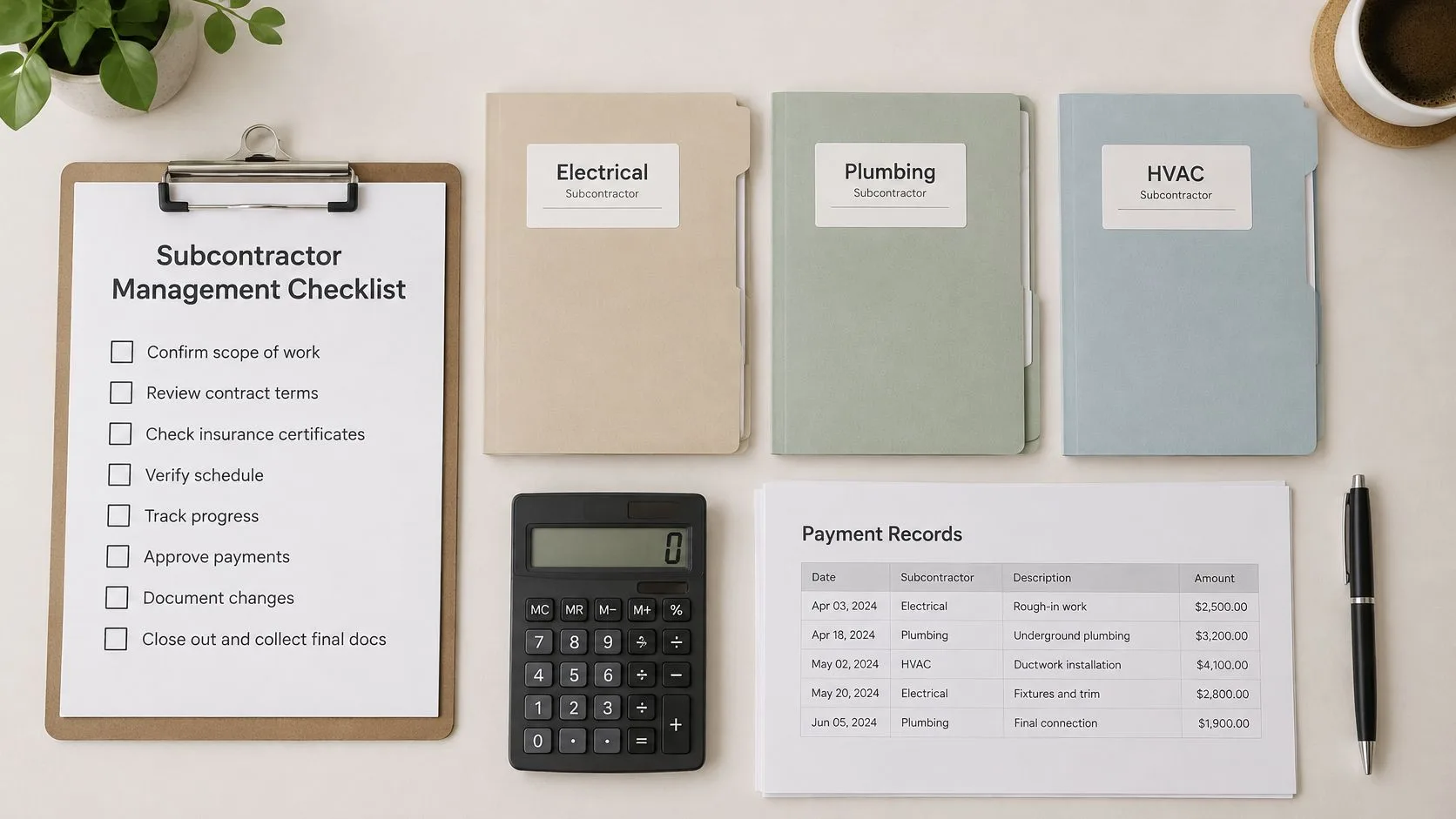
Keep your supporting documents together so you can trace each return entry back to the original transaction.
Keep a usable audit trail
For each subcontractor, hold their Unique Taxpayer Reference, relevant identity details and verification reference alongside their invoices. Our guide to CIS subcontractor verification explains that checking process.
Your monthly working file should also contain the payment dates, invoice breakdowns and evidence supporting any excluded material costs. Someone reviewing the file later should be able to follow the calculation without asking you to remember what happened on site.
For example, an invoice description saying supply and fit doesn't explain how much relates to materials. Obtain the breakdown before paying rather than adding an unsupported estimate when preparing the return.
Submit and preserve the evidence
File the CIS300 through HMRC's online service or compatible commercial software. Before submitting, compare the proposed return with your payment records, not just the previous month's return.
Save the submitted return and its acknowledgement with the supporting documents. If you spot an omitted subcontractor, treat it as a reporting error requiring attention, not merely an untidy spreadsheet.
A useful final review question is: Could another person rebuild this return from the records I've kept? If they couldn't, strengthen the working file before relying on the figures.
Deduction Rates and What Gets Deducted
Which rate applies depends on the subcontractor's status, not on how the invoice is worded. HMRC's guide for contractors and subcontractors sets the normal 20% deduction for registered, verified subcontractors and 30% where they aren't registered or can't be verified; gross-payment status means no deduction.
The rate and the base work like the two numbers in a multiplication. Get either wrong and the return shows a figure that won't reconcile with the invoice, even when it is filed on time.
| Subcontractor status | Deduction rate | How it appears on the return |
|---|---|---|
| Registered and verified | 20% | Payment with standard deduction |
| Not registered or cannot be verified | 30% | Payment with higher-rate deduction |
| HMRC gross-payment status | 0% | Gross payment, still reported |
These deductions are advance payments towards the subcontractor's own tax and National Insurance; they don't add to the contractor's own tax bill. The same guide requires a payment-and-deduction statement within 14 days after the tax month ends, so the paperwork runs close behind the payment.
Check the invoice breakdown as carefully as the rate.

Establish the deduction base
The same guide explains that the calculation excludes VAT charged by a VAT-registered subcontractor and qualifying costs, including materials paid for directly by the subcontractor.
Qualifying items can include consumable stores, construction fuel, plant hire and manufacturing or prefabrication costs. Ordinary overheads and travel fuel are not allowable materials, and a materials selling price doesn't prove the subcontractor's actual cost.
Calculation check: Separate the invoice components first, establish the allowable costs, then apply the verified rate to the remaining amount.
For a bundled invoice, use separate working columns for labour, supported material costs, other qualifying items and VAT. If the cost evidence is missing, request it rather than guessing.
Our explanation of CIS gross-payment status covers payment without withholding. Check the status before releasing the payment, because it decides whether any deduction happens at all.
The video below offers another walkthrough of the same steps.
Nil Returns and Employment Status Checks
No subcontractor payments doesn't automatically mean no action. A registered contractor still needs to tell HMRC when there's nothing to report, rather than leaving the reporting period blank.
HMRC's guidance on monthly returns and declarations requires a nil declaration when no subcontractors were paid, allows a requested inactivity period of up to six months, and warns that an incorrect employment-status declaration can attract a penalty of up to £3,000.
A quiet period still needs a decision
Suppose a small builder pays subcontractors during a busy project, makes no subcontractor payments in the next tax month, then starts paying them again when another job begins. The quiet tax month needs attention too.
The contractor should make the nil declaration rather than assuming HMRC can infer inactivity from the absence of a return. An empty payment ledger is evidence for your decision, not a message to HMRC by itself.
If you expect a longer pause, request an inactivity period. Inactivity is an administrative arrangement, not an automatic exemption because work has slowed down.
Keep a record of the request and check the position before payments resume. Your internal checklist should ask whether you paid subcontractors at all, before asking how much tax you deducted.
CIS registration doesn't establish self-employment
A separate trap arises when someone has a CIS registration but works in circumstances that amount to employment. You can't decide they belong on CIS solely because they provide a UTR, send an invoice or describe themselves as self-employed.
The return's employment-status declaration requires a judgement about the working relationship. If the person should be paid through PAYE, applying a CIS deduction doesn't fix the underlying mistake.
Useful questions include:
- Control: Who decides how the work is carried out, and how much freedom does the worker have?
- Equipment: Does the worker provide meaningful tools and equipment, or rely on yours?
- Substitution: Can they arrange for someone else to perform the work?
- Payment and responsibility: Are they undertaking a defined job with responsibility for the result, or mainly supplying their time?
These are prompts for a proper assessment, not a checklist where the most ticks determines the answer. The terms of the engagement and what happens in practice both matter.
Record the assessment before paying
Casual labour, labour-only subcontractors and frequently changing project teams deserve particular care. A familiar arrangement on site can still require a fresh assessment when responsibilities or working practices change.
Our guide to CIS versus PAYE explains the distinction. Record the reasons for your decision before the first payment, retain the supporting information and revisit it if the engagement changes.
Penalties for Late or Incorrect Returns
HMRC's late-filing penalty factsheet sets out escalating charges: £100 when a return is one day late, another £200 after two months, and £300 or 5% of the deductions that should have been reported, whichever is higher, after six months.
| Delay in filing | Penalty |
|---|---|
| One day late | £100 |
| Two months outstanding | £200 |
| Six months outstanding | £300 or 5% of deductions, whichever is higher |
| 12 months outstanding | Further penalty; higher penalties can apply for deliberate withholding |
These are successive stages, not replacement prices for filing late. The factsheet also explains that the deduction-based calculation uses what should have been shown, rather than what you happened to pay HMRC.
Paying too little therefore doesn't reduce the underlying figure used to assess the relevant penalty. Nor does making the HMRC payment remove the separate need to file the return.
Filing on time is only part of compliance
An on-time return can still contain omitted subcontractors, incorrect payments or unsupported declarations. Errors caused by negligence or deliberate behaviour can expose the business to penalties for incorrect reporting.
That's why the return should be treated as the end product of your checks. If the worker's status is wrong, the invoice breakdown is unsupported or the verification treatment is incorrect, submitting promptly only means you've reported the mistake promptly.
Don't use a submission receipt as your only compliance check. Keep evidence that the figures and declarations were reviewed before submission.
Put controls around the source records
Before filing, reconcile your CIS ledger to invoices and actual payment records. Investigate differences rather than adjusting a total to make the report balance.
Your review should include:
- Completeness: Check that every relevant subcontractor payment has been considered, including payments without withholding.
- Calculation support: Retain invoice breakdowns and evidence for costs excluded from the deduction base.
- Verification evidence: Keep the relevant references and payment treatment with the subcontractor's records.
- Authorisation: Record who reviewed the return and who is responsible for the HMRC payment.
If a return is already late, prioritise preparing and submitting it promptly. Leaving it outstanding can expose the business to later penalty stages, while a missing record becomes harder to reconstruct as people move between projects.
The simplest answer to what is a CIS return? is a monthly report. The more useful answer is a checked record of how your business paid its subcontractors.
Before your next filing deadline, contact Stewart Accounting Services to review your CIS calendar, reconciliation process and payment responsibilities. Arlene is responsible for our payroll, CIS and pension matters, and can help you establish what needs checking before the next return is submitted.
Recent Posts
18 Nov, 2026
18 Nov, 2026