

What questions should your accountant ask about records, accounts and tax?

What if the most useful questions from your accountant come before year-end? If you’re asking, “What questions should my accountant be asking me?”, expect questions about cash flow, the records behind your accounts, your tax position and how your industry affects your business. These conversations can bring financial issues into view while there’s still time to plan.
It’s understandable to expect an accountant to focus mainly on preparing accounts and filing tax returns. Useful support also means understanding how money moves through your business, whether your records explain your income and costs, and which decisions may affect your tax. The right questions depend on how your business operates, including its structure and sector.
This article covers topics to discuss, from cash-flow forecasts and record-keeping to limited company accounts and industry-specific tax considerations. Clear, regular conversations can help you make informed decisions and gain more time, more money and more peace of mind.
Key Takeaways
- Discuss cash-flow forecasts with your accountant so you can spot pressure points and plan for upcoming costs.
- Clear, well-organised records help your accountant prepare tax filings and make sense of your business finances.
- Your industry and business structure can affect which tax questions and reliefs deserve attention.
- An initial meeting should cover your goals, reporting needs and how your business earns and spends money.
- Questions about income, expenses and business activities help your accountant understand the full picture before preparing accounts.
1. Cash-flow management and forecasting
Your accountant should ask when money enters and leaves your business. A profitable month can still feel tight if customers pay invoices late. For example, a completed project may count as income before payment reaches your bank. That timing gap matters when wages, supplier bills and tax payments are due. Start by distinguishing recorded profit from cash available to spend.
Cash-flow projections turn expected income and spending into a forward view of your bank balance. Your accountant should ask what sales you expect, when customers usually pay and which costs are fixed. A monthly forecast can show whether a quiet trading period coincides with large supplier invoices. It should draw on your bookkeeping records and reflect planned work and known changes.
Ask how often the forecast will be updated and which assumptions it uses. A forecast based on invoices issued, for example, may differ from one based on expected payment dates. Your accountant should explain which changes could alter the outlook. A delayed customer payment, new contract or planned equipment purchase can all affect the cash available for other commitments.
For practical cash-flow management, an accountant can compare actual bank movements with the forecast. This helps identify whether income arrived later than expected or costs increased. If a supplier bill is due before a customer pays, the forecast makes the timing clear. It can also help you assess whether a proposed purchase fits your expected cash position.
Useful questions to discuss include:
- Which customer invoices remain unpaid, and when are they expected to clear?
- Do seasonal sales, such as a busy summer followed by quieter months, affect cash availability?
- Which regular costs, such as wages, rent or supplier bills, fall due soon?
- What changes to sales, payment timing or spending would improve the forecast?
These questions connect day-to-day decisions with the wider financial picture. If your forecast shows a shortfall, your accountant can help you understand the cause and consider your options. You may need to review payment terms, planned spending or the timing of work. A forecast is most useful when it reflects current income, costs and bank activity, rather than relying only on last year’s pattern.
Ask your accountant to explain the assumptions in plain language, including expected customer payments and planned outgoings. That gives you a clearer basis for decisions about spending, staffing or taking on work. Regular reviews can also help you spot changes before they become urgent. A monthly discussion can focus on what changed, why it changed and what needs attention next.
How an accountant prepares your records for tax filing
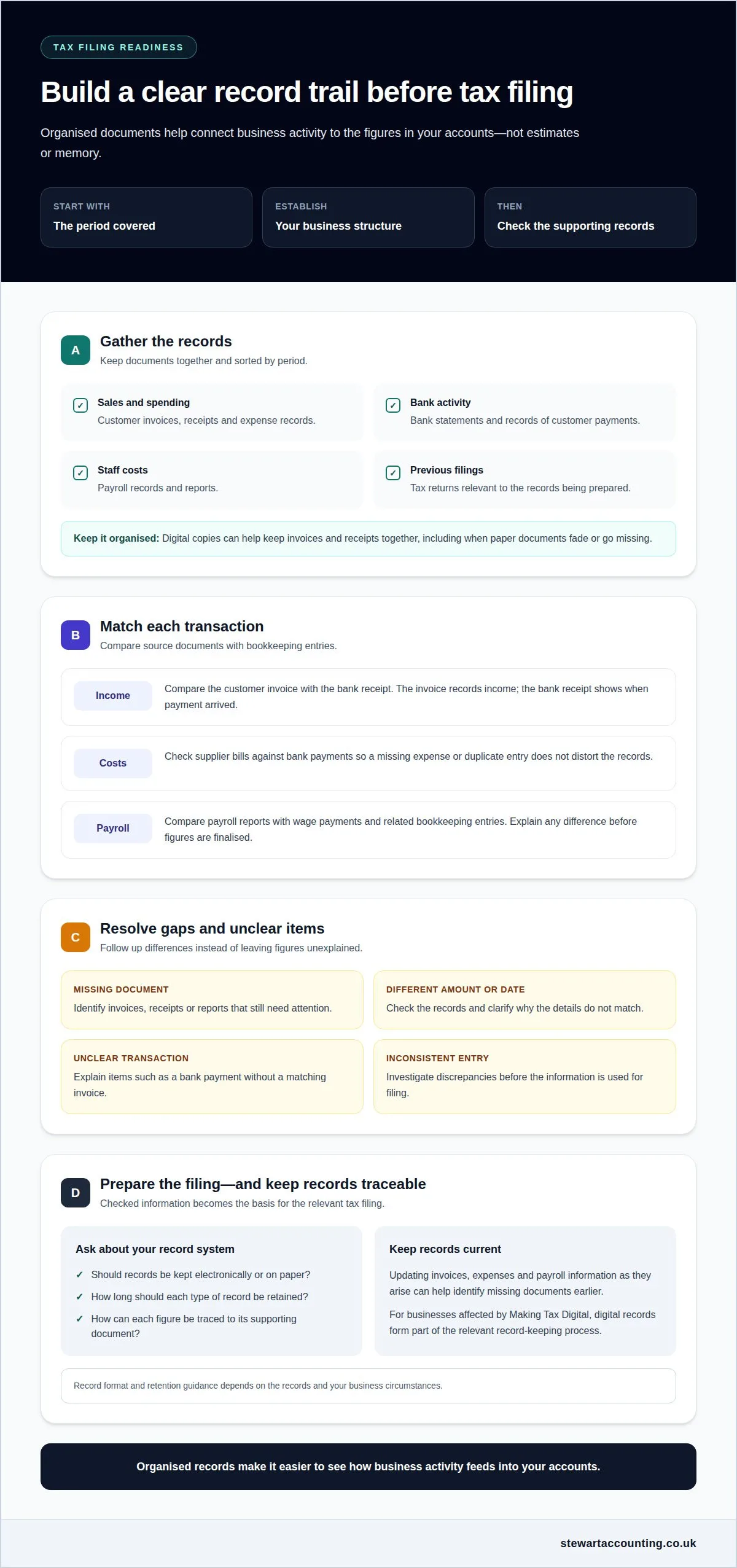
Tax filing starts with records that explain the figures in your accounts. An accountant first establishes the period covered and your business structure. For a UK limited company, working papers may include invoices, receipts, expense records, bank statements, payroll records and previous tax returns. These documents link business activity to reported figures, rather than leaving the accountant to rely on estimates or memory.
Next, transactions are organised into useful categories. A customer invoice records income, for example, while the bank receipt shows when payment arrived. An accountant compares the details and follows up on differences in amounts or dates. They may also check supplier bills against bank payments so a duplicate entry or missing expense does not distort the records.
Tax season runs more smoothly when you assemble records throughout the year. Digital copies can keep invoices and receipts together, even if a paper document fades or goes missing. A consistent filing system makes it easier to find a supplier bill, customer invoice or payroll report. It also gives your accountant clearer evidence when preparing a tax filing.
Payroll needs careful review too. An accountant can compare payroll reports with wage payments and related bookkeeping entries. If a payroll report shows wages but the bank record shows a different payment, the difference needs explaining before the figures are finalised. Keeping payroll records with other financial documents helps connect staff costs to the accounts.
- Sort: Group invoices, receipts, bank statements, payroll reports and tax returns by period.
- Match: Compare records with bookkeeping entries and investigate missing or inconsistent amounts.
- Clarify: Resolve unclear transactions, such as a bank payment without a matching invoice.
- Prepare: Use the checked information to assemble figures for the relevant tax filing.
Questions about record format and retention are useful as well. An accountant can advise whether to keep records electronically or on paper, and how long to retain them. The right approach depends on the records and your business circumstances. For businesses affected by Making Tax Digital (MTD), digital records form part of the relevant record-keeping process. Keep copies organised so figures can be traced to their supporting documents.
Preparation is not only a tax-season task. If records are updated as invoices, expenses and payroll information arise, missing documents can be identified earlier. Your accountant can explain which items still need attention and how each figure feeds into the accounts. For help organising this process, talk through your tax records with an accountant.
4. Industry-specific taxes and tax credits
What should your accountant ask about tax reliefs, allowances and expenses? They should ask what your business does, which costs support that work and what evidence records those costs. They should also ask about changes such as hiring staff, buying equipment or entering a new market, since these may affect which tax treatments need consideration.
Your industry shapes the details behind these questions. A construction business, manufacturer and shipping company may have different costs and income patterns. Freight charges, for example, are associated with shipping. Your accountant can ask whether freight charges appear in your records and how they relate to the services you provide. This helps distinguish a relevant cost from an expense that needs more context.
Business structure matters too. A sole trader and a limited company report business activity differently, so your accountant should understand whether you operate as an individual, through a partnership or through a company. For a limited company, questions about its activities, purchases and employees help frame its accounts and tax position. If you’re growing, a change in structure or operations may also affect the records needed for accurate reporting.
Expenses need more than a label. Your accountant should ask what was bought, who used it and how it supported the business. A vehicle used for both business and personal journeys, for instance, needs a clear explanation of its business use. A tax deduction is an expense subtracted from gross income to reduce taxable profit. Your accountant can assess whether a cost relates to the business and what records support that treatment.
- What activity generated this income, and which customers or contracts relate to it?
- Which purchases supported that work, and are invoices or receipts available?
- Have you started hiring, changed suppliers or added a new service?
- Does your business structure still reflect how you trade?
Tax reliefs and credits should be considered in light of actual activity, not assumed from an industry label. Your accountant can ask whether you developed a product, changed production methods or invested in equipment, then review the relevant records and costs. A manufacturer’s equipment purchase, for example, may raise different questions from a shipping firm’s freight costs. The activity, timing, ownership and supporting documents help determine which tax treatment to review.
Ask your accountant to explain the reasoning behind a relief or expense treatment. A useful discussion links the business activity, supporting records and tax calculation. It should also identify missing evidence, such as an invoice that does not say what was purchased. Clear answers help you understand which costs were considered and what may need attention as your business changes.
4. What should an accountant ask a new client at an initial meeting in the UK?
An initial meeting should establish your business structure, activity and priorities. Your accountant may ask whether you’re a sole trader, in a partnership, running a limited company or part of a limited liability partnership (LLP). UK legislation defines an LLP as a body corporate with legal personality separate from its members. Clarifying your structure helps shape the accounting questions that follow.
Your accountant should ask what you want the numbers to help you decide. You may need clearer information about planned growth, a new service or spending commitments. They should also ask how often you want financial reports. Monthly reports, for example, provide a different rhythm of oversight from information prepared only at year-end. Agreeing this early clarifies the purpose of reporting.
The meeting should cover the work you expect the accountant to handle and the information you’ll provide. A business with employees, for example, may need payroll records considered alongside its accounts. A new limited company may have different reporting needs from a sole trader. Your accountant should clarify which records exist, who maintains them and how information will be shared.
Questions about your trading model connect your goals with day-to-day activity. Your accountant may ask how customers find you, what you sell and whether work comes from regular contracts or one-off projects. A contractor with project-based income, for example, may need a different reporting discussion from a shop with daily sales. They should also ask what has changed since you started trading.
- Which decisions do you want financial reports to support?
- How often would reports help you understand business performance?
- Who handles bookkeeping, payroll and the supply of records?
- Have your business activities, structure or priorities changed?
Your answers help define a useful working relationship. If you want reports to support a business plan, your accountant needs to understand its purpose and the decisions you expect to make. If you need year-end accounts, they need to know your accounting period and business structure. Setting out these needs together keeps later discussions focused on relevant information.
A productive first meeting also gives you room to explain concerns in plain language. You might be unsure how to read reports or need a clearer view of performance before making a decision. Your accountant should identify what information would address the concern and how often it should be reviewed. A specific discussion about reporting frequency, responsibilities and business goals gives the relationship a practical starting point.
5. What questions should my accountant ask about my income, expenses and business activities?
Your accountant should ask how your business earns income, not just how much it earned. A limited company might receive payments from several customers, contracts or services. Each source should be understood and recorded clearly. If your income comes from different activities, explain what each involves. This helps your accountant interpret the figures and spot changes in your trading pattern.
They should also ask how you take money from a limited company. Some owners receive a salary and dividends, and the records should show each separately. Dividend income is not subject to National Insurance contributions. Your accountant can ask what payments you’ve received and how they were recorded, then explain how those details affect the accounts and tax work.
Expenses need the same attention. Your accountant may ask what a purchase was for, which business activity used it and whether it also had personal use. An invoice for materials, for example, should relate to the relevant project or service. A bank payment alone may not explain what was bought. The purpose and supporting record help your accountant assess how to treat the cost.
If you’re preparing for a discussion, you may wonder, “What questions should my accountant be asking me about income streams, owner payments and expenses?”
- Which products, services or contracts generated your income?
- Do you have several income streams, and how are they recorded?
- Which expenses relate to each activity, and what documents support them?
- Have you started a new service, changed your prices or taken on different work?
- How do salary, dividends and other payments to owners appear in the records?
Business structure affects which questions matter. A sole trader’s records and financial arrangements differ from those of a company. A limited company’s financial records may include invoices, expenses and receipts, bank statements, payroll records and business tax returns. Your accountant should understand which records relate to which activity, especially if the business has several income streams.
Changes in your work can alter the financial picture. If you add a service, take on a major contract or begin employing staff, your accountant should ask when the change began and how it affects income, costs or payroll. New staff, for example, create wage records that need to connect with the company’s other financial information. Clear answers help your accountant prepare accounts that reflect how the business operates.
Bring these topics into your next accounts discussion, particularly if your income sources or owner payments have changed. Discuss your business income and expenses with an accountant to clarify what information your accounts need.
Stewart Accounting Services
Stewart Accounting Services can help turn questions about records, accounts and tax into clear next steps. Its Bookkeeping Services help maintain organised financial records that support accounts and tax work.
For year-end reporting, Year End Accounts Preparation brings your business figures together for review. Self Assessment Tax Returns support sole traders and other individuals with relevant income, while Payroll Services help businesses manage payroll records. The right support depends on what you need and how your business operates.
With accounting work that Stewart Accounting Services can take it off your hands, you can focus on running your business with more time, more money, more mind. Contact Stewart Accounting Services to discuss the questions you’d like your accountant to address.
Make your next accountant conversation count
Your business will change, so keep your accountant’s questions connected to what you’re doing now and what you plan to do next. A new contract, change in ownership or shift in how you earn income can make a fresh conversation useful. Consider what your accountant should ask as these changes arise and whether the answers help you make informed decisions.
Stewart Accounting Services provides Year End Accounts Preparation, Self Assessment Tax Returns and Bookkeeping Services. These services help bring your financial information together and support the next step in your accounting work. Choose the support that fits the issue you need to address, then share the context behind your question.
Clear conversations can give you more confidence in your business decisions and help take accounting tasks off your hands. For a practical discussion about your needs, contact Stewart Accounting Services today. Take the next step at a pace that feels right for you.
Frequently Asked Questions
What financial records should my accountant help me keep?
Your accountant should help identify records that explain important business transactions. Alongside sales and purchase documents, keep loan agreements, finance statements, asset purchase paperwork and contracts that support unusual payments. If you use a vehicle for work, mileage records can help explain its business use. Ask which documents are relevant to your structure and how to organise them so future questions can be answered using clear evidence.
What business structure is most appropriate for my circumstances?
There isn’t one structure that suits every business. Discuss how you own and run the business, your growth plans, how you take income and the administration you can manage. Someone testing a business idea alone, for example, may have different priorities from co-founders planning to share ownership. Ask your accountant to compare the practical and financial implications of suitable structures before you decide.
How does the legal structure of my business affect my taxes?
Your structure helps determine whose income is reported and which accounts and tax returns relate to the business. It also affects how payments between the business and its owners are recorded. A company purchase paid for personally, for example, needs a clear explanation and supporting record. Ask how your structure changes the accounting work, what information supports each return and how owner transactions should be recorded.
What are my tax obligations?
Your accountant should identify the tax matters linked to your structure and activities, such as income tax, Corporation Tax, VAT or payroll reporting. VAT registration has a specific turnover test: according to UK Government, a business must register if taxable turnover exceeded £90,000 in the last 12 months or is expected to exceed £90,000 in the next 30 days. Ask which filings apply and what information each requires.
What tax records and documents should I provide to my UK accountant?
Provide documents that explain your business activity and unusual transactions. These may include contracts, loan or finance agreements, paperwork for significant asset purchases and previous tax returns. If a payment relates to a specific project, include information identifying the project and its purpose. Your accountant can then link the document to the relevant transaction and ask focused questions about anything unclear.
What questions should I ask my accountant about fees, services and deadlines?
Ask which tasks the agreed fee covers, how additional work is handled, what information you must provide and when documents are needed. Clarify who will prepare and submit each filing, and how you’ll hear about missing information or upcoming deadlines. Stewart Accounting Services agrees fixed fees in advance and never undertakes work without agreeing the fee first. Clear scope and responsibilities help you plan and avoid surprises.
What should my accountant ask about VAT registration, returns and Making Tax Digital?
Ask whether your taxable turnover means you need to register for VAT and what records are needed for VAT returns. If Making Tax Digital applies to your business, discuss how to keep and organise digital records.
What questions should an accountant ask about payroll, pensions and employees?
Your accountant should ask about employees, hiring changes, payroll reports and wage payments, then check that payroll records match the bookkeeping and bank records. Payroll responsibilities can differ depending on whether someone is an employee or a contractor, so discuss how payments and records should be handled. Discuss pension questions separately in light of your circumstances.