

Business advisory for startups in Alloa with tailored plans

What if the next step for your startup isn’t doing more, but making a clearer plan? Business advisory for startups in Alloa can help turn your goals into practical decisions, from shaping a business plan to understanding cash flow and funding options. The right support makes complex financial choices easier to manage.
Starting a business brings plenty to consider, and a useful plan should reflect your idea, finances and priorities. Learn how startup advisory can connect planning with accounting and tax considerations, and how funding and grant support may fit your next steps.
We’ll also explain how support can cover Alloa, Stirling and Falkirk, so you can see how local advice may help you spend less time carrying financial decisions alone and more time, more money, more mind on building your business.
Key Takeaways
- A tailored startup plan can connect your business goals with practical priorities, helping you decide what to address first.
- Cash-flow projections can help you anticipate when money may come in or go out and assess what funding could support your plans.
- Local and remote support can make business advice accessible across Alloa, Stirling and Falkirk.
- Choose an adviser whose experience matches your needs, from planning and finance to ongoing business decisions.
- Advisory costs depend on the work involved, the level of support and the complexity of your business needs.
Tailored advice and action plans for startups
In Alloa, look for an accountant who can connect startup planning with practical financial advice. Business advisory turns goals into actions, such as preparing a business plan, reviewing costs and setting priorities.
A tailored action plan starts with your business model, intended customers and route to income. An adviser can map immediate decisions against longer-term development, rather than treating each question in isolation. For example, a startup preparing to hire should consider likely payroll costs alongside expected sales and cash flow.
The plan can bring several strands of advice together:
- Strategy: define the offer, customers and steps needed to reach the next business milestone.
- Finance: assess costs, projected income, cash requirements and funding needs.
- Marketing: connect promotional activity with the customers and sales the business is targeting.
- HR: consider staffing plans and the financial impact of recruiting.
These areas affect one another. A marketing campaign may increase demand, for example, but also create a need for stock, staff or working capital. An adviser can help identify those connections and turn them into clear actions, responsibilities and review points.
Acquisition due diligence needs a separate focus. If a startup plans to buy an existing business, financial due diligence examines records, income, costs, debts and the assumptions behind the proposed purchase. Tax advice can explain the tax implications of the transaction and its structure. Legal advice is a distinct specialism, so a qualified legal adviser should handle legal matters.
A written business plan can support this work by setting out the business proposition, financial forecasts and intended direction. It gives the founder and adviser a shared reference point for reviewing decisions as circumstances change.
One-to-One Expert Business Advice
Business Gateway offers free one-to-one business advice for people developing an idea or addressing a specific growth question. A focused meeting can help clarify priorities, test assumptions and identify practical next steps. Bring a clear example, such as a planned launch or staffing decision, to keep the discussion relevant.
Review advice against your business model and financial position. A general strategy discussion may help set direction, while detailed forecasts, tax planning or transaction figures call for accounting input.
Adviser Costs and Startup Planning Accountants
Startup advisory fees vary with the work involved, the complexity of your plans and whether you need a one-off review or ongoing support. Stewart Accounting Services agrees fixed fees in advance and never undertakes work without agreeing the fee in advance. Ask for the proposed scope so you understand what the work covers.
For startup planning in Alloa, choose an accountant who can connect business plans with financial and tax considerations. Match the proposed work to your immediate need, such as building forecasts or assessing an acquisition, so the advice has a clear purpose.
Financing options and cash-flow projections
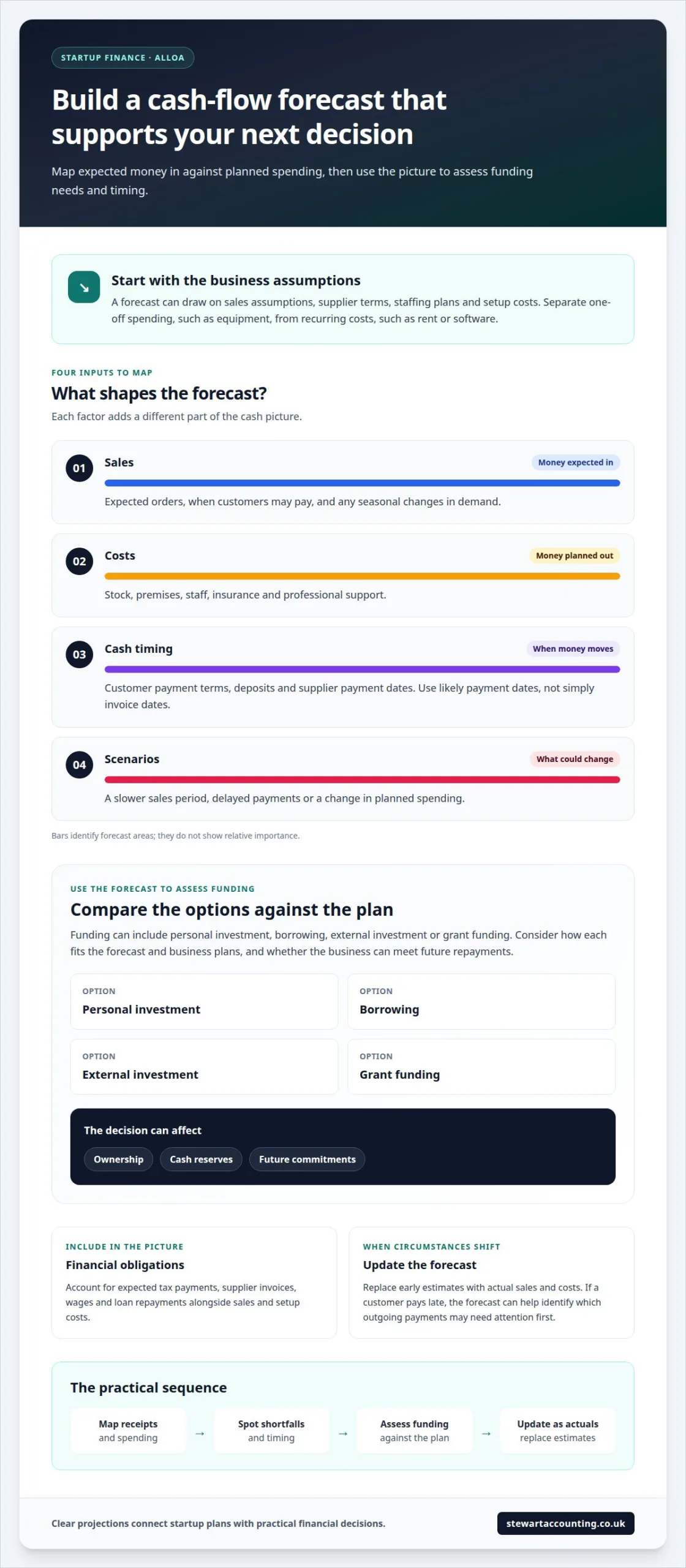
An exciting launch still needs a clear view of when money will arrive and when bills fall due. A cash-flow forecast maps expected receipts against planned spending, helping you assess how much funding the business needs and when.
An adviser can build a forecast from your sales assumptions, supplier terms, staffing plans and setup costs. First, separate one-off spending, such as equipment, from recurring costs, such as rent or software. Then place expected customer payments against their likely dates, not simply the dates invoices are issued. This can reveal a shortfall before it affects a planned launch or purchase.
Useful forecast inputs include:
- Sales: expected orders, payment timing and any seasonal changes in demand.
- Costs: stock, premises, staff, insurance and professional support.
- Cash timing: customer payment terms, deposits and supplier payment dates.
- Scenarios: a slower sales period, delayed payments or a change in planned spending.
Finance options can include personal investment, borrowing, external investment or grant funding. An adviser can compare how each option fits the forecast, the business’s plans and its ability to meet future repayments. The decision is not just about raising enough to start. It also affects ownership, cash reserves and future commitments.
How can an adviser help with the legal, tax and registration steps for a new business in Scotland? They can explain accounting and tax considerations, help map relevant registration tasks and clarify which matters need a legal adviser. This connects financial planning with the setup process without treating legal advice as an accounting service.
For local support and grants, an adviser can review each scheme’s eligibility criteria against the startup’s location, activity and plans. They can also help organise application information and build a deadline schedule, so requirements and submission dates form part of the funding plan.
Include financial obligations in the same projection as sales and setup costs. An adviser can account for expected tax payments, supplier invoices, wages and loan repayments, then show how these commitments affect available cash. If a customer pays late, the forecast helps identify which outgoing payments may need attention first.
A forecast is most useful when updated as real sales and costs replace early estimates. Discuss startup cash-flow and funding support to connect projections with practical financial decisions.
Edinburgh ranked second in the mid-sized European city of the future category in Financial Times’ fDi Intelligence report; finance and insurance generated more than £4 billion in 2017, 19% of its total gross value added.
Advisor availability and regional coverage
For a startup in Alloa, regional coverage affects how easily advice fits your working day. Ask whether meetings can take place locally or remotely, and how follow-up is handled. These details matter when you’re balancing customer work, planning and early business development.
Alloa, Stirling and Falkirk are useful reference points when considering support across this part of Scotland. A startup based in Alloa may sell to customers in Stirling or Falkirk, while suppliers or collaborators may be elsewhere in the region. Connect your trading area with questions about local customers, delivery and growth opportunities.
Availability is more than an office location. Before work begins, clarify who will handle your questions, how you will share records and how advice will be delivered when a decision cannot wait for the next scheduled review. For example, a founder preparing to recruit may need to discuss the cash-flow impact before committing to a start date.
Use these points to assess whether an adviser’s coverage suits your journey:
- Meeting format: establish whether appointments are available in person, online or by phone.
- Communication: understand how routine questions and urgent decisions are handled.
- Regional knowledge: discuss the customers, suppliers and markets relevant to your business.
- Continuity: find out whether you’ll work with the same adviser as your plans develop.
Business Gateway helped start 7,250 businesses in Scotland last year and recorded 27,233 attendees at its webinars and events last year. Those figures show the range of startup activity and learning across Scotland. They do not determine which adviser is right for you, but they underline why support should match your business stage and location.
Local knowledge can make advice more relevant, but your customers may extend beyond Alloa. A business selling online, for example, may need a plan that considers national demand rather than only nearby footfall. Your adviser should connect your location with your actual trading model, so regional insight supports practical decisions.
The level of support should also match the work required. A one-off discussion about a business plan differs from ongoing support through launch and growth. Agree the focus, meeting arrangements and information needed at the outset. This gives you a clear way to prepare for each conversation and use the adviser’s time well.
In Alloa, Stirling and Falkirk, accessible support can help turn positive opportunities into considered decisions. The best fit is an adviser whose location, communication approach and experience align with your plans, whether your next step is refining a launch or preparing to grow.
Business adviser specialisms
Startup advice can span finance, tax, strategy and people management. The right specialism depends on your next decision. A founder preparing to hire, for example, needs different support from an owner reviewing an acquisition. Identify the decision first, then match the adviser’s experience to its financial and operational effects.
An accountant can interpret records, assess forecasts and explain how choices affect your business finances. If your business plan relies on repeat sales, an adviser can test how changes in customer numbers affect expected income. For a limited company, they can also explain accounting and tax considerations linked to its structure. Legal questions require legal advice, not accounting guidance.
Business owners may need input in several areas as their plans develop:
- Finance: review income, costs and cash requirements before committing to expansion.
- Tax: consider how business decisions affect tax planning and financial records.
- Marketing: connect planned promotion with target customers, sales assumptions and available funds.
- HR: assess the financial effect of recruitment and planned staffing changes.
- Insurance: consider which business risks need attention as the enterprise changes.
These specialisms work best when their advice connects. A marketing plan that forecasts higher orders, for instance, should account for stock purchases and the timing of customer payments. An adviser with a broader view of the business can help link those figures, while a marketing specialist can assess the campaign itself.
Acquisition planning calls for another distinct skill set. An accountant can review financial records and assumptions behind a proposed purchase. A legal adviser handles legal review and transaction documents. Keeping those responsibilities clear helps you understand which questions each professional can answer before proceeding.
For a startup preparing to grow, strategic advice can turn a broad aim into decisions with clear responsibilities and review points. If the goal is to add a new service, an adviser can help assess its expected costs, pricing assumptions and effect on cash needs. You can then see how the proposal fits the wider plan.
Choose specialisms by matching them to the problem, rather than expecting one person to handle every task. Ask how the adviser will use your records, what decision the work will inform and where specialist input begins. A focused scope keeps advice practical and makes it easier to act on the findings.
What are the costs of business advisers and startup consultants in Alloa?
There is no single fee for every startup advisory project in Alloa. The cost depends on the work required, the complexity of your finances, the records available and whether you need a one-off review or continuing support. Stewart Accounting Services agrees fixed fees in advance and never undertakes work without agreeing the fee in advance.
Start with the decision you need help making. A founder preparing a business plan may need financial projections and feedback on assumptions. A startup considering an acquisition may need financial records reviewed, with separate legal advice for legal matters. These projects call for different work, so a useful proposal should set out the scope and expected outputs.
Ask for the proposed work to explain what the adviser will do, what information they need and how findings will be shared. For example, a cash-flow review might focus on income timing, planned costs and funding needs. Ongoing advice may involve reviewing updated figures and discussing decisions as the business develops. Clear scope helps you understand what the fee covers.
Costs can also reflect how well organised your business records are. When sales, expenses and forecasts are in order, an adviser can focus on analysis. If information needs sorting or assumptions need rebuilding, additional work may be needed before useful recommendations can be made. Agree which records are needed at the start, such as sales forecasts, supplier costs and staffing plans.
When reviewing a proposal, consider these points:
- Scope: identify the specific decisions and advisory tasks included.
- Deliverables: clarify whether you’ll receive a written plan, forecasts or meeting notes.
- Support: establish whether follow-up discussions or later reviews are part of the work.
- Specialist input: distinguish accounting advice from legal or other professional advice.
For instance, a startup seeking help with initial projections may need a defined planning project. A business preparing to expand may value advice that connects financial performance with future decisions. Compare proposals by matching the described work to your immediate needs, rather than choosing on the fee alone. This makes it easier to judge whether the advice supports a clear business outcome.
In Alloa, ask how the proposed scope fits your business stage and what could change the work involved. Stewart Accounting Services agrees fees in advance and never begins work without agreeing the fee, so you can plan for advisory support with a clear understanding of the terms.
Request a quote for startup advisory support to discuss the work your plans require.
Stewart Accounting Services: Business Advisory
Stewart Accounting Services helps turn startup decisions into a practical plan through Business Advisory. If you need clearer financial information, Bookkeeping Services can help keep records organised, while Year End Accounts Preparation and Self Assessment Tax Returns support key accounting needs as your business develops.
Consider advisory support when shaping a business plan, reviewing financial performance or deciding what to prioritise next. Bringing planning and accounting questions together can help you make decisions with a clearer view of your finances, while taking it off your hands.
If you’re ready to discuss what support fits your startup, contact Stewart Accounting Services.
Take your next startup step with a clearer plan
Your next decision can shape how your business develops, so make sure it reflects both your ambitions and your financial position. Business advisory for startups in Alloa can help turn that decision into a practical next step, with professional input suited to your business needs.
Stewart Accounting Services supports your wider financial picture with Bookkeeping Services, Year End Accounts Preparation and Self Assessment Tax Returns. These services help keep financial records and reporting aligned as your startup grows, leaving you more room to focus on running the business.
You don’t need every future decision settled before seeking support. Start with the question that matters most now, whether it concerns your plans, finances or next stage of growth. A clear conversation can help you decide what support is useful and what to prioritise.
Contact Stewart Accounting Services to discuss your startup’s next step. With the right support, you can move forward with greater clarity and more time, more money, more mind.
Frequently Asked Questions
How does the process work?
Business advisory for startups in Alloa starts with a discussion about your goals and the decisions you need to make. Stewart Accounting Services offers a free initial consultation, in person at an office or remotely. If you decide to proceed, the work and fixed fees are agreed in advance, and the firm never undertakes work without agreeing the fee in advance. The adviser can then focus on the agreed scope and your business priorities.
What is the benefit of an adviser?
An adviser brings an informed perspective to decisions that can be difficult to assess while running a startup. They can help you understand the financial implications of different choices, identify information you need and set priorities for action. For example, before changing your business structure, discuss the accounting and tax considerations with an adviser. Legal questions need a legal professional. This support can help you decide with greater clarity and less stress.
Which business advisory firms serve startups in Alloa and Clackmannanshire?
Stewart Accounting Services provides Business Advisory for startups in Alloa and Clackmannanshire. As a firm of Chartered Accountants, it connects business advice with accounting and tax considerations relevant to a new venture. Discuss your needs, such as business planning or financial decisions, during a free initial consultation. Meet in person at an office in Alloa, Stirling or Falkirk, or remotely, including by email or Skype.
How can a startup in Alloa get help with a business plan, cash flow forecast and financial projections?
A startup can ask an adviser to prepare or review these documents as part of its planning. Stewart Accounting Services offers Business Plans and Cashflow Forecast support. An adviser can organise your assumptions into useful financial documents and explain how they inform business decisions. For example, a forecast can help present anticipated funding needs clearly. Share the plan’s purpose, such as supporting growth planning or a funding discussion, so the work addresses your needs.
How do startup advisory services in Alloa compare with online and national providers?
Stewart Accounting Services offers local meetings in Alloa, Stirling and Falkirk, as well as remote support across the UK. Consider meeting formats, communication, regional knowledge, continuity and whether the adviser’s experience fits your business and trading area.
What risks should Alloa startups consider when choosing a business adviser?
Check that the adviser’s experience matches your needs and clarify the scope, costs, meeting arrangements and follow-up before work begins. For legal matters, use a qualified legal adviser rather than treating them as accounting advice.
Recent Posts
12 Nov, 2026
12 Nov, 2026